


07 Apr India’s Fisheries Sector: Driving Blue Economy Growth
This article covers “Daily Current Affairs” and From India’s Fisheries Sector: Driving Blue Economy Growth
SYLLABUS MAPPING
GS-2- Indian Economy – India’s Fisheries Sector: Driving Blue Economy Growth
FOR PRELIMS
What is fisheries? Why is it important?
FOR MAINS
What is the use of technology in fisheries?
Why in the News?
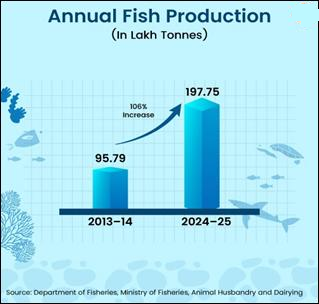
India’s fisheries sector occupies a unique position at the intersection of food security, rural employment, export competitiveness, and environmental stewardship. As the world’s second-largest fish-producing nation — accounting for approximately 8 percent of global output — India has leveraged a decade of sustained policy interventions to transform what was once a fragmented, subsistence-driven sector into an organised, technology-enabled value chain. Fish production has more than doubled, rising from 95.79 lakh tonnes in FY 2013-14 to 197.75 lakh tonnes in FY 2024-25, a remarkable 106 percent increase. The Union Budget 2026-27 has further reinforced this momentum with the highest-ever annual allocation of Rs. 2,761.80 crore, signalling that fisheries are now firmly at the core of India’s development agenda.
Economic Dimension: The Blue Economy Growth Engine
Fisheries now contribute 7.43 percent to Agricultural Gross Value Added (GVA), the highest share among agriculture and allied sectors. Seafood exports reached Rs. 62,408 crore in FY 2024-25, with frozen shrimp as the dominant commodity and the United States and China as key markets. This export performance underscores India’s growing global competitiveness, though concentration in two markets remains a structural vulnerability worth noting.
The Pradhan Mantri Matsya Sampada Yojana (PMMSY), allocated Rs. 2,500 crore in 2026-27, continues to be the central investment vehicle. Under it, 23,285 hectares of pond area for inland aquaculture, 52,058 reservoir cages, 634 value-added enterprise units, and 6,896 fish retail markets have been developed. The Fisheries and Aquaculture Infrastructure Development Fund (FIDF) has further sanctioned 225 projects worth Rs. 6,685.78 crore, mobilising Rs. 754.50 crore in private investment and creating 2.5 lakh employment opportunities.
Governance Dimension: From Schemes to Systems
A defining feature of fisheries governance in recent years has been the shift from individual scheme implementation to systemic institutional reform. The formation of 2,195 Fisheries Farmer Producer Organisations (FFPOs), backed by Rs. 544 crore, represents a significant step toward cooperative market integration — mirroring the success of Farmer Producer Organisations (FPOs) in crop agriculture.
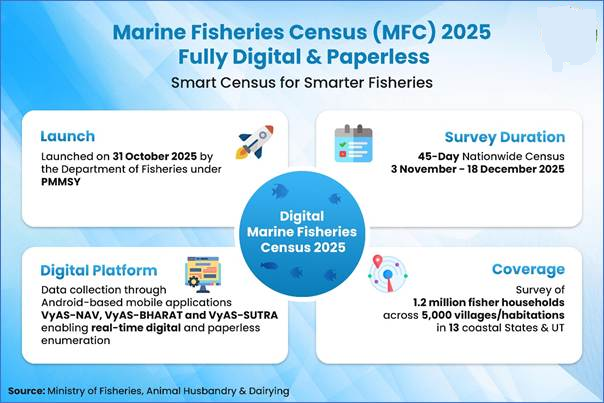
The National Fisheries Digital Platform (NFDP), launched in September 2024, embodies the government’s commitment to digital-first governance. Functioning as a single-window system, it has registered over 30.60 lakh stakeholders, integrated 12 banks, and enabled delivery of credit, insurance, and performance-linked incentives. The Marine Fisheries Census 2025 — the first fully digital, geo-referenced census — using mobile applications VyAS-NAV, VyAS-BHARAT, and VyAS-SUTRA, marks a leap in evidence-based policymaking. For the first time, detailed socio-economic profiling of fisher households — covering income, insurance, credit access, and scheme participation — has been captured at scale.
Social Justice Dimension: Financial Inclusion and Welfare
The fisheries sector supports the livelihoods of nearly three crore people, many belonging to marginalised coastal and inland communities — often Scheduled Castes and OBCs. Policy design has increasingly moved beyond production targets to address the financial vulnerabilities of fisher households directly.
The Kisan Credit Card (KCC) scheme, extended to fisheries in 2019, has covered 4.39 lakh fishers, with the lending limit recently raised from Rs. 2 lakh to Rs. 5 lakh. Insurance coverage now extends to 3.3 million beneficiaries. The Pradhan Mantri Matsya Kisan Samridhi Sah-Yojana (PM-MKSSY), with a Rs. 6,000 crore outlay from 2023-27, is formalising the sector by expanding institutional finance, aquaculture insurance, and traceability. Nutritional and livelihood support during fishing ban periods — disbursed to 4.33 lakh fisher families at a cost of Rs. 1,681.21 crore — acts as a social protection floor during lean seasons. Women-led collectives, self-help groups, and FFPOs are being explicitly integrated into reservoir-based fisheries development, advancing gender-intentional inclusion.
Environment & Sustainability Dimension: Responsible Resource Governance
India’s 11,099 km coastline and a 24 lakh sq km Exclusive Economic Zone (EEZ) are strategic assets that require responsible management. In 2025, the government notified the Rules and Guidelines for Sustainable Harnessing of Fisheries in the EEZ and High Seas — aligning India with UNCLOS norms and WTO fisheries subsidy disciplines, while combating Illegal, Unreported, and Unregulated (IUU) fishing. Duty-free status for catch landed abroad enhances price realisation and incentivises deep-sea ventures.
On the technology front, Recirculatory Aquaculture Systems (RAS) — where water is continuously filtered and reused — allow high-density fish farming on minimal land with negligible water wastage. As of March 2026, 12,081 RAS units have been approved under PMMSY (Rs. 902.97 crore). Bio-floc technology, which uses beneficial microbes to convert waste into fish feed, has seen 4,205 units approved (Rs. 523.30 crore). Both represent a decisive shift towards environmentally sustainable aquaculture. Domestically, Mission Amrit Sarovar has integrated 1,222 water bodies with fisheries activities, leveraging India’s 31.5 lakh hectare inland reservoir network. The sector’s trajectory is also explicitly aligned with SDG 14: Life Below Water.
Geography & International Relations: India as a Maritime Food Power
India’s dual advantage — a vast inland freshwater network and an extensive marine zone — differentiates it from most competitor nations. The inland sector is concentrated in Andhra Pradesh, West Bengal, and Odisha, while marine fisheries thrive in Kerala, Gujarat, Tamil Nadu, and Maharashtra. At the global level, frozen shrimp exports to the US and China position India as a critical node in global seafood supply chains. The EEZ governance framework, if enforced robustly, can also serve as a template for India’s leadership in the Indian Ocean Region (IOR) on sustainable maritime resource management — a dimension relevant to India’s broader Indo-Pacific strategy.
Critical Analysis: Challenges and the Road Ahead
Despite impressive headline numbers, several structural challenges persist:
Post-harvest losses remain high due to cold-chain infrastructure gaps — the 634 ice plant/cold storage units approved under PMMSY are a beginning, not a solution.
Export concentration risk: Over-reliance on the US and China makes India’s seafood revenue vulnerable to geopolitical shocks, tariffs, or disease-driven trade bans (as seen during the EMS shrimp disease episode).
Small and marginal fishers often remain outside formal credit systems despite KCC expansion, due to lack of land collateral and low digital literacy.
Climate change is altering fish migration patterns, threatening coastal livelihoods and requiring adaptive fisheries management — an area where current schemes are largely silent.
The 30.60 lakh NFDP registrations are impressive, but actual loan disbursals stand at only 217 — pointing to a significant last-mile credit delivery gap.
Way Forward
1. Strengthening Institutional Framework: Enhance the capacity, governance, and financial viability of Fisheries Farmer Producer Organizations (FFPOs) and cooperatives to improve collective bargaining and market access.
2. Scaling up Investment and Infrastructure: Promote public-private partnerships (PPPs) to mobilize capital, technology, and managerial expertise. Prioritize infrastructure development in inland, remote, and aspirational regions, including cold chains, storage, and processing facilities to reduce post-harvest losses.
3. Deepening Social Inclusion: Ensure last-mile delivery of welfare schemes through digital platforms and local institutions. Promote active participation of women, youth, and marginalized communities through skill development, entrepreneurship, and access to credit.
4. Leveraging Technology and Digital Innovation: Expand digital literacy among fishers to enable access to platforms like National Fisheries Digital Platform. Integrate AI, satellite data, and GIS tools for fish stock assessment, weather forecasting, and early warning systems to enhance productivity and safety.
5. Ensuring Environmental Sustainability: Enforce science-based fishing regulations and sustainable harvesting practices to prevent overexploitation. Promote conservation of marine and inland ecosystems, alongside climate-resilient aquaculture practices.
6. Diversifying Exports and Value Addition: Reduce overdependence on shrimp exports by promoting species diversification. Encourage value-added and processed fish products to enhance export earnings and global competitiveness.
Conclusion
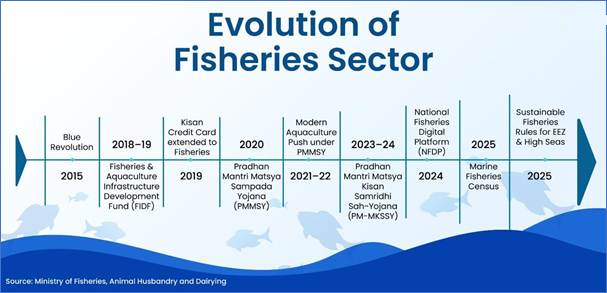
India’s fisheries sector story is ultimately one of institutional layering — each successive policy intervention building on the last, from the Blue Revolution (2015) to PMMSY (2020), from KCC expansion to NFDP digitisation, and now to the Sustainable EEZ Rules (2025). The Union Budget 2026-27’s record allocation of Rs. 2,761.80 crore signals political will, but translating capital into equitable and sustainable outcomes will require bridging three persistent divides: the credit access divide for small fishers, the digital delivery divide in remote coastal belts, and the climate adaptation divide for a sector on the front lines of ecological change. Done right, India’s blue economy could become not just a food-security anchor, but a model of inclusive, technology-driven, and environmentally responsible growth — a powerful narrative for both the UPSC essay paper and the global stage.
Q. Consider the following statements:
1. PMMSY focuses only on marine fisheries.
2. NFDP provides digital identity to fisheries stakeholders.
3. FIDF provides interest subvention.
Which of the statements are correct?
(a) 2 and 3
(b) 1 and 2
(c) 1 and 3
(d) All
Answer: A
Q. Discuss the role of the Pradhan Mantri Matsya Sampada Yojana in transforming India’s fisheries sector.
(250 words)

- RBI’s Shrinking Real-Rate Cushion Amid Rising Inflation and Strong Demand - September 21, 2026
- India’s NGOs at a New Funding Crossroads - September 21, 2026
- Deep-Sea Discovery, Environmental Responsibility - September 19, 2026

No Comments