


29 Dec India’s High-Growth, Low-Inflation Moment: Laying the Foundations for Viksit Bharat @2047
This article covers “Daily Current Affairs” and From India’s High-Growth, Low-Inflation Moment: Laying the Foundations for Viksit Bharat @2047
SYLLABUS MAPPING
GS– 3 – Indian Economy- India’s High-Growth, Low-Inflation Moment: Laying the Foundations for Viksit Bharat @2047
FOR PRELIMS
Why is India’s economy growing fast in recent years?
FOR MAINS
What role does domestic demand play in India’s economic growth?
Why in the News?
India stands at a defining moment in its economic journey. Emerging as one of the world’s fastest-growing major economies, the country has built strong macroeconomic foundations that place it on a credible path towards achieving high middle-income status by 2047, the centenary year of its independence. Anchored in robust domestic demand, structural reforms, improving labour market outcomes and macroeconomic stability, India’s growth trajectory reflects resilience amid persistent global uncertainties.
Growth Momentum and Domestic Demand
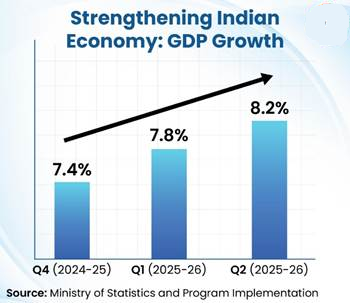
India’s economic momentum strengthened further in Q2 of FY 2025–26, with real GDP growth accelerating to 8.2%, the highest in six quarters. This followed growth rates of 7.8% in Q1 FY26 and 7.4% in Q4 FY25. Real Gross Value Added (GVA) expanded by 8.1%, led by buoyant industrial activity and resilient services. Crucially, growth has been domestically driven, with private consumption emerging as the principal engine. High-frequency indicators point to sustained activity—benign inflation, falling unemployment, strong credit growth and improving export performance. Urban consumption has strengthened further, while rural demand has benefited from improved agricultural prospects. Recognising these trends, the Reserve Bank of India (RBI) revised India’s FY 2025–26 growth forecast upward from 6.8% to 7.3%, reflecting confidence in domestic fundamentals.
Structural Drivers of Growth
India’s growth is being reinforced by a confluence of structural and policy-led factors:
1. Tax rationalisation under GST and personal income tax reforms enhancing disposable incomes
2. Front-loading of government capital expenditure, crowding in private investment
3. Softening crude oil prices, easing input and fiscal pressures
4. Facilitative monetary and financial conditions, supported by a stable inflation outlook
5. Strong balance sheets of corporates and financial institutions, enabling investment revival
Together, these factors have created what may be described as a rare “Goldilocks phase”—high growth combined with low inflation.
Employment: Linking Growth with Prosperity
1. Employment as the growth–inclusion bridge: Job creation converts economic growth into incomes, social mobility, and inclusive development.
2. Demographic dividend potential: With 26% of the population aged 10–24, India’s youth bulge can accelerate growth if matched with productive employment.
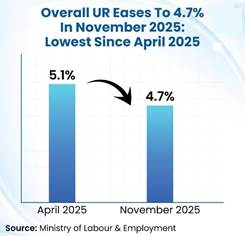
3. Lowest unemployment in recent months: PLFS 2025 shows unemployment (15+) declining to 4.8% in Nov 2025, the lowest since April 2025.
4. Broad-based labour market improvement: Unemployment fell in both rural (3.9%) and urban (6.5%) areas, indicating economy-wide recovery.
5. Women’s employment gains: A sharp decline in female unemployment reflects improving labour market inclusion and empowerment.
6. Rising workforce engagement: LFPR at 55.8% and WPR at 53.2% show stronger participation and effective employment absorption.
7. Virtuous growth–employment cycle: Sustained growth is creating jobs, while rising employment is boosting demand, productivity, and long-term prosperity.
Inflation: Anchoring Macroeconomic Stability
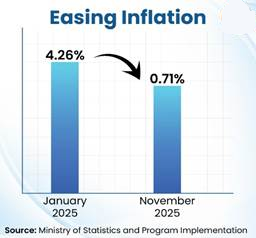
India witnessed a remarkably benign inflation environment in 2025. CPI inflation declined from 4.26% in January to multi-year lows of around 0.25% in October, before edging up slightly to 0.71% in November. This decline was led primarily by a sharp correction in food prices, defying seasonal inflationary patterns. For FY 2025–26, CPI inflation is projected at 2%, well within the RBI’s target band of 2–6%. The RBI responded by cutting the policy repo rate by 25 basis points to 5.25%, maintaining a neutral stance that balances growth support with price stability. Wholesale Price Index (WPI) trends mirrored this moderation, with inflation easing to a provisional –0.32% in November 2025, underscoring subdued cost pressures across the economy.
Trade and External Sector Performance
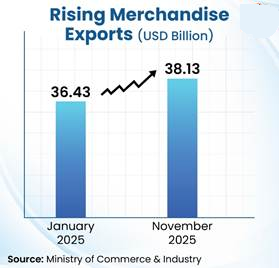
India’s external sector has shown notable resilience amid global trade disruptions. Total exports reached USD 74.97 billion in January 2025, growing nearly 10% year-on-year. By April–June 2025, cumulative exports rose to USD 210.31 billion, maintaining steady momentum through November.
Merchandise exports were supported by strong performance in:
1. Engineering goods
2. Electronic goods
3. Pharmaceuticals
4. Gems and jewellery
5. Petroleum products
Several commodities such as cashew, marine products, electronic goods and engineering goods recorded double-digit growth.
Services exports emerged as a key stabiliser, expanding by 8.65% to USD 270.06 billion (April–November 2025), led by computer and business services. India’s growing role in global value chains and digital trade has strengthened external resilience.
External Stability and Capital Flows
India’s external buffers remain strong. As of November 2025, foreign exchange reserves stood at USD 686.2 billion, providing over 11 months of import cover.
The current account deficit (CAD) moderated from 2.2% of GDP in Q2 FY25 to 1.3% in Q2 FY26, supported by robust services exports and rising remittances (up 10.7% y-o-y).
On the capital account:
1. Gross FDI rose by 19.4% to USD 51.8 billion (April–September 2025–26)
2. Net FDI surged by 127.6%, aided by lower repatriation
3. Portfolio flows witnessed mild volatility, reflecting global risk conditions
Q. India is experiencing a phase of high growth with macroeconomic stability amid global uncertainties. Examine the key drivers of India’s recent economic performance and discuss how employment generation and inflation management are critical for sustaining inclusive growth.
(250 words)

- RBI’s Shrinking Real-Rate Cushion Amid Rising Inflation and Strong Demand - September 21, 2026
- India’s NGOs at a New Funding Crossroads - September 21, 2026
- Deep-Sea Discovery, Environmental Responsibility - September 19, 2026

No Comments