India’s Historic Rise at the Asian Youth Games 2025: A New Era of Youth Sports Excellence

India’s Historic Rise at the Asian Youth Games 2025: A New Era of Youth Sports Excellence

This article covers “Daily Current Affairs” and From India’s Historic Rise at the Asian Youth Games 2025: A New Era of Youth Sports Excellence

SYLLABUS MAPPING

GS-2- Social Justice-India’s Historic Rise at the Asian Youth Games 2025: A New Era of Youth Sports Excellence

FOR PRELIMS

What were India’s main achievements in the Asian Youth Games 2025?

FOR MAINS

What were the major highlights of India’s performance at the Asian Youth Games 2025

Why in the News?

The Asian Youth Games (AYG), established under the Olympic Council of Asia (OCA), are designed as a continental platform for nurturing the next generation of sporting talent, enhancing cultural exchange, and strengthening youth development across Asia. Conceived after Singapore’s successful bid to host the 2010 Summer Youth Olympics, the inaugural AYG in 2009 aimed at athletes aged 14 to 18 years, marking the beginning of a new era in youth sports. For India, the AYG has evolved into a symbol of its aspiring sporting ambitions and its commitment to building a robust talent pipeline for future Olympic podiums.

India’s Progress Across Editions: A Story of Steady Rise

India’s journey through the three editions of the Asian Youth Games highlights exponential growth in performance, improved grassroots systems, and the strengthening of institutional sports ecosystems.

Edition Location Dates India’s Medals Total Rank Key Highlights
1st (2009) Singapore June 29–July 7 5G–3S–3B 11 11th 1,321 athletes across 9 sports
2nd (2013) Nanjing August 16–24 3G–4S–7B 14 10th 2,314 athletes across 16 sports
3rd (2025) Manama Oct 22–31 13G–18S–17B 48 6th Best-ever performance; more than 4× 2009 tally

Sport-Wise High Points: Asian Youth Games 2025 (India)

Sport / Discipline Medals Won (G-S-B) Highlights
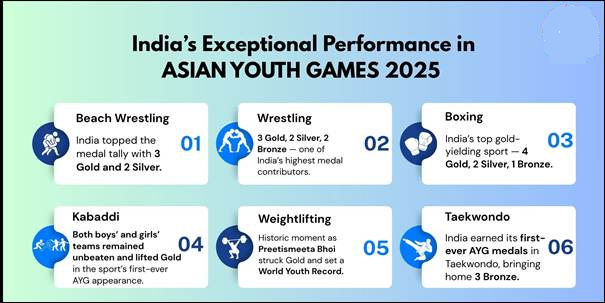
Boxing 4 – 2 – 1 Most successful discipline in terms of gold medals; reflects strong grassroots programmes and coaching reforms.
Beach Wrestling 3 – 2 – 0 India topped the table; showcased rising strength in non-traditional sports.
Wrestling 3 – 2 – 2 Consistent medal-winning discipline; reinforced India’s regional dominance in grappling sports.
Kabaddi 2 – 0 – 0 (Boys: 1 Gold, Girls: 1 Gold) Kabaddi debut at AYG; both teams unbeaten throughout tournament; reflects India’s cultural sporting identity.
Weightlifting 1 World Youth Record (medal details not specified here) Achieved a world youth record; signals India’s emergence in global-level strength sports.

A Triumph of Gender Inclusivity and Leadership

One of the most remarkable features of India’s 2025 participation was gender parity, with women athletes (122) outnumbering men (107) — a rare and significant milestone in Indian sports.

Medal Contribution by Gender

Category Gold Silver Bronze Total % of Total
Girls 9 11 6 26 54.17%
Boys 4 7 8 19 39.58%
Mixed 0 0 3 3 6.25%

Girls contributed ~54% of all medals.

69.23% of gold medals were won by female athletes.
Of 77 medal-winning athletes, 46 were girls, 31 were boys.
This represents not just statistical success but a profound shift in the landscape of Indian sport — propelled by targeted schemes, grassroots investments, and changing social attitudes.

Institutional Recognition and Incentives

The historic campaign drew praise from the highest levels of government.
Prime Minister’s Message
PM Narendra Modi congratulated the athletes for “scripting history” and lauded their determination, passion, and resilience.
IOA Support and Rewards
The Indian Olympic Association announced significant rewards:
1. ₹5 lakh for each Gold medallist
2. ₹3 lakh for each Silver medallist
3. ₹2 lakh for each Bronze medallist
4. ₹50,000 for fourth-place finishers
5. ₹1 lakh for coaches of medal winners
6. ₹10 lakh each for boys’ and girls’ Kabaddi teams
IOA President P.T. Usha emphasised that the athletes represent the future of Indian sports, reaffirming India’s commitment to youth-centric sports development.

Underlying Drivers of India’s Breakthrough Performance – Asian Youth Games 2025

Driver / Reform Key Contributions to India’s Breakthrough
1. Khelo India Youth & University Games • Broadened national talent identification
• Provided scientific training and regular competitive exposure
2. Sports Authority of India (SAI) Modernisation • Upgraded Centres of Excellence
• Integrated sports science, physiotherapy, and nutrition support
3. TOPS Development Programme • Offered international exposure
• Ensured access to advanced equipment and personalised coaching
4. National Sports Federations (NSFs) Reforms • Increased transparency and accountability
• Shifted to athlete-centric governance
5. Rise of School & State-Level Leagues • Boosted grassroots participation, especially among girls
• Strengthened regional sporting culture

Challenges Ahead

1. Limited High-Performance Centres: India still lacks enough modern, science-backed high-performance hubs, especially outside major states.
2. Nutrition Deficits Among Youth Athletes: Widespread protein gaps, anemia, and poor dietary support affect strength, stamina, and recovery.
3. Low International Exposure in Key Sports: Disciplines like swimming, athletics, and gymnastics suffer due to fewer global competitions and training tours.
4. Shortage of Elite Coaches and Support Staff: India lacks world-class coaches, sports scientists, physiotherapists, psychologists, and data analysts.
5. Uneven State-Level Infrastructure: Large disparities exist across states in stadium quality, coaching systems, and grassroots programmes.
6. Weak Grassroots Talent Identification: Rural, tribal, and remote regions remain under-scouted, causing loss of potential talent—especially among girls.
7. Dependence on Government Funding: Low private sector and CSR involvement leads to funding gaps for long-term training, equipment, and exposure.

Conclusion 

The Asian Youth Games 2025 represent far more than a statistical high for India. They reflect a paradigm shift in the country’s youth sports architecture—marked by inclusivity, professional coaching, institutional backing, and rising female leadership in sports.
As India continues to strengthen its grassroots and elite sports ecosystems, the Manama 2025 success stands as a defining moment, symbolising a new generation of confident, competitive, and globally ready Indian athletes. The journey to 2029 and beyond promises even greater achievements.

Q. Consider the following statements regarding the Asian Youth Games (AYG):
1. The Asian Youth Games are organised by the Olympic Council of Asia (OCA).
2. India recorded its best-ever performance in the 2025 Asian Youth Games held in Bahrain.
3. Kabaddi made its debut at the Asian Youth Games in 2025, and India won gold in both boys’ and girls’ categories.
4. Only athletes aged 18–23 years are eligible to participate in the Asian Youth Games.
Which of the statements given above are correct?
a) 1, 2 and 3 only
b) 1 and 4 only
c) 2 and 3 only
d) 1, 2, 3 and 4

Answer: A

Mains Question:

QIndia’s record-breaking performance at the Asian Youth Games 2025 reflects a structural transformation in its youth sports ecosystem.” Discuss the key factors behind this success and outline the challenges that must be addressed to sustain India’s upward trajectory in international sports.

                                                                                                                                                                                                                                                                                                                                                                                                                                                                                                                                                                                                                                                                                        (250 words)

No Comments

Post A Comment