India’s logistics sector is entering a transformative phase, evolving into a faster, smarter, and globally competitive ecosystem. This transformation is driven by the integration of digital platforms, modern infrastructure, and targeted policy reforms. By aligning logistics with national priorities, the government is positioning it as a key driver of economic growth, ease of doing business, and global trade competitiveness.
Transforming Logistics Through Policy and Technology
Several structural reforms are reshaping logistics planning, execution, and scalability. Platforms like ULIP (Unified Logistics Interface Platform) integrate data across government departments, while LDB 2.0 (Logistics Data Bank) provides real-time visibility of millions of containers. Every HSN (Harmonized System of Nomenclature) code is now mapped to its respective line ministry, improving accountability and streamlining policy interventions. City and state logistics plans under the SMILE (Strengthening Multimodal and Integrated Logistics Ecosystem) programme are being synchronized with national priorities, enhancing efficiency and coordination. On-the-ground reforms such as GST and the e-Way Bill have removed long-standing frictions in interstate transport, reducing costs and improving service reliability.
Multimodal Logistics along the Gangetic Plain
India is implementing an integrated multimodal logistics approach along the Gangetic Plain, combining road, rail, and inland waterways to make transport faster, cheaper, and environmentally sustainable. The Eastern Dedicated Freight Corridor (EDFC) has reduced wagon turnaround from 15–16 days to 2–3 days, and transit times from over 60 hours to 35–38 hours. Freight operations are centrally coordinated from Prayagraj, easing congestion. The revival of the Ganga Waterway, linked to the EDFC at Varanasi, enables efficient cargo movement to eastern ports like Haldia. Rapid development of warehousing and industrial zones has created employment, improved inventory management, and facilitated timely production and exports. With significant investments from the World Bank—$1.96 billion for EDFC and rail logistics initiatives and $375 million for Ganga Waterway development—India is creating an integrated, cost-efficient, and green logistics network.
The Economic Importance of Logistics
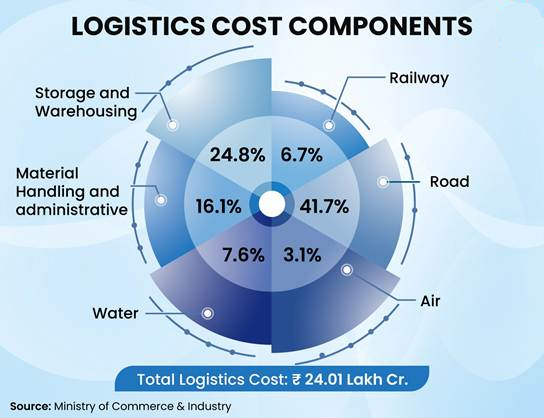
Efficient logistics is central to India’s growth and competitiveness. Historically, logistics costs were estimated at 13–14% of GDP based on partial data, creating policy confusion. A first-of-its-kind study by DPIIT and NCAER now provides a data-driven assessment, placing logistics costs at 7.97% of GDP and 9.09% of non-services output for 2023–24, amounting to ₹24.01 lakh crore. The study highlights higher costs for smaller firms, impacting their scalability and competitiveness. It also benchmarks freight costs across transport modes and distances, emphasizing that improvements in the first and last 50 kilometres of a journey can significantly reduce costs. This evidence-based approach allows policymakers and industry stakeholders to make informed decisions on investments, infrastructure, and pricing.
Key Initiatives Driving Logistics Transformation
1. PM GatiShakti: Integrated Planning: PM GatiShakti has revolutionized logistics planning through integrated district master plans in 112 aspirational districts, consolidating geospatial data for infrastructure projects, offshore projects, and coastal development. Platforms like PM GatiShakti Public, dashboards, and knowledge management systems enhance transparency, data-driven decision-making, and cross-sectoral collaboration.
2. SMILE: City-Level Logistics Optimization: The SMILE programme, in partnership with the Asian Development Bank, aligns city and state logistics plans with national priorities. Pilot projects in eight cities focus on optimizing urban freight, e-commerce deliveries, warehousing, truck terminals, and last-mile connectivity, while promoting low- and zero-emission vehicles, noise reduction, and congestion management.


3. LEADS 2025: Benchmarking State Logistics: LEADS 2025 assesses states on infrastructure, regulatory support, services, and sustainability. By monitoring transport corridors and real-time metrics like truck speeds and waiting times, it identifies bottlenecks and supports policy interventions to improve supply chain efficiency.
4. LDB 2.0: Real-Time Visibility: The upgraded Logistics Data Bank 2.0, integrated with ULIP, enables exporters and MSMEs to track shipments across road, rail, sea, and high seas in real time. Live heatmaps highlight delays, ensuring swift corrective actions and minimizing disruption in supply chains.
5. IPRS 3.0: Ranking Industrial Parks: The Industrial Park Rating System 3.0 evaluates industrial parks on connectivity, digital readiness, sustainability, and tenant satisfaction. Under NICDC, 20 plug-and-play parks are being developed to reduce entry barriers for industries and attract investment.

6. HSN Code Guidebook: Simplifying Compliance: A guidebook mapping 12,167 HSN codes across 31 ministries enhances clarity for businesses, improves policymaking, and strengthens India’s negotiation capacity in global trade.
Towards a Greener and More Efficient Logistics Network
The new-generation logistics ecosystem emphasizes multimodal integration, green corridors, and technology-enabled efficiency. Initiatives focus on reducing carbon emissions, improving last-mile delivery, and linking production centers with ports and international markets. By combining policy reforms, digital platforms, and infrastructure upgrades, logistics is transitioning from a cost center to a strategic competitive advantage.
Conclusion
India’s logistics sector is no longer a “black box.” With initiatives like PM GatiShakti, SMILE, LEADS 2025, LDB 2.0, and IPRS 3.0, combined with investments in waterways, rail, and industrial parks, India is building faster, greener, and fully integrated supply chains. Logistics now serves as the backbone of Make in India, enabling efficient movement of goods, reducing costs, promoting sustainability, and strengthening India’s position in global supply chains. The journey from growth engine to global logistics hub has truly begun.





No Comments