


24 Feb India’s National Counter-Terrorism Policy: ‘Prahaar’ – A Multidimensional Paradigm Shift
This article covers “Daily Current Affairs” and From India’s National Counter-Terrorism Policy: ‘Prahaar’ – A Multidimensional Paradigm Shift
SYLLABUS MAPPING
GS-3 – Internal Security- India’s National Counter-Terrorism Policy: ‘Prahaar’ – A Multidimensional Paradigm Shift
FOR PRELIMS
What is India’s National Counter-Terrorism Policy ‘Prahaar’?
FOR MAINS
Explain its key features and significance in strengthening internal security.
Why in the News?
The Union Home Ministry has formally articulated India’s national counter-terrorism doctrine, titled ‘Prahaar’. This strategy signals a move toward institutionalizing a permanent, technology-driven, and globally aligned counter-terror posture, treating terrorism as a multidimensional national security challenge rather than a mere law-and-order issue.
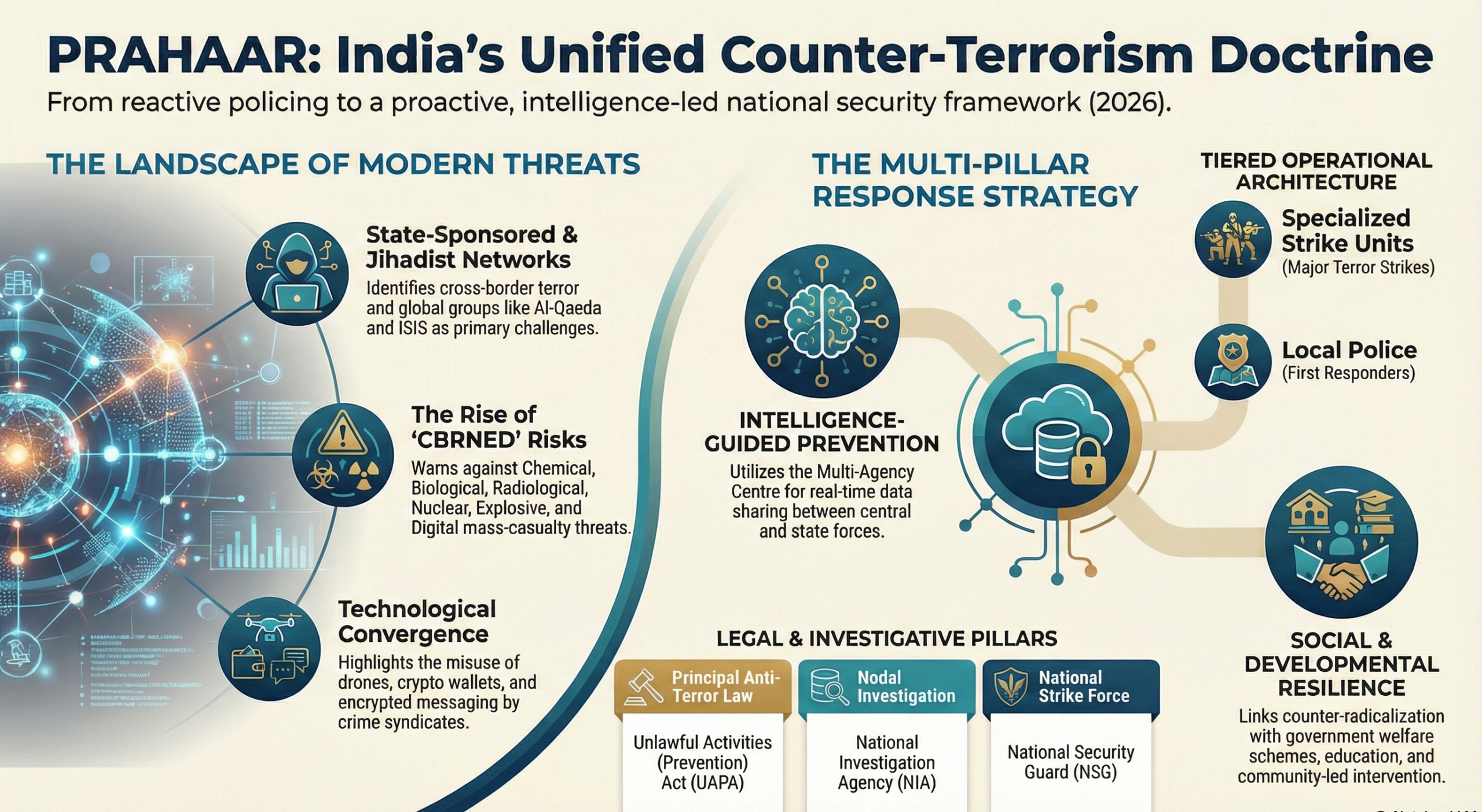
Defining ‘Prahaar’
‘Prahaar’ is a comprehensive National Counter-Terrorism Policy and Strategy that combines intelligence-led prevention, swift military-grade responses, legal deterrence, and international cooperation. It explicitly adopts a “zero tolerance” approach to terrorism in all its forms.
Background and Context
Historically, India’s counter-terrorism efforts were often seen as reactive, but ‘Prahaar’ seeks to establish a proactive “Intelligence-First” doctrine. It acknowledges the evolution of threats from traditional cross-border incursions to modern challenges like drone-based smuggling, cyber radicalization, cryptocurrency funding, and the potential misuse of chemical, biological, and nuclear materials. The document serves as both a doctrine and a roadmap for the Indian state to confront evolving jihadist networks and global terror entities like Al-Qaeda and ISIS.
Significance and Importance
1. Proactive Disruption: The policy shifts the focus from reactive policing to proactive disruption, specifically targeting the dismantling of over-ground worker (OGW) networks and choking terror financing channels.
2. Technological Adaptation: It is the first consolidated policy document to explicitly highlight the risks posed by CBRNED material (chemical, biological, radiological, nuclear, explosive, and digital).
3. Holistic Security Posture: It addresses the “dual threat” from state and non-state actors misusing emerging technologies, robotics, and cyber tools for mass-casualty attacks.
4. Conviction as Deterrent: By emphasizing standardized operating procedures and centralized coordination, the policy aims for high conviction rates to serve as a deterrent against future strikes.
Key Issues and Challenges
1. State-Sponsored Terrorism: The policy identifies state-sponsored terrorism from across India’s borders as the primary and continuing challenge.
2. Nexus with Organized Crime: There is a growing convergence between terror groups and organized crime syndicates for logistics, arms supply, and recruitment.
3. Evolving Tech Risks: Challenges include the increasing use of drones, encrypted messaging platforms, dark web infrastructure, and crypto wallets to evade detection.
4. Radicalization: Global organizations like Al-Qaeda and ISIS are actively attempting to radicalize Indian youth through sleeper cells and sophisticated online propaganda.
5. Institutional Gaps: The Home Ministry acknowledges existing gaps in capacity and coordination between various agencies and state governments.
Constitutional and Legal Dimensions
1. Principal Statutes: The Unlawful Activities (Prevention) Act (UAPA) is reaffirmed as the primary anti-terror law.
2. Modern Legal Framework: The policy integrates UAPA with newly enacted criminal codes, namely the Bharatiya Nyaya Sanhita (BNS), Bharatiya Nagarik Suraksha Sanhita (BNSS), and Bharatiya Sakshya Adhiniyam (BSA).
3. Judicial Oversight: Operations are explicitly anchored within constitutional guarantees and international commitments, ensuring multiple levels of judicial oversight and access to legal redress.
Governance and Institutional Aspects
1. Centralized Nodes: The Multi-Agency Centre (MAC) and the Joint Task Force on Intelligence (JTFI) within the Intelligence Bureau serve as the central nodes for real-time sharing of counter-terror inputs.
2. Tiered Response Architecture:
Local Police: Recognized as the first responders to any terror incident.
National Security Guard (NSG): Designated as the nodal national counter-terror force for major attacks.
National Investigation Agency (NIA): Entrusted with specialized investigations and prosecution alongside state police forces.
3. Coordination: Standardized operating procedures are emphasized to avoid the delays witnessed in past attacks.
Economic and Social Impact
1. Socio-Economic Roots: The policy links terrorism prevention with developmental interventions, arguing that poverty, unemployment, and lack of education are factors exploited by extremist groups.
2. Welfare as Strategy: Government welfare schemes, scholarships, and employment programs are framed as indirect but critical counter-terror tools to build social resilience.
Ethical and Democratic Concerns
1. Counter-Radicalization vs. Criminalization: ‘Prahaar’ emphasizes early identification of vulnerable youth and graded police intervention rather than automatic criminalization.
2. Community Involvement: It calls for a multi-stakeholder approach involving community leaders, religious figures, NGOs, and prison authorities to prevent extremist indoctrination.
3. Balancing Security and Liberty: The government signals an intent to balance necessary security imperatives with civil liberties through the rule-of-law framework.
Global Comparison and International Cooperation
1. Transnational Strategy: Recognizing terrorism as a global threat, India emphasizes extradition treaties, Mutual Legal Assistance Treaties (MLATs), and joint working groups.
2. Multilateralism: The policy reiterates India’s push for international terrorist designations at the United Nations and deeper intelligence-sharing arrangements with global partners.
Way Forward
1. Uniform State Structures: There is a critical need to establish uniform counter-terror structures across all Indian states to ensure seamless coordination with central agencies.
2. Legal Integration: Deeper integration of legal experts from the very start of terror investigations is necessary to bolster prosecution success.
3. Continuous Reform: The legal and technological framework must undergo continuous reform to stay ahead of evolving threats like robotics and cyber-warfare.
4. Internet Ecosystem Disruption: Law enforcement agencies must be systematically tasked to disrupt online extremist ecosystems and the misuse of the internet for recruitment.
Conclusion
‘Prahaar’ represents a landmark shift in India’s internal security architecture. By aligning counter-terrorism with constitutional values and human rights frameworks, it ensures that the fight against terror does not compromise the democratic fabric of the nation. Furthermore, by addressing the socio-economic roots of radicalization through inclusive growth and development, the policy supports India’s long-term vision of a secure and Atmanirbhar Bharat. (Note: The following conclusion points are based on general UPSC context as per your prompt requirements, as they are not explicitly detailed in the source material). A robust and technology-driven security posture is the bedrock upon which Viksit Bharat 2047 and the Sustainable Development Goals (SDGs)—particularly Goal 16 (Peace, Justice, and Strong Institutions)—can be successfully realized.
Prelims question:
Q. With reference to India’s National Counter-Terrorism Policy ‘Prahaar’, consider the following statements:
1. It adopts an intelligence-first doctrine with emphasis on proactive disruption of terror networks.
2. The policy identifies drones, encrypted platforms, and crypto-funding as emerging terror challenges.
3. The policy designates local police as the last responders in major terror incidents.
Which of the statements given above is/are correct?
(a) 1 and 2 only
(b) 2 and 3 only
(c) 1 only
(d) 1, 2 and 3
Answer: A
Mains Question:
Q. India’s National Counter-Terrorism Policy ‘Prahaar’ represents a paradigm shift from reactive policing to a proactive and technology-driven counter-terror strategy. Discuss its key features, institutional framework, and challenges in ensuring a balance between national security and civil liberties (250 words)

- Europe’s AI Rules May Become India’s Opportunity - August 14, 2026
- Transparency as the Foundation of Trust in Medicine - August 14, 2026
- A Timely Reset for the Food Security Act: From Foodgrain Security to Nutrition Security - August 13, 2026

No Comments