


22 Nov India’s New Labour Codes: Transforming the Workforce for a Modern Economy
This article covers “Daily Current Affairs” and From India’s New Labour Codes: Transforming the Workforce for a Modern Economy
SYLLABUS MAPPING
GS-2- Polity, Governance & Social Justice- India’s New Labour Codes: Transforming the Workforce for a Modern Economy
FOR PRELIMS
What are the major social security improvements introduced under the Social Security Code, 2020?
FOR MAINS
What are the major challenges India faced under the old labour law system that led to codification?
Why in the News?
India’s labour ecosystem has recently come into sharp focus due to major reforms, improved employment figures, and expanding social protection coverage. According to official data, employment in India has surged from 47.5 crore in 2017–18 to 64.33 crore in 2023–24, adding 16.83 crore jobs within six years—a historic rise. Simultaneously, the unemployment rate has halved from 6.0% to 3.2%, and 1.56 crore women have joined the formal workforce, reflecting the Government’s push toward inclusive growth. These developments come at a time when India is implementing its four new Labour Codes, which consolidate 29 existing labour laws into a simplified, modern framework. The Codes aim to improve workers’ welfare, streamline compliance for industries, and build a future-ready labour market.
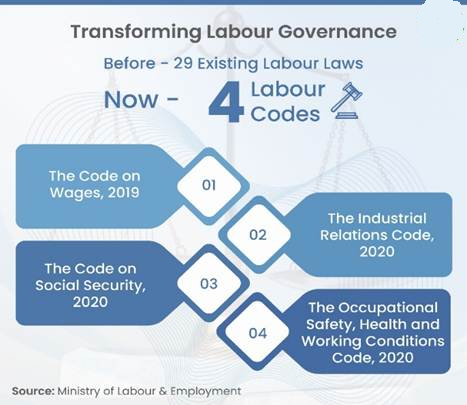
Rationale Behind the Codification of the Existing 29 Labour Laws
Reforms in labour laws are an ongoing process. The Government continuously works to modernize and streamline the legislative framework in line with the evolving economic and industrial landscape of the country. The codification of 29 existing labour laws into four Labour Codes was undertaken to address long-standing challenges and make the system more efficient and contemporary. The codification aims to enhance ease of doing business, promote employment generation, ensure safety, health, social & wage security for every worker.
The key reasons behind this reform include:
Simplifying compliance: Multiplicity of laws leads to difficulty in compliance.
Streamlining enforcement: Multiplicity of authorities in different labour laws led to complexity and difficulty in enforcement.
Modernizing outdated laws: Most labour legislations were framed during the pre-Independence era, necessitating alignment with today’s economic realities and technological advancements.
Formulation of 4 Labour Codes
An important reason of rationalizing labour laws via codification was to simplify the registration, licensing framework by introducing the concept of a Single Registration, Single License, and Single Return, thereby reducing the overall compliance burden to spur employment.
The second National Commission on Labour had recommended that the existing Labour Laws should be broadly grouped into four/ five Labour Codes on functional basis. Accordingly, the Ministry of Labour & Employment started the exercise to rationalize, simplify and amalgamate the relevant provisions of the labour laws in four codes. The four Labour Codes were enacted after the deliberations held in the tripartite meeting of the Government, employers’, industry representatives and various trade unions during 2015 to 2019. The Code on Wages, 2019 was notified on 8th August, 2019 and the remaining three Codes were notified on 29th September, 2020.

Establishment of the new Labour Codes marks a transformative step in India’s labour landscape- one that balances the welfare of workers with the efficiency of enterprises. These provisions simplify compliance, promote safety, and ensure fairness in wages. Moreover, these reforms lay the foundation for a more equitable, transparent, and growth-oriented economy. They reaffirm India’s commitment to fostering a modern labour ecosystem that empowers both workers and industry, paving the way for inclusive and sustainable progress.
Prelims question:
Q. Consider the following statements regarding India’s new Labour Codes:
1. The Code on Wages introduces a universal minimum wage applicable to both organised and unorganised sector workers.
2. The Industrial Relations Code mandates a 14-day notice period before strikes and lockouts.
3. The Code on Social Security, 2020 extends social security benefits to gig and platform workers for the first time.
4. The OSHWC Code provides for single registration and common licensing for establishments.
Which of the statements given above are correct?
(a) 1 and 2 only
(b) 1, 2 and 3 only
(c) 1, 3 and 4 only
(d) 1, 2, 3 and 4
Answer: D
Mains Question:
Q. The Four Labour Codes mark a major reform in India’s labour governance framework. Discuss their significance for employment generation, worker welfare, and ease of doing business. (250 words)

- RBI’s Shrinking Real-Rate Cushion Amid Rising Inflation and Strong Demand - September 21, 2026
- India’s NGOs at a New Funding Crossroads - September 21, 2026
- Deep-Sea Discovery, Environmental Responsibility - September 19, 2026

No Comments