


03 Feb India’s Rare Earth Strategy: Manufacturing, Corridors and Global Integration
This article covers “Daily Current Affairs” and From India’s Rare Earth Strategy: Manufacturing, Corridors and Global Integration
SYLLABUS MAPPING
GS- 3- Economic Development- India’s Rare Earth Strategy: Manufacturing, Corridors and Global Integration
FOR PRELIMS
What is the role of rare earth magnets in India’s defence and strategic sectors?
FOR MAINS
What is the significance of Rare Earth Permanent Magnets (REPMs) for India?
Why in the News?
India is taking decisive steps towards self-reliance in critical and strategic materials by building a domestic ecosystem for Rare Earth Permanent Magnets (REPMs)—high-performance magnets that are indispensable for electric vehicles, wind turbines, electronics, aerospace and defence systems. Recognising their strategic importance, the Government approved a ₹7,280 crore REPM Manufacturing Scheme in November 2025 to establish 6,000 MTPA of integrated capacity, covering the entire value chain from rare-earth oxides to finished magnets. Complementing this industrial push, the Union Budget 2026–27 announced the creation of Dedicated Rare Earth Corridors in mineral-rich coastal states. Together, these initiatives reflect India’s long-term vision under Atmanirbhar Bharat, Net Zero 2070 and Viksit Bharat @2047, while positioning the country as a credible player in global advanced-materials value chains.
Strategic Importance of Rare Earth Permanent Magnets (REPMs)
Rare Earth Permanent Magnets are among the strongest and most efficient magnets available, characterised by high magnetic strength, thermal stability and compact size. These properties make them essential for:
1. Electric mobility (EV traction motors)
2. Renewable energy (wind turbine generators)
3. Electronics and automation
4. Aerospace and defence systems
5. Precision instruments and sensors
As India scales up clean energy, advanced manufacturing and strategic capabilities, secure access to REPMs becomes a strategic necessity, not merely an industrial requirement. Domestic production enhances supply chain resilience, reduces import dependence and strengthens India’s competitiveness in high-technology sectors.
India’s Rare Earth Resource Base
India possesses a substantial geological endowment of rare-earth minerals, providing a strong foundation for downstream manufacturing.
Key Resource Indicators
1. Monazite Deposits: 13.15 million tonnes of monazite. Containing ~7.23 million tonnes of Rare Earth Oxides (REO)
2. Geographical Distribution: Coastal beach sands, teri/red sands and inland alluvium across Odisha, Kerala, Andhra Pradesh, Tamil Nadu, West Bengal, Gujarat, Maharashtra and Jharkhand
3. Hard-Rock Resources: 1.29 million tonnes of in-situ REO resources identified in Gujarat and Rajasthan
4. Exploration Expansion: GSI has identified 482.6 million tonnes of rare-earth ore resources through 34 exploration projects
Need for Accelerated Investment
Despite abundant resources, India remains heavily import-dependent for permanent magnets, with China supplying nearly 60–80% by value and 85–90% by quantity (2022–25). Demand for REPMs is expected to double by 2030, driven by rapid growth in electric vehicles, renewable energy, electronics and defence manufacturing.
This widening demand–supply gap makes it imperative for India to:
1. Expand domestic manufacturing capacity
2. Invest in processing and refining technologies
3. Secure long-term supply chains for strategic sectors
Budget Push: Manufacturing and Corridor-Based Development
Rare Earth Permanent Magnet (REPM) Manufacturing Scheme
Approved on 26 November 2025, the scheme aims to establish a fully integrated domestic REPM ecosystem.
1. Total Outlay: ₹7,280 crore
2. Capacity Creation: 6,000 MTPA of sintered REPMs
3. Beneficiaries: Up to five entities selected through global competitive bidding
4. Incentives: ₹6,450 crore sales-linked incentives (5 years) ₹750 crore capital subsidy for advanced facilities
5. Timeline: 2-year gestation period, 5-year incentive disbursement linked to production
6. Objective: Ensure reliable domestic supply for EVs, renewables, electronics, aerospace and defence.
Union Budget 2026–27: Dedicated Rare Earth Corridors
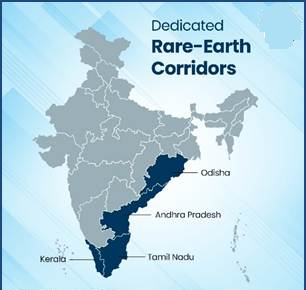
The Budget announced Rare Earth Corridors in Odisha, Kerala, Andhra Pradesh and Tamil Nadu to promote:
1. Mining and beneficiation
2. Processing and refining
3. Research and development
4. Advanced manufacturing
These corridors will leverage coastal mineral resources, boost regional economies, strengthen R&D ecosystems and integrate India more deeply into global advanced-materials value chains.
Role of IREL (India) Limited
The corridor strategy builds upon the existing institutional base of IREL (India) Limited, operating under the Department of Atomic Energy since 1963.
Processing capacity: 10 lakh tonnes per annum
Key facilities:
1. Rare Earth Extraction Plant – Odisha
2. Rare Earth Refining Unit – Aluva, Kerala
Alignment with National Priorities
Atmanirbhar Bharat: Reduced dependence on Chinese imports for critical magnets
Clean Energy & Net Zero 2070: REPMs enable EVs and wind energy
National Security: Assured supply for defence, aerospace and strategic technologies
Policy Reforms:
MMDR Act (Amended 2023): Private participation and critical minerals focus
National Critical Minerals Mission (2025): Sustainable and secure supply chains
Strengthening Global Mineral Partnerships
Bilateral Cooperation
India has signed agreements with Australia, Argentina, Zambia, Mozambique, Peru, Zimbabwe, Malawi and Côte d’Ivoire to secure long-term access to critical minerals.
Multilateral Engagement
1. Minerals Security Partnership (MSP)
2. Indo-Pacific Economic Framework (IPEF)
These platforms support technology cooperation, investment and supply chain diversification.
Role of KABIL
Khanij Bidesh India Limited (KABIL) — a JV of NALCO, HCL and MECL — focuses on overseas mineral assets. Its agreement with CAMYEN (Argentina) for lithium brine exploration marks a significant step in external resource security.
Conclusion
India’s rare earth strategy reflects a holistic shift from resource possession to value-chain leadership. The ₹7,280 crore REPM Manufacturing Scheme and Dedicated Rare Earth Corridors announced in Union Budget 2026–27 together create an integrated framework spanning mining, processing, research and manufacturing. These initiatives reduce import dependence, secure clean-energy and defence supply chains, and align with the national vision of Atmanirbhar Bharat, Net Zero 2070 and Viksit Bharat @2047. Backed by global partnerships and institutional reforms, India is steadily positioning itself as a reliable and competitive player in advanced materials and critical minerals value chains.

Best ias coaching in delhi Best ias coaching in chandigar
Prelims question:
Q. With reference to Rare Earth Permanent Magnets (REPMs) and India’s recent policy initiatives, consider the following statements:
1. Rare Earth Permanent Magnets are critical for electric vehicle motors and wind turbine generators.
2. India currently imports the majority of its permanent magnet requirements, mainly from China.
3. The Rare Earth Permanent Magnet Manufacturing Scheme aims to create integrated capacity covering the entire value chain from rare-earth oxides to finished magnets.
4. Dedicated Rare Earth Corridors announced in the Union Budget 2026–27 are proposed only in inland mineral-rich states.
Which of the statements given above are correct?
(a) 1, 2 and 3 only
(b) 1 and 4 only
(c) 2, 3 and 4 only
(d) 1, 2, 3 and 4
Answer: A
Q. Discuss the strategic significance of REPMs, India’s resource potential, and examine how policy initiatives such as the REPM Manufacturing Scheme and Dedicated Rare Earth Corridors contribute to India’s goals of Atmanirbhar Bharat, clean energy transition, and strategic autonomy.
(250 words)

- RBI’s Shrinking Real-Rate Cushion Amid Rising Inflation and Strong Demand - September 21, 2026
- India’s NGOs at a New Funding Crossroads - September 21, 2026
- Deep-Sea Discovery, Environmental Responsibility - September 19, 2026

No Comments