In an era marked by geopolitical uncertainties, supply-chain realignments, and uneven global recovery, India’s trade performance stands out for its resilience and structural transformation. Moving beyond volume-led growth, India’s export trajectory increasingly reflects diversification across products, markets, and value chains, supported by institutional reforms and strategic trade agreements. The sharp rise in exports between November 2024 and November 2025 underscores India’s emergence as a reliable and competitive partner in global trade.
India’s Trade Performance: Key Trends
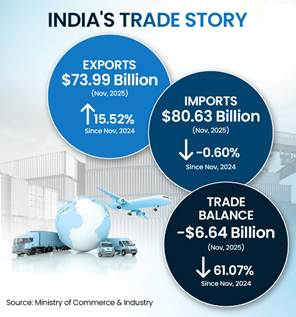
Between November 2024 and November 2025, India’s total exports rose from US$ 64.05 billion to US$ 73.99 billion, registering a robust 15.52% year-on-year growth. During the same period, imports remained relatively stable at US$ 80.63 billion, resulting in a significant 61% contraction in the trade deficit, from US$ 17.06 billion to US$ 6.64 billion. This improvement indicates a healthier external sector balance, reflecting not only demand recovery but also improved export competitiveness, higher value-added goods, and diversification of markets.
Merchandise and Services Exports: Balanced Growth
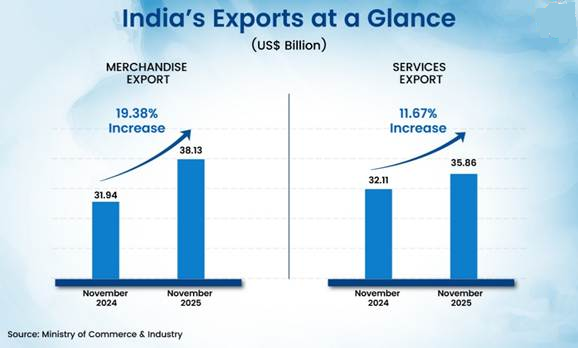
India’s export growth in November 2025 was supported by both merchandise and services sectors, highlighting the economy’s dual strength.
1. Merchandise exports increased by 19.38%, reaching US$ 38.13 billion
2. Services exports grew by 11.67%, touching US$ 35.86 billion
The near-equal share of merchandise (51.53%) and services (48.47%) reflects a structurally balanced export profile, reducing overdependence on any single sector and enhancing macroeconomic stability.
Sectoral Drivers of Export Growth
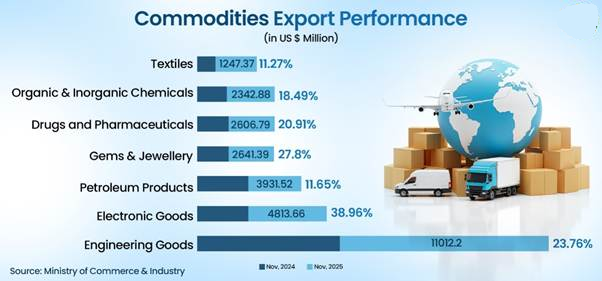
1. Labour-Intensive Sectors: Readymade garments recorded over 11% growth, reinforcing India’s comparative advantage in employment-generating exports. Such sectors are critical for inclusive growth, MSME participation, and women employment.
2. Chemicals and Pharmaceuticals: Exports of organic and inorganic chemicals grew by 18.49%, while pharmaceuticals expanded by over 20%. As the “Pharmacy of the World”, India’s presence in highly regulated markets such as the US, Europe, Japan, and Australia reflects quality compliance and global trust.
3. Gems and Jewellery: A growth of 27.8% in November 2025 highlights India’s craftsmanship-driven competitiveness, especially in gold, diamonds, and coloured gemstones, with strong demand from the US, UAE, Hong Kong, and Europe.
4. Petroleum Products: India’s position as one of the world’s top refining hubs enabled 11.65% growth in petroleum exports, leveraging robust infrastructure and strategic geography.
5. Engineering and Electronics: Engineering goods maintained steady growth, supported by export facilitation schemes. Meanwhile, electronics exports—particularly mobile phones—represent a structural shift. Mobile phone exports grew 127-fold over a decade, aligning with India’s ambition to build a US$ 500 billion electronics ecosystem by 2030-31.
Market Diversification: Expanding Global Reach
India’s export growth has been accompanied by geographical diversification. Traditional markets such as the US, UK, EU, and UAE continue to perform steadily, while emerging markets in West Asia, Africa, and East Asia have recorded faster growth. High growth in markets like Hong Kong, Egypt, Saudi Arabia, and Japan reduces concentration risk and strengthens resilience against regional demand shocks.
Export Diversification: Strategic Imperative
1. Risk mitigation: Reduces vulnerability to commodity price volatility and external shocks
2. Resilience building: Cushions the impact of global demand fluctuations
3. Knowledge spillovers: Encourages innovation, productivity, and technological upgrading
4. Macroeconomic stability: With exports contributing over 21% of GDP, diversification supports sustained growth and external balance
Trade Agreements: Expanding India’s Economic Footprint
1. India–Oman CEPA (2025): Signed on the 70th anniversary of diplomatic relations, the agreement provides zero-duty access on over 98% of tariff lines, benefiting agriculture, textiles, MSMEs, pharmaceuticals, and traditional medicine (AYUSH). It also includes advanced commitments on services mobility, enhancing employment opportunities for Indian professionals.
2. UK CETA (2025): Offers duty-free access to 99% of Indian exports, expands services trade, eases professional mobility, and includes a Double Contribution Convention, reducing compliance costs for Indian workers abroad.
3. Other Key FTAs: Agreements with UAE, Australia, EFTA countries, and Mauritius, along with ongoing negotiations with the EU, US, GCC, ASEAN, Israel, Canada, and New Zealand, signal India’s integration into emerging global trade architectures.
Policy and Institutional Support for Export Competitiveness
1. Export Promotion Mission (2025): ₹25,060 crore outlay to improve trade finance, branding, quality compliance, and MSME participation
2. Labour Code Reforms: Simplified compliance, enhanced flexibility, and social security coverage
3. Next-Gen GST 2.0: Faster refunds, lower logistics costs, and reduced working capital stress
4. PLI Scheme: Boosting manufacturing competitiveness across 14 sectors
5. Logistics and Infrastructure: PM GatiShakti, National Logistics Policy, SEZs, and digital trade platforms





No Comments