


31 Dec India’s Vision for Artificial Intelligence: Empowering the Nation through Technology
Introduction:
Artificial Intelligence (AI) is no longer a far-off idea but a transformative force driving India’s growth. From enhancing public services to revolutionizing industries such as healthcare, agriculture, and education, AI is central to India’s future. The Indian government, through initiatives like the IndiaAI Mission and the AI for Inclusive Societal Development report, is charting a path towards harnessing the full potential of AI for societal and economic advancement. This article highlights the government’s strategic vision for AI and the broader impact of AI on India’s development goals.
1. India’s AI Landscape: Growth, Development, and Global Competitiveness
India’s AI journey is marked by significant advancements in AI adoption across a variety of sectors. The nation’s AI ecosystem is expanding rapidly, fueled by investments in research, infrastructure, and human capital. The government’s guiding principle is clear: “Make AI in India and Make AI Work for India”. By making AI accessible, affordable, and impactful, India aims to become a global leader in AI.
Key Statistics and Developments:
- India holds the 3rd position globally in terms of AI competitiveness, according to the Stanford Global AI Vibrancy Tool (2025).
- The tech and AI sectors in India employ over 6 million professionals, with significant contributions from Global Capability Centres (GCCs), over 500 of which are focused on AI.
- In 2024, 89% of new startups integrated AI into their business models, reflecting the technology’s penetration across industries.
- AI is being adopted at a rate of 87% across Indian enterprises, particularly in sectors like banking, automotive, consumer goods, and healthcare.
2. Government Initiatives: Strategic Policy and Institutional Support for AI
The Indian government has laid out a comprehensive strategy to use AI as a tool for innovation and public welfare. This strategy includes substantial investments in AI infrastructure, the promotion of research and development, and the creation of an AI ecosystem that benefits all citizens.
IndiaAI Mission: A National Initiative for AI Excellence
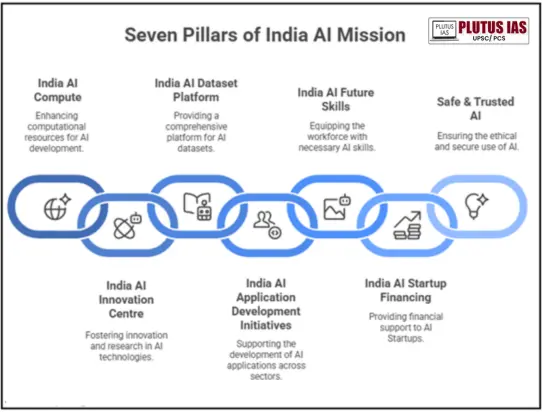
The IndiaAI Mission, launched in March 2024, represents India’s largest national push for AI. With an allocated budget of ₹10,371.92 crore over five years, the mission seeks to foster innovation, support AI startups, and build world-class computing infrastructure.
- IndiaAI Compute Pillar: This initiative offers 38,000 GPUs at subsidized rates, ensuring that AI resources are available to startups and educational institutions.
- Application Development: AI solutions are being developed in critical sectors like healthcare, agriculture, and governance to address India-specific challenges.
- AIKosh (Dataset Platform): This platform provides access to over 5,500 datasets, making it easier for researchers and developers to create AI models without starting from scratch.
- IndiaAI Foundation Models: The focus is on developing India’s own AI models tailored to Indian languages and needs, increasing the country’s technological sovereignty.
- AI Skills Development: Over 13,000 individuals, including PhD researchers, postgraduates, and undergraduates, are being trained in AI to build a robust, skilled workforce.
- Startup Financing: This pillar is dedicated to supporting AI startups with funding and resources to scale their operations.
- Safe and Trusted AI: The government has set up mechanisms to ensure AI is developed and deployed responsibly, adhering to ethical standards and privacy regulations.
3. Empowering India’s Workforce: AI for Inclusive Development
A cornerstone of India’s AI strategy is ensuring that AI benefits every citizen, especially those in marginalized sectors. The government is focusing on the informal workforce—a group that forms the backbone of the Indian economy but often lacks access to advanced technology.
NITI Aayog’s Vision: Leveraging AI for Inclusive Growth
According to NITI Aayog’s report on AI for Inclusive Societal Development (2025), AI can play a critical role in improving access to education, healthcare, and financial services for India’s 490 million informal workers.
- AI-driven skilling programs to equip informal workers with the digital literacy and technical skills needed for modern jobs.
- Voice-first AI interfaces to bridge language barriers and ensure that AI tools are accessible to people with limited literacy.
- Micro-credentialing platforms and on-demand learning resources that empower workers to continuously improve their skills.
Notable Initiatives:
- Bhashini: An AI-powered platform designed to break language barriers, offering translation and speech tools in over 20 Indian languages, ensuring digital inclusion.
- Sarvam AI: A Bengaluru-based initiative working with the UIDAI to enhance Aadhaar services using AI, ensuring security, efficiency, and better service delivery.
4. Transforming Governance: AI for Better Public Services
- AI in the Justice System: The e-Courts Project uses AI tools like Natural Language Processing (NLP) and Machine Learning (ML) to improve the speed and transparency of judicial processes.
- AI Translation Committees: Court judgments are being translated into multiple regional languages.
- MausamGPT: An AI chatbot offering real-time weather forecasts and climate advice to farmers.
5. AI’s Socio-Economic Impact: Opportunities and Challenges
Far from replacing jobs, AI is expected to create new job categories, particularly in AI research, data science, and cybersecurity. According to NASSCOM, India’s AI workforce is projected to exceed 12.5 lakh professionals by 2027.
- Data Privacy: Protecting user data and ensuring AI systems are secure.
- Digital Divide: Ensuring that the benefits of AI reach both urban and rural populations.
- AI Bias: Addressing inherent biases in AI models to ensure fairness and avoid discrimination.
6. The Road Ahead: India’s Vision for AI in 2047
- AI for Smart Cities: Enhancing urban living through AI-driven solutions.
- Sustainable Development: Using AI to manage resources better and address climate change.
Conclusion:
India’s AI journey is characterized by a powerful blend of technological innovation and inclusive growth. Through visionary initiatives, strong policy frameworks, and a focus on empowering every citizen, the Indian government is ensuring that AI drives not only economic development but also social equity. As the nation moves toward Viksit Bharat 2047, AI will be a cornerstone of India’s efforts to foster digital inclusion, empower citizens, and promote sustainable development. The vision of AI in India is clear: it is not just about technological advancement but about building a fairer, more prosperous, and inclusive India for the future.

- 23 June 2026 Current Affairs – UPSC PPT - June 24, 2026
- 19 June 2026 Current Affairs of UPSC-PPT - June 24, 2026
- 18 June 2026 Current Affairs of UPSC-PPT - June 24, 2026

No Comments