


08 Aug INL Challenges Kerala CM on PM SHRI Scheme Implementation
✎ The PM SHRI scheme is a voluntary, centrally-sponsored initiative to upgrade 14,500 schools under NEP 2020, with no legal compulsion for states to implement it despite signing an MoU.
Subject Relevance — Where This Topic Fits
- GS Paper II — Centre-State Relations | GS Paper II — Government Policies and Interventions for Development | GS Paper II — Issues Relating to Development and Management of Social Sector/Services relating to Education
- Prelims: PM SHRI Scheme, Samagra Shiksha Abhiyan, MoU in education sector, NEP 2020, Centre-State financial devolution, Kerala education policy, LDF vs UDF governance, INL (Indian National League)
- Essay: The role of federalism in India’s educational policy implementation, Balancing ideological commitments with constitutional federalism in governance
Quick Revision: The PM SHRI scheme is a voluntary, centrally-sponsored initiative to upgrade 14,500 schools under NEP 2020, with no legal compulsion for states to implement it despite signing an MoU.
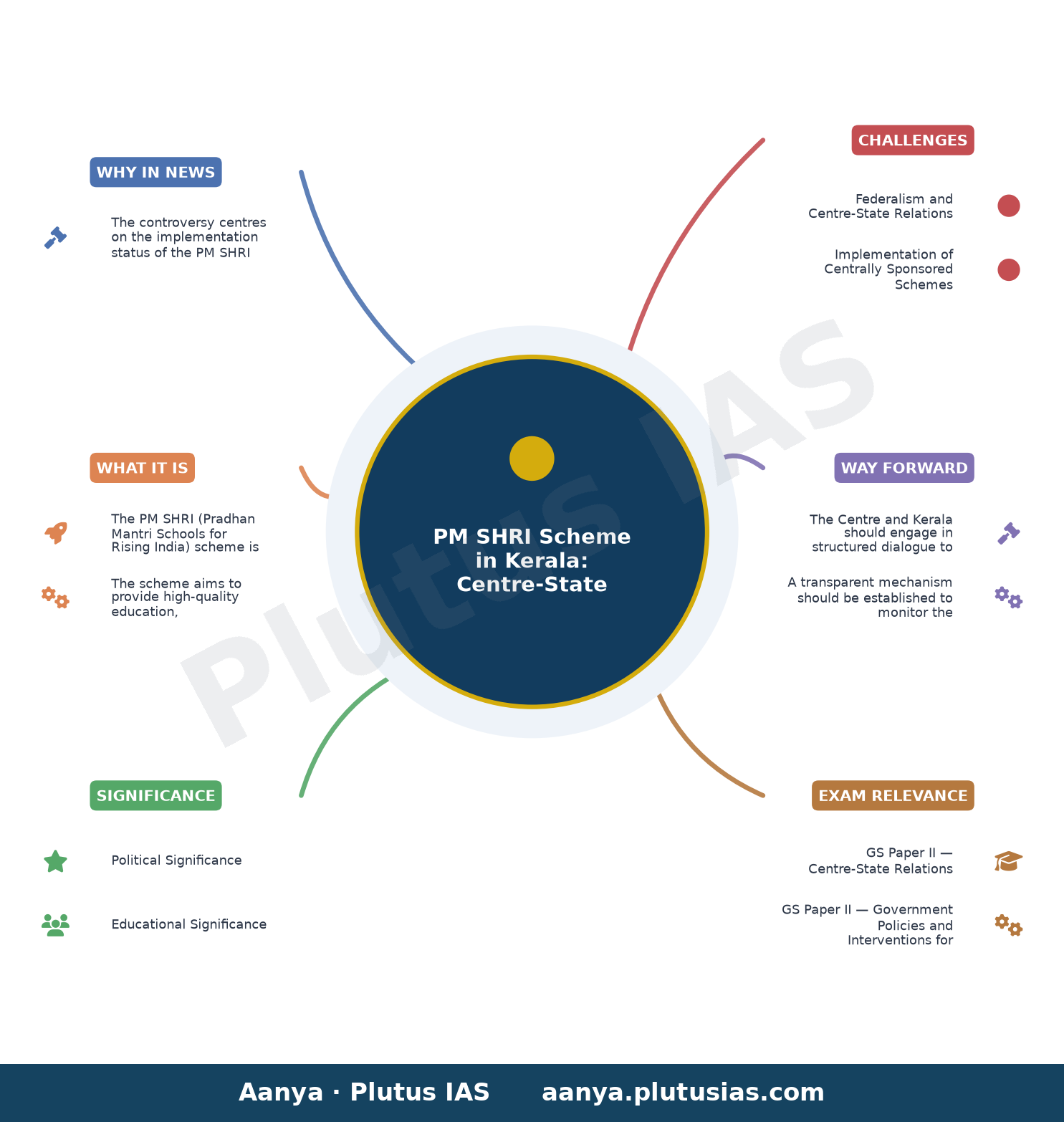
Why is this in the news?
The controversy centres on the implementation status of the PM SHRI (Pradhan Mantri Schools for Rising India) scheme in Kerala, with the Centre clarifying that no schools in the state have been included under the scheme despite the state government’s earlier signing of an MoU. The Indian National League (INL) has accused the Kerala Chief Minister of misrepresenting facts to justify the state’s potential adoption of the scheme, which is linked to the National Education Policy (NEP) 2020. This dispute highlights broader tensions between the Centre’s push for centrally-sponsored schemes and states’ autonomy in education policy, particularly in the context of Kerala’s longstanding secular and progressive stance on education.
Background
- The PM SHRI scheme was launched in September 2022 as a centrally-sponsored initiative to upgrade 14,500 schools across India, including Kendriya Vidyalayas and government schools, to serve as model schools aligned with NEP 2020.
- Kerala, under the Left Democratic Front (LDF) government (2021–2026), signed an MoU for the PM SHRI scheme in 2023 but did not implement it, citing concerns over the scheme’s alignment with the state’s secular education policy.
- The current United Democratic Front (UDF) government has faced scrutiny over its stance on the scheme, with the INL alleging that after the UDF government assumed office, the Chief Minister and General Education Minister N. Samsudheen were attempting to implement the National Education Policy, which reflects the ideological vision of the Rashtriya Swayamsevak Sangh (RSS).
- The Centre, through Union Minister of State for Education Jayant Chaudhary, clarified in Parliament that Kerala has not implemented the PM SHRI scheme and has only received funds under the Samagra Shiksha Kerala (SSK) programme, amounting to ₹99.27 crore.
- The Indian National League (INL), a political party in Kerala, has accused the Chief Minister of misleading the public by claiming the state was legally bound to implement the PM SHRI scheme due to the LDF government’s MoU.
- Kerala has historically maintained a secular and progressive approach to education, resisting centralised schemes that it perceives as encroaching on state autonomy or compromising its secular ethos.
What is the PM SHRI Scheme?
- The PM SHRI (Pradhan Mantri Schools for Rising India) scheme is a centrally-sponsored initiative launched in September 2022 to upgrade 14,500 existing schools across India, including Kendriya Vidyalayas and government schools, into model schools aligned with the National Education Policy (NEP) 2020.
- The scheme aims to provide high-quality education, infrastructure, and digital resources to transform these schools into exemplars of NEP 2020’s vision, including experiential learning, skill development, and holistic development of students.
- Funding under PM SHRI is shared between the Centre and states in a 60:40 ratio, with the Centre bearing the larger share. The scheme is implemented through the Ministry of Education and is monitored by a dedicated portal.
- The scheme is voluntary for states, and signing an MoU does not legally bind states to implement it. States retain the autonomy to decide whether to participate based on their educational priorities and policy alignment.
- Critics argue that the PM SHRI scheme represents a centralising tendency in education policy, potentially undermining state autonomy and the constitutional right of states to determine their educational curricula and governance.
- Proponents view the scheme as a transformative step to improve educational outcomes and bridge regional disparities in school education across India.
Key Features
| Feature | Significance |
|---|---|
| PM SHRI Scheme | A centrally sponsored scheme launched in 2022 to upgrade 14,500 existing schools across India into model schools, emphasizing experiential learning and socio-emotional development. |
| Memorandum of Understanding (MoU) | A non-binding agreement signed by states to express intent to participate in centrally sponsored schemes; does not mandate implementation or funding. |
| Samagra Shiksha Kerala (SSK) | A state-run flagship programme for universalising inclusive and equitable quality education in Kerala, receiving ₹99.27 crore in funding. |
| National Education Policy (NEP) 2020 | A policy framework guiding educational reforms in India, including structural changes in school governance, curriculum, and pedagogy. |
| Rashtriya Swayamsevak Sangh (RSS) | A socio-cultural organisation whose ideological influence is often cited in debates over the implementation of NEP and other centrally driven educational reforms. |
Why it Matters
Political Significance
- The controversy highlights the federal tensions between the Centre and Kerala, particularly over the implementation of centrally sponsored schemes and the autonomy of states in educational governance.
- The INL’s criticism reflects broader political opposition to the perceived imposition of NEP-aligned reforms, framing them as ideologically driven rather than pedagogically sound.
- The Chief Minister’s assertion that the state was bound by the MoU contrasts with the Centre’s clarification, raising questions about the legal and administrative obligations of states in such agreements.
Educational Significance
- The PM SHRI scheme aims to transform 14,500 schools into model institutions, but its implementation in Kerala remains disputed, with no schools reportedly included under the scheme.
- The SSK programme, which received funding, operates independently of PM SHRI, indicating that Kerala has pursued its own educational priorities despite the MoU.
- The debate underscores the need for clarity in the distinction between non-binding MoUs and binding commitments in centrally sponsored schemes.
Constitutional Significance
- The issue touches upon the constitutional division of powers between the Centre and states under the Seventh Schedule, particularly in the domain of education (List III, Concurrent List).
- The dispute raises questions about the enforceability of MoUs in the absence of explicit statutory backing, highlighting the need for legal clarity in inter-governmental agreements.
Challenges
1. Federalism and Centre-State Relations
- The dispute exemplifies the challenge of reconciling the Centre’s policy priorities with state-level autonomy, particularly in education, a subject under the Concurrent List.
- The ambiguity in the legal status of MoUs—whether they create binding obligations or merely express intent—complicates inter-governmental coordination.
- Political narratives often overshadow administrative and legal interpretations, leading to misinformation and public confusion.
UPSC Link: https://niti.gov.in/seventh-schedule
2. Implementation of Centrally Sponsored Schemes
- States may sign MoUs to access funds or demonstrate compliance, but this does not necessarily translate into full implementation of centrally driven schemes.
- The lack of a clear mechanism to enforce or monitor the implementation of schemes post-MoU signing creates operational inefficiencies.
- Kerala’s decision to prioritise SSK over PM SHRI suggests a strategic choice to align with state-specific educational goals rather than national priorities.
UPSC Link: https://www.education.gov.in/en
3. Politicisation of Educational Reforms
- The framing of NEP as an ideologically driven policy by opposition parties risks polarising debates and delaying pragmatic educational reforms.
- The conflation of PM SHRI with NEP in public discourse obscures the distinct objectives and operational frameworks of each initiative.
- States may resist centrally sponsored schemes due to perceived ideological mismatches, even when the schemes offer tangible benefits.
UPSC Link: https://www.education.gov.in/en/national-education-policy-2020
4. Funding Disparities and State Autonomy
- The receipt of ₹99.27 crore under SSK, while no funds are allocated under PM SHRI, highlights disparities in funding flows and state priorities.
- States may opt to utilise centrally allocated funds for existing programmes rather than new schemes, reflecting local governance preferences.
- The lack of transparency in fund utilisation and scheme implementation further erodes trust between the Centre and states.
UPSC Link: https://www.education.gov.in/en/samagra-shiksha
Challenges — UPSC Perspective
| Issue | Concern |
|---|---|
| Ambiguity in MoU Obligations | Lack of clarity on whether MoUs create binding commitments or merely express intent, leading to disputes over implementation. |
| Political Narratives vs. Administrative Reality | Public statements by political leaders may not align with administrative or legal interpretations, creating confusion. |
| Divergence in Educational Priorities | States may prioritise local programmes (e.g., SSK) over centrally sponsored schemes (e.g., PM SHRI) due to ideological or practical reasons. |
| Funding Disparities | Disproportionate allocation of funds to state programmes over centrally sponsored schemes may undermine national educational goals. |
| Legal Enforceability of MoUs | The absence of statutory backing for MoUs raises questions about their enforceability and the recourse available to aggrieved parties. |
Government Initiatives — Must-Memorise for Prelims
- PM SHRI Scheme
- Samagra Shiksha Kerala (SSK)
Way Forward
- The Centre and Kerala should engage in structured dialogue to clarify the legal and administrative implications of MoUs signed under centrally sponsored schemes.
- A transparent mechanism should be established to monitor the implementation of schemes post-MoU signing, ensuring accountability and reducing ambiguity.
- States should be empowered to opt out of centrally sponsored schemes without penalty if their educational priorities diverge from national goals, provided they demonstrate alternative pathways to achieve similar outcomes.
- The Union Education Ministry should issue clear guidelines distinguishing between binding and non-binding agreements, including the consequences of non-compliance.
- Kerala should conduct an independent review of its educational programmes (e.g., SSK) to assess their alignment with national standards while preserving state autonomy.
- Political parties should refrain from politicising educational reforms, focusing instead on evidence-based policy discussions.
- The Seventh Schedule of the Constitution should be reviewed to address ambiguities in the division of powers between the Centre and states in concurrent subjects like education.
UPSC Value Addition
Keywords for Mains Answer-Writing
PM SHRI Scheme · Memorandum of Understanding (MoU) · National Education Policy (NEP) 2020 · State autonomy in education · Union-State relations in education · Secularism in education · Samagra Shiksha Abhiyan · Rashtriya Swayamsevak Sangh (RSS) · Kerala’s education policy · Centre-State fiscal federalism
Constitutional & Policy Linkages
- Article 246 – Division of Legislative Powers (Concurrent List, Entry 25: Education)
- Article 263 – Inter-State Council (for Centre-State coordination)
Concept Flow
Kerala’s LDF government signs MoU for PM SHRI scheme → Centre clarifies MoU is non-binding → INL questions Chief Minister’s claim of obligation → Political opposition frames issue as ideological → Centre-State trust deficit widens → Implementation of PM SHRI remains stalled in Kerala → Debate over federalism and state autonomy intensifies.
Prelims Practice Questions
Q1. Consider the following statements regarding the PM SHRI Scheme:
1. It is a centrally sponsored scheme aimed at upgrading existing schools.
2. States are mandated to implement the scheme after signing an MoU with the Centre.
3. The scheme is implemented under the aegis of the Ministry of Education.
4. The PM SHRI Scheme is a replacement for the Samagra Shiksha Abhiyan.
How many of the above statements are correct?
- Only one
- Only two
- Only three
- All four
Answer: Only three — Statements 1, 2, and 3 are correct. Statement 4 is incorrect as the PM SHRI Scheme is an upgrade to existing schools under Samagra Shiksha Abhiyan, not a replacement.
Q2. Assertion (A): The PM SHRI Scheme requires states to sign an MoU with the Centre to access funds.
Reason (R): The MoU ensures that states align their education policies with the National Education Policy (NEP) 2020.
Options:
A. Both A and R are true, and R is the correct explanation of A.
B. Both A and R are true, but R is not the correct explanation of A.
C. A is true, but R is false.
D. A is false, but R is true.
- A
- B
- C
- D
Answer: B — Both the assertion and reason are true. The MoU is a prerequisite for states to access funds under the PM SHRI Scheme, and alignment with NEP 2020 is a key condition.
Q3. Match the following schemes with their respective ministries:
Column I (Scheme) | Column II (Ministry)
— | —
1. PM SHRI Scheme | A. Ministry of Education
2. Samagra Shiksha Abhiyan | B. Ministry of Women and Child Development
3. National Nutrition Mission | C. Ministry of Rural Development
4. Mahatma Gandhi National Rural Employment Guarantee Scheme | D. Ministry of Skill Development and Entrepreneurship
Options:
A. 1-A, 2-B, 3-C, 4-D
B. 1-A, 2-A, 3-B, 4-C
C. 1-B, 2-A, 3-D, 4-C
D. 1-D, 2-B, 3-A, 4-C
- A
- B
- C
- D
Answer: B — PM SHRI Scheme and Samagra Shiksha Abhiyan are under the Ministry of Education. National Nutrition Mission is under the Ministry of Women and Child Development, and MGNREGS is under the Ministry of Rural Development.
Mains Practice Question
✍ Critically examine the constitutional and political dimensions of the Centre-State conflict over the implementation of the PM SHRI Scheme in Kerala. In your answer, discuss the implications of the MoU mechanism, the role of secularism in education policy, and the ideological underpinnings of the dispute. (15 Marks)
Approach: MODEL-ANSWER SKELETON:
1. **Constitutional Framework**:
– Article 29 and 30 (cultural and educational rights of minorities) and Article 28 (freedom from religious instruction in state-funded institutions).
– Federalism under Article 1 and the Seventh Schedule (Union List Entry 66 and State List Entry 11).
– Doctrine of pith and substance and the balance between legislative competence and cooperative federalism.
2. **MoU Mechanism and Fiscal Federalism**:
– Nature of MoUs as instruments of cooperative federalism vs. potential coercion.
– Role of the Finance Commission and the Gadgil formula in determining state allocations.
– Case: *State of West Bengal v. Union of India* (2012) on the Centre’s power to attach conditions to centrally sponsored schemes.
3. **Secularism and Education Policy**:
– Constitutional secularism (S.R. Bommai v. Union of India, 1994) and its application to education.
– Kerala’s historical stance on secularism in education (e.g., SSK programme and its alignment with NEP 2020).
– Critique of the RSS’s ideological influence on NEP 2020 and its perception in Kerala.
4. **Ideological and Political Dimensions**:
– Contrast between LDF’s secular stance and UDF’s alignment with NEP 2020.
– Role of regional parties in resisting centralised education policies (e.g., Tamil Nadu’s stance on NEP 2020).
– Impact on state autonomy and the principle of subsidiarity in governance.
5. **Conclusion**:
– Weigh the Centre’s developmental goals against state autonomy.
– Suggest a middle path: decentralised implementation with safeguards for secularism and fiscal federalism.
Source: The Hindu
Generated by AanyaAi for educational purpose.

- UPSC Civil Services (Main) Examination 2026 — Mechanical Engineering Optional Paper I: Question Paper | Plutus IAS - September 24, 2026
- सुप्रीम कोर्ट ने टीएमसी नाम और चुनाव चिह्न विवाद पर चुनाव आयोग से समयसीमा मांगी, 28 सितंबर को सुनवाई - September 24, 2026
- UPSC Civil Services (Main) Examination 2026 — Chemistry Optional Paper I: Questions with Model Answers | Plutus IAS - September 24, 2026

No Comments