


31 Aug INS Nipun Commissioned: Boosting India’s Submarine Rescue & Deep-Sea Diving Capabilities
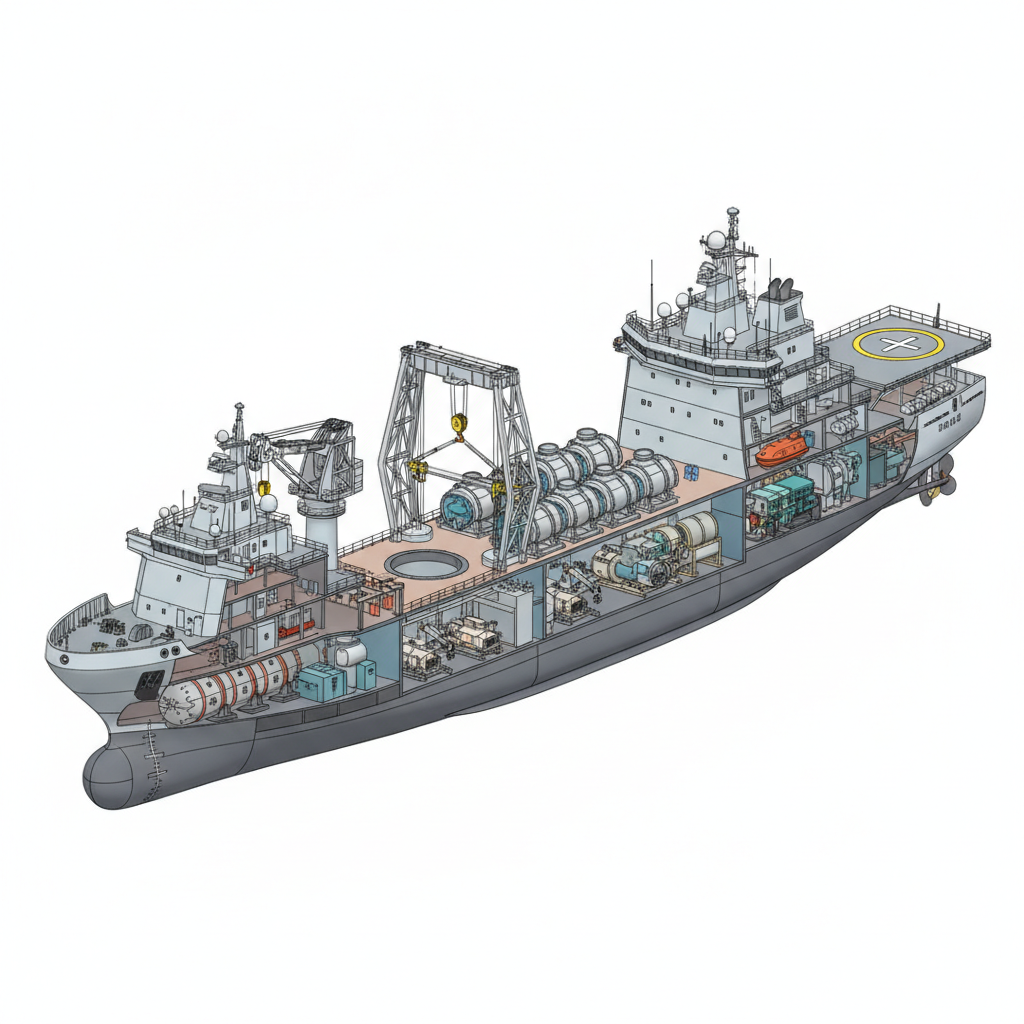
✎ INS Nipun is India’s second indigenously built Deep-Sea Diving Support Vessel (DSV) with a 300-metre diving depth capability, designed for submarine rescue, disaster relief, and deep-sea operations.
Subject Relevance — Where This Topic Fits
- GS Paper III — Security: Challenges and Responses | GS Paper III — Science and Technology: Indigenous Defence Technologies
- Prelims: Deep-Sea Diving Vessel (DSV), Submarine Rescue Operations, Nistar-class vessels, Hindustan Shipyard Limited (HSL), Strategic Maritime Assets
- Essay: Maritime Security: India’s Evolving Strategic Posture, Indigenisation in Defence Manufacturing: Opportunities and Challenges
Quick Revision: INS Nipun is India’s second indigenously built Deep-Sea Diving Support Vessel (DSV) with a 300-metre diving depth capability, designed for submarine rescue, disaster relief, and deep-sea operations.
Why is this in the news?
The commissioning of INS Nipun, the second Diving Support Vessel (DSV) of the Nistar-class, marks a significant augmentation of the Indian Navy’s deep-sea diving and submarine rescue capabilities. This vessel, commissioned on 31 August 2026, enhances India’s operational readiness in contested maritime environments and supports disaster relief and humanitarian missions, reflecting the Navy’s focus on strategic preparedness amid evolving maritime threats.
Background
- The Indian Navy operates under the Ministry of Defence and is responsible for safeguarding India’s maritime interests, including coastal security, deep-sea operations, and submarine rescue.
- Submarine rescue operations are critical for mitigating risks associated with submarine accidents, which can pose significant threats to naval personnel and national security.
- The Nistar-class DSVs are designed to provide rapid submarine rescue capabilities, supporting the Indian Navy’s commitment to maintaining a robust and self-reliant maritime force.
- Hindustan Shipyard Limited (HSL), a Government of India-owned shipbuilding enterprise, is a key player in the indigenous construction of naval vessels, including submarines and support ships.
- India’s maritime strategy is shaped by the need to address emerging challenges in the Indian Ocean Region (IOR), including piracy, illegal fishing, and geopolitical tensions.
- The commissioning of INS Nipun follows the induction of its predecessor, INS Nistar, and aligns with the Navy’s broader modernisation efforts to enhance operational flexibility and technological self-sufficiency.
What is INS Nipun?
- INS Nipun is a Deep-Sea Diving Support Vessel (DSV) commissioned into the Indian Navy on 31 August 2026, designed to perform deep-sea diving operations and submarine rescue missions.
- It is the second vessel of the Nistar-class, following INS Nistar, and is built indigenously by Hindustan Shipyard Limited (HSL) in Visakhapatnam.
- The vessel has a length of 119.4 metres, a displacement of 10,500 tonnes, and is equipped to support diving operations up to a depth of 300 metres.
- Key operational capabilities include rapid submarine rescue, disaster relief operations, and humanitarian assistance, making it a versatile asset for the Indian Navy.
- Its deployment enhances the Indian Navy’s ability to respond to submarine emergencies, conduct underwater repairs, and support deep-sea exploration and salvage operations.
- The commissioning of INS Nipun underscores India’s commitment to indigenous defence manufacturing and the development of strategic maritime assets.
UPSC Value Addition
Keywords for Mains Answer-Writing
Indian Navy · deep-sea diving vessel · INS Nipun · Nistar-class · submarine rescue · Hindustan Shipyard Ltd · maritime security · disaster relief operations · strategic churn · maritime domain awareness · defence indigenisation · maritime governance
Prelims Practice Questions
Q1. Consider the following statements regarding the recently commissioned INS Nipun: 1. INS Nipun is a deep-sea diving vessel of the Nistar-class. 2. It has been commissioned by the Indian Navy to provide rapid submarine rescue capabilities. 3. The vessel is capable of supporting diving operations up to a depth of 300 metres. 4. It was built by Cochin Shipyard Limited. How many of the above statements are correct?
- Only one
- Only two
- Only three
- All four
Answer: Only three — Statements 1, 2, and 3 are correct. Statement 4 is incorrect as INS Nipun was built by Hindustan Shipyard Ltd, not Cochin Shipyard Limited.
Q2. Assertion (A): The commissioning of INS Nipun enhances India’s maritime disaster relief capabilities.
Reason (R): The vessel is designed to support diving operations up to 300 metres and can be deployed for humanitarian operations.
- Both A and R are true, and R is the correct explanation of A.
- Both A and R are true, but R is not the correct explanation of A.
- A is true, but R is false.
- A is false, but R is true.
Answer: Both A and R are true, and R is the correct explanation of A. — Both Assertion (A) and Reason (R) are true. INS Nipun’s capabilities, including supporting diving operations and deployment for humanitarian operations, directly enhance India’s maritime disaster relief capabilities. Thus, R correctly explains A.
Q3. Match the following columns regarding Indian naval vessels and their roles:
Column I (Vessel) Column II (Role)
A. INS Nipun 1. Aircraft carrier
B. INS Vikramaditya 2. Deep-sea diving and submarine rescue
C. INS Arihant 3. Nuclear-powered ballistic missile submarine
D. INS Vikrant 4. Indigenous aircraft carrier
- A-2, B-1, C-3, D-4; A-1, B-2, C-3, D-4; A-4, B-3, C-2, D-1; A-3, B-4, C-1, D-2
- answer_array_indexes_to_display_as_single_string_here_but_keep_JSON_valid_so_use_an_array_of_integers_for_answer_field_instead
- answer_array_indexes_to_display_as_single_string_here_but_keep_JSON_valid_so_use_an_array_of_integers_for_answer_field_instead
Answer: ? — The correct matches are: A-2 (INS Nipun is a deep-sea diving vessel), B-1 (INS Vikramaditya is an aircraft carrier), C-3 (INS Arihant is a nuclear-powered ballistic missile submarine), D-4 (INS Vikrant is an indigenous aircraft carrier).
Mains Practice Question
✍ Critically examine the strategic significance of the commissioning of deep-sea diving vessels like INS Nipun for India’s maritime security architecture. Also, analyse how such assets contribute to disaster relief and humanitarian operations in the Indian Ocean Region. (15 Marks)
Approach: MODEL-ANSWER SKELETON:
1. **Strategic Significance of INS Nipun**:
– Role in submarine rescue and maritime domain awareness (MDA).
– Enhances India’s ‘SAGAR’ (Security and Growth for All in the Region) doctrine.
– Supports India’s naval diplomacy and power projection in the Indian Ocean Region (IOR).
– Aligns with the ‘Make in India’ initiative as it is indigenously built by Hindustan Shipyard Ltd.
2. **Maritime Security Architecture**:
– Integration with India’s broader naval strategy, including the development of indigenous platforms (e.g., Project 75, Project 75I).
– Contribution to India’s ‘Two-Front’ strategy and preparedness for maritime contingencies.
– Strengthening of India’s submarine rescue capabilities, complementing existing assets like the Deep Submergence Rescue Vehicle (DSRV).
3. **Disaster Relief and Humanitarian Operations**:
– Capability to deploy for search and rescue (SAR) operations during cyclones, tsunamis, and maritime accidents.
– Support for international humanitarian missions under frameworks like the Indian Ocean Naval Symposium (IONS).
– Enhances India’s soft power and regional leadership in disaster management.
4. **Challenges and Limitations**:
– Operational constraints in extreme weather conditions.
– Need for continuous training and interoperability with allied navies.
– Balancing resource allocation between strategic and humanitarian roles.
5. **Conclusion**:
– INS Nipun exemplifies India’s evolving maritime security strategy, balancing hard power and humanitarian commitments. Its commissioning underscores the importance of indigenisation and strategic autonomy in defence procurement.
Source: The Hindu
Generated by AanyaAi for educational purpose.

- ‘मेरा भारत’ अभियान: ग्रामीण युवाओं ने नशामुक्त समाज के लिए खेल और सेवा का संगम किया - October 24, 2026
- Forex Rule Confusion Delays Service Payments: RBI Clarification Needed - October 24, 2026
- माई भारत अभियान: ग्राम सेवा एवं खेल दिवस के तहत गांवों में Nasha Mukt Yuva Abhiyan - October 24, 2026

No Comments