


30 Oct Integrated Cold Chain and Value Addition Infrastructure (ICCVAI)
This article covers “Daily Current Affairs” and Integrated Cold Chain and Value Addition Infrastructure (ICCVAI)
SYLLABUS MAPPING
GS- 2- Economy- Integrated Cold Chain and Value Addition Infrastructure (ICCVAI)
FOR PRELIMS
What are post-harvest losses, and how do they affect India’s agricultural economy?
FOR MAINS
What role does technology play in improving the efficiency of cold chain infrastructure in India?
Why in the News?
The Ministry of Food Processing Industries (MoFPI) has highlighted the significant impact of the Integrated Cold Chain and Value Addition Infrastructure Scheme under the Pradhan Mantri Kisan Sampada Yojana (PMKSY) in reducing post-harvest losses of perishable commodities. The scheme has successfully established modern cold chain infrastructure, linking farmers to markets and processors, thereby minimizing wastage, improving farmers’ income, generating rural employment, and ensuring better availability of perishable products. Recent progress reports show enhanced capacity creation in cold storage, reefer transport, and value addition facilities across India, marking a major step toward strengthening India’s agri-logistics and food processing ecosystem.
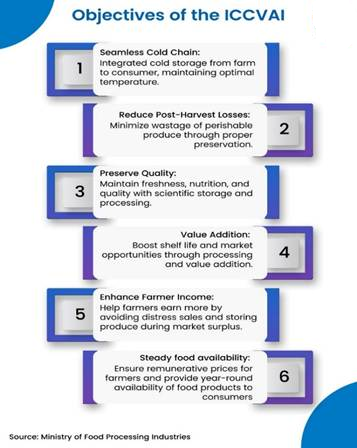
Objectives of the ICCVAI
The founding objectives of the scheme were clearly defined to ensure the holistic development of cold chain infrastructure:
Key components of ICCVAI
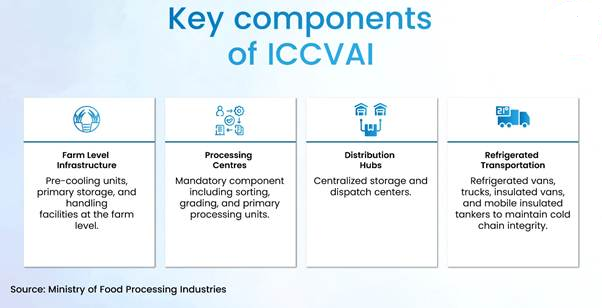
The scheme supports the creation of facilities across the supply chain, often emphasizing infrastructure at the farm level. For an applicant to receive financial assistance under the general cold chain scheme (as per 22.05.2025 guidelines), they must set up Farm Level Infrastructure (FLI) and connect it with either a Distribution Hub (DH) and/or refrigerated/insulated transport.
Its key components include:
Eligibility of PIA to establish Food Processing Unit
ICCVAI is a demand driven scheme. Various eligible entities (Project Implementing Agencies – PIAs can establish the food processing units. PIA can be anyone from the following:
Individuals (including farmers).
Entity/Organization such as Farmer Producer Organizations (FPOs), Farmer Producer Companies (FPCs), Non-Governmental Organizations (NGOs), Public Sector Undertakings (PSUs), Firms, Companies, Corporations, Cooperatives, and Self-Help Groups (SHGs).
Ministry invites applications/proposals from eligible entities through floating Expressions of Interest (EOIs) based on the availability of funds. Obtaining consent from the States for the storage of food commodities is not mandatory; however, their assistance is required in establishing the food processing units.
Key Government Initiatives Complementing the ICCVAI Scheme
| Scheme / Initiative | Implementing Agency / Ministry | Key Objectives | Type of Assistance / Features | Coverage / Target Areas |
|---|---|---|---|---|
| Mission for Integrated Development of Horticulture (MIDH) | Ministry of Agriculture & Farmers’ Welfare | Promote holistic development of horticulture and strengthen cold chain infrastructure | • Credit-linked back-ended subsidy for cold storages up to 5,000 MT • 35% subsidy in general areas • 50% in NE, hilly, and scheduled areas |
All States & UTs through State Horticulture Missions |
| Operation Greens Scheme | Ministry of Food Processing Industries (MoFPI) under PM Kisan SAMPADA Yojana | Enhance value realisation for farmers and reduce post-harvest losses | • Support for integrated value chain development • Initially covered Tomato, Onion, Potato (TOP) • Later expanded to other fruits, vegetables & shrimp |
Nationwide coverage; focus on perishables |
| National Horticulture Board (NHB) – Capital Investment Subsidy Scheme | National Horticulture Board (NHB) | Promote scientific storage and reduce post-harvest losses in horticulture | • Credit-linked back-ended subsidy for cold storages (5,000–20,000 MT) • 35% subsidy in general areas • 50% in NE, hilly, and scheduled areas |
Nationwide; focus on horticultural products |
| Agriculture Infrastructure Fund (AIF) | Department of Agriculture & Farmers’ Welfare | Strengthen post-harvest management and agri-infrastructure | • Corpus of ₹1 lakh crore • Collateral-free term loans up to ₹2 crore • 3% interest subvention per annum |
All States & UTs; supports cold storages, warehouses, processing units |
Financial Assistance
Enhanced Budgetary Allocation under PMKSY (2025)
The Union Cabinet in July 2025 approved an additional outlay of₹1,920 crore for the PMKSY, raising the total allocation to ₹6,520 crore for the 15th Finance Commission cycle (up to March 31, 2026). This approval includes Rs. 1000 crore to support the setting up of 50 Multi-Product Food Irradiation Units under the component scheme-Integrated Cold Chain and Value Addition Infrastructure (ICCVAI). This significant increase reflects the government’s strong commitment to expand the impact of cold chain infrastructure.
The scheme provides grants or subsidies to set up integrated cold chain projects covering 35% of the eligible project cost in general areas and 50% in difficult areas, as well as for proposals from SC/ST groups, FPOs, and SHGs. Difficult Areas include North-Eastern States (including Sikkim), Uttarakhand, Himachal Pradesh, Jammu & Kashmir, Ladakh, Integrated Tribal Development Programme (ITDP) areas, and Islands. Each project can receive up to ₹10 crore in financial assistance.
Achievements and Progress
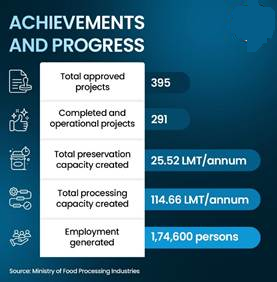
As of June 2025, a total of 395 integrated cold chain projects have been approved under the Cold Chain Scheme since its launch in 2008. Out of these, 291 projects have been completed and are operational, creating a preservation capacity of 25.52 lakh metric tonnes (LMT) per year and a processing capacity of 114.66 LMT per year. The completed and operationalised projects have contributed to the generation of 1,74,600 jobs across the country.
Substantial progress became evident after 2016–17. Since 2016-17, an amount of ₹1535.63 crore has been released against approved grants-in-aid / subsidy of ₹2066.33 crore for implementing 269 approved projects with 169 cold chain projects have been completed and operationalised across the country.
Major Revision and Policy Updates
The scheme has undergone several revisions to enhance its effectiveness and align with emerging needs:
June 2022 Revision: A significant policy change was implemented on June 08, 2022 when the scheme discontinued support for cold chain projects in the fruits and vegetables sector. Moreover, the sector was shifted to the Operation Greens Scheme which is another component of PMKSY specifically designed to address price stabilization measures in the horticulture sector. Therefore, this strategic reallocation allowed for specialized focus and optimized resource utilization.
August 2024 Guidelines: Operational scheme guidelines were issued on August 06, 2024 for setting up multi-product food irradiation units (use of ionizing radiation to preserve food, extend shelf life, and reduce post-harvest losses for various products) under the cold chain scheme. Therefore, this addition reflects the incorporation of modern preservation technologies that extend shelf life and ensure food safety without compromising nutritional quality.
May 2025 Revision: The latest operational guidelines, released on May 22, 2025, focus on strengthening preservation and value-addition infrastructure across the entire supply chain, from the farm gate to the consumer. These measures aim to minimize post-harvest losses of non-horticulture produce, while also ensuring farmers receive fair and remunerative prices and consumers benefit from the year-round availability of food products.
Conclusion
The evolution of the scheme demonstrates adaptive governance. The 2022 sectoral realignment, transferring fruits and vegetables to Operation Greens, reflects strategic specialization. The 2025 budget increase to ₹6,520 crore underscores the government’s focus on strengthening and expanding the impact of cold chain infrastructure. The introduction of irradiation facilities and regular guideline revisions shows responsiveness to technological advancements and ground-level requirements.
The scheme’s financial framework ensures that cold chain development remains economically feasible for a wide range of stakeholders, from individual farmers to large corporate entities. It aims to ensure that projects are implemented in response to actual market needs. Furthermore, the scheme holds significant potential. Integrating modern technologies such as IoT-based monitoring, energy-efficient systems, and AI-driven logistics optimization can greatly enhance operational efficiency. Strengthening linkages with agricultural marketing reforms can further amplify benefits for farmers.
Prelims question:
Q. With reference to the Integrated Cold Chain and Value Addition Infrastructure (ICCVAI) Scheme, consider the following statements:
1. The scheme provides financial assistance only to government agencies for establishing cold chain projects.
2. It supports farm-level infrastructure, distribution hubs, and refrigerated transport facilities.
3. Fruits and vegetables are now supported under the Operation Greens Scheme instead of ICCVAI.
Which of the statements given above are correct?
(a) 1 and 2 only
(b) 2 and 3 only
(c) 1 and 3 only
(d) 1, 2 and 3
Answer: B
Mains Question:
Q. Discuss the significance of the Integrated Cold Chain and Value Addition Infrastructure (ICCVAI) Scheme under PMKSY in addressing post-harvest losses in India. Highlight the recent policy updates, achievements, and the way forward for building a sustainable cold chain ecosystem.
(250 words)

- Before New Taxes, Make Every Rupee Count: Fiscal Discipline and Outcome-Based Governance in Tamil Nadu - August 20, 2026
- A Palestinian State as the Foundation for Regional Peace - August 20, 2026
- A Vision for an Inclusive Bangladesh: Democracy, Minority Rights and India’s Neighbourhood - August 19, 2026

No Comments