


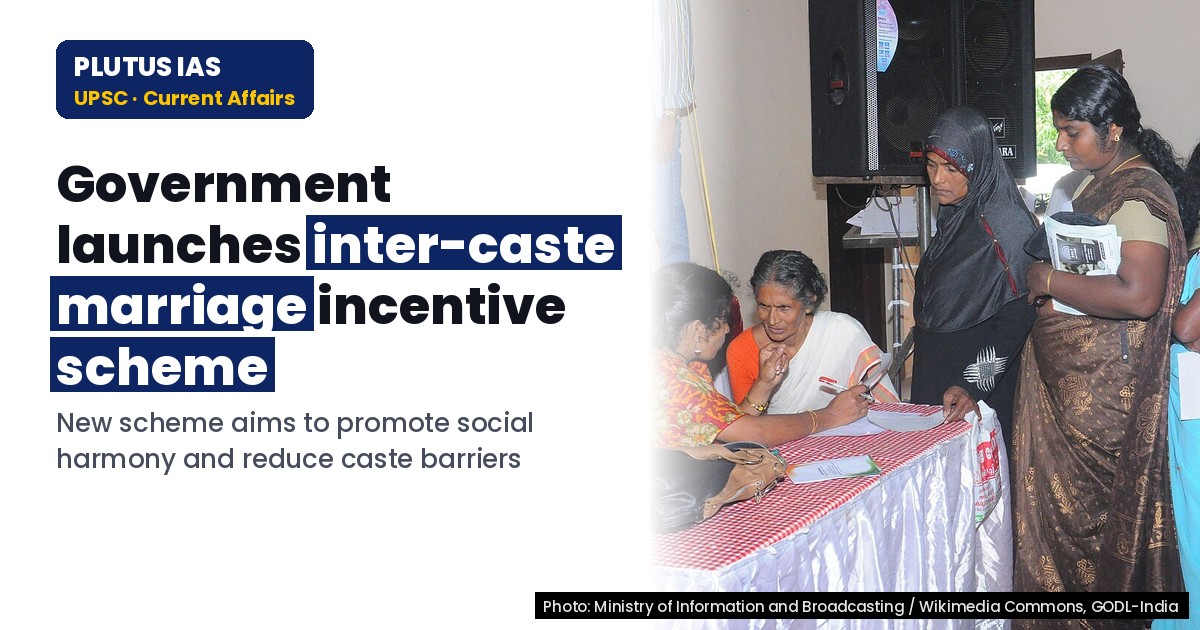
15 Oct Inter-Caste Marriage Incentive Scheme: Polity & Governance Initiative
✎ Inter-caste marriage incentive schemes are constitutional policy instruments under Articles 15, 17, and 46, implemented by states to promote social integration and reduce caste-based discrimination through financial and…
Subject Relevance — Where This Topic Fits
- GS Paper I — Social Empowerment | GS Paper II — Governance, Polity and Social Justice | GS Paper III — Human Development and Inclusive Growth
- Prelims: Article 15 (Prohibition of discrimination), Directive Principles of State Policy (Article 46), Protection of Civil Rights Act, 1955, Scheduled Castes and Scheduled Tribes (Prevention of Atrocities) Act, 1989, National Commission for Scheduled Castes, Social Justice and Empowerment Ministry
- Essay: Social Justice and Inclusive Development: Bridging Divides Through Policy, The Role of State Intervention in Social Reform
Quick Revision: Inter-caste marriage incentive schemes are constitutional policy instruments under Articles 15, 17, and 46, implemented by states to promote social integration and reduce caste-based discrimination through financial and non-financial rewards.
Why is this in the news?
The Inter-Caste Marriage Incentive Scheme has been highlighted in recent official communications as a policy intervention aimed at promoting social integration and reducing caste-based discrimination. Such schemes are periodically revisited in governance discourse to assess their effectiveness in achieving constitutional goals of equality and fraternity. The renewed focus underscores the importance of evaluating incentive-based approaches within India’s broader social justice framework.
Background
- The Constitution of India, through Articles 15 and 17, prohibits discrimination on grounds of religion, race, caste, sex, or place of birth and abolishes untouchability, respectively.
- Directive Principles of State Policy (DPSP), particularly Article 46, mandate the State to promote educational and economic interests of weaker sections and protect them from social injustice.
- Post-independence, the Indian state has implemented various affirmative action policies, including reservation in education and employment, to address historical social inequalities.
- Inter-caste marriage incentive schemes are a subset of social justice policies designed to encourage inter-caste unions, traditionally viewed as a means to break caste barriers and foster social cohesion.
- These schemes are implemented by state governments and union territories, often under the aegis of the Ministry of Social Justice and Empowerment.
- The effectiveness of such schemes is periodically reviewed by constitutional bodies like the National Commission for Scheduled Castes (NCSC) and civil society organizations.
What are Inter-Caste Marriage Incentive Schemes?
- These are state-sponsored financial or non-financial incentives provided to couples who enter into inter-caste marriages, defined as unions where one spouse belongs to a Scheduled Caste (SC) or Scheduled Tribe (ST) and the other does not.
- Incentives typically include monetary rewards, housing assistance, employment preference, or educational benefits for the couple or their children, aimed at reducing social stigma and economic barriers.
- The schemes are grounded in the constitutional principle of promoting fraternity (Preamble) and social justice (Part IV), aligning with the Directive Principles of State Policy.
- Implementation varies across states, with some offering lump-sum cash incentives (e.g., ₹2.5 lakh in Maharashtra) and others providing land allocation or housing schemes.
- The schemes are often complemented by awareness campaigns and legal protections under the Protection of Civil Rights Act, 1955, and the Scheduled Castes and Scheduled Tribes (Prevention of Atrocities) Act, 1989.
- Monitoring and evaluation mechanisms are critical to ensure transparency, prevent misuse, and assess impact on social integration.
- The schemes reflect a policy shift from purely punitive measures against caste discrimination to proactive incentives for social transformation.
- Critics argue that such schemes may inadvertently reinforce caste identities by categorizing individuals based on caste, while proponents highlight their role in challenging traditional hierarchies.
Key Features
| Feature | Significance |
|---|---|
| Financial Incentive | Provides monetary support to inter-caste couples to mitigate social and economic barriers to marriage. |
| Awareness Campaigns | Includes targeted outreach to educate communities on the legal and social benefits of inter-caste unions. |
| Eligibility Criteria | Defines clear parameters for couples to qualify, ensuring transparency and inclusivity. |
| Monitoring Mechanism | Establishes a grievance redressal and progress tracking system for effective implementation. |
Why it Matters
Social Justice
- Promotes constitutional ideals of equality (Article 14) and fraternity (Article 51A) by addressing caste-based discrimination.
- Encourages social integration and reduces caste-based segregation in marital practices.
- Supports marginalised communities by providing tangible incentives for inter-caste unions.
Governance & Policy
- Demonstrates the state’s role in fostering inclusive social policies beyond legal prohibitions of caste discrimination.
- Aligns with Directive Principles of State Policy (DPSP) under Part IV of the Constitution, particularly Articles 38 and 46.
Economic Impact
- Potential to reduce socio-economic disparities by enabling inter-caste mobility and resource-sharing.
- May contribute to long-term human capital development through diversified social networks.
Challenges
1. Social Resistance
- Deep-rooted caste prejudices may persist despite incentives, limiting uptake in conservative communities.
- Risk of backlash or ostracisation from families and local social structures.
UPSC Link: GS-I: Social Issues
2. Implementation Gaps
- Ensuring equitable distribution of incentives across regions and castes may face administrative challenges.
- Verification mechanisms for inter-caste marriages may be susceptible to fraud or misrepresentation.
UPSC Link: GS-II: Governance
3. Sustainability Concerns
- Long-term funding viability of the scheme requires robust budgetary allocations and periodic reviews.
- Need for continuous evaluation to assess impact and adjust incentives as societal attitudes evolve.
UPSC Link: GS-III: Economic Development
Challenges — UPSC Perspective
| Issue | Concern |
|---|---|
| Regional Disparities | Uneven adoption due to varying levels of caste consciousness and socio-economic conditions. |
| Verification Challenges | Difficulty in authenticating inter-caste marriages in remote or informal settings. |
| Stigma Persistence | Lack of change in societal attitudes may render incentives ineffective over time. |
| Funding Constraints | Dependence on state budgets may limit scalability or lead to discontinuity. |
Way Forward
- Strengthen grassroots awareness campaigns in collaboration with local institutions and NGOs.
- Establish a transparent grievance redressal mechanism with multi-stakeholder oversight.
- Conduct periodic impact assessments to measure social and economic outcomes.
- Expand eligibility criteria to include transgender and other marginalised groups where relevant.
- Integrate the scheme with existing social welfare programmes for holistic support.
- Leverage digital platforms for monitoring and publicising success stories to inspire adoption.
- Ensure adequate budgetary provisions and explore public-private partnerships for sustainable funding.
UPSC Value Addition
Keywords for Mains Answer-Writing
Inter-Caste Marriage Incentive Scheme · Social Justice · Scheduled Castes and Scheduled Tribes (Prevention of Atrocities) Act, 1989 · Constitutional provisions for social equity · Reservation policy in India · Directive Principles of State Policy · Article 15(4) and 16(4) · Inclusive governance · Dalit empowerment · Affirmative action · Caste-based violence · Social harmony · Union Ministry of Social Justice and Empowerment · Constitutional morality · Intersectionality in public policy
Constitutional & Policy Linkages
- Article 14: Right to Equality (prohibition of caste-based discrimination).
- Article 15(1): Prohibition of discrimination on grounds of religion, race, caste, sex, or place of birth.
- Article 17: Abolition of Untouchability.
Concept Flow
Caste-based social stratification → Inter-caste discrimination → Legal and policy interventions → Incentive schemes → Social integration → Constitutional ideals of equality and fraternity.
Prelims Practice Questions
Q1. Consider the following statements regarding the Inter-Caste Marriage Incentive Scheme in India:
1. The scheme is primarily aimed at preventing caste-based violence.
2. Financial incentives are provided to couples from different castes who legally register their marriage.
3. The scheme is implemented under the provisions of the Scheduled Castes and Scheduled Tribes (Prevention of Atrocities) Act, 1989.
4. The Union Ministry of Social Justice and Empowerment is the nodal authority for the scheme.
How many of the above statements are correct?
- Only one
- Only two
- Only three
- All four
Answer: Only three — Statements 2 and 4 are correct. The scheme provides financial incentives to inter-caste couples and is administered by the Union Ministry of Social Justice and Empowerment. Statement 1 is incorrect as the scheme’s primary objective is to promote social harmony and inter-caste unity, not merely prevent violence. Statement 3 is incorrect as the scheme is not directly linked to the Prevention of Atrocities Act, 1989.
Q2. Assertion (A): The Inter-Caste Marriage Incentive Scheme is designed to address structural inequalities in Indian society.
Reason (R): The scheme provides financial incentives to inter-caste couples to encourage social integration and reduce caste-based discrimination.
In the context of the above two statements, which one of the following is correct?
- Both A and R are true, and R is the correct explanation of A.
- Both A and R are true, but R is not the correct explanation of A.
- A is true, but R is false.
- A is false, but R is true.
Answer: Both A and R are true, and R is the correct explanation of A. — Both Assertion (A) and Reason (R) are true, and Reason (R) correctly explains Assertion (A). The scheme’s objective is to address structural inequalities by promoting social integration through financial incentives for inter-caste marriages.
Q3. Match the following provisions with their respective constitutional or statutory frameworks:
Column I (Provision) | Column II (Framework)
———————|———————-
1. Promotion of educational and economic interests of SCs/STs | A. Article 15(4)
2. Reservation in public employment for backward classes | B. Article 16(4)
3. Special provisions for the advancement of socially and educationally backward classes | C. Article 46
4. Duty of the State to promote the educational and economic interests of weaker sections | D. Article 16(4A)
Select the correct match:
- 1-A, 2-B, 3-D, 4-C
- 1-C, 2-B, 3-A, 4-D
- 1-D, 2-A, 3-B, 3-C
- 1-B, 2-D, 3-A, 4-C
Answer: 1-A, 2-B, 3-D, 4-C — The correct matches are: 1-C (Article 46), 2-B (Article 16(4)), 3-D (Article 16(4A)), and 4-A (Article 15(4)).
Mains Practice Question
✍ The Inter-Caste Marriage Incentive Scheme is a policy intervention aimed at fostering social integration and reducing caste-based discrimination in India. Critically examine the constitutional and legal foundations of such schemes, with particular reference to the Directive Principles of State Policy and fundamental rights. Also, assess the potential challenges in their effective implementation. (15 Marks)
Approach: MODEL-ANSWER SKELETON:
1. **Constitutional Foundations**:
– Article 15(4) and 16(4): Permissibility of special provisions for advancement of socially and educationally backward classes.
– Article 46: Duty of the State to promote educational and economic interests of weaker sections.
– Article 17: Abolition of untouchability.
– Article 21: Right to life and personal liberty (interpreted to include dignity and autonomy).
2. **Legal and Policy Framework**:
– Scheduled Castes and Scheduled Tribes (Prevention of Atrocities) Act, 1989: Context of caste-based violence and discrimination.
– Union Ministry of Social Justice and Empowerment: Role in designing and implementing affirmative action schemes.
– Judicial precedents: Landmark judgments such as Indra Sawhney v. Union of India (1992) on reservation policy.
3. **Purpose and Objectives of the Scheme**:
– Promoting social harmony and reducing caste-based discrimination.
– Encouraging inter-caste marriages as a tool for social integration.
– Addressing structural inequalities in Indian society.
4. **Challenges in Implementation**:
– **Social Resistance**: Deep-rooted caste prejudices and resistance from dominant castes.
– **Awareness Gaps**: Lack of awareness among target beneficiaries about the scheme and its benefits.
– **Administrative Bottlenecks**: Delays in disbursement of incentives and bureaucratic hurdles.
– **Legal and Ethical Concerns**: Potential for misuse or coercion in inter-caste marriages.
– **Regional Disparities**: Uneven implementation across states due to varying socio-economic conditions.
5. **Comparative Perspective**:
– Similar schemes in other countries (e.g., affirmative action in the United States, South Africa’s post-apartheid policies).
6. **Conclusion**:
– While the scheme is a commendable step towards social justice, its success depends on robust implementation, community engagement, and addressing structural inequalities. The State must balance affirmative action with constitutional morality and individual autonomy.
Source: PIB (Press Information Bureau)
Generated by AanyaAi for educational purpose.
Related guides on our sites
- Best PSIR optional coaching for upsc
- Best sociology optional coaching for upsc
- Which is best sociology optional coaching for upsc
- Best PSIR optional teacher for upsc


No Comments