


25 Sep Iran Sets 6-Day Deadline for US to Reopen Strait of Hormuz: Key Facts for UPSC
✎ The Strait of Hormuz is a critical chokepoint for global oil supplies, governed by UNCLOS, whose disruption could destabilise energy markets and international trade.
Subject Relevance — Where This Topic Fits
- GS Paper II — International Relations — Maritime Security and Global Commons | GS Paper II — International Relations — Regional Organisations and Conflicts (West Asia) | GS Paper III — Economy — Energy Security and Trade Routes
- Prelims: Strait of Hormuz, Bab al-Mandab, Hormuz Crisis, Freedom of Navigation, UNCLOS, Energy Security, Chokepoint, Global Shipping Lanes, Strait of Malacca, Suez Canal
- Essay: Energy Security in the 21st Century: Balancing Geopolitics and Economic Stability, The Role of Chokepoints in Shaping Global Trade and Diplomacy
Quick Revision: The Strait of Hormuz is a critical chokepoint for global oil supplies, governed by UNCLOS, whose disruption could destabilise energy markets and international trade.
Why is this in the news?
Recent diplomatic exchanges between the United States and Iran, mediated by British and other international actors, have brought renewed attention to the Strait of Hormuz—a critical chokepoint for global energy supplies. The crisis has implications not only for Gulf security but also for global oil markets, shipping routes, and the broader architecture of maritime governance.
Background
- The Strait of Hormuz is a narrow waterway between the Persian Gulf and the Gulf of Oman, measuring approximately 39 km at its narrowest point, through which nearly 20-30% of the world’s seaborne oil passes annually.
- Historically, the Strait has been a flashpoint in regional geopolitics, with incidents such as the 1980s ‘Tanker War’ during the Iran-Iraq War and the 2019 attacks on oil tankers in the Gulf highlighting its strategic vulnerability.
- Regional tensions have escalated in recent years due to the reimposition of US sanctions on Iran following its withdrawal from the Joint Comprehensive Plan of Action (JCPOA) in 2018, leading to increased Iranian military presence and asymmetric threats in the Gulf.
- The Bab al-Mandab Strait, another critical chokepoint linking the Red Sea to the Indian Ocean, has also seen heightened tensions due to Houthi control of parts of Yemen’s Red Sea coast, further complicating maritime security dynamics in the region.
- The global economy remains heavily dependent on the uninterrupted flow of oil and gas through these straits, with disruptions posing risks to energy prices, inflation, and economic stability worldwide.
What is the Strait of Hormuz and why is it strategically significant?
- The Strait of Hormuz is a narrow maritime passage connecting the Persian Gulf to the Gulf of Oman and the Arabian Sea, serving as the sole sea route for oil exports from several Gulf states, including Saudi Arabia, Iran, Iraq, the UAE, and Kuwait.
- It is one of the world’s most critical chokepoints, with an estimated 20-30 million barrels of oil transiting daily, accounting for roughly one-third of global seaborne oil shipments.
- The Strait’s strategic importance lies in its geographic constriction, which makes it vulnerable to disruption through military action, sabotage, or blockades, thereby enabling state or non-state actors to exert significant geopolitical leverage.
- Under the United Nations Convention on the Law of the Sea (UNCLOS), the Strait is classified as an ‘international strait,’ where all vessels enjoy the right of ‘transit passage’—a higher degree of freedom than ‘innocent passage’—ensuring unimpeded movement for commercial and military vessels.
- Historically, the Strait has been a focal point of conflict, including during the Iran-Iraq War (1980-1988) when both sides targeted oil tankers, and more recently, in 2019, when attacks on tankers in the Gulf of Oman raised concerns about maritime security.
- The Strait’s security is intertwined with broader regional dynamics, including the rivalry between Iran and Gulf Cooperation Council (GCC) states, the role of non-state actors such as the Houthis in Yemen, and the strategic interests of global powers such as the US, China, and Russia.
- Disruptions in the Strait can trigger volatility in global oil markets, leading to spikes in fuel prices, inflationary pressures, and economic slowdowns, particularly in energy-dependent economies.
- Ensuring the Strait’s security requires a combination of diplomatic engagement, multilateral frameworks, and crisis management mechanisms to prevent escalation and maintain the principles of freedom of navigation and maritime law.
Key Features
| Feature | Significance |
|---|---|
| Strait of Hormuz | A critical chokepoint for global oil transit, handling ~20% of the world’s daily oil supply, linking the Persian Gulf to the Gulf of Oman and the Arabian Sea. |
| Iranian Proposal | A conditional framework for reopening the Strait, including lifting sanctions, releasing frozen assets, and halting regional military operations. |
| US-Iran Negotiations | Ongoing diplomatic talks mediated by third parties, with no immediate breakthrough but structured engagement to de-escalate tensions. |
| British Diplomatic Role | UK’s mediation efforts to ensure freedom of navigation and address bilateral concerns, including consular access for detained nationals. |
| Regional Spillover | Escalation in adjacent waterways (Bab al-Mandab) due to Houthi control, compounding disruptions to global trade routes. |
Why it Matters
Economic/Strategic
- Disruption in the Strait of Hormuz could trigger a 20-30% spike in global oil prices, impacting inflation, trade balances, and economic growth in energy-importing nations.
- The Strait is a vital artery for India’s energy security, with ~60% of its oil imports transiting through it, making geopolitical stability here a national priority.
- Prolonged closure risks rerouting oil shipments via the Cape of Good Hope, increasing transit time and costs, thereby altering global maritime logistics.
- Energy market volatility may deter foreign investment in upstream oil projects, particularly in the Middle East, affecting long-term supply stability.
Geopolitical
- The crisis underscores the fragility of multilateral security frameworks in the Persian Gulf, where non-state actors (e.g., Houthis) and regional powers (e.g., Iran, Saudi Arabia) exert asymmetric influence.
- US-Iran negotiations reflect broader diplomatic efforts to revive the Joint Comprehensive Plan of Action (JCPOA), though with conditionalities tied to regional de-escalation.
- The involvement of external mediators (e.g., UK) highlights the role of third-party diplomacy in managing conflicts where direct talks face domestic constraints.
- Escalation in Bab al-Mandab (Red Sea) and Yemen further complicates maritime security, creating a domino effect on global trade routes.
Legal/Institutional
- The principle of ‘freedom of navigation’ under the United Nations Convention on the Law of the Sea (UNCLOS) is central to resolving disputes over maritime chokepoints.
- Sanctions regimes (e.g., US secondary sanctions) and asset freezes create legal ambiguities, complicating compliance for third-party entities (e.g., shipping firms, banks).
- Diplomatic immunity and consular access for detained nationals fall under the Vienna Convention on Consular Relations, a key legal framework in bilateral disputes.
Challenges
1. Sanctions and Economic Coercion
- US sanctions on Iran have disrupted trade flows, frozen assets, and restricted access to international financial systems, complicating de-escalation efforts.
- Secondary sanctions deter non-US entities from engaging with Iran, limiting diplomatic flexibility and exacerbating economic isolation.
- Asset repatriation and unfreezing funds require complex legal and political negotiations, often stalled by domestic constraints in both countries.
UPSC Link: GS-II: India and its neighbourhood- relations
2. Regional Proxy Conflicts
- Iran’s support for proxies (e.g., Houthis in Yemen) creates asymmetric threats, complicating direct negotiations and escalating regional tensions.
- Saudi Arabia’s military responses to Houthi attacks risk broadening the conflict, drawing in external actors and destabilising the Arabian Peninsula.
- The Bab al-Mandab Strait’s closure would disrupt ~10% of global oil shipments, compounding the impact of Hormuz disruptions.
UPSC Link: GS-II: Effect of policies and politics of developed and developing countries
3. Maritime Security Governance
- The absence of a robust multilateral mechanism for managing chokepoint disputes leaves gaps in enforcement and dispute resolution.
- Piracy, armed attacks, and non-state actor threats require coordinated naval patrols, but political divisions hinder unified action.
- Climate change-induced waterway congestion and infrastructure vulnerabilities (e.g., port security) add layers of complexity to maritime governance.
UPSC Link: GS-III: Security challenges and their management
4. Energy Market Volatility
- Sudden supply disruptions could trigger speculative trading, distorting oil futures and increasing hedging costs for importers like India.
- Stranded assets in the Middle East may deter long-term investments, affecting future production capacity and price stability.
- Renewable energy transitions could accelerate if oil price spikes persist, reshaping global energy geopolitics.
UPSC Link: GS-III: Infrastructure- energy
5. Diplomatic Constraints
- Domestic political pressures in the US and Iran limit negotiating flexibility, with hardliners in both countries opposing concessions.
- Mistrust between parties reduces the efficacy of backchannel diplomacy, necessitating third-party mediation.
- The JCPOA’s stalled revival complicates broader regional security architecture, as its failure sets a precedent for future agreements.
UPSC Link: GS-II: Bilateral, regional and global groupings
Challenges — UPSC Perspective
| Issue | Concern |
|---|---|
| Sanctions Regime | Economic isolation of Iran, deterring trade and complicating de-escalation. |
| Proxy Warfare | Asymmetric threats from non-state actors escalate regional instability. |
| Maritime Governance | Lack of unified enforcement mechanisms for chokepoint security. |
| Energy Market Disruptions | Volatility in oil prices impacts global trade and economic stability. |
| Diplomatic Trust Deficit | Political constraints hinder substantive negotiations and concessions. |
Way Forward
- Accelerate backchannel diplomacy through trusted mediators to bridge trust deficits between the US and Iran.
- Revive the JCPOA framework with expanded clauses addressing regional de-escalation and proxy conflicts.
- Strengthen maritime security governance by establishing a multilateral task force for chokepoint monitoring.
- Diversify energy supply chains to reduce reliance on the Strait of Hormuz, including strategic petroleum reserves.
- Enhance naval patrols in the Bab al-Mandab and Strait of Hormuz under UNCLOS-compliant frameworks.
- Encourage regional dialogue platforms (e.g., GCC + Iran) to address proxy conflicts and mutual security concerns.
- Invest in alternative trade routes (e.g., Arctic shipping, overland corridors) to mitigate chokepoint vulnerabilities.
- Promote transparency in sanctions regimes to reduce unintended economic spillovers for third-party entities.
UPSC Value Addition
Keywords for Mains Answer-Writing
Strait of Hormuz · freedom of navigation · geopolitical chokepoints · maritime security · sanctions regime · diplomatic negotiations · United Nations Convention on the Law of the Sea (UNCLOS) · regional stability in West Asia · energy security · maritime disputes
Constitutional & Policy Linkages
- [‘UNCLOS – Freedom of Navigation’, ‘Legal basis for resolving maritime disputes.’]
- [‘Vienna Convention on Consular Relations’, ‘Framework for consular access to detained nationals.’]
Concept Flow
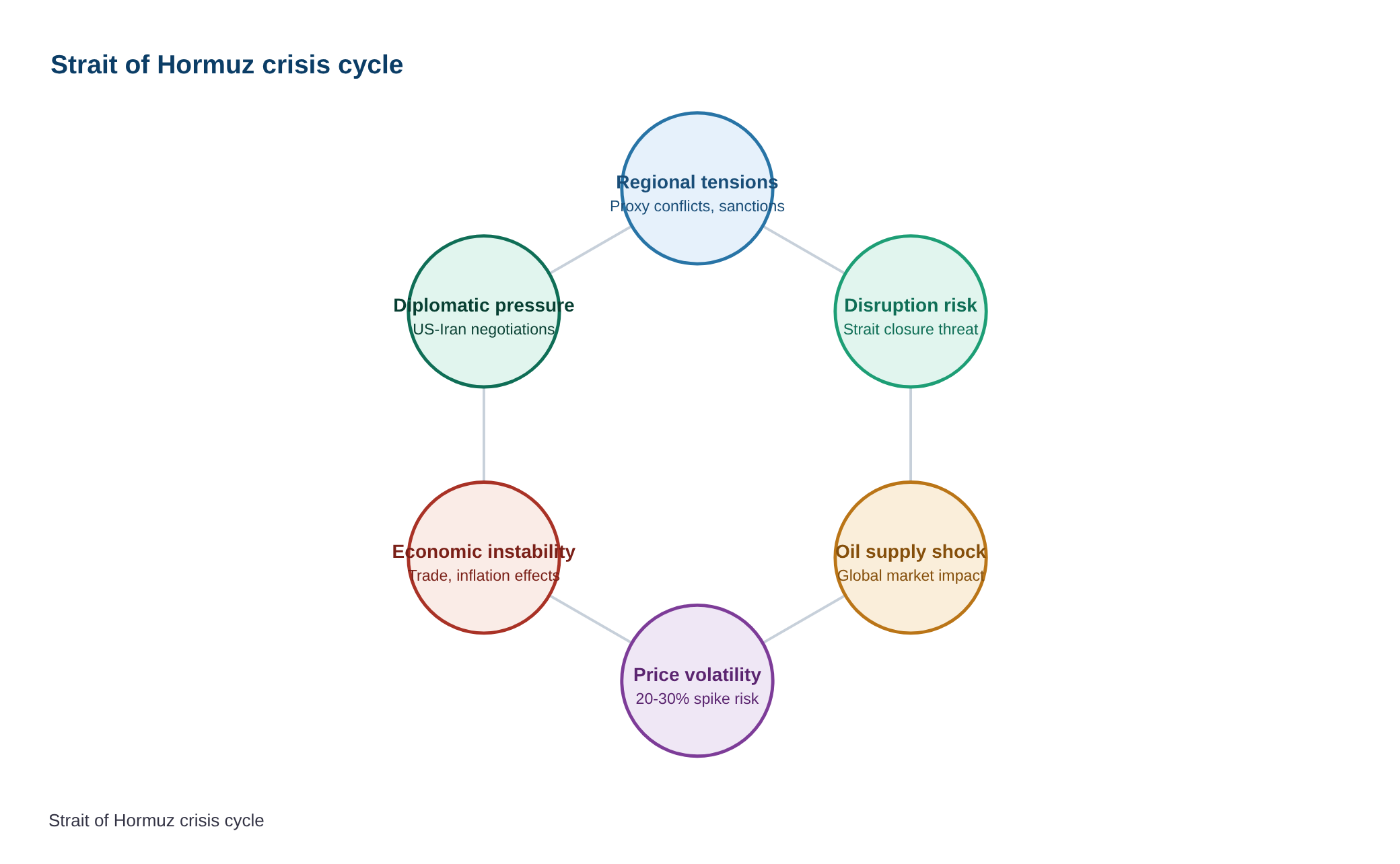
Regional tensions (proxy conflicts, sanctions) → Disruption in Strait of Hormuz → Global oil supply shock → Energy price volatility → Economic instability → Diplomatic negotiations → Conditional reopening proposal → Regional spillover risks → Multilateral governance challenges.
Prelims Practice Questions
Q1. Consider the following statements regarding the Strait of Hormuz:
1. It connects the Persian Gulf with the Gulf of Oman.
2. It is a critical chokepoint for global oil shipments.
3. The strait lies entirely within the territorial waters of Iran.
4. The United Nations Convention on the Law of the Sea (UNCLOS) guarantees the right of innocent passage through straits used for international navigation.
How many of the above statements are correct?
- Only one
- Only two
- Only three
- All
Answer: All — Statements 1, 2, and 4 are correct. Statement 3 is incorrect as the Strait of Hormuz is bordered by Iran and Oman, and its waters are not entirely within Iran’s territorial limits.
Q2. Assertion (A): The Strait of Hormuz is governed by the principle of ‘transit passage’ under the United Nations Convention on the Law of the Sea (UNCLOS).
Reason (R): UNCLOS grants ships of all states the freedom to navigate through straits used for international navigation, provided such passage is continuous and expeditious.
Options:
A. Both A and R are true, and R is the correct explanation of A.
B. Both A and R are true, but R is not the correct explanation of A.
C. A is true, but R is false.
D. A is false, but R is true.
- A
- B
- C
- D
Answer: A — Both the assertion and reason are correct. The principle of ‘transit passage’ under UNCLOS (Article 38) indeed grants ships the freedom to navigate through straits used for international navigation, including the Strait of Hormuz, as long as the passage is continuous and expeditious.
Q3. Which of the following is NOT a condition typically associated with the concept of ‘freedom of navigation’ in international maritime law?
- The right of innocent passage through territorial seas
- The right of transit passage through straits used for international navigation
- The right of ships to engage in espionage activities within the exclusive economic zone
- The right of overflight by aircraft over the high seas
Answer: The right of ships to engage in espionage activities within the exclusive economic zone — The right of ships to engage in espionage activities within the exclusive economic zone is not recognized under international maritime law. Freedom of navigation does not extend to activities like espionage, which are prohibited under UNCLOS.
Mains Practice Question
✍ The Strait of Hormuz, a critical maritime chokepoint, has been the subject of heightened geopolitical tensions in recent times. Critically examine the legal and geopolitical dimensions of the freedom of navigation in the Strait of Hormuz, with reference to the United Nations Convention on the Law of the Sea (UNCLOS). Also, analyse the implications of unilateral sanctions and diplomatic negotiations on regional stability in West Asia. (15 Marks)
Approach: MODEL-ANSWER SKELETON:
1. **Legal Framework (UNCLOS)**:
– Define the Strait of Hormuz and its geostrategic importance.
– Explain the principles of ‘innocent passage’ (Article 17) and ‘transit passage’ (Article 38) under UNCLOS.
– Highlight Article 38(2) on the right of transit passage through straits used for international navigation.
– Cite relevant case law, such as the *Corfu Channel Case* (ICJ, 1949) on freedom of navigation.
2. **Geopolitical Dimensions**:
– Discuss the role of the Strait of Hormuz in global energy security (e.g., 20% of global oil shipments pass through it).
– Analyse the impact of unilateral sanctions (e.g., US sanctions on Iran) on maritime security and diplomatic relations.
– Examine the role of regional actors (e.g., Iran, Oman, Saudi Arabia) and external powers (e.g., US, UK) in maintaining or disrupting stability.
3. **Diplomatic Negotiations and Regional Stability**:
– Outline the recent diplomatic efforts (e.g., US-Iran talks, UK’s role) to resolve tensions.
– Discuss the challenges posed by unilateral actions (e.g., sanctions, military posturing) to multilateral frameworks like UNCLOS.
– Evaluate the consequences of prolonged disruption in the Strait of Hormuz on global trade, energy prices, and regional alliances.
4. **Conclusion**:
– Summarise the balance between national security interests and international legal obligations.
– Argue for the necessity of multilateral cooperation to uphold freedom of navigation and regional stability.
Source: Times of India
Generated by AanyaAi for educational purpose.
Related guides on our sites
- Current affairs for upsc 2026
- Best PSIR optional coaching for upsc
- Best economics optional coaching for upsc
- Best PSIR optional teacher for upsc

- Iran Sets 6-Day Deadline for US to Reopen Strait of Hormuz: Key Facts for UPSC - September 25, 2026
- परमाणु ऊर्जा: जलवायु संकट का नया समाधान बन रही है? - September 25, 2026
- Nuclear Energy’s Role in India’s 2047 Carbon Neutrality Target: SHANTI Act 2025 Explained - September 25, 2026

No Comments