


11 May Iran Threatens Undersea Internet Cables at Hormuz and Red Sea
This article covers “Daily Current Affairs”
SYLLABUS MAPPING : GS Paper 2,3 : IR, Economy, Security
FOR PRELIMS : Undersea Cables , Key Cables at Risk , International Law
FOR MAINS : “The Iran-Hormuz cable crisis of 2026 has exposed a fundamental gap in the global governance of critical digital infrastructure — the world has no binding multilateral framework to protect undersea cables from state-sponsored sabotage or coercion.” Evaluate the existing international legal framework governing undersea cables, the gaps it reveals, and the institutional reforms needed to protect the digital commons. (15 M)
Why in News?
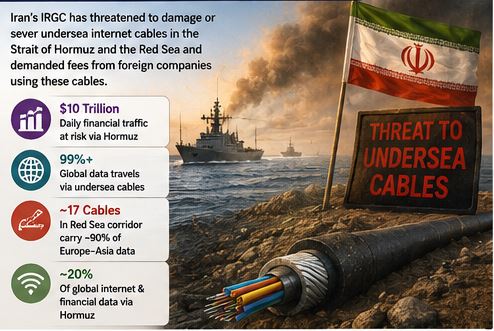
In May 2026, Iran’s Islamic Revolutionary Guard Corps (IRGC) and IRGC-linked state media have explicitly threatened to damage or sever undersea internet cables passing through the Strait of Hormuz and the Red Sea — two of the world’s most critical maritime chokepoints for global internet infrastructure. Iran’s state-run Tasnim News Agency published an article titled “Practical Measures for Revenue Generation Through Hormuz Strait Internet Cables,” in which the IRGC demanded that foreign companies — including Meta, Amazon, and Microsoft — pay licensing fees and annual “protection payments” to use cables passing through Iranian-claimed seabed. Iran described the Strait as a “hidden highway” whose sovereign benefits have been denied to Iran. These threats emerge amid a 72-day naval standoff with the United States following the US-Iran conflict that began in February 2026, during which the IRGC formally closed the Strait of Hormuz to commercial traffic — an event that has simultaneously imperilled both the world’s oil trade and its invisible internet backbone. The Strait of Hormuz alone carries approximately 20% of global internet and financial data traffic — equivalent to $10 trillion in daily financial transactions.
What Are Undersea Cables? — The Invisible Backbone of the World
Despite the popular image of wireless internet and satellites, over 99% of all international internet data — emails, cloud files, video calls, banking transactions, stock trades, and AI computations — travels through thin fibre-optic cables laid on the ocean floor. These cables, often no thicker than a garden hose, form the true circulatory system of the global economy. Satellites carry less than 1% of international data traffic because of high latency and limited bandwidth.
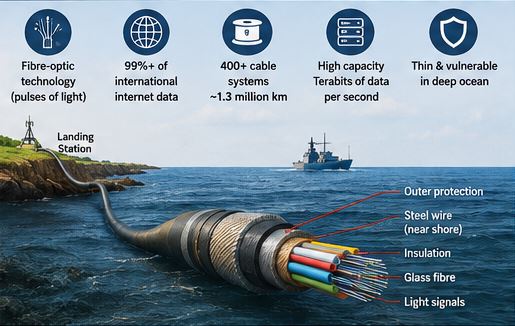
- Modern submarine cables usefibre-optic technology— pulses of light transmitted through glass strands at near the speed of light, enabling terabits of data per second per cable
- Cables are armoured in shallow waters (steel wire sheathing) but thin and relatively unprotected in deep ocean — the outer diameter is typically25mm in deep water, thicker near shore
- The global undersea cable network consists ofover 400 cable systemsspanning approximately 1.3 million kilometres — enough to wrap the Earth 30 times
- Most cables are owned byconsortia of telecom companies and tech giants— Google, Meta, Amazon, Microsoft are now among the largest private cable investors globally
- Cables are highly vulnerableat chokepoints — narrow maritime passages where geographic constraints force dozens of separate systems to converge within a few kilometres of each other
- Repair is extremely slow: a typical cable cut takesweeks to months to fix— ships must locate the exact fault, retrieve the cable from the ocean floor, and splice in a new section
The Two Chokepoints — Hormuz and Red Sea
Strait of Hormuz
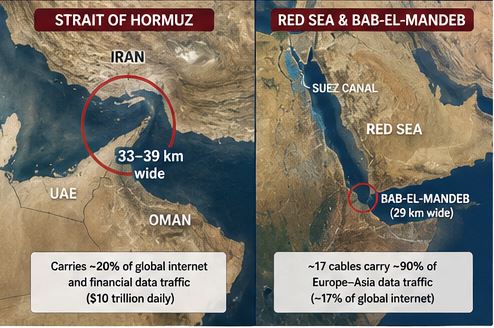
The Strait of Hormuz is a narrow waterway — just 33–39 km wide at its narrowest — separating Iran from the Sultanate of Oman and the UAE. It is the world’s most critical energy chokepoint (roughly 20% of global oil trade passes through it), but it is equally vital to the invisible architecture of the internet. Seven major undersea cables — including AAE-1, FALCON, Gulf Bridge International (GBI), Tata-TGN Gulf, and SMW-5 — pass through or near the strait, carrying approximately 20% of global internet and financial data traffic, equivalent to $10 trillion in daily financial transactions.
Red Sea and Bab-el-Mandeb
The Red Sea corridor, particularly the Bab-el-Mandeb Strait at its southern end (just 29 km wide), funnels approximately 17 major submarine cables between Europe, Asia, and Africa. These cables carry roughly 90% of communications between Europe and Asia — and approximately 17% of all global internet traffic. Both chokepoints have now been simultaneously closed or threatened for the first time in recorded history, creating what analysts describe as the most serious stress test the global internet has ever faced.
Key Cables at Risk — Full Technical Profile
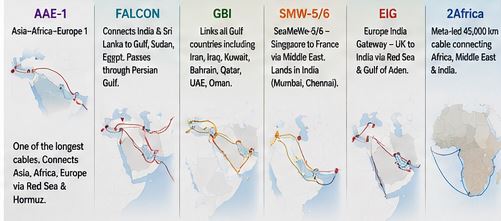
One of the world’s longest and most important cable systems, connecting Southeast Asia to Europe via Egypt, with landing points in UAE, Oman, Qatar, Saudi Arabia, Pakistan, India, and multiple African countries. Passes through both the Red Sea and the Strait of Hormuz corridor. Already severed once in the Red Sea by Houthi attacks in February 2024, taking months to repair.
Connects India and Sri Lanka to Gulf countries, Sudan, and Egypt. Critically important for India’s data traffic to the Middle East and Europe. Passes through the Persian Gulf and is directly in the zone of Iranian cable control demands.
Links all Gulf countries including Iran, Iraq, Kuwait, Bahrain, Qatar, UAE, and Oman. Critically, this is the cable system that Iran has most direct sovereign claims over, given its landing stations inside Iranian territory. Central to Iran’s leverage narrative.
Two of the world’s longest submarine cable systems connecting Singapore to France via the Middle East. SMW-6 (21,700 km) includes consortium members from Bangladesh, India, Pakistan, Sri Lanka, UAE, Oman, Qatar, and Egypt. Both route through Red Sea waters. SMW-6 landed at Chennai and Mumbai in 2024, making it directly relevant to India’s connectivity.
Connects the UK to India via the Red Sea and Gulf of Aden. Severed in the Red Sea incident of February 2024 alongside AAE-1 and Seacom — disrupted nearly 25% of internet traffic between Asia, Europe, and the Middle East at the time.
A landmark45,000-km cable systembacked by Meta, connecting Africa, the Middle East, and South Asia — including India via the 2Africa Pearls extension through Oman, UAE, Qatar, Pakistan, and India. Already completed its core infrastructure by November 2025, butRed Sea landings delayed due to regional instability (force majeure declared March 2026).
Iran’s Legal Claims vs. International Law — UNCLOS Analysis
| UNCLOS Provision / Principle | What It Provides | Iran’s Position / Claim | Prevailing International Law View |
|---|---|---|---|
| Article 58 — Freedom of the High Seas | Within the Exclusive Economic Zone (EEZ) and beyond, all states enjoy freedoms including the laying and maintenance of submarine cables | Iran argues that this freedom does not apply within what it considers its sovereign seabed jurisdiction in the Strait of Hormuz | Generally rejected — international law recognises submarine cable laying and maintenance as a protected freedom of the seas |
| Article 79 — Rights over the Continental Shelf | A coastal state may not impede the laying or maintenance of submarine cables on the continental shelf | Iran contends that its “regulatory authority” overrides these freedoms | Rejected — Article 79 expressly limits coastal-state interference with submarine cables |
| Article 38 — Transit Passage | Ships and aircraft of all states enjoy the right of transit passage through straits used for international navigation | Iran argues that transit passage rights do not extend to cable infrastructure or repair operations | Not widely supported — transit passage is interpreted broadly, and cable repair vessels have historically been treated as entitled to access |
| Article 113 — Protection of Submarine Cables | States are obligated to criminalise wilful or negligent breaking or damage to submarine cables | Iran has not substantially addressed this obligation in its arguments | Binding upon signatories to United Nations Convention on the Law of the Sea — deliberate cable damage would violate Article 113 |
| Customary International Law (1884 Paris Convention Legacy) | The freedom to lay, maintain, and repair submarine cables has existed as an international norm since the 1884 convention regime | Iran argues that the 19th-century framework is outdated and requires renegotiation | Broadly rejected — the principle has evolved into customary international law, and unilateral reinterpretation is not accepted internationally |
Iran’s Strategy — Hybrid Warfare and Asymmetric Leverage
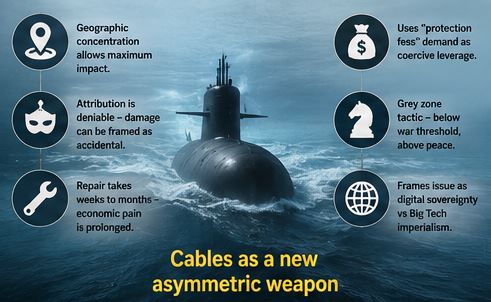
Iran’s cable threat is best understood as a new hybrid warfare instrument — using critical infrastructure as a coercive tool in a confrontation where direct conventional military engagement with the United States carries unacceptable escalation risks. This mirrors how Iran has previously weaponised the Strait of Hormuz oil transit threat as a deterrent — for decades, the closure was a rhetorical weapon; the 2026 actual closure shocked even Tehran’s own strategists.
Geographic concentration at chokepoints means a single cut can disrupt dozens of countries simultaneously. Cables are physically accessible from submarines, divers, or anchor dragging. Repair time is measured in months, not days. Attribution is deniable — cable damage can be framed as accidental
The Hormuz seabed technically lies within Iran’s continental shelf jurisdiction — this gives Tehran a legally ambiguous but operationally real position of control. The “protection fees” demand mirrors mafia-style extortion but wrapped in sovereignty language — making it harder for the West to respond without escalating
IRGC media explicitly framed cables as a revenue source Iran has been denied. By naming Google, Meta, and Microsoft as fee payers, Iran repositions the conflict as one of digital sovereignty vs. Big Tech imperialism — a frame designed to attract sympathy in the Global South
Cable threats sit precisely in the grey zone between peace and war. A deliberate severance would trigger enormous economic damage but may not meet the threshold for a conventional military response — giving Iran deniable coercive leverage without crossing a clear war-line
Global Impact — Two Syndromes of Cable Disruption
| Feature | Red Sea Cable Disruption Scenario | Strait of Hormuz Cable Disruption Scenario |
|---|---|---|
| Cables affected | ~17 cables including AAE-1, SMW-4, IMEWE, EIG, and Seacom | ~7 cables including AAE-1 Gulf branch, FALCON, GBI, Tata-TGN Gulf, and SMW-5 |
| Estimated traffic share at risk | ~90% of Europe–Asia data traffic; ~17% of global internet traffic | ~20% of global internet traffic; financial flows linked to nearly $10 trillion in daily transactions |
| Primary impacted regions | Europe, South Asia, East Africa, and the Middle East | Gulf states, India, South Asia, and Southeast Asia–Europe connectivity corridors |
| Financial sector impact | Increased latency in SWIFT payments, stock exchange operations, and cloud-based financial services | Major disruption to Gulf financial hubs such as Dubai International Financial Centre and Abu Dhabi Global Market; real-time trading systems heavily affected |
| Repair complexity | Politically difficult due to conflict zones and Houthi-controlled waters near Yemen; repairs could take months | Repairs effectively impossible during an active Islamic Revolutionary Guard Corps closure scenario; legal access to waters disputed |
| Prior real-world incident | February 2024: AAE-1, EIG, and Seacom cables severed; September 2025: SMW-4 and IMEWE disruptions reported | February 2026: Iranian-linked attacks on UAE data infrastructure; submarine cable threats escalated |
| Big Tech exposure | Google, Meta, and Amazon Europe–Asia data routes significantly affected | UAE- and Bahrain-based infrastructure of Google, Meta, and Amazon directly exposed to disruption risks |
India’s Exposure — The Digital Lifeline at Risk
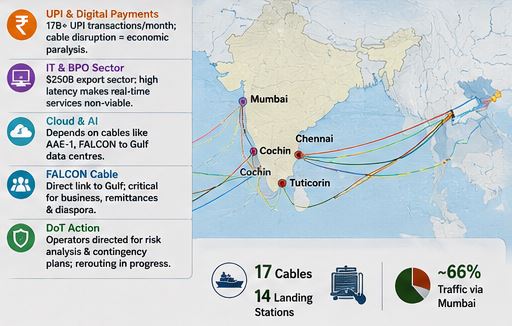
India is among the countries most directly exposed to the Hormuz-Red Sea cable crisis. India hosts 17 international submarine cables across 14 landing stations in Mumbai, Chennai, Cochin (Kochi), Tuticorin, and Thiruvananthapuram. Approximately two-thirds of India’s international internet traffic is concentrated through Mumbai alone — creating a severe single-point-of-failure vulnerability.
- UPI and digital payments:India processes over 17 billion UPI transactions per month; real-time settlement relies on international data routing. Extended cable disruption could introduce latency or outages in payment systems, triggering economic paralysis
- IT and BPO sector:India’s $250 billion IT export sector depends on low-latency data links to US and European clients. A significant cable outage would force traffic rerouting through satellite (higher latency) — making real-time services like financial analytics and AI processing non-viable
- Cloud and AI:India’s growing cloud adoption (AWS, Azure, Google Cloud) relies on cables like AAE-1 and FALCON for connectivity to Gulf-hosted data centres. Major cloud providers already noted increased latency after the September 2025 Red Sea cuts
- FALCON specifically:This cable directly connects India to Gulf countries — its disruption would most immediately affect India-Gulf business, remittance flows, and the Gulf’s 9 million-strong Indian diaspora’s communication links
- DoT action:India’s Department of Telecommunications (DoT) directed telecom operators and cable firms to conduct a risk analysis and prepare contingency plans — Airtel, Jio, and Tata Communications have already begun rerouting protocols
- India’s opportunity:Diversification pressure is accelerating India’s case as an alternative cable route — the Chennai-Singapore route and the proposed India-Pacific cable routes are now being discussed as long-term resilience investments
Global Governance — What Protects Undersea Cables?
- 1884 Paris Convention for the Protection of Submarine Telegraph Cables— the oldest international treaty protecting cables; prohibits wilful or negligent breaking; does not cover modern fibre-optic systems adequately
- UNCLOS (1982) — Articles 79, 113, 114, 115— prohibits impeding cable laying on continental shelves; makes wilful cable damage a criminal offence; obliges states to prosecute perpetrators; but enforcement depends on cooperation of the territorial state
- No dedicated UN treaty on subsea cable protection— a critical gap; cables are technically civilian infrastructure but treated as strategic military targets in grey-zone conflicts
- No equivalent of NATO Article 5 for cable attacks— there is no binding multilateral mutual defence clause that treats cable severance as an act of war triggering collective response
- Cable repair ships are unarmed and slow— they require safe passage into conflict zones; no legal framework compels belligerents to allow repair operations during active conflict
- NATO Critical Undersea Infrastructure Coordination Cell (2023)— created to coordinate surveillance and protection of cables in the North Atlantic; no equivalent exists for the Indo-Pacific or Middle East
Prelims Question
Q. With reference to undersea internet cables and the recent Iran-Hormuz cable crisis (2026), consider the following statements:
1. Over 99% of international internet and financial data is transmitted through undersea fibre-optic cables, with satellites carrying less than 1% of international traffic.
2. UNCLOS Article 79 explicitly permits coastal states to impose licensing fees and block the laying or maintenance of submarine cables on their continental shelf as an exercise of sovereignty.
3. The FALCON cable system is significant for India as it directly connects India and Sri Lanka to Gulf countries, Sudan, and Egypt.
4. In February 2024, Houthi attacks on a commercial vessel in the Red Sea resulted in the accidental severing of three major undersea cables — AAE-1, EIG, and Seacom — disrupting approximately 25% of Asia-Europe internet traffic.
Which of the statements given above are correct?
Mains Questions

- India’s Youth Unemployment and Education Crisis - August 5, 2026
- India’s Sports Infrastructure and the 2036 Olympics Ambition - August 5, 2026
- Critical Minerals: The Foundation of Strategic Power - August 4, 2026

No Comments