


23 Mar Iran’s War Windfall: Energy, Economy and Geopolitical Resilience
This article covers “Daily Current Affairs” and From Iran’s War Windfall: Energy, Economy and Geopolitical Resilience
SYLLABUS MAPPING
GS- 2- International Relations- Iran’s War Windfall: Energy, Economy and Geopolitical Resilience
FOR PRELIMS
What is meant by the term “war windfall”?
FOR MAINS
What are the challenges faced by Iran’s economy even after increased oil revenues?
Why in the News?
The ongoing global geopolitical instability, particularly in West Asia and Eastern Europe, has led to a significant surge in global energy prices. This shift has created an unexpected “war windfall” for major energy exporters like Iran, allowing them to bypass the intended effects of international sanctions and bolster their domestic and military sectors.
Defining the Concept: The ‘War Windfall’
In the context of international political economy, a war windfall refers to the disproportionate economic gains accrued by resource-rich nations due to commodity price spikes—primarily oil and gas—triggered by global conflicts. For Iran, this phenomenon represents a critical lifeline, enabling the state to maintain fiscal stability despite being largely decoupled from the global financial system.
Oil and Gas Sector
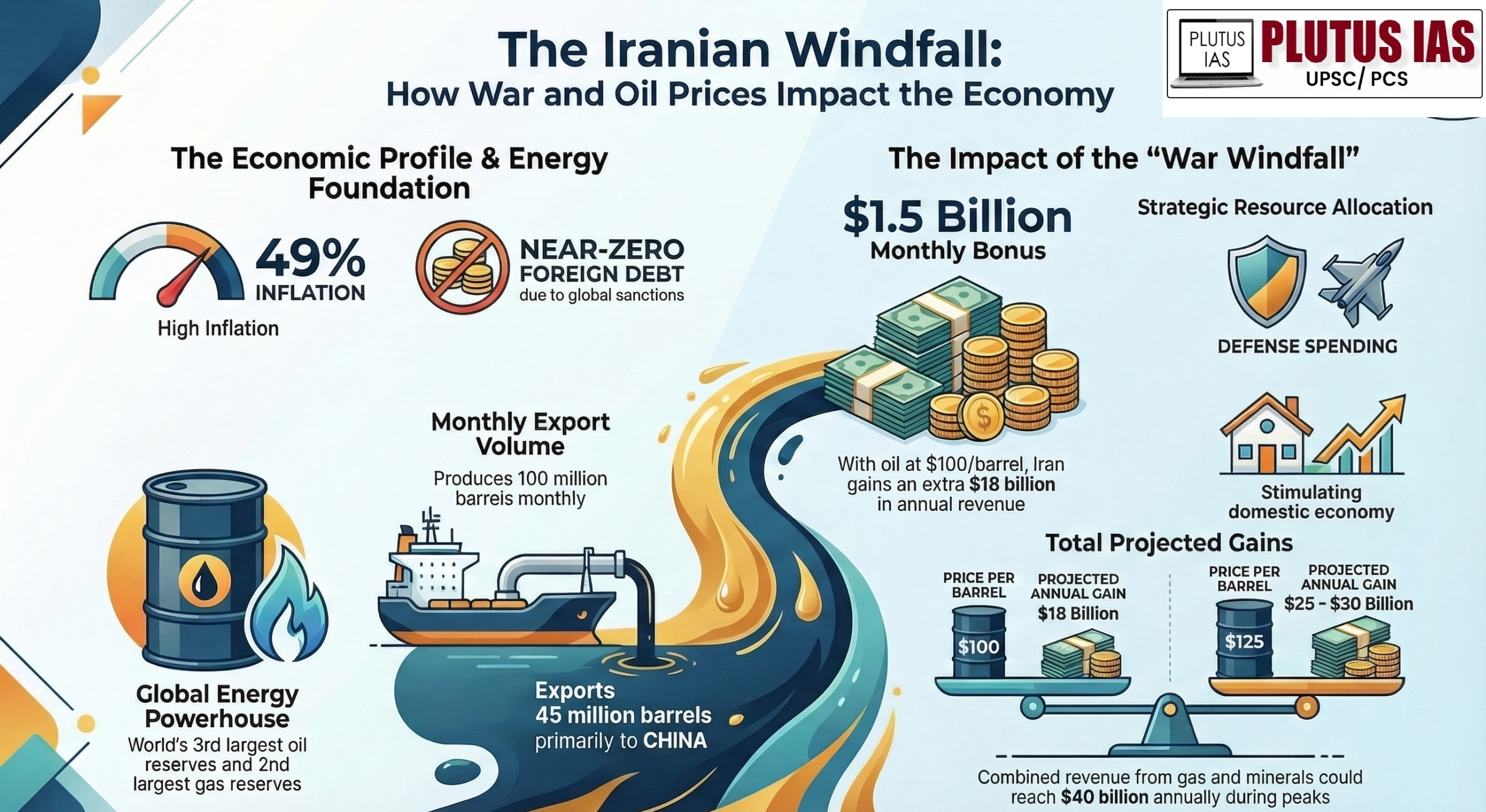
1. Oil Production: Iran produces nearly 100 million barrels of oil each month, of which around 45 million barrels are exported, largely to China.
2. Oil Reserves: With about 208.6 billion barrels of proven reserves, Iran ranks among the top three oil-rich nations globally .
3. Gas Reserves: The country also possesses approximately 1,200 trillion cubic feet of natural gas reserves, making it the second-largest globally, with exports mainly directed to Turkey and Iraq.
Economic Landscape under Sanctions
1. GDP: Approximately $375 billion
2. Per Capita GDP: Around $4,000
3. Inflation: Approximately 49%
4. Debt-to-GDP Ratio: About 30%, with near-zero foreign debt due to sanctions
Economic Impact of the War
1. At an oil price of $100 per barrel, Iran earns roughly $1.5 billion extra each month, adding up to about $18 billion annually.
2. If prices remain around $125 per barrel, the additional yearly income could rise to $25–30 billion, amounting to nearly $50–60 billion over two years.
3. When revenues from natural gas and mineral exports are included, the total additional earnings are estimated at $35–40 billion per year.
Key Challenges
1. Inflationary Pressures: While oil revenue grows, the 49% inflation rate continues to erode the purchasing power of the average citizen.
2. Sanction Rigidity: Despite the windfall, Iran remains excluded from mainstream international banking, complicating the long-term conversion of oil wealth into sustainable infrastructure.
3. Over-reliance on China: The heavy dependence on a single primary buyer for oil exports creates a strategic vulnerability in Iran’s trade portfolio.
Way Forward: A Strategic Roadmap
1. Diversification of Trade (The Indian Perspective): From a regional standpoint, India’s engagement with Iran—particularly through the Chabahar Port and the International North-South Transport Corridor (INSTC)—could provide Iran with trade alternatives while securing India’s access to Central Asia (Note: This is external to the sources but relevant for UPSC context).
2. Global Energy Transition: To mitigate the “war windfall” effect, the international community must accelerate the transition to renewable energy, reducing the global economy’s sensitivity to oil price shocks caused by conflict.
3. Diplomatic Re-engagement: Addressing the root causes of sanctions through renewed nuclear and regional security frameworks is essential to integrate Iran’s scientific and economic potential into the formal global order.
Conclusion
The Iranian case study demonstrates how resource wealth and “frugal engineering” can create resilience in the face of maximum pressure. However, for a future aligned with Sustainable Development Goal 16 (Peace, Justice, and Strong Institutions), the world must move toward an economic model where prosperity is not tied to the volatility of war. As India marches toward Viksit Bharat 2047, understanding these complex energy-security linkages will be vital for maintaining strategic autonomy and ensuring inclusive, stable growth in an increasingly multipolar world.
Best ias coaching in delhi Best ias coaching in chandigarh
Prelims question:
Q. Consider the following statements regarding Iran’s economy and energy sector:
1. Iran has the second-largest natural gas reserves in the world.
2. Iran exports the majority of its oil primarily to European countries.
3. Rising global oil prices due to conflicts can increase Iran’s revenue despite sanctions.
Which of the statements given above is/are correct?
(a) 1 and 3 only
(b) 2 and 3 only
(c) 1 only
(d) 1, 2 and 3
Answer: A
Q. The phenomenon of “war windfall” highlights the complex relationship between global conflicts and energy economics. In the context of Iran, examine how rising oil prices amid geopolitical instability influence its economy and strategic behavior. Also discuss the broader global implications.
(250 words)

- RBI’s Shrinking Real-Rate Cushion Amid Rising Inflation and Strong Demand - September 21, 2026
- India’s NGOs at a New Funding Crossroads - September 21, 2026
- Deep-Sea Discovery, Environmental Responsibility - September 19, 2026

No Comments