


13 Oct Israel–Hamas Peace Deal: A New Hope for Lasting Peace and Reconstruction in Gaza
This article covers “Daily Current Affairs” and the Topic Israel–Hamas Peace Deal: A New Hope for Lasting Peace and Reconstruction in Gaza.”
SYLLABUS MAPPING:
GS -2- International Relations- Israel–Hamas Peace Deal: A New Hope for Lasting Peace and Reconstruction in Gaza”
FOR PRELIMS
What are the key challenges in implementing the Israel–Hamas peace agreement?
FOR MAINS
What are the main problems in making the peace deal work?
Why in the News?
The United Kingdom has announced it will host an international summit on Gaza’s recovery and reconstruction as part of global efforts to secure lasting peace after years of conflict. The move comes ahead of a multi-nation peace conference in Egypt’s Sharm el-Sheik, attended by UK Prime Minister Keir Starmer and former U.S. President Donald Trump, to finalize a truce and plan Gaza’s rebuilding. The UK has also redirected £20 million in aid toward water, sanitation, and hygiene projects in Gaza, to be delivered through UNICEF, the World Food Programme, and the Norwegian Refugee Council.
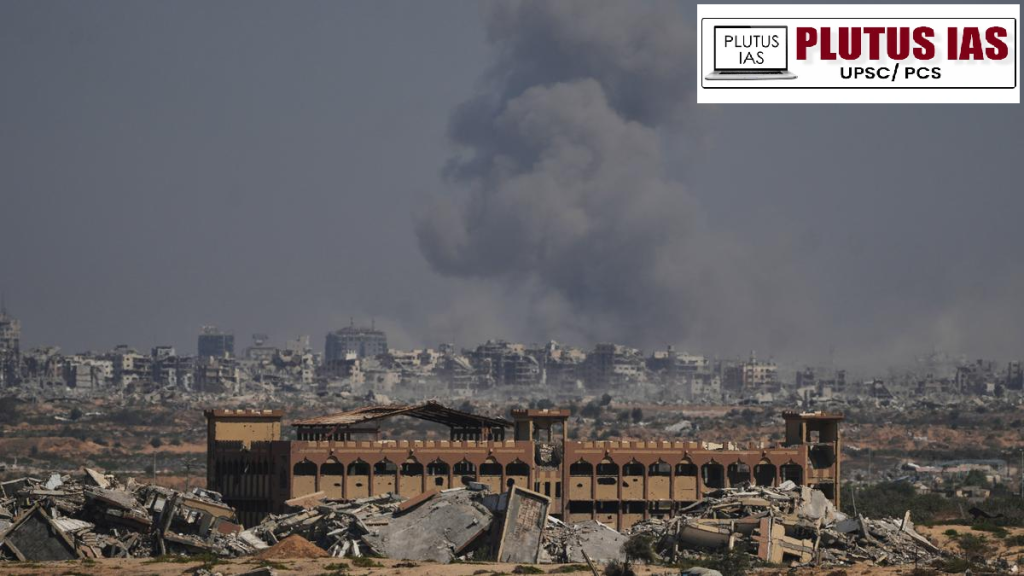
Background of the Conflict
The Israel–Hamas war, which erupted on October 7, 2023, following Hamas’s large-scale attacks on Israeli territory, has led to immense destruction and humanitarian suffering in Gaza. Israel’s military response resulted in widespread casualties, displacement, and infrastructure collapse.
Over the past two years, several international attempts — including those by Egypt, Qatar, and the United Nations — failed to achieve a lasting ceasefire, largely due to disagreements over hostages, border control, and political authority in Gaza.
Details of the Peace Plan
1. Ceasefire: A temporary halt in hostilities between Israel and Hamas to create conditions for humanitarian relief and negotiations.
2. Hostage–Prisoner Exchange:
Hamas will release 20 living Israeli hostages.
Israel will free 2,000 Palestinian prisoners, including 250 serving life sentences and 1,700 others detained since October 2023.
The exchange will take place within 72 hours of the agreement’s activation.
3. Humanitarian Access: The truce will allow the entry of aid, water, and medical supplies into Gaza through international agencies such as the World Food Programme, UNICEF, and the Norwegian Refugee Council.
4. Next Phases: The deal is designed as a multi-phase peace process, with future stages expected to address Gaza’s reconstruction, governance reforms, and long-term regional security guarantees.
International Mediation and Role of Key Players
1. United States: Led diplomatic efforts; President Trump called the truce a “decisive step toward permanent peace.”
2. Egypt: Hosted preparatory meetings in Sharm el-Sheikh; facilitated dialogue between Israel, Hamas, and global leaders.
3. United Kingdom: Announced a West Sussex summit for Gaza’s recovery; reaffirmed global commitment to reconstruction.
4. Qatar: Supported humanitarian engagement and diplomatic coordination with both sides.
5. Over 20 Countries: Participated in peace talks to ensure a multilateral approach to the truce.
6. International Financial Institutions: Included to aid reconstruction, governance reforms, and funding.
7. NGOs and UN Agencies: Coordinated humanitarian assistance and ensured effective aid delivery.
UK’s Humanitarian and Reconstruction Support
The UK government has pledged £20 million in redirected aid to focus on water, sanitation, and hygiene (WASH) services in Gaza. This assistance will be channelled through UNICEF, the World Food Programme (WFP), and the Norwegian Refugee Council.
In addition, the UK Foreign Office’s Wilton Park agency will host a three-day conference with participation from the Palestinian Authority, Saudi Arabia, Jordan, Germany, Italy, and major financial institutions such as the World Bank and the European Bank for Reconstruction and Development (EBRD) to discuss Gaza’s long-term reconstruction strategy.
Significance of the Agreement
1. Humanitarian Relief: The ceasefire will enable the flow of critical supplies and medical assistance to millions of civilians in Gaza who have been living under siege conditions.
2. Confidence-Building Measure: The exchange of hostages and prisoners is expected to build trust and open the door for sustained peace negotiations.
3. Diplomatic Breakthrough: After months of failed ceasefire attempts, this deal marks the first concrete step toward ending the Gaza war.
4. Regional Stability: A truce in Gaza could ease tensions in the broader Middle East, particularly in Lebanon, Syria, and the Red Sea region, where the conflict has had spillover effects.
Challenges Ahead
1. Fragile Trust: Deep-seated mistrust between Israel and Hamas may threaten the sustainability of the truce.
2. Internal Politics: Both sides face domestic political pressures that may limit flexibility in further negotiations.
3. Exclusion of Hamas from Governance Talks: The UK and other Western nations have emphasised “no role for Hamas” in Gaza’s reconstruction, which could complicate implementation on the ground.
4. Reconstruction Funding: Rebuilding Gaza will require substantial financial commitments and transparent governance, which remain uncertain.
Way Forward
1. Empower the Palestinian Authority: Strengthen Gaza’s governance and institutional capacity to effectively manage reconstruction, public services, and security.
2. Ensure Humanitarian Access: Facilitate timely delivery of food, water, medical aid, and sanitation services while protecting civilians under international humanitarian law.
3. Promote Inclusive Dialogue: Engage regional powers, international organizations, and local stakeholders to foster political consensus and prevent marginalization of key actors.
4. Monitor Ceasefire Compliance: Establish independent verification mechanisms to ensure adherence to the truce and build confidence between parties.
5. Oversee Aid Distribution: Implement transparent systems to manage funds, resources, and reconstruction projects efficiently, preventing diversion or misuse.
6. Prevent Relapse into Violence: Address security, political, and social risks proactively through coordinated diplomacy, conflict-resolution initiatives, and early warning mechanisms.
Conclusion
The Israel–Hamas peace deal represents a historic opportunity to end one of the most devastating conflicts of recent years. While the road ahead remains uncertain, the combined efforts of global leaders — particularly the United States, the United Kingdom, and Egypt — reflect a renewed international determination to achieve a lasting peace and rebuild Gaza. For the millions affected, this moment offers a glimmer of hope that diplomacy can triumph over destruction.
Prelims question:
Q. With reference to the recent international peace efforts in Gaza, consider the following statements:
1. The United Kingdom will host an international summit on Gaza’s recovery and reconstruction in West Sussex.
2. The first phase of the peace plan includes a temporary ceasefire and an exchange of hostages and prisoners between Israel and Hamas.
3. The United Kingdom’s aid for Gaza will be delivered through agencies such as UNICEF, the World Food Programme, and the Norwegian Refugee Council.
Which of the statements given above is/are correct?
(a) 1 and 2 only
(b) 2 and 3 only
(c) 1 and 3 only
(d) 1, 2 and 3
Answer: D
Mains Question:
Q. “The Israel–Hamas peace deal marks a crucial step toward ending one of the most protracted conflicts in recent history.” Discuss the significance of the agreement, the role of international mediation, and the challenges that lie ahead.
(250 words)

- RBI’s Shrinking Real-Rate Cushion Amid Rising Inflation and Strong Demand - September 21, 2026
- India’s NGOs at a New Funding Crossroads - September 21, 2026
- Deep-Sea Discovery, Environmental Responsibility - September 19, 2026

No Comments