


08 Aug Jagat Prakash Nadda chairs CEO Roundtable on India Medical Device 2026
✎ Evidence-based decision-making, transparent HTA frameworks, and sustainable reimbursement mechanisms are essential for scaling up innovative medical technologies and achieving Universal Health Coverage in India.
Subject Relevance — Where This Topic Fits
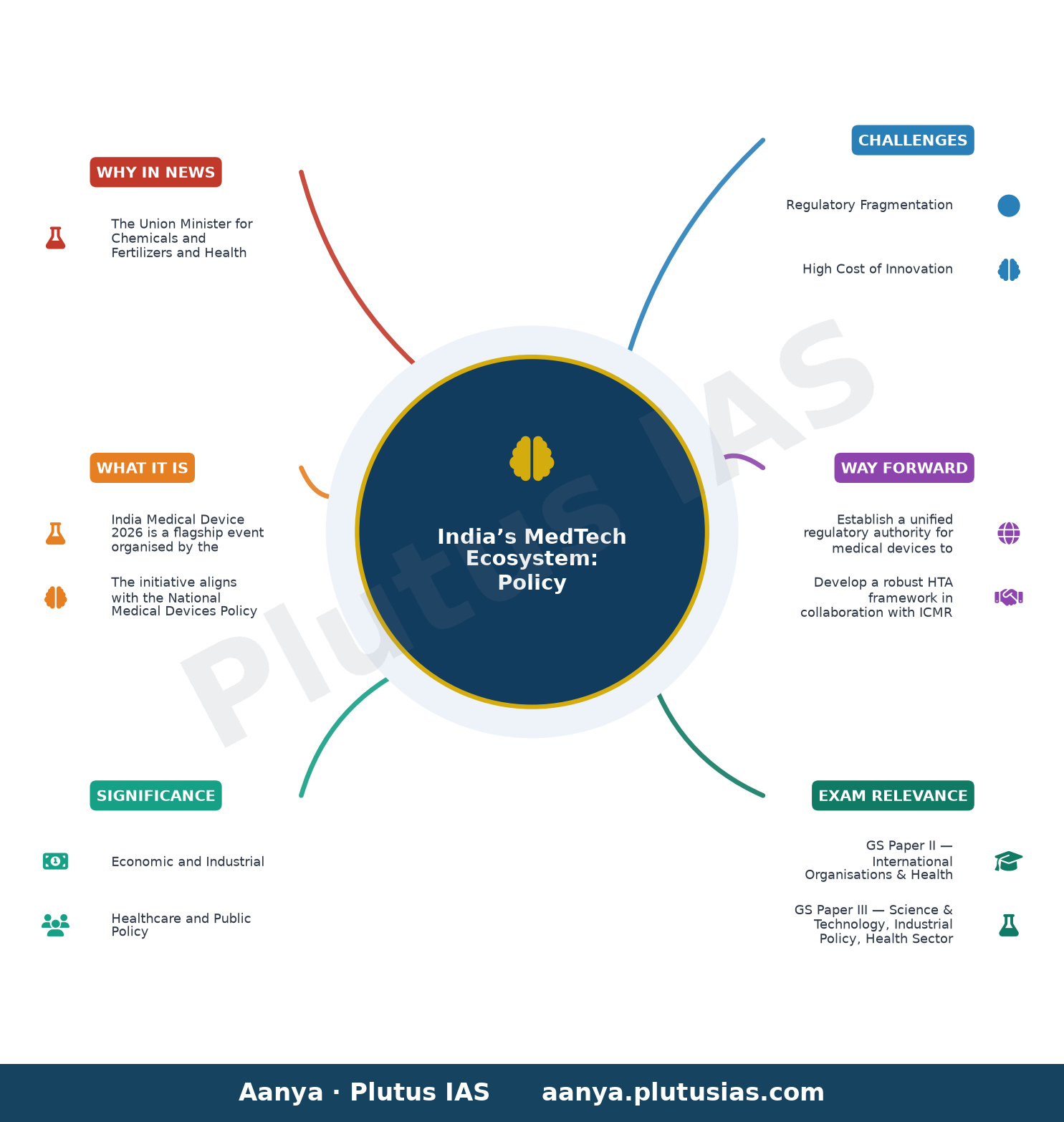
- GS Paper II — International Organisations & Health Diplomacy | GS Paper III — Science & Technology, Industrial Policy, Health Sector Reforms
- Prelims: Medical Devices Rules, 2017, Production-Linked Incentive (PLI) Scheme for Medical Devices, National Medical Devices Policy 2023, Health Technology Assessment (HTA) in India, Universal Health Coverage (UHC), ICMR, NITI Aayog, DPIIT, FICCI Medical Devices Committee
- Essay: The intersection of innovation and equity in healthcare: Lessons from India’s MedTech sector, Public-private partnerships as catalysts for achieving Sustainable Development Goal 3
Quick Revision: Evidence-based decision-making, transparent HTA frameworks, and sustainable reimbursement mechanisms are essential for scaling up innovative medical technologies and achieving Universal Health Coverage in India.
Why is this in the news?
The Union Minister for Chemicals and Fertilizers and Health and Family Welfare, Shri Jagat Prakash Nadda, chaired the CEO Roundtable at ‘India Medical Device 2026’ in New Delhi on 8 August 2026. The event, organised by the Department of Pharmaceuticals under the Ministry of Chemicals and Fertilizers in collaboration with FICCI, brought together senior policymakers and industry leaders to deliberate on strengthening India’s MedTech ecosystem, fostering innovation, enhancing domestic manufacturing, and expanding the global footprint of Indian medical device companies. The deliberations underscored the critical role of evidence-based decision-making, transparent Health Technology Assessment (HTA) frameworks, and sustainable reimbursement mechanisms in scaling up innovative medical technologies for Universal Health Coverage (UHC).
Background
- The Indian medical devices sector is valued at approximately USD 11 billion (2023) and is projected to grow at a CAGR of 15-20%, driven by rising healthcare demand, increasing prevalence of chronic diseases, and government initiatives such as the Production-Linked Incentive (PLI) Scheme for medical devices.
- The National Medical Devices Policy, 2023, aims to position India as a global hub for manufacturing high-quality, affordable medical devices by promoting innovation, research and development, and ease of doing business.
- The Medical Devices Rules, 2017, regulate the manufacture, import, sale, and distribution of medical devices in India, categorising them into four risk-based classes (Class A to D) to ensure patient safety and quality standards.
- India’s healthcare expenditure remains low at around 3.5% of GDP, necessitating efficient resource allocation, evidence-based procurement, and robust reimbursement frameworks to achieve Universal Health Coverage (UHC) under Sustainable Development Goal 3.
What is the India Medical Device 2026 initiative?
- India Medical Device 2026 is a flagship event organised by the Department of Pharmaceuticals, Ministry of Chemicals and Fertilizers, in collaboration with FICCI, to foster dialogue between policymakers, industry leaders, and global stakeholders on the future of India’s MedTech sector.
- The initiative aligns with the National Medical Devices Policy 2023, which seeks to enhance domestic manufacturing, promote innovation, and position India as a global leader in affordable, high-quality medical devices.
- The CEO Roundtable, chaired by the Union Minister, serves as a high-level platform for discussing strategic interventions to strengthen the MedTech ecosystem, including regulatory reforms, investment facilitation, and capacity-building for Micro, Small, and Medium Enterprises (MSMEs).
- The event highlights the critical role of evidence-based decision-making in healthcare, emphasising the need for robust clinical evidence, transparent HTA processes, and sustainable reimbursement mechanisms to ensure that innovative technologies deliver measurable health outcomes.
- Key discussions focus on creating a balanced reimbursement ecosystem that aligns affordability, accessibility, and financial sustainability, thereby supporting the goal of Universal Health Coverage (UHC).
- The initiative also underscores the importance of public-private partnerships (PPPs) in accelerating innovation, reducing import dependence, and enhancing India’s global competitiveness in the MedTech sector.
- The event provides a platform for global and domestic MedTech companies, including MSMEs, to showcase innovations, forge collaborations, and explore investment opportunities in India’s rapidly growing healthcare market.
- The deliberations at India Medical Device 2026 are expected to inform policy recommendations for the Department of Pharmaceuticals, NITI Aayog, and other stakeholders to enhance the regulatory, reimbursement, and procurement frameworks for medical devices.
Key Features
| Feature | Significance |
|---|---|
| Multi-stakeholder platform | Convergence of policymakers, industry leaders, and regulators to align on India’s MedTech ecosystem development. |
| Focus on innovation and investment | Deliberations to enhance domestic manufacturing capabilities and global competitiveness of Indian medical device companies. |
| Evidence-based decision-making | Emphasis on robust clinical evidence, Health Technology Assessment (HTA), and cost-effectiveness for reimbursement and adoption of medical technologies. |
| Reimbursement ecosystem | Discussions on balancing affordability, financial sustainability, and access to innovative therapies under Universal Health Coverage (UHC). |
| Regulatory and procurement alignment | Need for transparent HTA processes, fair pricing, and sustainable reimbursement systems to ensure equitable healthcare delivery. |
Why it Matters
Economic and Industrial
- Accelerates the growth of India’s MedTech sector, positioning it as a global manufacturing and innovation hub.
- Enhances domestic production of medical devices, reducing import dependency and strengthening the ‘Make in India’ initiative.
- Attracts foreign direct investment (FDI) and fosters partnerships between global and domestic MedTech firms.
- Promotes the development of MSMEs in the medical device ecosystem, creating employment and entrepreneurial opportunities.
Healthcare and Public Policy
- Supports the realization of Universal Health Coverage (UHC) by ensuring affordable and accessible medical technologies.
- Strengthens evidence-based policymaking for reimbursement and procurement of innovative therapies.
- Aligns regulatory frameworks with clinical evidence to improve patient outcomes and healthcare efficiency.
- Facilitates the adoption of cutting-edge medical technologies in public health systems.
Strategic and Geopolitical
- Positions India as a key player in the global MedTech supply chain, reducing reliance on imports from specific geographies.
- Encourages indigenous R&D and innovation in medical devices, reducing dependence on foreign technologies.
- Enhances India’s soft power in healthcare diplomacy through collaborative frameworks with global stakeholders.
Challenges
1. Regulatory Fragmentation
- Lack of harmonized regulatory standards across states and sectors may delay approvals and market access for medical devices.
- Inconsistent enforcement of existing regulations hampers the ease of doing business in the MedTech sector.
UPSC Link: GS Paper 2: Health Sector Reforms
2. High Cost of Innovation
- Substantial capital required for R&D, clinical trials, and compliance with global standards increases the cost of medical devices.
- Limited funding and venture capital support for startups and MSMEs in the MedTech space.
UPSC Link: GS Paper 3: Startup Ecosystem & Innovation
3. Reimbursement and HTA Gaps
- Absence of a robust HTA framework leads to ad-hoc reimbursement decisions, affecting affordability and accessibility.
- Inadequate integration of cost-effectiveness data into procurement and reimbursement policies.
UPSC Link: GS Paper 2: Health Financing Models
4. Skill and Infrastructure Deficit
- Shortage of skilled workforce in medical device manufacturing, clinical engineering, and regulatory affairs.
- Inadequate testing and certification infrastructure for medical devices, leading to delays in market entry.
UPSC Link: GS Paper 3: Skill Development & Infrastructure
5. Global Competitiveness
- Indian MedTech firms face stiff competition from established global players with advanced technologies and economies of scale.
- Limited export capabilities due to lack of brand recognition and compliance with international standards.
UPSC Link: GS Paper 3: Export Promotion & Global Trade
Challenges — UPSC Perspective
| Issue | Concern |
|---|---|
| Regulatory delays | Prolonged approval processes hinder innovation and market entry for new devices. |
| High R&D costs | Financial constraints limit the ability of firms to invest in cutting-edge technologies. |
| Reimbursement uncertainties | Lack of standardized HTA processes creates ambiguity in pricing and coverage decisions. |
| Skill shortages | Insufficient training programs for engineers, clinicians, and regulatory professionals. |
| Infrastructure gaps | Limited testing labs and certification bodies delay product launches. |
| Export barriers | Non-compliance with international standards restricts global market access. |
Way Forward
- Establish a unified regulatory authority for medical devices to streamline approvals and ensure compliance with global standards.
- Develop a robust HTA framework in collaboration with ICMR and NITI Aayog to guide evidence-based reimbursement policies.
- Increase public and private investment in R&D for medical devices, with a focus on indigenous innovation.
- Expand skill development programs through partnerships with industry and academic institutions to address talent shortages.
- Strengthen testing and certification infrastructure by setting up accredited labs and certification bodies across regions.
- Promote export-oriented policies, including subsidies and trade agreements, to enhance the global competitiveness of Indian MedTech firms.
- Encourage public-private partnerships to accelerate the adoption of innovative medical technologies in healthcare systems.
- Implement a dedicated fund for MSMEs in the MedTech sector to support scaling up and market expansion.
UPSC Value Addition
Keywords for Mains Answer-Writing
Medical Devices Sector in India · MedTech Ecosystem · Health Technology Assessment (HTA) · Universal Health Coverage (UHC) · Reimbursement Mechanisms in Healthcare · Innovation in Medical Technology · Regulatory Framework for Medical Devices · Make in India for Medical Devices · Clinical Evidence in Healthcare · Public-Private Partnership in Healthcare · Federation of Indian Chambers of Commerce & Industry (FICCI) · Pharmaceuticals Department, Ministry of Chemicals and Fertilizers · ICMR and Evidence-Based Medicine · Healthcare Financing and Sustainability
Concept Flow
India’s growing healthcare needs and UHC aspirations drive demand for affordable, innovative medical devices. → The MedTech sector’s growth is constrained by regulatory, financial, and infrastructural challenges. → Multi-stakeholder platforms like ‘India Medical Device 2026’ aim to align policies, investment, and innovation. → Evidence-based decision-making (HTA, clinical trials) ensures cost-effective and sustainable adoption of technologies. → Strengthening domestic manufacturing and global competitiveness reduces import dependency and boosts exports. → Skill development, infrastructure investment, and regulatory reforms create an enabling ecosystem for MedTech growth. → Successful implementation of these measures accelerates India’s transition to a self-reliant and globally competitive MedTech hub.
Prelims Practice Questions
Q1. Consider the following statements regarding the Medical Devices Sector in India: 1. The Medical Devices Sector is regulated by the Ministry of Health and Family Welfare alone. 2. The ‘India Medical Device 2026’ event aims to strengthen the domestic manufacturing capabilities of medical devices. 3. The reimbursement mechanisms for medical technologies in India are primarily governed by the National Health Authority (NHA). 4. The Federation of Indian Chambers of Commerce & Industry (FICCI) is not involved in policy formulation for the medical devices sector. How many of the above statements are correct?
- Only one
- Only two
- Only three
- All four
Answer: Only two — Statement 1 is incorrect because the Medical Devices Sector is regulated by multiple ministries, including the Ministry of Health and Family Welfare and the Ministry of Chemicals and Fertilizers. Statement 2 is correct as the event focuses on strengthening domestic manufacturing. Statement 3 is correct because the NHA plays a key role in reimbursement mechanisms under Ayushman Bharat. Statement 4 is incorrect as FICCI actively collaborates with the government in policy formulation.
Q2. Assertion (A): The Health Technology Assessment (HTA) process in India is designed to ensure that only clinically proven and cost-effective medical technologies are reimbursed. Reason (R): HTA relies on robust clinical evidence and health-economic evaluations to determine the value of medical technologies.
- Both A and R are true, and R is the correct explanation of A.
- Both A and R are true, but R is not the correct explanation of A.
- A is true, but R is false.
- A is false, but R is true.
Answer: Both A and R are true, and R is the correct explanation of A. — Both the assertion and reason are correct. HTA in India is indeed aimed at ensuring reimbursement only for clinically proven and cost-effective technologies. The reason correctly explains the assertion as HTA relies on clinical evidence and health-economic evaluations to determine value.
Q3. Match the following institutions with their roles in the Medical Devices Sector in India:
Column I
1. National Health Authority (NHA)
2. Indian Council of Medical Research (ICMR)
3. Department of Pharmaceuticals (DoP), Ministry of Chemicals and Fertilizers
4. Federation of Indian Chambers of Commerce & Industry (FICCI)
Column II
A. Formulates policies for the pharmaceutical and medical devices sector
B. Conducts research and provides clinical evidence for medical technologies
C. Implements reimbursement mechanisms under Ayushman Bharat
D. Represents industry interests and collaborates with the government on policy formulation
- 1-C, 2-B, 3-A, 4-D; 1-A, 2-B, 3-C, 4-D; 1-D, 2-A, 3-B, 3-C; 1-B, 2-D, 3-A, 4-C
- answer_list_indexes_in_options_is_invalid_so_use_this_format_instead
- answer_pairs_exact_strings_in_array_not_numbers
- answer_pairs_exact_strings_in_array_not_numbers
Answer: ? — The National Health Authority (NHA) implements reimbursement mechanisms under Ayushman Bharat. The Indian Council of Medical Research (ICMR) conducts research and provides clinical evidence. The Department of Pharmaceuticals (DoP) formulates policies for the pharmaceutical and medical devices sector. The Federation of Indian Chambers of Commerce & Industry (FICCI) represents industry interests and collaborates with the government on policy formulation.
Mains Practice Question
✍ The Government of India has recently emphasized the need for a robust Health Technology Assessment (HTA) framework to ensure the adoption of innovative medical technologies in the healthcare system. In this context, critically examine the significance of HTA in achieving Universal Health Coverage (UHC) in India. Also, analyse the challenges in establishing an effective HTA ecosystem in the country. (15 Marks)
Approach: MODEL-ANSWER SKELETON:
1. **Introduction (2 Marks)**
– Define Health Technology Assessment (HTA) and its core objectives: evidence-based decision-making, cost-effectiveness, and clinical efficacy.
– Briefly explain Universal Health Coverage (UHC) as per the World Health Organization (WHO) definition: ensuring all individuals and communities receive the health services they need without financial hardship.
– Establish the link between HTA and UHC: HTA ensures that only clinically proven, cost-effective, and sustainable technologies are reimbursed, thereby optimizing resource allocation and expanding access.
2. **Significance of HTA in Achieving UHC (5 Marks)**
– **Resource Optimization**: HTA helps prioritize technologies that offer the highest clinical value per unit of cost, ensuring efficient use of limited healthcare resources.
– **Equitable Access**: By evaluating cost-effectiveness, HTA ensures that expensive but life-saving technologies are accessible to all, including marginalized populations, without imposing undue financial burden.
– **Evidence-Based Policy**: HTA provides policymakers with robust clinical and economic data to design reimbursement policies under schemes like Ayushman Bharat, thereby enhancing transparency and accountability.
– **Innovation Incentivization**: A well-structured HTA framework encourages domestic and global MedTech companies to invest in R&D for technologies that meet India’s healthcare priorities, fostering a self-reliant ecosystem.
– **Global Benchmarking**: HTA aligns India with international best practices, such as those followed by NICE (UK) or ICER (USA), enhancing the credibility of India’s healthcare system.
3. **Challenges in Establishing an Effective HTA Ecosystem (5 Marks)**
– **Data Availability and Quality**: India lacks a centralized, standardized database for clinical and economic evidence, leading to gaps in reliable data for HTA.
– **Regulatory and Institutional Fragmentation**: Multiple agencies (e.g., ICMR, NHA, DoP) are involved, leading to overlaps, delays, and inconsistencies in HTA processes.
– **Stakeholder Resistance**: Industry players may resist HTA due to perceived threats to profitability, while clinicians may prioritize technological advancements over cost considerations.
– **Capacity Building**: There is a shortage of trained HTA professionals in India, necessitating capacity-building initiatives and collaborations with international institutions.
– **Balancing Innovation and Affordability**: Ensuring that HTA does not stifle innovation by being overly restrictive, while also preventing the adoption of low-value technologies.
4. **Way Forward (3 Marks)**
– Strengthen ICMR’s role in generating high-quality clinical evidence and standardizing HTA methodologies.
– Establish a dedicated HTA body under the Department of Pharmaceuticals or NITI Aayog to streamline processes and reduce fragmentation.
– Foster public-private partnerships to build capacity and incentivize the adoption of HTA-compliant technologies.
– Integrate HTA with procurement and reimbursement policies under Ayushman Bharat to ensure seamless implementation.
– Promote awareness among clinicians, policymakers, and industry stakeholders about the long-term benefits of HTA.
**Balanced View**: Conclude by weighing the transformative potential of HTA against the practical challenges, emphasizing that a phased, collaborative approach is essential for success.
Source: PIB (Press Information Bureau)
Generated by AanyaAi for educational purpose.

- Gurugram’s groundwater extraction exceeds limit by 212%; HC seeks ban - October 4, 2026
- स्वतंत्रता सेनानी श्यामजी कृष्ण वर्मा की जन्म जयंती पर पीएम का श्रद्धांजलि - October 4, 2026
- KWML’s Feasibility Reports for Water Metro in 18 Cities: UPSC & PCS Insights - October 3, 2026

No Comments