


06 Aug Jal Jeevan Mission 2.0: ₹6,155 Cr Released for Rural Water Supply in 2026-27
✎ Jal Jeevan Mission 2.0 shifts focus from infrastructure creation to sustainable O&M, community ownership, and digital governance, with ₹8.69 lakh crore outlay and ₹3.59 lakh crore central assistance, aiming for 100% rural…
Subject Relevance — Where This Topic Fits
- GS Paper II — Governance, Transparency and Accountability | GS Paper III — Infrastructure: Water Supply, Rural Development and Digital Governance
- Prelims: Jal Jeevan Mission 2.0, SNA Sparsh, Village Water and Sanitation Committees (VWSCs), Sujalam Bharat ID, PM Gati Shakti Platform, Geotagging of assets, Rural water supply O&M, Fiscal federalism in centrally sponsored schemes
- Essay: Water Security as a Foundation for Rural Development: The Jal Jeevan Mission Paradigm, Digital Governance and Community Participation: Catalysts for Sustainable Public Service Delivery
Quick Revision: Jal Jeevan Mission 2.0 shifts focus from infrastructure creation to sustainable O&M, community ownership, and digital governance, with ₹8.69 lakh crore outlay and ₹3.59 lakh crore central assistance, aiming for 100% rural household tap connections by December 2028.
Why is this in the news?
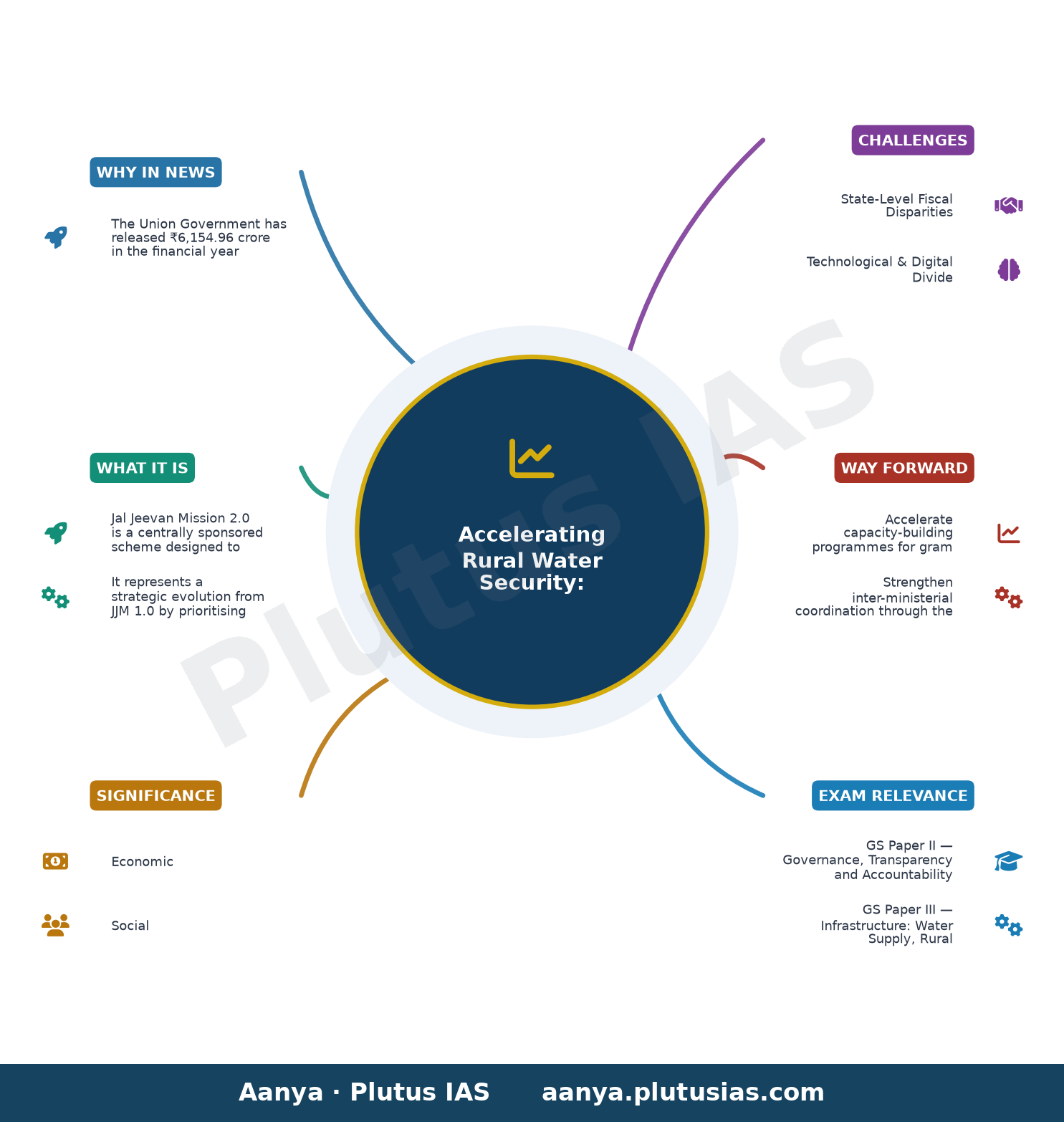
The Union Government has released ₹6,154.96 crore in the financial year 2026–27 to accelerate the implementation of Jal Jeevan Mission 2.0, including ₹5,289.09 crore as central assistance to 10 states and ₹865.87 crore via the ‘SNA Sparsh’ platform to 13 states. This marks a significant step toward ensuring reliable, adequate, and safe piped water supply to all rural households by December 2028, while embedding digital governance, community ownership, and long-term operational sustainability in the mission’s architecture.
Background
- The original Jal Jeevan Mission (JJM 1.0), launched in August 2019, aimed to provide Functional Household Tap Connections (FHTCs) to all rural households by 2024.
- Recognising the need for continuity, operational sustainability, and enhanced service delivery, the Union Cabinet approved JJM 2.0 on 10 March 2026, extending the mission timeline to December 2028.
- JJM 2.0 introduces a paradigm shift from infrastructure creation to robust operation and maintenance (O&M), quality monitoring, and digital governance, with a total outlay of ₹8.69 lakh crore, including ₹3.59 lakh crore in central assistance.
- The mission leverages fiscal federalism, with central funds released directly to states and Union Territories based on performance, utilisation, and adherence to prescribed guidelines.
- The ‘SNA Sparsh’ platform, launched under JJM 2.0, enables plan-based fund disbursement, real-time expenditure tracking, and enhanced transparency and accountability in fund utilisation.
What is Jal Jeevan Mission 2.0?
- Jal Jeevan Mission 2.0 is a centrally sponsored scheme designed to ensure universal access to reliable, adequate, and safe piped water supply in rural India by December 2028.
- It represents a strategic evolution from JJM 1.0 by prioritising the operational sustainability of water supply systems, quality monitoring, and community ownership over mere infrastructure creation.
- The mission places strong emphasis on the role of Village Water and Sanitation Committees (VWSCs) in managing O&M, ensuring local accountability and responsiveness.
- The ‘SNA Sparsh’ platform facilitates plan-based fund disbursement, real-time monitoring of expenditures, and third-party audits, enhancing transparency and fiscal discipline.
- The mission integrates digital governance tools to streamline planning, monitoring, and grievance redressal, ensuring timely and accountable service delivery.
- JJM 2.0 also promotes source sustainability through rainwater harvesting, groundwater recharge, and watershed management, aligning with the broader goal of long-term water security.
Key Features
| Feature | Significance |
|---|---|
| Jal Jeevan Mission 2.0 (JJM 2.0) | A centrally sponsored scheme approved by the Union Cabinet on 10 March 2026, extending the mission timeline to December 2028 with a total outlay of ₹8.69 lakh crore, including ₹3.59 lakh crore central assistance, to ensure 100% coverage of rural households with safe and sustainable piped water supply. |
| Central Fund Disbursement (₹5,289.09 crore) | Direct release of central funds to 10 states (e.g., Uttar Pradesh ₹2,711.52 crore, Maharashtra ₹594.44 crore) under JJM 2.0 for FY 2026-27, ensuring uninterrupted implementation and state-level accountability. |
| SNA Sparsh Platform (₹865.87 crore) | A digital governance tool enabling plan-based fund releases, real-time expenditure tracking, and financial auditing for 13 states (e.g., Assam ₹669.92 crore, Tamil Nadu ₹0.01 crore), enhancing transparency and efficiency in fund utilisation. |
| Operation & Maintenance (O&M) Focus | Shift from infrastructure creation to sustainable service delivery through gram panchayat-led O&M, community ownership, and water quality monitoring, ensuring long-term reliability of water supply systems. |
| Digital Governance & Geo-tagging | Integration with PM Gati Shakti for geo-tagging and digital mapping of rural water supply infrastructure, coupled with unique ‘Sujalam Bharat ID’ for asset tracking, to improve planning and monitoring. |
| Community-Led Assessment (Jal Seva Assessment) | Institutionalising community-driven evaluation of water supply services to identify gaps, enhance ownership, and ensure demand-responsive service delivery under JJM 2.0. |
Why it Matters
Economic
- Enhances rural productivity by reducing time and health costs associated with water collection, thereby contributing to GDP growth through improved human capital and labour efficiency.
- Stimulates local economies via employment generation in water infrastructure maintenance, community-based monitoring, and digital governance operations.
Social
- Ensures equitable access to safe drinking water, reducing waterborne diseases and improving public health outcomes, particularly for marginalised communities.
- Empowers gram panchayats and Village Water and Sanitation Committees (VWSCs) through decentralised governance, fostering grassroots democracy and social inclusion.
Environmental
- Promotes sustainable water resource management through source sustainability measures, reducing groundwater depletion and ensuring long-term ecological balance.
- Encourages rainwater harvesting and watershed management as part of integrated rural water security strategies.
Administrative
- Strengthens fiscal federalism by ensuring timely and transparent fund disbursement to states, reducing delays and improving intergovernmental coordination.
- Leverages digital platforms (SNA Sparsh, PM Gati Shakti) to enhance governance efficiency, reduce leakages, and improve accountability in public fund utilisation.
Challenges
1. State-Level Fiscal Disparities
- Variations in state capacities to mobilise matching funds may lead to uneven implementation, particularly in fiscally weaker states.
- Risk of underutilisation of central funds due to administrative bottlenecks or lack of state-level planning.
UPSC Link: GS2: Centre-State Relations
2. Technological & Digital Divide
- Limited digital literacy among rural communities may hinder effective utilisation of SNA Sparsh and other digital tools.
- Dependence on technology for monitoring and governance could exclude technologically disadvantaged populations.
UPSC Link: GS3: Science & Technology
3. Groundwater Depletion & Source Sustainability
- Over-reliance on groundwater sources in many regions poses a long-term threat to water security despite JJM 2.0’s focus on source sustainability.
- Climate change-induced erratic rainfall patterns exacerbate water scarcity, requiring adaptive strategies beyond conventional infrastructure.
UPSC Link: GS3: Environmental Conservation
4. Community Participation & Ownership
- Ensuring sustained community engagement in O&M and governance remains a persistent challenge, particularly in areas with low social capital.
- Risk of elite capture in gram panchayats and VWSCs, leading to inequitable distribution of benefits.
UPSC Link: GS2: Panchayati Raj
5. Monitoring & Evaluation Gaps
- Real-time monitoring through digital platforms may face data inaccuracies or delays, undermining the effectiveness of SNA Sparsh.
- Lack of standardised metrics for assessing service quality and community satisfaction across states.
UPSC Link: GS2: Governance
6. Inter-Ministerial Coordination
- JJM 2.0’s success depends on seamless coordination with ministries like Rural Development, Environment, and Agriculture for integrated water management.
- Risk of siloed implementation leading to suboptimal outcomes in cross-sectoral initiatives like watershed development.
UPSC Link: GS2: Inter-State Relations
Challenges — UPSC Perspective
| Issue | Concern |
|---|---|
| Fiscal Federalism | Disparities in state capacities to utilise central funds, leading to uneven progress across regions. |
| Digital Literacy | Low adoption of digital tools (e.g., SNA Sparsh) among rural communities due to lack of awareness or infrastructure. |
| Groundwater Stress | Persistent over-extraction of groundwater in states like Punjab, Rajasthan, and Tamil Nadu, threatening long-term water security. |
| Community Mobilisation | Difficulty in sustaining grassroots participation in O&M and governance, risking elite capture or apathy. |
| Climate Vulnerability | Increased frequency of droughts and erratic rainfall, necessitating climate-resilient water infrastructure. |
| Data Quality | Inaccuracies in geo-tagging or expenditure tracking due to poor digital infrastructure or human error. |
Government Initiatives — Must-Memorise for Prelims
- Jal Jeevan Mission (JJM) 1.0
- Jal Jeevan Mission (JJM) 2.0
- SNA Sparsh (Digital Governance Platform under JJM 2.0)
Way Forward
- Accelerate capacity-building programmes for gram panchayats and VWSCs to enhance O&M capabilities and community ownership.
- Strengthen inter-ministerial coordination through the establishment of a dedicated task force for integrated water resource management under JJM 2.0.
- Expand digital literacy initiatives in rural areas to improve adoption of tools like SNA Sparsh and PM Gati Shakti.
- Enhance groundwater recharge and watershed management schemes in states facing acute water scarcity (e.g., Rajasthan, Punjab).
- Develop standardised metrics and frameworks for community-led assessments to ensure uniform service quality across states.
- Leverage CSR funds and private partnerships for sustainable financing of O&M and digital governance infrastructure.
- Conduct periodic audits of SNA Sparsh data to identify and rectify discrepancies in fund disbursement and expenditure tracking.
- Promote climate-resilient water infrastructure, including decentralised rainwater harvesting and grey-water recycling systems.
UPSC Value Addition
Keywords for Mains Answer-Writing
Jal Jeevan Mission 2.0 · Safe drinking water · SNA Sparsh platform · Community ownership of water assets · Village Water and Sanitation Committees (VWSC) · Digital governance in rural water supply · Geotagging of water infrastructure · Source sustainability · Water quality monitoring · PM Gati Shakti platform · Rural water supply schemes · Central assistance to states · Sustainable Development Goals (SDG 6) · Gram Panchayat-led O&M · Sujalam Bharat ID
Constitutional & Policy Linkages
- Article 243G (Functions of Panchayats)
- Article 243W (Functions of Municipalities)
- Seventh Schedule (State List: Item 17 – Water Supply)
- Seventh Schedule (Concurrent List: Item 17 – Water, that is to say, water supplies, irrigation and canals, drainage and embankments, water storage and water power subject to the provisions of Entry 56 of List I)
Concept Flow
Central Cabinet approval of JJM 2.0 (March 2026) → Expansion of mission scope and timeline to December 2028 → Allocation of ₹8.69 lakh crore outlay with ₹3.59 lakh crore central assistance → State-level fund disbursement (₹5,289.09 crore) and digital governance via SNA Sparsh (₹865.87 crore) → Implementation through gram panchayats and VWSCs with focus on O&M and community ownership → Real-time monitoring via PM Gati Shakti and geo-tagging → Community-led assessments and service quality improvements → Long-term water security and equitable access.
Prelims Practice Questions
Q1. Consider the following statements regarding the Jal Jeevan Mission (JJM) 2.0:
1. The mission aims to provide safe drinking water to every rural household by December 2028.
2. The central assistance under JJM 2.0 is limited to ₹3.59 lakh crore.
3. The SNA Sparsh platform facilitates geotagging of rural water supply infrastructure.
4. The mission emphasizes community ownership through Village Water and Sanitation Committees (VWSC).
How many of the above statements are correct?
- Only one
- Only two
- Only three
- All
Answer: All — Statements 1, 2, and 4 are correct. Statement 3 is incorrect as SNA Sparsh is a platform for plan-based payments and financial monitoring, not geotagging (which is done via the PM Gati Shakti platform).
Q2. Assertion (A): The Jal Jeevan Mission 2.0 shifts focus from infrastructure creation to operational sustainability and community-led management of water supply systems.
Reason (R): The mission mandates the transfer of completed water supply schemes to Gram Panchayats and Village Water and Sanitation Committees (VWSC) for operation and maintenance.
Options:
A. Both A and R are true, and R is the correct explanation of A.
B. Both A and R are true, but R is not the correct explanation of A.
C. A is true, but R is false.
D. A is false, but R is true.
Answer: ? — Both Assertion (A) and Reason (R) are true, and Reason (R) correctly explains Assertion (A) as JJM 2.0 prioritizes O&M and community ownership over mere infrastructure creation.
Q3. Match the following initiatives under Jal Jeevan Mission 2.0 with their respective objectives:
Column I (Initiative) Column II (Objective)
A. SNA Sparsh 1. Geotagging and digital mapping of water infrastructure
B. Sujalam Bharat ID 2. Unique identification of water supply assets
C. PM Gati Shakti Platform 3. Plan-based payment and financial monitoring
D. VWSC-led O&M 4. Community-led operation and maintenance of water systems
Options:
A. A-3, B-2, C-1, D-4
B. A-2, B-3, C-4, D-1
C. A-1, B-4, C-2, D-3
D. A-4, B-1, C-3, D-2
Answer: ? — Correct matching: A-3 (SNA Sparsh for plan-based payments), B-2 (Sujalam Bharat ID for unique asset identification), C-1 (PM Gati Shakti for geotagging), D-4 (VWSC-led O&M for community management).
Mains Practice Question
✍ The Jal Jeevan Mission 2.0 represents a paradigm shift from infrastructure-centric approaches to sustainable, community-owned water supply systems. Critically examine this proposition with reference to the mission’s architecture, financial outlays, and institutional mechanisms. Also, analyse how digital governance tools such as SNA Sparsh and PM Gati Shakti platform enhance transparency and accountability in fund utilisation. (15 Marks)
Approach: MODEL-ANSWER SKELETON:
1. **Introduction (2 marks)**
– Brief context: JJM 1.0 (2019–2024) focused on infrastructure creation; JJM 2.0 (2024–2028) extends deadline to December 2028 with a total outlay of ₹8.69 lakh crore (₹3.59 lakh crore central assistance).
– Core proposition: Shift from ‘infrastructure creation’ to ‘sustainable service delivery’ through community ownership, O&M, and digital governance.
2. **Architectural Shift (4 marks)**
– **Community Ownership**: Transfer of completed schemes to Gram Panchayats and Village Water and Sanitation Committees (VWSC) for O&M; emphasis on ‘source sustainability’ and ‘water quality monitoring’.
– **Institutional Mechanisms**: Role of VWSCs as statutory bodies under the mission; convergence with Mahatma Gandhi NREGS for source sustainability.
– **Legal and Policy Framework**: Reference to ‘Sujalam Bharat ID’ for unique identification of water assets; integration with SDG 6 (Clean Water and Sanitation).
3. **Financial Outlays and Implementation (4 marks)**
– Total outlay: ₹8.69 lakh crore (₹3.59 lakh crore central share).
– Recent financial disbursements: ₹5,289.09 crore to 10 states and ₹865.87 crore via SNA Sparsh to 13 states in FY 2026–27.
– State-wise allocations: Highlight disproportionate allocations (e.g., Uttar Pradesh: ₹2,711.52 crore; Kerala: ₹144.66 crore) and their implications for equity.
4. **Digital Governance Tools (3 marks)**
– **SNA Sparsh**: Plan-based payment system enabling real-time tracking of expenditures, audits, and accountability; reduces leakages and delays.
– **PM Gati Shakti Platform**: Geotagging and digital mapping of rural water infrastructure for spatial planning and monitoring.
– **Data-Driven Governance**: Integration of digital tools with ‘Jal Seva Assessment’ for community-led evaluations of service delivery.
5. **Critical Analysis (2 marks)**
– **Strengths**: Enhanced transparency, reduced corruption, community empowerment, and long-term sustainability.
– **Challenges**: Digital divide in rural areas; capacity constraints of Gram Panchayats; need for sustained funding and inter-departmental coordination.
– **Comparative Perspective**: Contrast with traditional top-down approaches (e.g., centrally funded schemes like NRDWP) to highlight the shift in governance philosophy.
Source: PIB (Press Information Bureau)
Generated by AanyaAi for educational purpose.

- लोकसभा ने पास किया बिल: UPI और RuPay पर MDR लगाने का रास्ता खुला - August 7, 2026
- Lok Sabha Passes Bill to Allow UPI MDR Charges: Key Implications for UPSC - August 7, 2026
- राज्यसभा ने पारित किया ₹54,067 करोड़ का विनियोग विधेयक, जानिए प्रमुख बिंदु - August 7, 2026

No Comments