


27 Jul Jal Jeevan Mission: Rural Tap Water Coverage Jumps to 82.09% in 2026
Subject Relevance — Where This Topic Fits
- GS Paper II — Governance, Public Policy and Welfare Schemes | GS Paper III — Infrastructure: Water Supply and Sanitation
- Prelims: Jal Jeevan Mission (JJM), Har Ghar Jal, BIS 10500 drinking water standards, Village Water and Sanitation Committees (VWSC), Operation & Maintenance (O&M) Policy, Community-managed piped water supply systems, Integrated Implementation & Reform Plan (CIRP), Jal Jeevan Mission 2.0
- Essay: Water security as a cornerstone of rural development and inclusive governance, The role of community participation in sustainable infrastructure management
Quick Revision: Jal Jeevan Mission (JJM) aims for 100% rural household tap water coverage by December 2028 under JJM 2.0, with a total outlay of ₹8.69 lakh crore, ensuring 55 lpcd potable water meeting BIS 10500 standards through decentralised, community-managed infrastructure.
Why is this in the news?
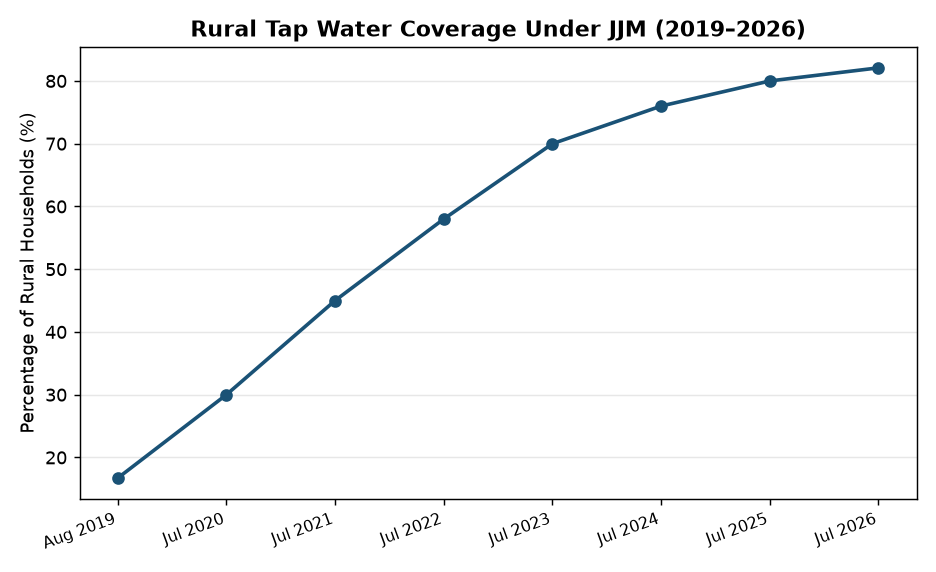
The Union Cabinet, in March 2026, approved the extension of the Jal Jeevan Mission (JJM) until December 2028 under the Jal Jeevan Mission 2.0 framework, with a significantly enhanced outlay of ₹8.69 lakh crore. This decision follows the Mission’s progress in expanding functional household tap connections from 16.71% to 82.09% of rural households as of July 2026, signalling a critical phase in achieving universal rural water supply. The expansion includes the transfer of rural water supply schemes to Gram Panchayats (GPs) and Village Water and Sanitation Committees (VWSCs), necessitating robust institutional and financial mechanisms for sustainable operation and maintenance (O&M).
Background
- The Jal Jeevan Mission (JJM) was launched in August 2019 by the Government of India to provide functional household tap water connections to all rural households in a time-bound manner, ensuring a minimum of 55 litres per capita per day (lpcd) of potable water meeting BIS 10500 standards.
- Prior to JJM, only 3.23 crore (16.71%) rural households had tap water connections, highlighting a significant infrastructure deficit in rural water supply.
- JJM operates as a centrally sponsored scheme with the Union Government providing financial and technical support to States/Union Territories, while implementation, O&M, and policy formulation remain the responsibility of State governments under the State subject of ‘Drinking Water’.
- The Mission’s progress is monitored through a decentralised framework involving Gram Sabhas, VWSCs, and user committees, with a focus on community ownership and cost recovery.
- The Union Cabinet’s approval of JJM 2.0 in March 2026 reflects a strategic shift towards structural reforms, enhanced funding, and a revised implementation timeline to address residual gaps and ensure sustainable water supply.
What is the Jal Jeevan Mission (JJM)?
- A centrally sponsored scheme launched in August 2019 by the Ministry of Jal Shakti to provide functional household tap water connections to all rural households by 2024, later extended to December 2028 under JJM 2.0.
- Aims to ensure a minimum of 55 litres per capita per day (lpcd) of potable water meeting Bureau of Indian Standards (BIS) 10500 norms for drinking water quality.
- Operates on a ‘bottom-up’ approach, with States/UTs responsible for planning, implementation, and O&M, while the Centre provides financial and technical assistance.
- Focuses on the transfer of rural water supply schemes to Gram Panchayats (GPs) and Village Water and Sanitation Committees (VWSCs) to ensure decentralised management and long-term sustainability.
- Promotes user fee collection at the Gram Panchayat level, with provisions for involving women Self-Help Groups (SHGs) in fee collection and O&M activities to ensure financial sustainability.
- Envisions ‘community-managed piped water supply systems’ to ensure continuous service delivery and reduce dependency on external agencies for O&M.
Key Features
| Feature | Significance |
|---|---|
| Expansion of Jal Jeevan Mission (JJM) to 82.09% coverage | Demonstrates accelerated progress in achieving universal rural piped water supply, aligning with Sustainable Development Goal 6 (Clean Water and Sanitation). |
| Community-led initiatives like ‘Jal Arpan’ | Ensures participatory governance, fosters local ownership, and strengthens sustainability of water infrastructure through village-level engagement. |
| Guidelines for community-managed piped water systems | Provides a structured framework for transfer of schemes to Gram Panchayats, ensuring operational and maintenance (O&M) efficiency and accountability. |
| 15-day trial period for O&M transfer | Facilitates smooth transition of water supply schemes, reduces service disruptions, and builds institutional capacity at the grassroots level. |
| Enhanced financial outlay under JJM 2.0 (₹8.69 lakh crore) | Reflects prioritisation of rural water security, with increased central share (₹3.59 lakh crore) to address funding gaps and scale up infrastructure. |
Why it Matters
Economic
- Reduces expenditure on waterborne diseases and improves household productivity by saving time and resources previously spent on fetching water.
- Enhances agricultural productivity through reliable irrigation, indirectly supporting rural incomes and food security.
- Stimulates local economies via employment generation in water infrastructure construction and maintenance sectors.
Social
- Improves gender equity by reducing the drudgery of water collection, particularly for women and girls, thereby enabling greater participation in education and livelihood activities.
- Promotes inclusive development by ensuring equitable access to safe drinking water across marginalised communities, including Scheduled Castes and Tribes.
- Strengthens social capital through community-led governance models, fostering trust and collective action in rural areas.
Environmental
- Encourages sustainable water use practices through community awareness and efficient distribution systems, reducing wastage.
- Supports groundwater recharge initiatives by integrating rainwater harvesting and recharge structures in water supply schemes.
- Mitigates health risks associated with contaminated water sources, thereby reducing environmental degradation linked to waterborne diseases.
Administrative
- Demonstrates cooperative federalism by leveraging state-level implementation while ensuring central financial and technical support.
- Enhances institutional capacity at the grassroots level through structured O&M frameworks and community participation.
- Sets a precedent for scalable, decentralised models of public service delivery in rural India.
Challenges
1. Geographical Disparities
- Persistent regional imbalances in coverage, with states like Bihar, Uttar Pradesh, and Jharkhand lagging behind the national average.
- Hilly and tribal regions face unique challenges due to terrain, remoteness, and lower population density, necessitating tailored solutions.
UPSC Link: GS-III: Water Resources (Distribution)
2. Sustainable O&M Financing
- Long-term viability of schemes hinges on reliable user fee collection, which remains inconsistent across states.
- Dependence on central funds risks discontinuity if budgetary allocations are not sustained post-mission completion.
UPSC Link: GS-II: Centre-State Relations (Finance)
3. Technological and Infrastructure Gaps
- Aging or poorly maintained distribution networks lead to high non-revenue water losses, undermining efficiency.
- Lack of real-time monitoring systems hampers leak detection and preventive maintenance, increasing operational costs.
UPSC Link: GS-III: Science & Tech (Water Management)
4. Community Participation and Awareness
- Low awareness among rural populations about water quality standards and the importance of regular maintenance.
- Resistance to user charges due to entrenched perceptions of water as a free public good, despite BIS standards.
UPSC Link: GS-II: Governance (Participatory Development)
5. Climate Change Vulnerabilities
- Increased frequency of droughts and erratic rainfall patterns threaten long-term water security in vulnerable regions.
- Flooding and waterlogging in certain areas disrupt infrastructure and contaminate water sources, requiring adaptive planning.
UPSC Link: GS-III: Environment (Climate Change)
Challenges — UPSC Perspective
| Issue | Concern |
|---|---|
| Regional disparities in coverage | States with low initial coverage face higher operational costs and logistical challenges. |
| User fee collection inefficiencies | Inconsistent enforcement leads to underfunding of O&M activities. |
| Aging water infrastructure | High non-revenue water losses due to poor maintenance and leakages. |
| Climate-induced water stress | Droughts and floods disrupt supply chains and contaminate sources. |
| Low community engagement | Limited awareness and resistance to cost-sharing undermine sustainability. |
Government Initiatives — Must-Memorise for Prelims
- Jal Jeevan Mission (JJM) – Har Ghar Jal
- Jal Jeevan Mission 2.0
Way Forward
- Accelerate coverage in lagging states through targeted interventions and additional central support.
- Strengthen O&M frameworks by mandating real-time monitoring systems and leak detection technologies.
- Increase community awareness campaigns to promote water conservation and the necessity of user charges.
- Integrate climate-resilient design in new water supply schemes to mitigate future vulnerabilities.
- Enhance state-level capacity building for Gram Panchayats to ensure effective scheme transfer and management.
- Expand public-private partnerships for technology adoption and efficient service delivery in remote areas.
- Establish a national-level data repository to track progress, identify gaps, and facilitate evidence-based policymaking.
- Promote inter-state knowledge sharing to replicate best practices in water governance and infrastructure management.
UPSC Value Addition
Keywords for Mains Answer-Writing
Jal Jeevan Mission (JJM) · Har Ghar Jal · Rural Drinking Water Supply · Functional Household Tap Connections (FHTC) · BIS 10500 Water Quality Standards · Village Water and Sanitation Committees (VWSC) · Community-Managed Water Supply Systems · Operation & Maintenance (O&M) Policy · Jal Adhikar Shakti · Convergence with MGNREGA · Decentralised Governance of Water · Water Security for Rural India
Constitutional & Policy Linkages
- [‘Article 243G’, ‘Empowers Gram Panchayats to manage water supply and sanitation services.’]
- [‘Article 47’, ‘Directive Principle of State Policy mandating public health improvements through water supply.’]
- [‘Seventh Schedule’, ‘Concurrent List (Entry 17) on water supply and sanitation.’]
Concept Flow
Launch of Jal Jeevan Mission (2019) → Expansion of piped water coverage from 16.71% to 82.09% → Community-led governance models (Jal Arpan) → Transfer of schemes to Gram Panchayats → Sustainable O&M through user fees and local committees → Long-term water security and health benefits.
Prelims Practice Questions
Q1. Which of the following statements about Jal Jeevan Mission (JJM) is/are correct? 1) JJM aims to provide 55 litres of safe drinking water per capita per day to all rural households. 2) The mission is implemented under the Ministry of Rural Development. 3) The water quality standard prescribed under JJM is BIS 10500. 4) JJM mandates 100% household tap connections by 2024.
- 1 and 2 only
- 1 and 3 only
- 1, 3 and 4 only
- All of the above
Answer: 1 and 3 only — Statement 1 and 3 are correct: JJM targets 55 litres per capita per day and prescribes BIS 10500 standards. Statement 2 is incorrect as JJM is under the Ministry of Jal Shakti. Statement 4 is incorrect as the target is not 2024 but 2028 under JJM 2.0.
Q2. Which initiative under Jal Jeevan Mission promotes community-led water governance and celebrates the commissioning of water supply schemes?
- Jal Shakti Abhiyan
- Jal Adhikar Shakti
- Jal Aapda Prabandhan
- Jal Aapda Kalyan
Answer: Jal Adhikar Shakti — Jal Adhikar Shakti is the community-led initiative under JJM that promotes participatory water governance and celebrates the commissioning of water supply schemes through events like ‘Jal Aapda’.
Q3. What is the primary objective of the ‘Guidelines for Community-Managed Pipe-Based Water Supply Systems’ launched under Jal Jeevan Mission?
- To mandate private sector participation in water supply
- To ensure smooth transfer and sustainable operation of water supply schemes to Gram Panchayats
- To promote water-intensive agricultural practices
- To centralise water supply management under the Union Government
Answer: To ensure smooth transfer and sustainable operation of water supply schemes to Gram Panchayats — The guidelines aim to ensure the smooth transfer of water supply schemes to Gram Panchayats and their sustainable operation through a 15-day trial period involving VWSCs and community participation.
Mains Practice Question
✍ Critically examine the role of decentralised governance mechanisms in ensuring the sustainability of rural drinking water supply under the Jal Jeevan Mission (JJM). How does the mission integrate community participation and technological interventions to achieve water security in rural India?
Approach: Begin by defining the decentralised governance framework under JJM, including the role of Gram Panchayats, Village Water and Sanitation Committees (VWSCs), and community-led initiatives like ‘Jal Adhikar Shakti’. Discuss the mission’s emphasis on community-managed water supply systems and the 15-day trial period for smooth transfer of schemes. Highlight the technological interventions such as adherence to BIS 10500 water quality standards and the provision of 55 litres per capita per day. Critically analyse the challenges in decentralised governance, including fund utilisation, capacity building, and ensuring equitable access. Conclude by assessing the mission’s progress in achieving its objectives and the way forward for ensuring long-term sustainability.
Source: PIB (Press Information Bureau)
Generated by AanyaAi for educational purpose.

- छत्तीसगढ़ पुलिस कांस्टेबल भर्ती: सुप्रीम कोर्ट ने राज्य सरकार की याचिका खारिज, क्या मिलेगी नौकरी? - September 15, 2026
- Supreme Court Clears Constable Recruitment in Chhattisgarh: Key UPSC Polity Insight - September 15, 2026
- किशाऊ बहुउद्देशीय परियोजना: 6 राज्यों के बीच ऐतिहासिक समझौता, जानें पूरा विवरण - September 15, 2026

No Comments