


30 Jan Joint India–EU Comprehensive Strategic Agenda 2026: Towards a Resilient, Technology-Driven and Rules-Based Partnership
This article covers “Daily Current Affairs” and From Joint India–EU Comprehensive Strategic Agenda 2026: Towards a Resilient, Technology-Driven and Rules-Based Partnership
SYLLABUS MAPPING
GS- 2- International Relations – EU Comprehensive Strategic Agenda 2026: Towards a Resilient, Technology-Driven and Rules-Based Partnership
FOR PRELIMS
What is the Joint India–EU Comprehensive Strategic Agenda 2026?
FOR MAINS
What is the significance of the India–EU Strategic Agenda 2026 in today’s global context?
Why in the News?
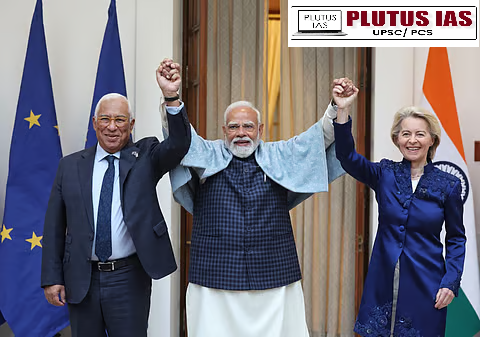
The Joint India–EU Comprehensive Strategic Agenda, endorsed at the 16th India–EU Summit on 27 January 2026 in New Delhi, marks a decisive step in elevating the India–EU Strategic Partnership. Coming at a time of geopolitical fragmentation, supply-chain disruptions, climate stress, and rapid technological change, the Agenda provides a forward-looking, action-oriented roadmap to deepen cooperation across economic, technological, security, connectivity, and global governance domains. It reflects the shared commitment of India and the European Union to act as trusted, predictable, and like-minded partners in shaping a stable and inclusive global order.
Prosperity and Sustainability: Anchoring Economic Resilience
1. Boosting Trade and Investment
Timely implementation of the India–EU Free Trade Agreement (FTA), hailed as a historic milestone capable of unlocking trade, investment, and supply-chain resilience.
Conclusion of an Investment Protection Agreement (IPA) to ensure predictability and investor confidence.
Finalisation of a Geographical Indications (GI) Agreement, benefitting traditional Indian products and EU producers alike.
Enhanced financial regulatory cooperation, including a structured EU–India Regulatory Dialogue on Financial Services.
Strengthening customs cooperation and macroeconomic dialogue.
2. Strengthening Supply Chains and Economic Security
Cooperation on semiconductors, including R&D, design, manufacturing, and resilient supply chains.
Collaboration on critical minerals, pharmaceuticals, agrifood systems, and biotechnology.
Expanding economic security discussions under the Trade and Technology Council (TTC), including protection of sensitive technologies.
This reflects a shift from pure trade liberalisation to strategic economic resilience.
3. Advancing Clean Transition and Climate Resilience
Strengthening the India–EU Clean Energy and Climate Partnership.
Operationalising the Green Hydrogen Task Force and promoting wind energy, smart grids, and storage.
Cooperation on industrial decarbonisation, carbon markets (India’s CCTS and EU ETS), sustainable finance, and circular economy.
Joint efforts on climate adaptation, disaster resilience (via CDRI), water security, sustainable urbanisation, agriculture, and health systems.
II. Technology and Innovation: Co-Creating the Future
1. Critical and Emerging Technologies
The Agenda places technology cooperation at its core:
Joint research on AI, quantum computing, semiconductors, clean tech, biotech, and space technologies.
Establishment of India–EU Innovation Hubs and a Startup Partnership to support deep-tech scale-ups.
Cooperation on trustworthy, human-centric AI, including collaboration between EU AI Office and India’s National AI Mission.
Expanded cooperation on HPC, space security, and advanced semiconductor ecosystems.
2. Building a Trusted Digital Ecosystem
Key initiatives include:
Regulatory cooperation on data protection, digital markets, online safety, and cybersecurity.
Collaboration on Digital Public Infrastructure (DPI), leveraging India’s experience in digital identity and financial inclusion.
Exploring interoperability between digital wallets, advanced e-signatures, and trusted telecom ecosystems including 6G cooperation.
Together, these efforts aim to promote inclusive, secure, and interoperable digital growth.
3. Research and Knowledge Partnerships
Deepening cooperation under Horizon Europe, with exploration of India’s association.
Collaboration in nuclear science, advanced materials, and ITER.
This enhances India’s integration into global knowledge networks.
Security and Defence: Converging Strategic Interests
1. Institutionalised Security Cooperation: Implementation of the India–EU Security and Defence Partnership (SDP). Elevation of security consultations to an annual Security and Defence Dialogue. Conclusion of a Security of Information Agreement to enable deeper cooperation.
2. Defence Industrial Collaboration: Establishment of an India–EU Defence Industry Forum. Exploration of joint initiatives in defence technology, aligned with respective legal frameworks.
3. Regional and Global Security: Cooperation for a free, open, and rules-based Indo-Pacific Engagement through IPOI, IORA, and Indian Ocean Commission. Coordination on global issues including Ukraine.
4. Countering Terrorism and Hybrid Threats: Enhanced counter-terrorism cooperation, AML standards, cyber and hybrid threat responses. Strengthened law enforcement ties via CBI–Europol cooperation.
Connectivity and Global Issues: Shaping Global Public Goods (India–EU Strategic Agenda 2026)
| Dimension | Key Initiatives / Instruments | Strategic Significance |
|---|---|---|
| 1. Connectivity Corridors | • Global Gateway – EU’s infrastructure connectivity framework • MAHASAGAR – India’s maritime connectivity vision • India–Middle East–Europe Economic Corridor (IMEC) • Green Shipping Corridors • Aviation cooperation and possible Comprehensive Air Transport Agreement • Digital connectivity via Blue Raman submarine cable |
• Diversifies trade routes and reduces over-dependence on chokepoints • Enhances resilient, sustainable and secure supply chains • Promotes low-carbon transport and maritime decarbonisation • Strengthens Europe–India–Indo-Pacific connectivity architecture |
| 2. Cooperation in Third Countries | • Trilateral projects under India–EU Administrative Arrangement on Trilateral Cooperation • Joint initiatives in energy transition, climate resilience, green mobility and digitalisation • Collaboration through International Solar Alliance (ISA) • Support to Coalition for Disaster Resilient Infrastructure (CDRI) • Coordinated humanitarian assistance |
• Supports development priorities of Global South • Enhances India–EU credibility as development partners • Builds climate-resilient and disaster-ready infrastructure • Promotes rules-based and inclusive development cooperation |
| 3. Global Governance Reform | • Coordinated engagement in UN, G20, WTO and international financial institutions • Support for reform of multilateral institutions • Joint action on climate change and Paris Agreement implementation • Cooperation on biodiversity (KMGBF), plastic pollution negotiations, ocean governance • Coordination on AI governance and global health security • Establishment of India–EU Ocean and Fisheries Dialogue |
• Strengthens multilateralism in a fragmented global order • Promotes fair, inclusive and representative global governance • Advances global public goods such as climate stability, biodiversity and ocean health • Positions India–EU as norm-shapers in emerging domains like AI and maritime sustainability |
Enablers: People-Centric and Institutional Foundations
1. Skills, Mobility, and Education: Legal mobility pathways, EU Talent Pool, Erasmus+, research exchanges, and recognition of qualifications. Launch of European Legal Gateway Office in India. Focus on gender balance and inclusive mobility.
2. Mutual Understanding and Cultural Ties: Think-tank collaboration, Track 1.5 dialogues, cultural exchanges, academic research, and youth engagement.
3. Business and Institutional Architecture: Creation of an EU–India Business Forum. Annual summits, strengthened TTC, and structured monitoring through the Strategic Partnership Review.
Conclusion
The Joint India–EU Comprehensive Strategic Agenda 2026 represents a mature, multidimensional partnership adapted to contemporary global challenges. By integrating economic resilience, technological co-creation, security cooperation, sustainable connectivity, and people-centric enablers, the Agenda moves beyond declaratory diplomacy towards actionable strategic convergence. For India, it enhances access to markets, technology, and global influence; for the EU, it strengthens engagement with a pivotal Indo-Pacific partner. Collectively, the partnership contributes to a rules-based, inclusive, and sustainable global order in an era of uncertainty.
Best ias coaching in delhi Best ias coaching in chandigarh
Prelims question:
Q. With reference to the Joint India–EU Comprehensive Strategic Agenda (2026), consider the following statements:
1. The Agenda places equal emphasis on economic resilience, technology cooperation, security, connectivity, and global governance.
2. The India–EU Trade and Technology Council (TTC) serves as a key platform for cooperation on semiconductors, economic security, and emerging technologies.
3. Under the Agenda, India and the EU have agreed to replace multilateral institutions with minilateral groupings for global governance reforms.
Which of the statements given above is/are correct?
(a) 1 and 2 only
(b) 2 and 3 only
(c) 1 only
(d) 1, 2 and 3
Answer: A
Q. Discuss the significance of the Joint India–EU Comprehensive Strategic Agenda 2026 in strengthening bilateral cooperation and shaping global public goods in a changing geopolitical order.
(250 words)

- RBI’s Shrinking Real-Rate Cushion Amid Rising Inflation and Strong Demand - September 21, 2026
- India’s NGOs at a New Funding Crossroads - September 21, 2026
- Deep-Sea Discovery, Environmental Responsibility - September 19, 2026

No Comments