


08 Aug July 31 Deadline: Last-Minute Rush for Crop Insurance in Rayalaseema
✎ Crop insurance under PMFBY and RWBCIS provides a critical safety net for farmers in monsoon-dependent regions like Rayalaseema, mitigating financial risks from erratic weather by offering subsidised premiums, faster claim…
Subject Relevance — Where This Topic Fits
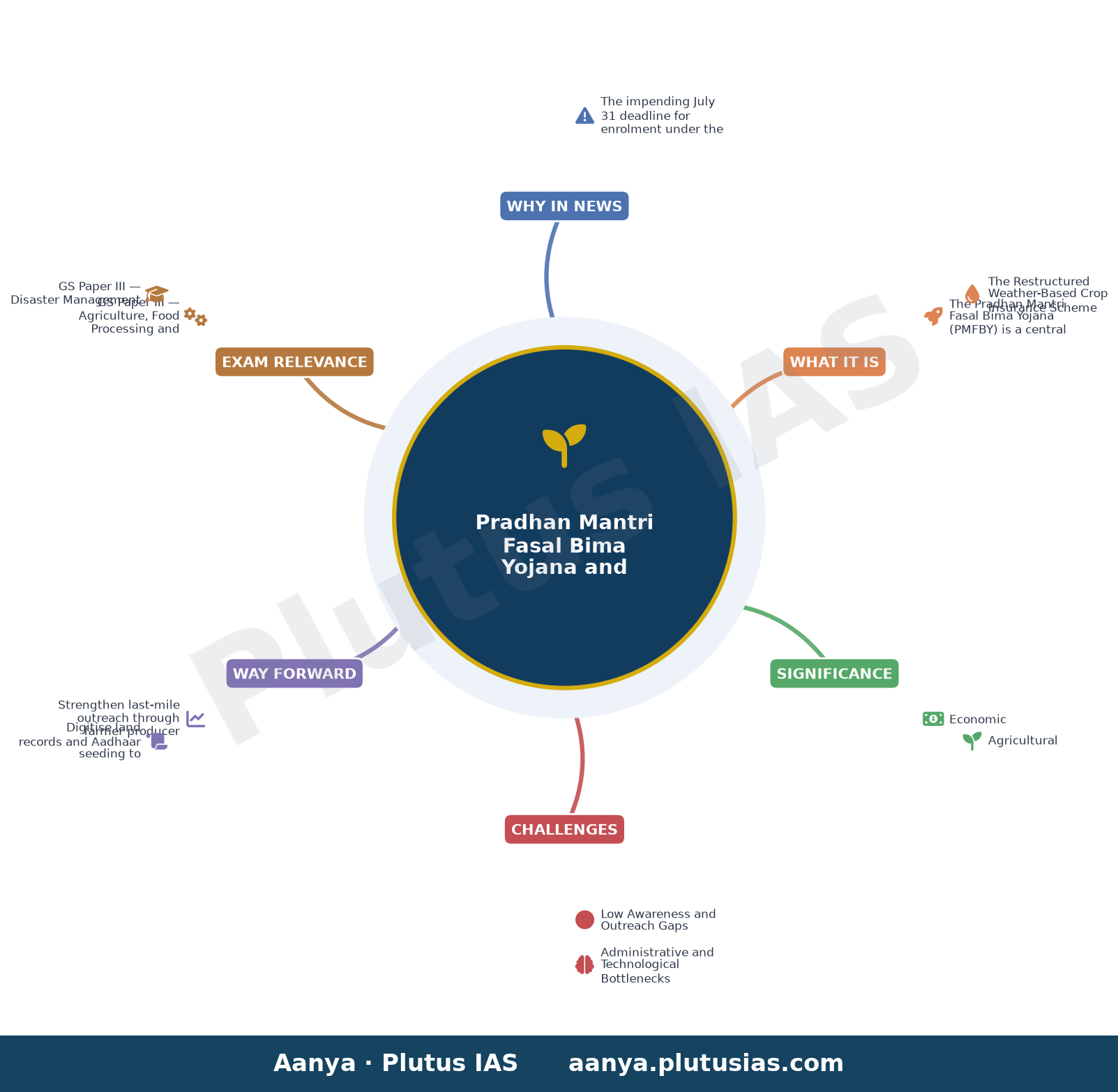
- GS Paper III — Agriculture, Food Processing and Related Issues | GS Paper III — Disaster Management
- Prelims: Pradhan Mantri Fasal Bima Yojana (PMFBY), Restructured Weather-Based Crop Insurance Scheme (RWBCIS), Rayalaseema, El Niño, monsoon variability, crop insurance, marginal farmers, horticulture crops
- Essay: Agricultural resilience in the face of climate change: The role of crop insurance in securing rural livelihoods, Climate variability and its socio-economic implications for agrarian communities in India
Quick Revision: Crop insurance under PMFBY and RWBCIS provides a critical safety net for farmers in monsoon-dependent regions like Rayalaseema, mitigating financial risks from erratic weather by offering subsidised premiums, faster claim settlements, and coverage for a wide range of crops, including horticulture.
Why is this in the news?
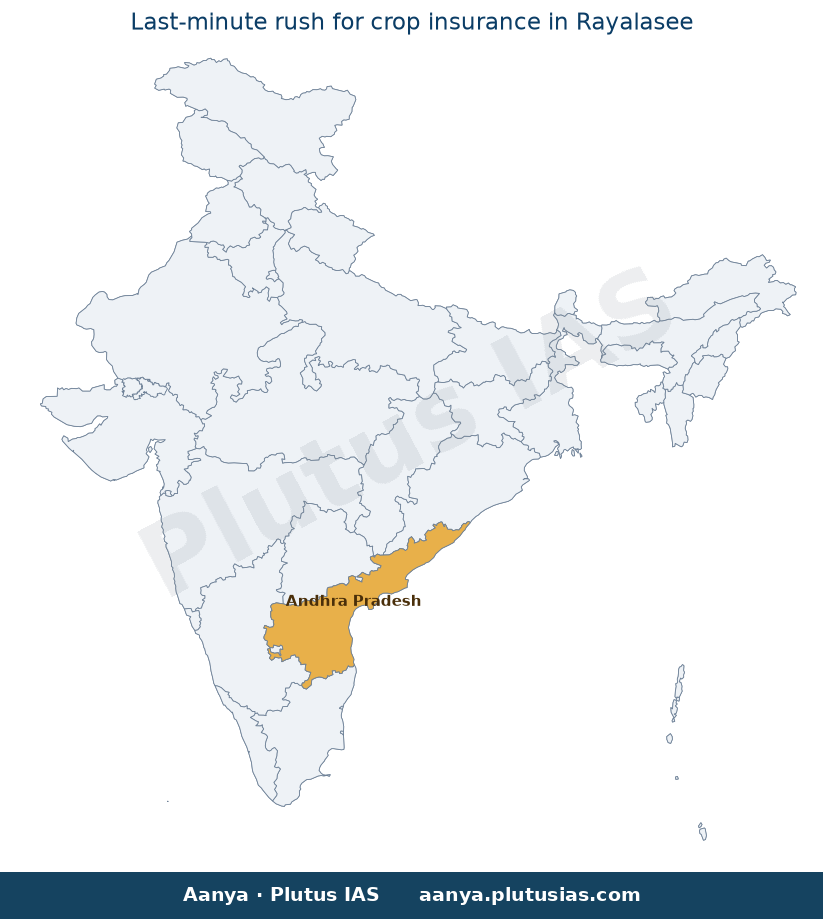
The impending July 31 deadline for enrolment under the Pradhan Mantri Fasal Bima Yojana (PMFBY) and the Restructured Weather-Based Crop Insurance Scheme (RWBCIS) has triggered a last-minute surge in farmer registrations across the monsoon-dependent Rayalaseema region of Andhra Pradesh, particularly in Sri Sathya Sai, Chittoor, and Annamayya districts. This urgency underscores the critical role of crop insurance in mitigating financial risks posed by erratic weather patterns, including delayed monsoons and El Niño-induced droughts, which disproportionately affect small and marginal farmers in the region.
Background
- The Rayalaseema region in Andhra Pradesh is historically characterised by high dependence on monsoon rainfall for agricultural activities, with agriculture and horticulture forming the backbone of its rural economy.
- The region has experienced recurrent episodes of delayed monsoons, prolonged dry spells, and unseasonal rainfall over the past several decades, exacerbating vulnerability among small and marginal farmers.
- The El Niño phenomenon, known to disrupt monsoon patterns in India, has further intensified agricultural distress in Rayalaseema, necessitating robust risk mitigation mechanisms such as crop insurance.
- The Government of India launched the Pradhan Mantri Fasal Bima Yojana (PMFBY) in 2016 to provide comprehensive crop insurance coverage to farmers.
- Small and marginal farmers constitute the majority of the agrarian workforce in Rayalaseema, with horticulture crops like mango, tomato, and banana contributing significantly to their livelihoods and regional economic growth.
What is Crop Insurance under PMFBY and RWBCIS?
- The Pradhan Mantri Fasal Bima Yojana (PMFBY) is a central sector scheme launched in 2016 to provide financial support to farmers in the event of crop failure due to natural calamities, pests, or diseases, ensuring income security and credit access.
- The Restructured Weather-Based Crop Insurance Scheme (RWBCIS) complements PMFBY by using weather indices (e.g., rainfall deficit, excess temperature) to trigger payouts, reducing delays in claim settlement and minimising disputes over loss assessment.
- Both schemes operate on a voluntary basis, allowing farmers to enrol for insurance coverage at the beginning of each cropping season, typically aligned with the kharif and rabi seasons.
Key Features
| Feature | Significance |
|---|---|
| Pradhan Mantri Fasal Bima Yojana (PMFBY) | Provides financial support to farmers in case of crop failure due to natural calamities, pests, or diseases, ensuring income security and reducing distress migration. |
| Restructured Weather-Based Crop Insurance Scheme (RWBCIS) | Offers insurance coverage based on weather parameters (e.g., rainfall deficiency, temperature anomalies) rather than yield loss, enhancing adaptability to climate variability. |
| Last-minute enrolment drive | Aims to maximize farmer participation before the July 31 deadline, addressing awareness gaps and administrative bottlenecks in historically vulnerable regions like Rayalaseema. |
| District-level implementation | Localised efforts by Agriculture and Horticulture departments in Sri Sathya Sai, Chittoor, and Annamayya districts to streamline enrolment, leveraging ground-level networks for outreach. |
| El Niño impact mitigation | Crop insurance acts as a risk mitigation tool against El Niño-induced droughts, which disproportionately affect monsoon-dependent regions such as Rayalaseema. |
Why it Matters
Economic
- Ensures financial stability for small and marginal farmers by compensating for crop losses, thereby preventing debt traps and distress sales of assets.
- Safeguards rural livelihoods in horticulture-intensive districts like Chittoor and Annamayya, where high-value crops (e.g., mango, tomato) are vulnerable to weather shocks.
- Reduces the fiscal burden on state exchequers by preventing ad-hoc relief packages in the aftermath of crop failures.
Agricultural
- Encourages adoption of risk-averse agricultural practices by providing a safety net against unpredictable monsoon patterns and climate change-induced extremes.
- Promotes crop diversification by mitigating risks associated with high-value but climate-sensitive horticultural crops.
- Supports agricultural credit systems by reducing lender risks, thereby improving access to institutional finance for farmers.
Social
- Mitigates farmer distress and suicide risks in drought-prone regions like Rayalaseema, where agriculture is the primary livelihood.
- Enhances food security by stabilising farm incomes, indirectly supporting rural consumption and demand for agricultural inputs.
Environmental
- Indirectly incentivises climate-resilient farming practices by linking insurance payouts to weather parameters, encouraging adaptive strategies.
Challenges
1. Low Awareness and Outreach Gaps
- Many small and marginal farmers in remote areas remain unaware of PMFBY/RWBCIS benefits or face language barriers in accessing information.
- Last-minute enrolment drives risk excluding farmers who lack documentation or face logistical hurdles in reaching enrolment centres.
UPSC Link: GS-III: Agricultural Marketing & Issues
2. Administrative and Technological Bottlenecks
- Delays in claim settlements and grievance redressal erode farmer trust in the scheme, particularly in regions with high historical claim rejections.
- Dependence on manual data collection for RWBCIS exposes the system to errors, especially during last-minute rushes.
UPSC Link: GS-III: E-Governance & Applications
3. Climate Change and Weather Variability
- Increasing frequency of El Niño events and erratic monsoons exacerbate crop losses, straining the actuarial viability of insurance schemes.
- Regions like Rayalaseema face compounded risks from delayed monsoons, dry spells, and unseasonal rainfall, reducing the predictability of insurance payouts.
UPSC Link: GS-III: Conservation & Climate Change
4. Financial Sustainability of Schemes
- High claims-to-premium ratios in drought-prone districts (e.g., Rayalaseema) threaten the long-term viability of PMFBY/RWBCIS without adequate state or central subsidies.
- State governments often bear a significant share of premium subsidies, creating fiscal pressures in resource-constrained regions.
UPSC Link: GS-III: Government Budgeting & Fiscal Policy
5. Farmer Distrust and Moral Hazard
- Past instances of delayed or inadequate payouts have led to scepticism among farmers, reducing voluntary enrolment rates.
- Moral hazard risks arise when farmers reduce efforts in crop management, assuming insurance will cover losses.
UPSC Link: GS-III: Agricultural Extension & Technology
Challenges — UPSC Perspective
| Issue | Concern |
|---|---|
| Documentation requirements | Small farmers lack land records or Aadhaar-linked bank details, complicating enrolment under PMFBY/RWBCIS. |
| Claim settlement delays | Bureaucratic hurdles and verification processes lead to prolonged wait times for payouts, defeating the scheme’s purpose. |
| Actuarial challenges | Climate-induced volatility makes premium calculations and risk assessment difficult, risking scheme insolvency. |
| Digital divide | Limited internet access in rural Rayalaseema hinders online enrolment and real-time weather data integration for RWBCIS. |
| Over-reliance on monsoon | Crops like mango and tomato in Chittoor/Annamayya districts face multi-hazard risks (drought, hail, pests), not fully covered by existing schemes. |
Way Forward
- Strengthen last-mile outreach through farmer producer organisations (FPOs) and local self-help groups (SHGs) to improve enrolment rates before deadlines.
- Digitise land records and Aadhaar seeding to streamline enrolment and reduce documentation-related exclusions.
- Accelerate claim settlement processes by leveraging AI/ML for automated verification of weather data and loss assessment.
- Expand coverage under RWBCIS to include multi-hazard risks (e.g., hail, pests) for high-value horticultural crops in Chittoor and Annamayya districts.
- Introduce premium subsidies for small and marginal farmers in drought-prone districts, funded through convergence with MGNREGS or state budgets.
- Enhance climate literacy among farmers via Krishi Vigyan Kendras (KVKs) to promote adaptive practices alongside insurance uptake.
- Pilot blockchain-based smart contracts for transparent and real-time payouts, reducing administrative delays and building trust.
UPSC Value Addition
Keywords for Mains Answer-Writing
Pradhan Mantri Fasal Bima Yojana (PMFBY) · Restructured Weather-Based Crop Insurance Scheme (RWBCIS) · Rayalaseema region vulnerability · El Niño impact on agriculture · Monsoon-dependent agriculture · Small and marginal farmers · Agrarian distress mitigation · Crop insurance penetration · Climate-resilient agriculture · Agricultural risk management
Concept Flow
Climate variability (El Niño) → Delayed monsoons/dry spells → Crop failure risks → Farmer distress → Urgency for crop insurance enrolment → Small/marginal farmer vulnerability → Dependence on agriculture → Need for financial safety nets → PMFBY/RWBCIS enrolment drive → Horticulture-intensive districts (Chittoor/Annamayya) → High-value crop risks → Weather-based insurance (RWBCIS) adoption → Economic stability → Last-minute enrolment rush → Administrative bottlenecks → Documentation/awareness gaps → Exclusion risks → Need for last-mile solutions → Claim settlement delays → Farmer distrust → Reduced voluntary enrolment → Weakening of scheme sustainability → Policy reforms required
Prelims Practice Questions
Q1. Consider the following statements regarding the Pradhan Mantri Fasal Bima Yojana (PMFBY):
1. It is a voluntary scheme for all farmers.
2. It covers all food and oilseed crops and annual commercial/horticultural crops.
3. The premium rates are uniform across all states and crops.
4. The scheme is implemented by the Ministry of Agriculture and Farmers’ Welfare.
How many of the above statements are correct?
- Only one
- Only two
- Only three
- All
Answer: Only three — Statements 1 and 2 are correct. Statement 3 is incorrect as premium rates vary by crop and state. Statement 4 is correct as the scheme is implemented by the Ministry of Agriculture and Farmers’ Welfare.
Q2. Assertion (A): The Restructured Weather-Based Crop Insurance Scheme (RWBCIS) is designed to provide insurance coverage based on weather parameters rather than yield loss.
Reason (R): RWBCIS aims to address the challenges of data unavailability for yield estimation in certain regions.
Code:
- Both A and R are true, and R is the correct explanation of A.
- Both A and R are true, but R is not the correct explanation of A.
- A is true, but R is false.
- A is false, but R is true.
Answer: Both A and R are true, and R is the correct explanation of A. — Both A and R are true. RWBCIS indeed uses weather parameters (e.g., rainfall, temperature) as proxies for yield loss, addressing data unavailability issues in yield estimation.
Q3. Match the following crop insurance schemes with their key features:
Column I (Scheme) Column II (Feature)
A. PMFBY 1. Covers only horticultural crops
B. RWBCIS 2. Premium rates vary by crop and state
C. National Agricultural Insurance Scheme (NAIS) 3. Weather-based parametric insurance
D. Coconut Palm Insurance Scheme 4. Yield-based insurance with threshold yield
Select the correct match:
- A-4, B-3, C-2, D-1
- A-2, B-3, C-4, D-1
- A-1, B-2, C-3, D-4
- A-3, B-4, C-1, D-2
Answer: A-2, B-3, C-4, D-1 — PMFBY (A) is yield-based insurance with threshold yield (4). RWBCIS (B) is weather-based parametric insurance (3). NAIS (C) had premium rates varying by crop and state (2). Coconut Palm Insurance Scheme (D) covers only horticultural crops (1).
Mains Practice Question
✍ The Pradhan Mantri Fasal Bima Yojana (PMFBY) and the Restructured Weather-Based Crop Insurance Scheme (RWBCIS) represent a paradigm shift in India’s agricultural risk mitigation strategy. Critically examine their effectiveness in addressing the agrarian distress in monsoon-dependent regions such as Rayalaseema, with reference to recent data and challenges. (15 Marks)
Approach: MODEL-ANSWER SKELETON:
1. **Introduction (2 marks)**
– Define PMFBY and RWBCIS, their objectives, and the context of Rayalaseema’s vulnerability to monsoon variability and El Niño impacts.
– Cite the enrolment figures from the article (e.g., 10,279 farmers under PMFBY in Sri Sathya Sai district; 78,798 under RWBCIS covering 1,00,320 hectares) to highlight the scale of implementation.
2. **Mechanisms and Coverage (3 marks)**
– Explain the operational differences: PMFBY (yield-based) vs. RWBCIS (weather-based/parametric).
– Highlight the role of technology (e.g., remote sensing, weather stations) in RWBCIS for data-driven claims.
– Mention the premium subsidy structure (e.g., 2% for kharif, 1.5% for rabi, 5% for annual commercial/horticultural crops under PMFBY).
3. **Effectiveness in Rayalaseema (4 marks)**
– **Strengths**:
– Provides financial security to small and marginal farmers (e.g., 3.5 lakh farmers in Chittoor and Annamayya districts).
– Addresses data gaps in yield estimation through RWBCIS, critical for horticultural crops (mango, tomato, banana).
– Reduces distress migration and debt traps by timely payouts (cite any recent payout data if available).
– **Challenges**:
– Low awareness and last-minute enrolment rushes (e.g., July 31 deadline in the article).
– Exclusion errors (e.g., tenant farmers, sharecroppers often left out).
– Delayed claim settlements due to bureaucratic hurdles and data verification issues.
– Limited coverage for horticultural crops under PMFBY (RWBCIS is more suitable but has lower uptake).
4. **Comparative Analysis (3 marks)**
– Compare PMFBY and RWBCIS in terms of:
– **Precision**: RWBCIS is more precise for weather-related risks but may underestimate losses due to localized events.
– **Scalability**: PMFBY is more scalable but faces yield data challenges in remote areas.
– **Farmer Suitability**: RWBCIS better suits horticultural crops; PMFBY is more inclusive for staple crops.
– Reference to the article’s data (e.g., higher enrolment under RWBCIS in Sri Sathya Sai district) to illustrate trends.
5. **Way Forward (3 marks)**
– **Institutional Reforms**: Strengthen gram panchayat-level awareness campaigns and simplify enrolment processes (e.g., digital platforms like PM-KISAN integration).
– **Technological Integration**: Expand the use of drones and AI for yield estimation and claim verification to reduce delays.
– **Policy Synergies**: Link crop insurance with other schemes (e.g., PM-KISAN, soil health cards) for holistic risk management.
– **Climate Adaptation**: Integrate climate-resilient agriculture practices (e.g., drought-resistant varieties) with insurance to reduce long-term vulnerability.
**Balanced View**: Acknowledge that while the schemes have improved financial security, systemic challenges (e.g., exclusion errors, delayed payouts) persist. Conclude that their effectiveness hinges on both technological and institutional reforms.
Source: The Hindu
Generated by AanyaAi for educational purpose.


No Comments