


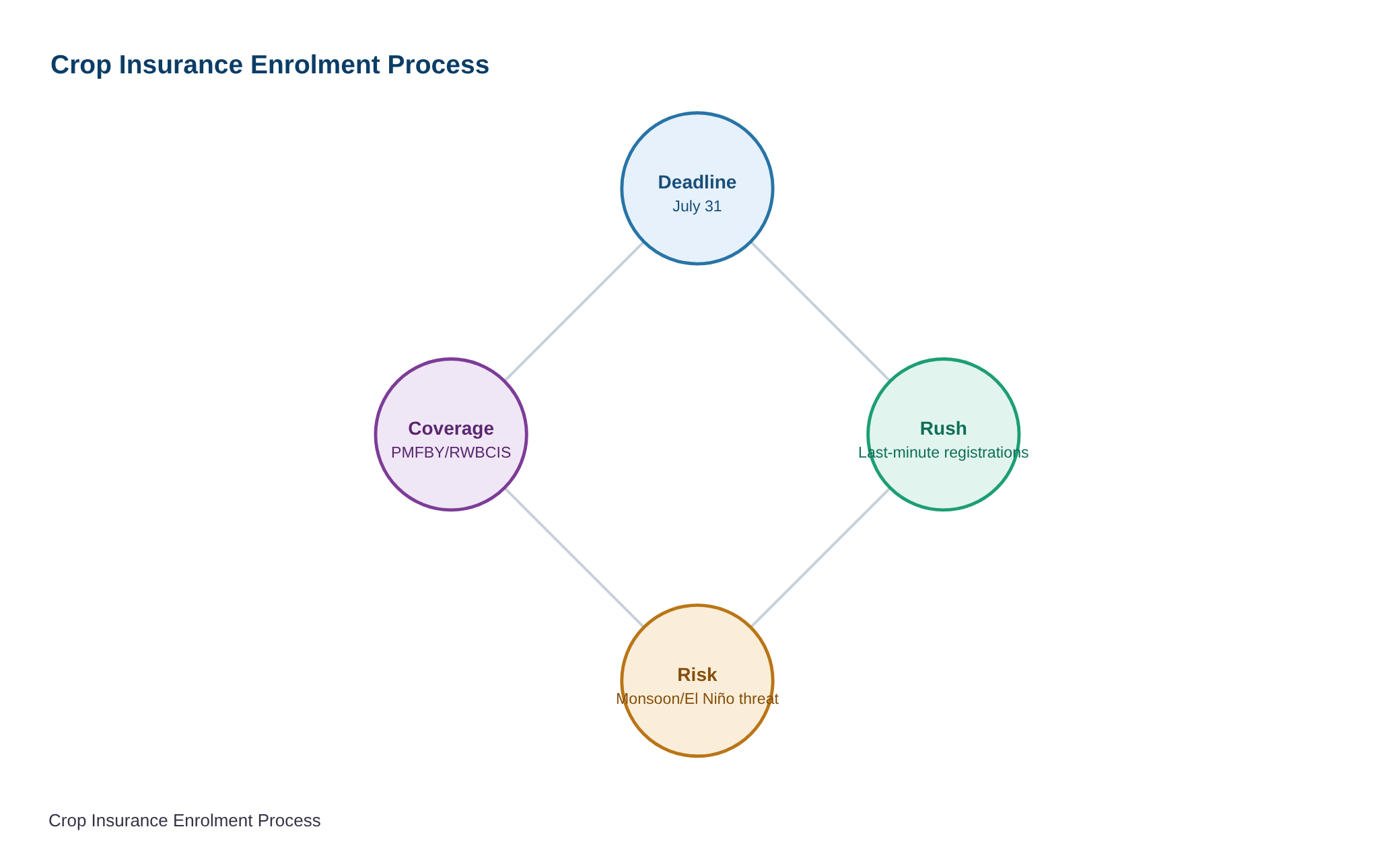
08 Aug July 31 Deadline: Last-Minute Rush for Crop Insurance in Rayalaseema
✎ PMFBY and RWBCIS are flagship crop insurance schemes designed to mitigate the financial risks of rainfed agriculture, with premiums subsidized for small and marginal farmers and claims triggered by either actual crop loss (PMFBY)…
Subject Relevance — Where This Topic Fits
- GS Paper III — Agriculture, Food Processing and Related Issues | GS Paper III — Disaster Management
- Prelims: PMFBY, RWBCIS, El Niño, Rayalaseema, monsoon variability, crop insurance, marginal farmers, horticulture crops
Quick Revision: PMFBY and RWBCIS are flagship crop insurance schemes designed to mitigate the financial risks of rainfed agriculture, with premiums subsidized for small and marginal farmers and claims triggered by either actual crop loss (PMFBY) or adverse weather parameters (RWBCIS).
Why is this in the news?
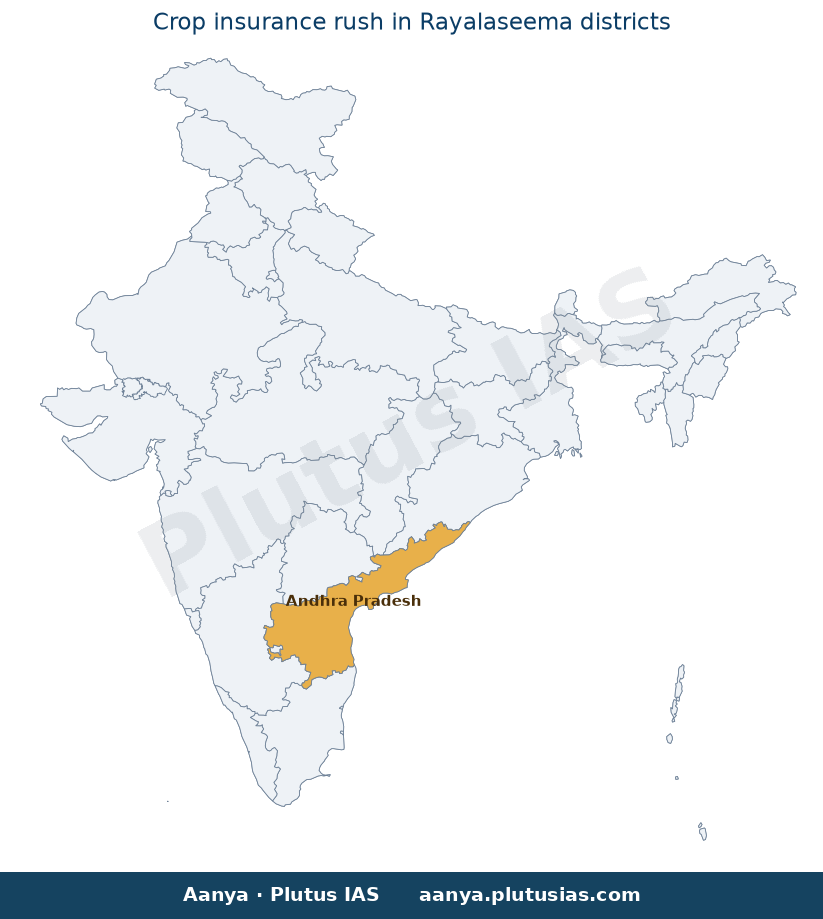
The impending July 31 deadline for enrolment under the Pradhan Mantri Fasal Bima Yojana (PMFBY) and Restructured Weather-Based Crop Insurance Scheme (RWBCIS) has triggered a last-minute surge in registrations in three districts of Andhra Pradesh’s Rayalaseema region—Sri Sathya Sai, Chittoor, and Annamayya—where agriculture remains critically dependent on monsoon rainfall. The urgency underscores the vulnerability of rainfed farming systems to climate variability, particularly in the context of an impending El Niño event, which threatens to exacerbate drought conditions and crop losses.
Background
- The Rayalaseema region in Andhra Pradesh is historically prone to erratic monsoon patterns, including delayed onset, prolonged dry spells, and unseasonal rainfall, which have intensified over the past several decades due to climate change.
- Agriculture in Rayalaseema is predominantly rainfed, with small and marginal farmers constituting the majority, making them highly susceptible to weather-induced crop failures.
- The region’s horticulture sector—dominated by mango, tomato, banana, and other fruit and vegetable crops—contributes significantly to rural livelihoods and regional economic growth, further amplifying the need for risk mitigation.
- The Government of India launched the Pradhan Mantri Fasal Bima Yojana (PMFBY) to provide comprehensive crop insurance coverage to farmers against natural calamities, pests, and diseases, replacing earlier fragmented schemes.
- The Restructured Weather-Based Crop Insurance Scheme (RWBCIS) complements PMFBY by offering insurance based on weather parameters such as rainfall, temperature, and humidity, which are critical for horticulture crops.
- El Niño events, characterized by abnormal warming of the Pacific Ocean, are associated with reduced monsoon rainfall in India, thereby increasing the risk of drought and crop failure in rainfed regions like Rayalaseema.
What are PMFBY and RWBCIS?
- **Pradhan Mantri Fasal Bima Yojana (PMFBY)**: A central sector scheme, PMFBY provides financial support to farmers in the event of crop loss due to natural calamities, pests, or diseases. It covers all food and oilseed crops, as well as horticulture crops, with premiums subsidized up to 90% for small and marginal farmers.
- The scheme operates on a ‘uniform premium’ model, where farmers pay a fixed premium (2% for kharif crops, 1.5% for rabi crops, and 5% for horticulture crops), while the remaining premium is shared equally by the central and state governments.
- PMFBY is implemented through a multi-agency framework involving insurance companies, banks, and state agriculture departments, with claims processed using technology such as remote sensing and smartphone-based crop cutting experiments.
- **Restructured Weather-Based Crop Insurance Scheme (RWBCIS)**: RWBCIS provides insurance coverage based on weather parameters (e.g., rainfall deficit, temperature anomalies) rather than actual crop loss, making it particularly suitable for horticulture and high-value crops.
- Under RWBCIS, the sum insured is linked to the cost of cultivation or the value of the crop, and claims are triggered when predefined weather thresholds are breached, ensuring faster payouts without the need for extensive field verification.
- Both schemes aim to reduce the financial burden on farmers by providing timely compensation, thereby stabilizing farm incomes and encouraging investment in agriculture.
- The schemes are voluntary for farmers but are actively promoted by state governments to enhance agricultural resilience, particularly in drought-prone regions like Rayalaseema.
- Data from the Ministry of Agriculture indicates that over 5 crore farmers have been enrolled under PMFBY since its inception, with cumulative claims exceeding ₹1.2 lakh crore.
Key Features
| Feature | Significance |
|---|---|
| Pradhan Mantri Fasal Bima Yojana (PMFBY) | Provides financial support to farmers in case of crop failure due to natural calamities, pests, or diseases, ensuring income security and reducing distress in agriculture-dependent regions. |
| Restructured Weather-Based Crop Insurance Scheme (RWBCIS) | Uses weather parameters as triggers for payouts, offering a more objective and timely compensation mechanism compared to traditional yield-based insurance. |
| Last-minute enrolment drive | Highlights the urgency and necessity of crop insurance in regions with high monsoon dependency, where delayed or erratic rainfall can severely impact agricultural output. |
| Small and marginal farmers’ participation | Emphasizes the critical role of crop insurance in safeguarding the livelihoods of smallholders, who form the majority of the farming community in Rayalaseema. |
| Regional vulnerability to climate variability | Demonstrates how districts like Sri Sathya Sai, Chittoor, and Annamayya face recurring challenges from delayed monsoons, dry spells, and unseasonal rainfall, necessitating risk mitigation tools. |
Why it Matters
Economic
- Crop insurance serves as a financial safety net, mitigating the economic losses incurred by farmers due to adverse weather events, thereby stabilising rural incomes.
- Enhances agricultural productivity by reducing the risk aversion among farmers, encouraging them to adopt modern farming practices and high-yielding varieties.
- Supports the agrarian economy in Rayalaseema, where horticulture crops like mango, tomato, and banana contribute significantly to regional GDP and employment.
Agricultural
- Provides resilience against climate-induced agricultural risks, particularly in rain-fed regions where monsoon variability directly impacts crop yields.
- Encourages sustainable agricultural practices by reducing the need for distress sales of assets or migration during crop failures.
- Facilitates access to credit for small and marginal farmers, as insurance coverage is often a prerequisite for availing institutional loans.
Policy and Governance
- Demonstrates the implementation challenges of centrally sponsored schemes at the grassroots level, particularly in ensuring last-mile delivery and awareness among farmers.
- Highlights the role of district administration in expediting enrolment drives, reflecting the importance of local governance in policy execution.
- Showcases the integration of weather-based triggers in insurance schemes, aligning agricultural risk management with scientific data.
Challenges
1. Low Awareness and Outreach
- Many small and marginal farmers remain unaware of the benefits and modalities of crop insurance schemes, leading to under-enrolment despite the July 31 deadline.
- Language barriers and limited digital literacy in rural areas hinder effective dissemination of scheme-related information.
UPSC Link: GS3: Agricultural Marketing & Issues
2. Implementation Bottlenecks
- Last-minute enrolment drives reflect systemic delays in scheme implementation, often due to bureaucratic hurdles or inadequate coordination between departments.
- Verification of claims and timely disbursement of compensation remain persistent challenges, eroding farmer trust in the system.
UPSC Link: GS2: Centre-State Relations
3. Climate Change and Unpredictability
- Increasing frequency of extreme weather events, such as delayed monsoons and unseasonal rainfall, complicates risk assessment and premium calculations for insurers.
- The projected El Niño impact exacerbates the distress scenario, making traditional insurance models less effective in addressing emerging risks.
UPSC Link: GS3: Environmental Pollution & Climate Change
4. Financial Sustainability
- High claim ratios in drought-prone regions like Rayalaseema strain the financial viability of insurance schemes, necessitating government subsidies to maintain affordability.
- Premium collection and timely premium payments by farmers pose logistical challenges, impacting the operational efficiency of the schemes.
UPSC Link: GS3: Food Security & Subsidies
Challenges — UPSC Perspective
| Issue | Concern |
|---|---|
| Farmer Awareness | Limited understanding of scheme benefits and procedures among small and marginal farmers, leading to low enrolment rates. |
| Bureaucratic Delays | Systemic inefficiencies in scheme implementation, reflected in last-minute enrolment drives and delayed claim settlements. |
| Climate Variability | Increasing unpredictability of monsoons and weather patterns, complicating risk assessment and premium calculations. |
| Financial Viability | High claim ratios in drought-prone regions threaten the sustainability of insurance schemes without adequate government support. |
| Verification Challenges | Difficulties in accurately assessing crop losses and verifying claims, leading to delays and disputes. |
| Digital Divide | Limited access to digital platforms in rural areas hinders seamless enrolment and claim processing. |
Way Forward
- Strengthen last-mile awareness campaigns through local self-help groups, cooperatives, and agricultural extension services to improve farmer participation.
- Streamline the enrolment and verification processes by leveraging digital platforms and mobile applications for real-time data collection.
- Enhance the role of district administration in coordinating between agriculture, horticulture, and revenue departments to expedite scheme implementation.
- Integrate climate-resilient agricultural practices and weather-based advisories to reduce the dependency on traditional insurance models.
- Improve the financial sustainability of insurance schemes by revising premium structures and exploring public-private partnerships for risk sharing.
- Conduct periodic reviews of claim settlement mechanisms to identify bottlenecks and ensure timely disbursement of compensation.
- Promote the adoption of climate-smart agriculture technologies to mitigate the impact of erratic weather patterns on crop yields.
- Expand the coverage of horticulture crops under insurance schemes to include high-value fruits and vegetables, boosting regional economic resilience.
UPSC Value Addition
Keywords for Mains Answer-Writing
Pradhan Mantri Fasal Bima Yojana (PMFBY) · Restructured Weather-Based Crop Insurance Scheme (RWBCIS) · Rayalaseema region vulnerability · monsoon-dependent agriculture · small and marginal farmers · El Niño impact on agriculture · financial security for farmers · climate-resilient agriculture · agricultural insurance schemes · rural economy and livelihoods
Concept Flow
Delayed monsoons and climate variability → Increased risk of crop failure in rain-fed regions like Rayalaseema. → Crop failure leads to financial distress for small and marginal farmers, threatening livelihoods and food security. → Government introduces crop insurance schemes (PMFBY, RWBCIS) to provide financial safety nets and stabilise rural incomes. → Farmer enrolment in insurance schemes remains low due to awareness gaps, bureaucratic delays, and verification challenges. → Last-minute enrolment drives highlight systemic inefficiencies and the urgent need for last-mile delivery improvements. → Timely insurance coverage enables farmers to adopt riskier but higher-yielding agricultural practices, enhancing productivity. → Effective implementation of insurance schemes contributes to agricultural resilience, economic stability, and sustainable development.
Prelims Practice Questions
Q1. Consider the following statements regarding the Pradhan Mantri Fasal Bima Yojana (PMFBY):
1. PMFBY is a voluntary scheme for farmers.
2. It provides insurance coverage for all types of crops including horticulture crops.
3. The premium rates are uniform across all states and union territories.
4. The scheme is implemented by the Ministry of Agriculture and Farmers’ Welfare.
How many of the above statements are correct?
- Only one
- Only two
- Only three
- All
Answer: Only three — Statements 1 and 4 are correct. PMFBY is voluntary for farmers, and it is implemented by the Ministry of Agriculture and Farmers’ Welfare. Statement 2 is incorrect as the scheme primarily covers notified crops, not all types. Statement 3 is incorrect as premium rates vary by state and crop.
Q2. Assertion (A): The Restructured Weather-Based Crop Insurance Scheme (RWBCIS) provides compensation based on weather parameters rather than actual crop loss.
Reason (R): RWBCIS is designed to address the challenges of delayed monsoons and dry spells in regions like Rayalaseema.
Options:
A. Both A and R are true, and R is the correct explanation of A.
B. Both A and R are true, but R is not the correct explanation of A.
C. A is true, but R is false.
D. A is false, but R is true.
- A
- B
- C
- D
Answer: A — Both the assertion and reason are true. RWBCIS indeed compensates farmers based on weather parameters (e.g., rainfall deficit) rather than actual crop loss, and it is specifically designed to address weather-related risks in regions like Rayalaseema.
Q3. Match the following crop insurance schemes with their key features:
Column I (Scheme) | Column II (Feature)
1. PMFBY | a. Covers horticulture crops
2. RWBCIS | b. Compensation based on weather parameters
3. National Agricultural Insurance Scheme (NAIS) | c. Premium subsidy shared by Centre and States
4. Weather-Based Crop Insurance Scheme (WBCIS) | d. Covers all notified crops including cereals, pulses, and oilseeds
Options:
A. 1-a, 2-b, 3-d, 4-c
B. 1-d, 2-b, 3-c, 4-a
C. 1-c, 2-a, 3-d, 4-b
D. 1-b, 2-d, 3-a, 4-c
- A
- B
- C
- D
Answer: B — Correct matches: 1-d (PMFBY covers all notified crops), 2-b (RWBCIS compensates based on weather parameters), 3-c (NAIS premium subsidy is shared by Centre and States), 4-a (WBCIS covers horticulture crops).
Mains Practice Question
✍ The Pradhan Mantri Fasal Bima Yojana (PMFBY) and the Restructured Weather-Based Crop Insurance Scheme (RWBCIS) represent critical interventions to mitigate agricultural risks in climate-vulnerable regions like Rayalaseema. Critically examine the effectiveness of these schemes in providing financial security to small and marginal farmers, with particular reference to their design, implementation challenges, and the role of weather uncertainties. Also, discuss the socio-economic implications of widespread adoption of such insurance mechanisms for rural livelihoods. (15 Marks)
Approach: MODEL-ANSWER SKELETON:
1. **Introduction (2 marks)**
– Briefly define PMFBY and RWBCIS, their objectives, and their relevance in the context of climate change and monsoon-dependent agriculture.
– Cite the recent enrolment rush in Rayalaseema districts as a contemporary hook.
2. **Design and Coverage (3 marks)**
– PMFBY: Covers all notified crops (cereals, pulses, oilseeds), voluntary participation, premium subsidy (up to 90% for farmers), and actuarial premium rates.
– RWBCIS: Weather-based compensation (e.g., rainfall deficit, temperature anomalies), covers horticulture crops, and is implemented in high-risk regions.
– Contrast with earlier schemes like NAIS and WBCIS to highlight improvements.
3. **Implementation Challenges (4 marks)**
– Last-minute enrolment rush: Administrative bottlenecks, awareness gaps among small farmers, and digital divide.
– Weather parameter limitations: Difficulty in accurately measuring micro-climatic variations; disputes over compensation triggers.
– Financial sustainability: High claims in drought/flood years straining state and central budgets.
– Data infrastructure: Lack of real-time weather data and crop loss assessment mechanisms.
4. **Effectiveness in Providing Financial Security (3 marks)**
– Success stories: Instances where PMFBY/RWBCIS disbursed timely compensation (e.g., drought in 2020-21).
– Limitations: Inadequate coverage for horticulture crops, exclusion of tenant farmers, and delays in claim settlement.
– Role of weather uncertainties: El Niño impact exacerbating risks; need for dynamic premium adjustments.
5. **Socio-Economic Implications (3 marks)**
– Livelihood security: Reduced distress migration and increased investment in agriculture due to risk mitigation.
– Rural credit access: Banks and financial institutions more willing to lend to insured farmers.
– Gender dimensions: Women farmers, who constitute a significant portion of smallholders, often face exclusion due to land-title issues.
– Long-term resilience: Encourages adoption of climate-resilient practices and diversification.
6. **Conclusion (2 marks)**
– Summarize the dual role of PMFBY and RWBCIS as both safety nets and catalysts for agricultural transformation.
– Highlight the need for technological integration (e.g., AI-driven weather forecasting) and policy reforms (e.g., mandatory coverage for tenant farmers) to enhance effectiveness.
Source: The Hindu
Generated by AanyaAi for educational purpose.

- मद्रास उच्च न्यायालय ने एआईएडीएमके के व्हिप के मामले को खारिज किया, मेकेदातू संशोधन पर तमिलनाडु विधानसभा का फैसला बरकरार - September 23, 2026
- Madras HC Rejects AIADMK Plea Against Mekedatu Resolution Amendment - September 23, 2026
- कर्नाटक में उद्योग-आधारित पाठ्यक्रम तैयार करेगा विशेष समिति: मुख्यमंत्री - September 23, 2026

No Comments