


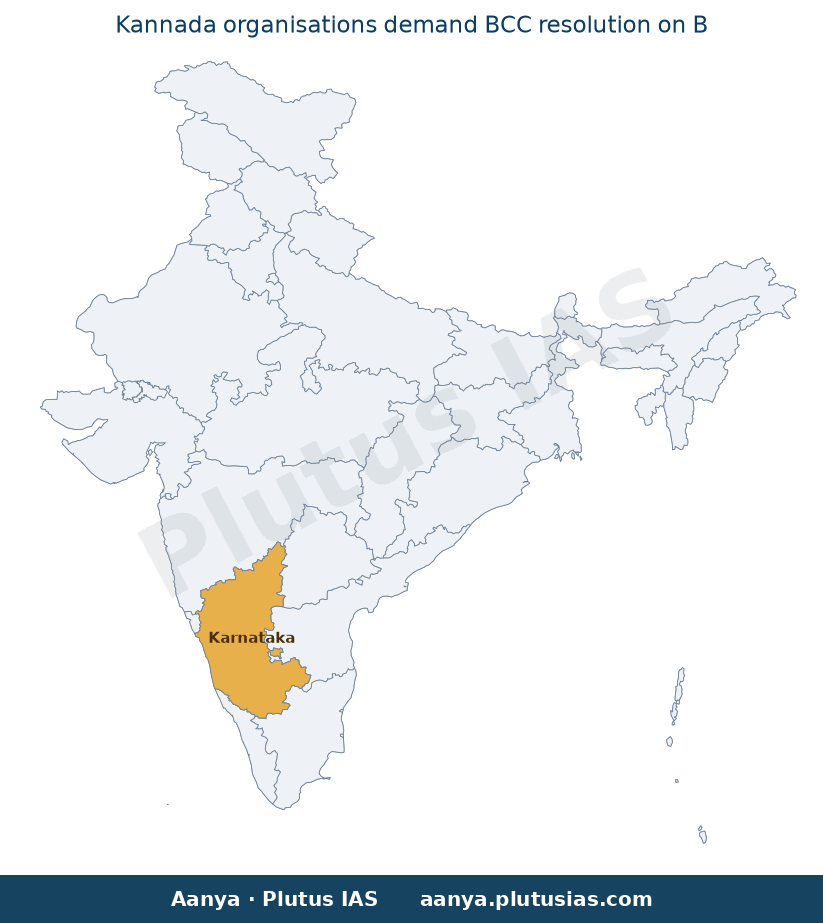
11 Aug Kannada Groups Push BCC for Mahajan Commission Resolution in Belagavi
✎ Urban local bodies like the Belagavi City Corporation function under the 74th Constitutional Amendment Act and state municipal laws to address local governance issues within their jurisdictions.
Subject Relevance — Where This Topic Fits
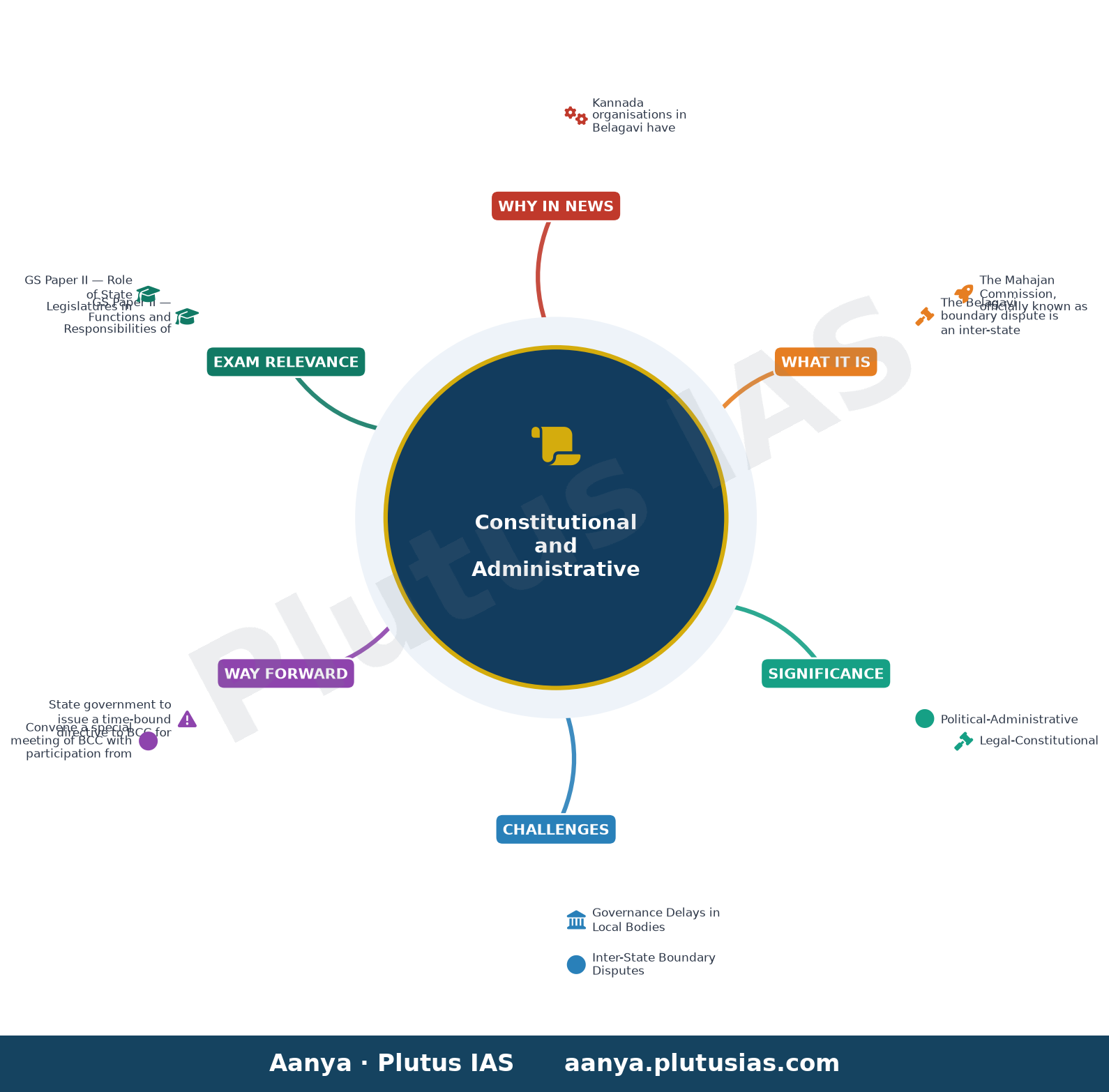
- GS Paper II — Functions and Responsibilities of the Union and the States, Issues and Challenges Pertaining to the Federal Structure, Devolution of Powers and Finances up to Local Levels and Challenges Therein | GS Paper II — Role of State Legislatures in Democratic Polity | GS Paper III — Role of Local Self-Governments in Urban Governance and Conflict Resolution
- Prelims: Belagavi boundary dispute, Mahajan Commission, Belagavi City Corporation (BCC), Urban Local Bodies (ULBs), 74th Constitutional Amendment Act, State Finance Commission, Karnataka Municipal Corporations Act, 1976
- Essay: Federalism and the Challenges of Inter-State Boundary Disputes in India, The Role of Local Governance in National Integration: Lessons from Belagavi
Quick Revision: Urban local bodies like the Belagavi City Corporation function under the 74th Constitutional Amendment Act and state municipal laws to address local governance issues within their jurisdictions.
Why is this in the news?
Kannada organisations in Belagavi have announced their intention to meet the Chief Minister of Karnataka to seek directions for the Belagavi City Corporation (BCC) to pass a resolution affirming Belagavi as an integral part of Karnataka. This development underscores the ongoing administrative and political tensions surrounding the long-standing boundary dispute between Karnataka and Maharashtra, and highlights the role of urban local bodies in addressing such issues within the framework of constitutional federalism.
Background
- The Belagavi (formerly Belgaum) boundary dispute is a protracted inter-state conflict between Karnataka and Maharashtra, originating from the reorganisation of states in 1956 under the States Reorganisation Act, 1956, which left certain regions with mixed linguistic demographics.
- The Mahajan Commission, constituted in 1966, was tasked with examining the dispute and submitted its report in 1967, recommending the transfer of certain areas to Maharashtra while retaining Belagavi with Karnataka. The report was not fully accepted by either state, leading to continued contention.
- The Karnataka Municipal Corporations Act, 1976, governs the functioning of municipal corporations in the state, including the BCC, and outlines their powers to pass resolutions on matters of local and state significance.
- The dispute has periodically resurfaced, with political and social organisations in Karnataka asserting Belagavi’s integral status within the state, while similar voices in Maharashtra advocate for its inclusion in their jurisdiction.
- The role of ULBs in such disputes is constitutionally significant, as they serve as the first point of administrative contact for citizens and can influence public sentiment and policy through formal resolutions.
What is the Belagavi Boundary Dispute and the Role of the Mahajan Commission?
- The Belagavi boundary dispute is an inter-state territorial conflict between Karnataka and Maharashtra, rooted in linguistic and administrative reorganisation post-independence, particularly the States Reorganisation Act, 1956.
- The Mahajan Commission, officially known as the Mahajan Committee, was constituted by the Union Government in 1966 under the chairmanship of Justice Mehr Chand Mahajan to examine and resolve the dispute. The committee submitted its report in 1967, recommending a partial reallocation of territories, including certain areas near Belagavi.
- The Commission’s recommendations were not binding, and neither state fully accepted the report, leading to continued disagreement over the status of Belagavi and surrounding regions. The dispute remains unresolved in the absence of a mutually agreed settlement.
- The 74th Constitutional Amendment Act, 1992, introduced Part IX-A to the Constitution, establishing a three-tier system of local self-government in urban areas, including municipal corporations like the BCC, with defined functions and powers.
- The Karnataka Municipal Corporations Act, 1976, provides the legal framework for the establishment, powers, and functions of municipal corporations in Karnataka, including the BCC. The Act empowers the corporation to pass resolutions on matters of local and state importance, subject to state government oversight.
- The current demand by Kannada organisations for the BCC to pass a resolution affirming Belagavi’s integral status reflects the utilisation of local governance institutions as platforms for asserting state identity and mobilising public opinion within the constitutional framework.
Key Features
| Feature | Significance |
|---|---|
| Mahajan Commission | A judicial or quasi-judicial body constituted to examine and resolve inter-state boundary disputes, particularly concerning the Belagavi region. |
| Belagavi City Corporation (BCC) | The local governing body responsible for urban administration in Belagavi, including resolution of civic issues and policy implementation. |
| Resolution in favour of Mahajan Commission | A formal declaration by BCC affirming Belagavi’s integral part of Karnataka, reflecting local legislative intent. |
| Kannada organisations’ delegation | A collective of regional cultural and linguistic groups advocating for statehood integrity and administrative clarity. |
| Urban Development Minister’s assurance | A policy directive issued to BCC to expedite the resolution process, underscoring state government’s role in local governance. |
Why it Matters
Political-Administrative
- Demonstrates the interplay between local self-governance (BCC) and state-level policy directives in resolving inter-state boundary disputes.
- Highlights the role of cultural organisations in shaping regional identity and administrative priorities.
- Exposes potential governance gaps where assurances from state ministers are not translated into local action.
Legal-Constitutional
- Reinforces the constitutional framework for inter-state disputes under Article 263, where state governments mediate boundary issues.
- Underscores the importance of local bodies in implementing state policies, as envisaged under the 74th Constitutional Amendment Act.
Social-Cultural
- Reflects the linguistic and cultural identity movements in Karnataka, particularly concerning the Kannada-speaking regions.
- Illustrates the role of civil society in influencing public policy and administrative decisions.
Challenges
1. Governance Delays in Local Bodies
- Inordinate delays by BCC in passing resolutions despite state ministerial assurances.
- Absence of monthly meetings by the Mayor since May 13, 2026, indicating administrative dysfunction.
- Failure to comply with directives from higher authorities (e.g., Chief Secretary), raising questions about local autonomy vs. state oversight.
UPSC Link: 74th CAA: State-local relations
2. Inter-State Boundary Disputes
- Prolonged ambiguity over Belagavi’s status creates administrative and developmental uncertainties.
- Potential for escalation if unresolved, affecting public services, infrastructure, and citizen welfare.
- Historical precedence of such disputes (e.g., Maharashtra-Karnataka border) necessitates structured resolution mechanisms.
UPSC Link: Article 263: Inter-State Councils
3. Civil Society Mobilisation
- Rising public protests and delegations may pressure governments but risk politicisation of administrative issues.
- Need for structured dialogue between civil society, local bodies, and state governments to avoid confrontational approaches.
UPSC Link: Role of NGOs in governance
Challenges — UPSC Perspective
| Issue | Concern |
|---|---|
| Administrative Delays | BCC’s inaction despite state directives undermines governance credibility. |
| Legal Ambiguity | Unresolved boundary disputes create uncertainty in land records and civic administration. |
| Public Trust Erosion | Failure to address citizen demands may lead to erosion of faith in local institutions. |
| Coordination Gaps | Lack of alignment between state ministers, local bodies, and civil society exacerbates the problem. |
Way Forward
- State government to issue a time-bound directive to BCC for passing the resolution within 30 days.
- Convene a special meeting of BCC with participation from district administration to ensure compliance.
- Establish a grievance redressal mechanism for citizens affected by boundary disputes.
- Conduct a joint review by the Urban Development Department and Local Administration to assess local governance bottlenecks.
- Engage civil society organisations in structured dialogues to align demands with administrative feasibility.
- Explore mediation through the Inter-State Council to formalise a resolution mechanism for boundary disputes.
- Strengthen capacity-building for local bodies in policy implementation and public service delivery.
UPSC Value Addition
Keywords for Mains Answer-Writing
Mahajan Commission · Belagavi City Corporation · Karnataka-Karnataka border disputes · Inter-State Relations · Local self-government under 73rd and 74th Amendments · Role of Mayor and Municipal Corporation · Constitutional provisions for urban local bodies · Inter-State Water Disputes Act, 1956 · Federalism in India · Constitutional remedies for inter-state disputes · Administrative delays in local governance · Role of Chief Secretary in inter-state disputes · Urban Development Ministry’s jurisdiction · Constitutional status of municipalities · Inter-State Council and dispute resolution
Constitutional & Policy Linkages
- Article 263: Inter-State Councils for resolving disputes
- 74th Constitutional Amendment Act: Empowerment of urban local bodies
Concept Flow
Inter-state boundary dispute (Belagavi) -> Local governance failure (BCC inaction) -> Civil society mobilisation (Kannada organisations) -> State government intervention (ministerial assurances) -> Administrative impasse (lack of compliance) -> Escalation (public protests, delegations) -> Need for structured resolution (mediation, directives)
Prelims Practice Questions
Q1. Consider the following statements regarding the Mahajan Commission:
1. The Mahajan Commission was constituted to resolve the Belagavi border dispute between Karnataka and Maharashtra.
2. The Commission submitted its report in 2006, recommending that Belagavi remain with Karnataka.
3. The Commission’s recommendations are binding on both states as per the Inter-State Water Disputes Act, 1956.
How many of the above statements are correct?
- Only one
- Only two
- All three
- None
Answer: Only two — Statement 1 is correct. Statement 2 is correct as the Mahajan Commission submitted its report in 2006. Statement 3 is incorrect because the Commission’s recommendations are not binding; they are advisory and subject to acceptance by the respective state governments.
Q2. Assertion (A): The 74th Constitutional Amendment Act, 1992, provides for the establishment of a three-tier system of urban local bodies in India.
Reason (R): The Act mandates the reservation of seats for women and Scheduled Castes/Scheduled Tribes in these bodies.
Options:
A. Both A and R are true, and R is the correct explanation of A.
B. Both A and R are true, but R is not the correct explanation of A.
C. A is true, but R is false.
D. A is false, but R is true.
Answer: ? — Assertion (A) is true as the 74th Amendment Act mandates a three-tier system of urban local bodies. Reason (R) is also true but does not directly explain the assertion, as the reservation provisions are a separate mandate under the Act.
Q3. Match the following pairs related to inter-state disputes in India:
Column I (Dispute/Commission) Column II (Year of Establishment)
1. Mahajan Commission A. 1969
2. Godavari Water Disputes Tribunal B. 2006
3. Krishna Water Disputes Tribunal C. 1976
4. Ravi & Beas Waters Tribunal D. 2004
Options:
A. 1-D, 2-C, 3-A, 4-B
B. 1-B, 2-D, 3-C, 4-A
C. 1-C, 2-A, 3-D, 4-B
D. 1-A, 2-B, 3-C, 4-D
- A
- B
- C
- D
Answer: B — 1-B: Mahajan Commission was established in 2006. 2-D: Godavari Water Disputes Tribunal was established in 2004. 3-A: Krishna Water Disputes Tribunal was established in 1976. 4-C: Ravi & Beas Waters Tribunal was established in 1969.
Mains Practice Question
✍ The demand for a resolution affirming Belagavi as an integral part of Karnataka by the Belagavi City Corporation (BCC) reflects underlying tensions in India’s federal structure. Critically examine the constitutional and administrative mechanisms available to resolve such inter-state disputes. Also, elucidate the role of urban local bodies in this context, with reference to the 74th Constitutional Amendment Act, 1992. (15 Marks)
Approach: MODEL-ANSWER SKELETON:
1. **Introduction (2 marks)**: Define inter-state disputes and their constitutional context under Part XI (Articles 262-263) of the Constitution. Mention the Belagavi dispute as a case study of federalism in action.
2. **Constitutional Mechanisms (4 marks)**:
– Article 262: Adjudication of inter-state water disputes (Inter-State Water Disputes Act, 1956).
– Article 263: Provision for an Inter-State Council to investigate and advise on disputes.
– Role of the Supreme Court under Article 131 (original jurisdiction) and Article 32 (writs).
– Advisory role of the President under Article 143 (not applicable here).
3. **Administrative Mechanisms (4 marks)**:
– Role of the Union Ministry of Home Affairs and Ministry of Urban Development in coordinating between states.
– Functioning of the Chief Secretary as a nodal officer in inter-state disputes.
– The 74th Amendment Act, 1992: Empowerment of urban local bodies (ULBs) like BCC. Key provisions: Article 243P-243ZG, 243W (functions), 243T (reservation), and 243U (financial devolution).
– Limitations: ULBs lack binding authority in inter-state disputes; their role is consultative.
4. **Case Study: Belagavi Dispute (3 marks)**:
– Background: Historical context of the Belagavi border dispute and the Mahajan Commission (2006).
– Current impasse: Delay in BCC resolution, role of Mayor and Deputy Mayor, and administrative lapses.
– Legal recourse: Petitioning the Supreme Court or seeking intervention from the Inter-State Council.
5. **Conclusion (2 marks)**:
– Federalism requires cooperative federalism; disputes should be resolved through dialogue and institutional mechanisms.
– ULBs, while empowered, cannot unilaterally resolve inter-state disputes but can influence policy through resolutions and public advocacy.
– Emphasize the need for timely administrative action and constitutional remedies to uphold federal harmony.
Source: The Hindu
Generated by AanyaAi for educational purpose.

- Piyush Goyal Attends G20 Trade Ministers’ Meeting in Milwaukee - October 1, 2026
- विशेष अभियान-6: कोल इंडिया लिमिटेड की तैयारी पर केंद्र सरकार की निगरानी - October 1, 2026
- ECL’s Action Plan for Special Campaign 6: A UPSC Governance Case Study - October 1, 2026

No Comments