


11 Aug Kannada groups to urge CM to direct BCC on Mahajan Commission resolution
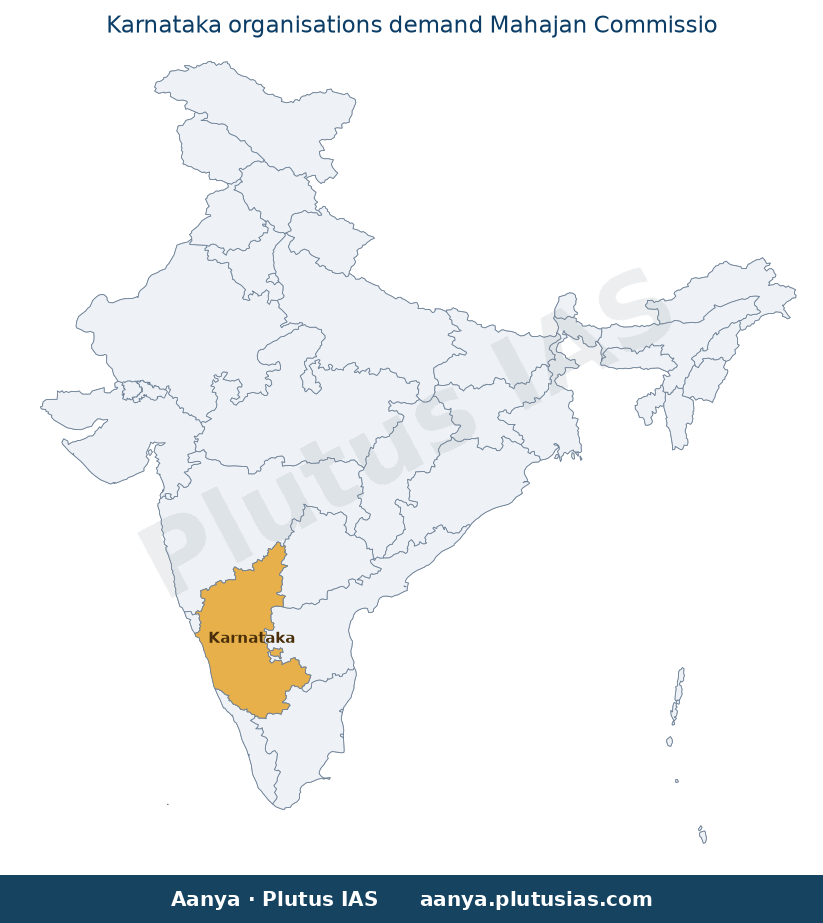
✎ The Mahajan Commission’s 1967 report, accepted by the Government of India, affirmed Belagavi’s inclusion in Karnataka, and its findings remain a reference point for territorial integrity debates in the region.
Subject Relevance — Where This Topic Fits
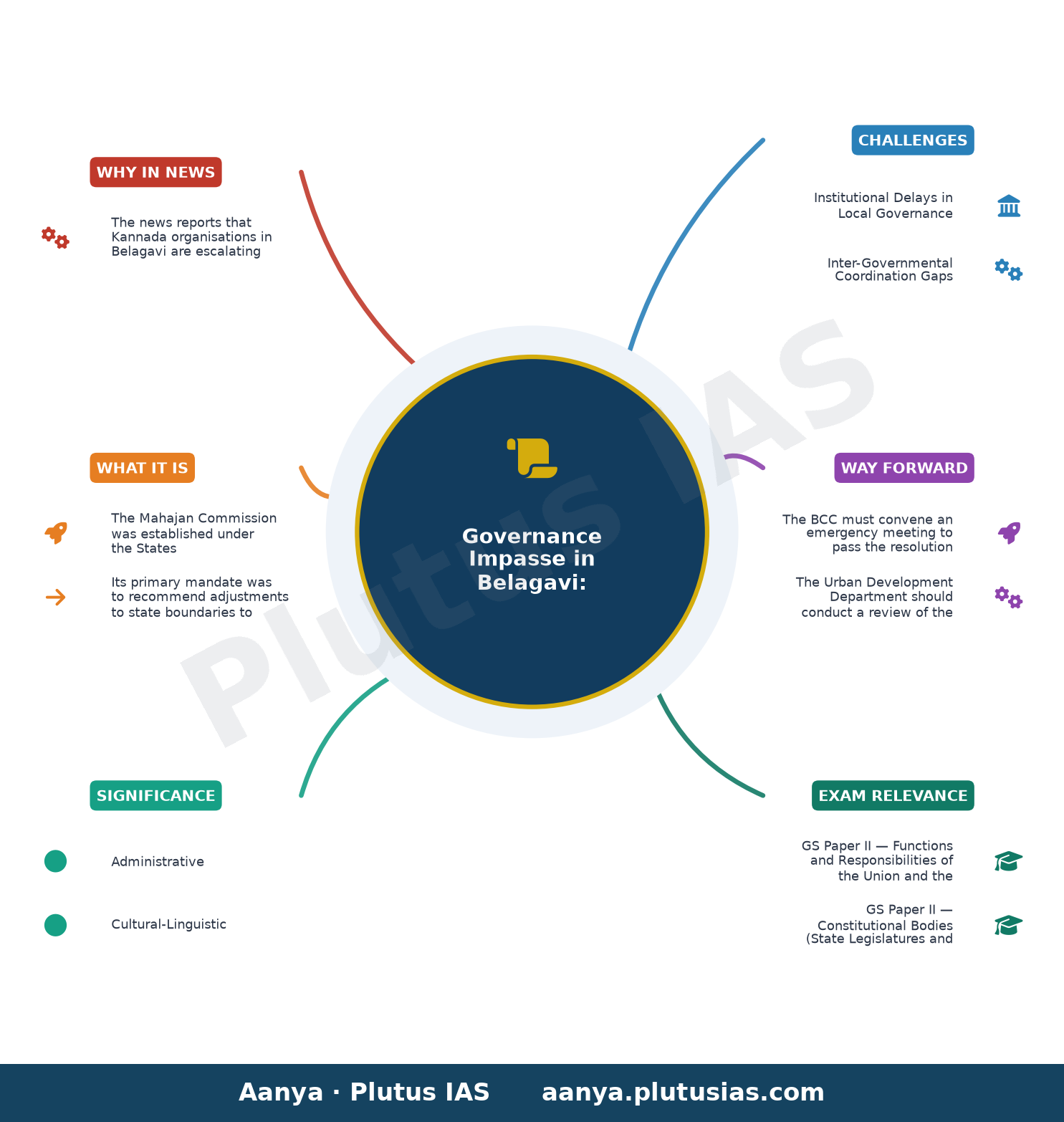
- GS Paper II — Functions and Responsibilities of the Union and the States, Federalism | GS Paper II — Constitutional Bodies (State Legislatures and Local Governments)
- Prelims: Belagavi City Corporation (BCC), Mahajan Commission, Article 243U (Constitution of Municipalities), Urban Local Bodies (ULBs), Karnataka Municipal Corporations Act, 1976, Constitutional provisions on municipal governance
- Essay: Federalism and cooperative governance in India, Role of local self-governance in national integration
Quick Revision: The Mahajan Commission’s 1967 report, accepted by the Government of India, affirmed Belagavi’s inclusion in Karnataka, and its findings remain a reference point for territorial integrity debates in the region.
Why is this in the news?
The news reports that Kannada organisations in Belagavi are escalating their demand for the Belagavi City Corporation (BCC) to pass a resolution affirming Belagavi’s integral status within Karnataka, citing prolonged inaction by the municipal body despite directives from higher authorities. This impasse highlights institutional friction between local governance structures and state-level political-administrative processes, raising questions about the efficacy of constitutional and statutory mechanisms in resolving inter-state boundary disputes and ensuring local self-governance.
Background
- Belagavi has been a subject of inter-state boundary disputes between Karnataka and Maharashtra, with claims based on linguistic and administrative considerations.
- The Belagavi City Corporation (BCC), as a statutory urban local body under the Karnataka Municipal Corporations Act, 1976, is mandated to pass resolutions on matters of local governance, including those pertaining to territorial integrity and civic identity.
- The Chief Secretary of Karnataka had issued a directive to the BCC to comply with the resolution, yet the municipal body has not convened a meeting since May 13, 2026, exacerbating the governance vacuum.
- Article 243U of the Constitution of India empowers municipal bodies to function as institutions of self-government, with responsibilities including the preservation of local identity and governance.
What is the Mahajan Commission and its relevance to Belagavi?
- The Mahajan Commission was established under the States Reorganisation Act, 1956, to address boundary disputes arising from the linguistic reorganisation of states in post-independence India.
- Its primary mandate was to recommend adjustments to state boundaries to align with linguistic and administrative considerations, ensuring administrative convenience and cultural cohesion.
- The Commission’s findings have been periodically invoked in debates on territorial integrity, particularly in regions with historical claims from multiple states, such as Belagavi.
- The resolution sought by Kannada organisations is symbolic of the broader assertion of Karnataka’s administrative and cultural sovereignty over Belagavi, a region with historical ties to both Karnataka and Maharashtra.
- The demand for the BCC to pass a resolution reaffirming Belagavi’s status within Karnataka is rooted in the constitutional principle of local self-governance (Article 243U) and the statutory obligations of municipal corporations under state laws.
- The impasse underscores the challenges in translating constitutional and statutory provisions into administrative action at the local governance level, particularly in politically sensitive regions.
Key Features
| Feature | Significance |
|---|---|
| Mahajan Commission | A judicial commission constituted to examine the border dispute between Karnataka and Maharashtra, particularly concerning Belagavi (then Belgaum), with implications for linguistic and administrative identity. |
| Belagavi City Corporation (BCC) | The local self-government body responsible for urban governance in Belagavi, whose resolution on the city’s territorial status carries symbolic and administrative weight. |
| Kannada organisations’ delegation | A collective of cultural and linguistic advocacy groups seeking to influence policy through direct engagement with the state executive, reflecting grassroots civic participation. |
| Urban Development Minister’s assurance | A ministerial commitment to direct the BCC, demonstrating the executive’s role in resolving inter-institutional disputes and ensuring policy compliance. |
| Chief Secretary’s directive | An administrative order issued to enforce compliance by the BCC, highlighting the hierarchy of governance and the role of bureaucratic oversight in local bodies. |
Why it Matters
Administrative
- The demand for a BCC resolution underscores the principle of local self-government (Article 243W) and the need for institutional alignment with state policy on territorial integrity.
- The delay in passing the resolution reflects challenges in inter-governmental coordination between local bodies, state ministries, and the executive.
- The intervention of higher administrative authorities (Chief Secretary, Urban Development Minister) highlights the layered nature of governance in resolving disputes involving local institutions.
Cultural-Linguistic
- The agitation by Kannada organisations reflects the enduring significance of linguistic identity in shaping regional politics and administrative demands.
- Belagavi’s status as a contested territory has historical roots in the linguistic reorganisation of states (1956), making the dispute a recurring theme in Karnataka’s socio-political discourse.
- The demand for a resolution aligns with the broader discourse on federalism and the protection of regional linguistic identities within India’s constitutional framework.
Legal-Institutional
- The Mahajan Commission’s findings, if endorsed by the BCC, could influence inter-state relations and set a precedent for resolving border disputes through institutional resolutions rather than judicial interventions.
- The failure of the BCC to convene meetings (since May 13) raises questions about the functional autonomy of local bodies and their responsiveness to civic demands.
Challenges
1. Institutional Delays in Local Governance
- The BCC’s failure to pass the resolution despite directives from higher authorities indicates systemic inefficiencies in local self-government bodies.
- The absence of monthly meetings since May 2026 suggests a breakdown in the regular functioning of the BCC, undermining democratic accountability.
- The lack of transparency in the BCC’s decision-making process further erodes public trust in local institutions.
UPSC Link: 7th Schedule (Local Government)
2. Inter-Governmental Coordination Gaps
- The disconnect between the Urban Development Minister’s assurance and the BCC’s inaction highlights gaps in the implementation of executive directives at the local level.
- The Chief Secretary’s directive being ignored underscores the challenges in enforcing administrative orders across hierarchical tiers of governance.
- The delegation’s appeal to the Chief Minister reflects the need for higher-level intervention to resolve inter-institutional disputes.
UPSC Link: Article 256 (Executive Power of State)
3. Civic Mobilisation vs. Institutional Stagnation
- The prolonged protest by Kannada organisations (nearly four months) demonstrates the limitations of civic engagement in the absence of responsive institutional mechanisms.
- The failure of the Mayor and Deputy Mayor to address the demands raises questions about the accountability of elected representatives in local bodies.
- The complaint to the Chief Secretary indicates a reliance on bureaucratic rather than electoral channels to seek redressal.
UPSC Link: 74th Amendment Act (Municipalities)
Challenges — UPSC Perspective
| Issue | Concern |
|---|---|
| Delay in BCC resolution | Erosion of public trust in local institutions and delayed affirmation of Belagavi’s territorial status. |
| Absence of BCC meetings | Breakdown in the regular functioning of the local body, undermining democratic processes. |
| Non-compliance with directives | Failure of the BCC to adhere to higher administrative orders, indicating governance failures. |
| Civic protests | Prolonged agitation reflects the disconnect between civic aspirations and institutional responsiveness. |
| Executive intervention required | Need for higher-level intervention to resolve inter-institutional disputes, highlighting coordination gaps. |
Way Forward
- The BCC must convene an emergency meeting to pass the resolution affirming Belagavi’s status as an integral part of Karnataka, as per the Mahajan Commission’s findings.
- The Urban Development Department should conduct a review of the BCC’s functioning to identify systemic bottlenecks and ensure timely compliance with executive directives.
- The Chief Secretary’s office should issue a follow-up directive to the BCC, accompanied by a timeline for compliance, to reinforce administrative accountability.
- The Mayor and Deputy Mayor should be held accountable for the prolonged inaction, with potential disciplinary action if necessary, to restore institutional credibility.
- The state government should establish a grievance redressal mechanism for local bodies to address civic demands promptly and transparently.
- The Mahajan Commission’s report should be formally adopted by the state government to provide a definitive resolution to the border dispute.
- A multi-stakeholder dialogue involving Kannada organisations, local representatives, and state officials should be initiated to foster consensus and prevent future disputes.
UPSC Value Addition
Keywords for Mains Answer-Writing
Belagavi dispute · Mahajan Commission · Karnataka-Karnataka boundary issues · Belagavi City Corporation (BCC) · institutional delays in governance · State-City relations · urban local bodies (ULBs) · constitutional provisions for local governance · federalism in India · inter-state boundary disputes · Article 243R (Constitution of Municipalities) · Article 243Z (Constitution of Municipal Corporations) · role of State governments in boundary disputes · institutional accountability in public administration · Mahajan Commission report · Karnataka State Official Language Act, 1963 · Karnataka State flag controversy · federalism and cooperative federalism · local self-government and federalism
Constitutional & Policy Linkages
- Article 243W – Powers, authority and responsibilities of Municipalities
- Article 243ZD – Committee on Metropolitan Planning
Concept Flow
Kannada organisations demand BCC resolution on Belagavi’s territorial status → BCC fails to act despite directives → Protests and appeals to higher authorities → Chief Secretary issues directive → BCC remains unresponsive → Delegation meets Chief Minister for intervention. → Local self-government (BCC) fails to function → Executive (Urban Development Minister) issues assurance → Administrative order (Chief Secretary’s directive) issued → Institutional non-compliance persists → Higher-level intervention sought. → Linguistic identity (Kannada organisations) drives civic demand → Historical context (1956 linguistic reorganisation) → Administrative dispute (Mahajan Commission) → Political mobilisation → Governance challenge (institutional delays). → BCC resolution sought → Symbolic affirmation of territorial integrity → Potential impact on inter-state relations → Legal-institutional precedent for border disputes. → Civic protest (4 months) → Failure of local mechanisms → Appeal to bureaucracy → Need for executive intervention → Governance reform required. → Executive power (Article 256) invoked → Administrative directive issued → Compliance failure → Systemic governance challenge identified.
Prelims Practice Questions
Q1. Consider the following statements regarding the Mahajan Commission: 1. It was constituted to resolve the Belagavi boundary dispute between Karnataka and Maharashtra. 2. The Commission submitted its report in 1967. 3. The report was fully accepted by both states without any objections. 4. The Commission recommended that Belagavi should remain with Karnataka. How many of the above statements are correct?
- Only one
- Only two
- Only three
- All four
Answer: Only three — Statements 1 and 4 are correct as the Mahajan Commission was indeed constituted to resolve the Belagavi boundary dispute and recommended that Belagavi remain with Karnataka. Statement 2 is incorrect because the Commission submitted its report in 1966, not 1967. Statement 3 is incorrect as the report faced objections and was not fully accepted by both states.
Q2. Assertion (A): The Belagavi City Corporation (BCC) is a statutory body under the Constitution of India. Reason (R): Article 243R of the Constitution provides for the constitution of Municipalities, including Municipal Corporations, as institutions of local self-government.
- Both A and R are true, and R is the correct explanation of A
- Both A and R are true, but R is not the correct explanation of A
- A is true, but R is false
- A is false, but R is true
Answer: Both A and R are true, but R is not the correct explanation of A — Assertion (A) is true as the BCC is indeed a statutory body under the Constitution. Reason (R) is also true and correctly explains the constitutional basis for the BCC’s existence under Article 243R, which empowers the constitution of Municipal Corporations as institutions of local self-government.
Q3. Match the following pairs related to boundary disputes in India: 1. Mahajan Commission – A. Dispute between Karnataka and Maharashtra 2. Fazal Ali Commission – B. Dispute between Assam and Nagaland 3. Dar Commission – C. Dispute between Punjab and Haryana 4. Sarkaria Commission – D. Dispute between Andhra Pradesh and Odisha
- 1-A, 2-B, 3-C, 4-D; 1-A, 2-D, 3-B, 4-C; 1-B, 2-A, 3-D, 4-C; 1-C, 2-B, 3-A, 4-D
- answer
- explain
- format
Answer: 1-A, 2-B, 3-C, 4-D; 1-A, 2-D, 3-B, 4-C; 1-B, 2-A, 3-D, 4-C; 1-C, 2-B, 3-A, 4-D —
Mains Practice Question
✍ The delay in the Belagavi City Corporation (BCC) passing a resolution affirming Belagavi as an integral part of Karnataka raises questions about the efficacy of local self-governance institutions in resolving inter-state boundary disputes. Examine the constitutional and administrative dimensions of this issue, with particular reference to the role of urban local bodies (ULBs) in federal governance. Also, discuss the implications of such delays on cooperative federalism and institutional accountability. (15 Marks)
Approach: MODEL-ANSWER SKELETON:
1. **Constitutional Framework for ULBs**:
– Article 243R (Constitution of Municipalities) and Article 243Z (Constitution of Municipal Corporations) empower ULBs as institutions of local self-government.
– Article 243W lists the functions of Municipalities, including urban planning and development, which may intersect with boundary disputes.
– The 74th Constitutional Amendment Act, 1992, strengthened ULBs by mandating their constitutional status and functions.
2. **Role of ULBs in Boundary Disputes**:
– ULBs, as grassroots democratic institutions, can play a role in affirming local identity and administrative continuity, as seen in the Belagavi case.
– However, their role is often constrained by state-level political and administrative priorities, leading to delays in resolution.
3. **Administrative and Political Dimensions**:
– The BCC’s delay reflects challenges in inter-institutional coordination between local bodies and state governments.
– The role of the Mayor, Deputy Mayor, and state ministers (e.g., Urban Development Minister) in resolving such disputes is critical but often undermined by political or bureaucratic inertia.
4. **Cooperative Federalism and Institutional Accountability**:
– The issue underscores the need for cooperative federalism, where state and local institutions collaborate to resolve disputes without undermining constitutional provisions.
– Institutional accountability mechanisms, such as directives from the Chief Secretary or judicial interventions, are essential to ensure timely resolution.
5. **Implications of Delays**:
– Prolonged delays can erode public trust in local governance and exacerbate regional grievances.
– They may also lead to judicial interventions, as seen in past boundary disputes (e.g., the Mahajan Commission’s report).
6. **Balancing Views**:
– Proponents of local autonomy argue that ULBs should have greater autonomy in resolving such disputes.
– Critics highlight the need for state-level intervention to maintain administrative coherence and prevent fragmentation.
7. **Conclusion**:
– The Belagavi case highlights the need for institutional reforms to ensure ULBs function effectively within the federal framework, balancing local identity with state-level governance.
Source: The Hindu
Generated by AanyaAi for educational purpose.

- सुप्रीम कोर्ट का बड़ा फैसला: 19 राज्यों से पूछा- कब लागू होगी कैंसर रोगियों की अनिवार्य रिपोर्टिंग? - August 11, 2026
- Supreme Court Directs 19 States to Implement Mandatory Cancer Reporting Soon - August 11, 2026
- डिजिटल सामान्य फसल अनुमान सर्वेक्षण: UPSC परीक्षा के लिए अर्थव्यवस्था एवं शासन विषय पर नवीनतम अपडेट - August 11, 2026

No Comments