


18 Aug Kannampotti Mangrove Revival: UPSC’s Key to Saving Excoecaria agallocha in Kerala
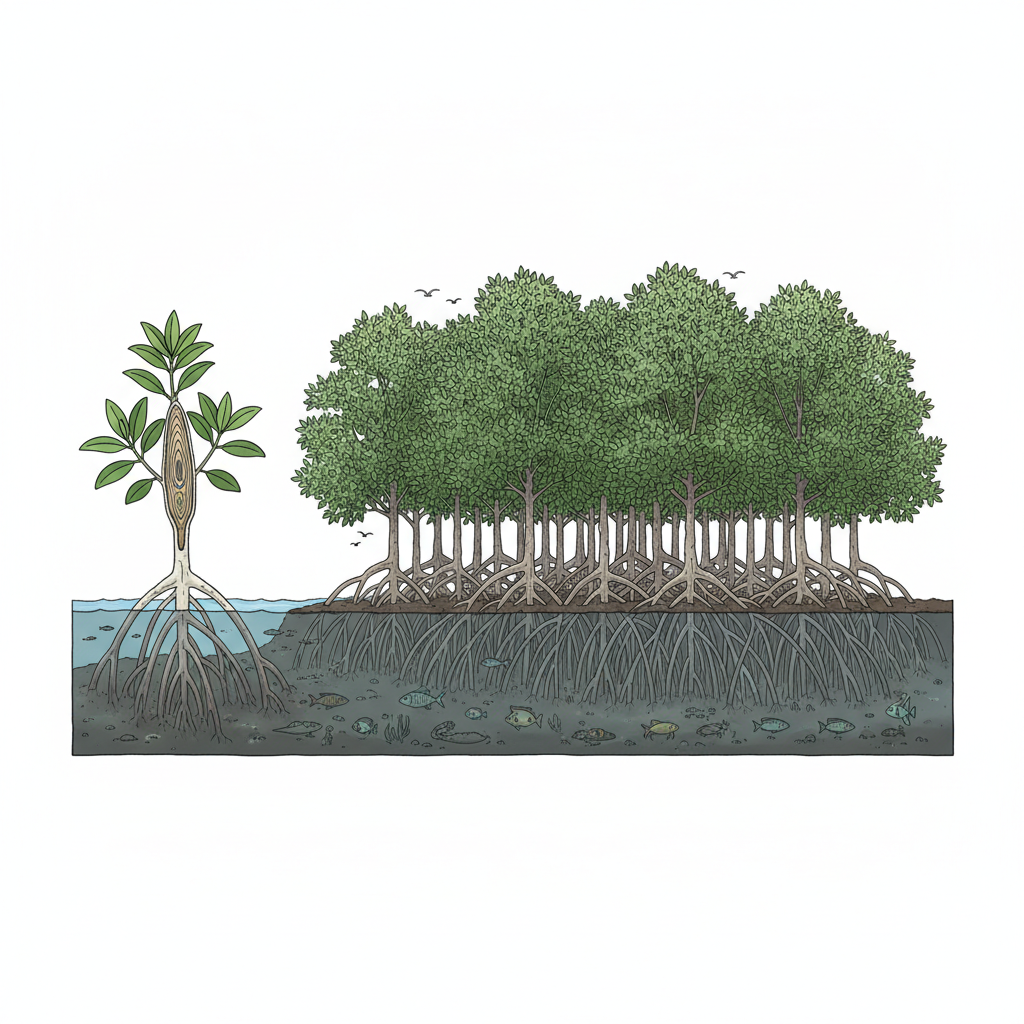
Mangrove speciesRoot systemSeed podsTidal zoneCanopy cover✎ Excoecaria agallocha (Kannampotti) is a rare mangrove species with unique germination traits and ecological roles, whose conservation in Kerala highlights the importance of community-led biodiversity restoration and the threats…
Subject Relevance — Where This Topic Fits
- GS Paper III — Environment and Ecology: Conservation of Biodiversity, Ecosystem Services, and Sustainable Development Goals (SDG 13, SDG 14, SDG 15) | GS Paper III — Science and Technology: Indigenous Knowledge Systems and Traditional Ecological Knowledge
- Prelims: Mangrove ecosystems, Excoecaria agallocha (Kannampotti), Mangrove conservation, Ecosystem services of mangroves, Plastic pollution in coastal ecosystems, Traditional ecological knowledge, Biodiversity hotspots, Erosion control by mangroves
- Essay: The interplay between indigenous knowledge and modern conservation science in preserving biodiversity, Sustainable utilisation of coastal ecosystems: Balancing livelihoods and ecological integrity
Quick Revision: Excoecaria agallocha (Kannampotti) is a rare mangrove species with unique germination traits and ecological roles, whose conservation in Kerala highlights the importance of community-led biodiversity restoration and the threats posed to coastal ecosystems.
Why is this in the news?
The conservation efforts of Parayil Rajan, a fisherman-turned-mangrove conservationist in Kannur, Kerala, have brought renewed attention to the rare mangrove species *Excoecaria agallocha* (locally known as Kannampotti). His initiative to propagate and reintroduce the species, which is critically threatened in the region, highlights the ecological significance of mangroves. The case underscores the role of community-led conservation in biodiversity preservation and ecosystem restoration.
Background
- Mangroves are salt-tolerant plant communities that thrive in coastal tidal zones, providing critical ecosystem services such as coastal protection, carbon sequestration, and biodiversity support.
- *Excoecaria agallocha*, commonly known as the blinding tree or milky mangrove, is a species of mangrove native to the Indo-Pacific region, including India, Sri Lanka, and Southeast Asia.
- The species is known for its milky sap, which contains toxic compounds and can cause skin irritation, and has been traditionally used in local medicine, though its medicinal properties require further scientific validation.
- Kannur district in Kerala is part of the Malabar Coast, a recognised biodiversity hotspot with diverse mangrove ecosystems, including the Pazhayangadi River and its tributaries.
- Mangrove ecosystems in Kerala face threats from urbanisation, aquaculture, pollution (including plastic waste), and climate change-induced sea-level rise.
- Community-led conservation initiatives, such as those led by Parayil Rajan, demonstrate the potential of indigenous knowledge and grassroots efforts in complementing formal conservation policies.
What is Excoecaria agallocha (Kannampotti)?
- *Excoecaria agallocha* is a mangrove species belonging to the family Euphorbiaceae, characterised by its ability to thrive in both freshwater and saline environments, provided the soil retains sufficient moisture.
- The species is identified by its small, rounded leaves and distinctive milky sap, which contains diterpenoid compounds such as excoecariatoxin, known for its toxic and irritant properties.
- Kannampotti is notable for its unique germination process: the seed remains attached to the young shoot, providing nourishment until the plant develops sufficient roots and leaves to sustain itself independently.
- The species plays a role in stabilising muddy coastal banks, reducing erosion, and trapping sediment, thereby contributing to coastal land formation and protection.
- While traditional knowledge attributes medicinal properties to the plant—including uses in treating skin ailments, rheumatism, and even cancer—these claims remain largely unverified by modern scientific studies.
- The rarity of the species in the Kannur region is attributed to habitat loss and limited natural regeneration, necessitating active conservation measures such as seed collection and nursery propagation.
- Its conservation is critical for maintaining the ecological balance of coastal ecosystems and ensuring the resilience of mangrove-dependent communities.
Key Features
| Feature | Significance |
|---|---|
| Botanical name: Excoecaria agallocha (Kannampotti) | A rare mangrove species endemic to specific tidal zones in Kerala, requiring targeted conservation due to its ecological specificity. |
| Germination process with persistent seed | The seed remains attached to the shoot until the sapling reaches ~2 inches, nourishing it before detachment; a unique adaptation for survival in muddy, saline conditions. |
| Milky, acidic sap | Acts as a natural deterrent against herbivory but poses skin irritation risks; its chemical composition remains understudied for potential medicinal applications. |
| Dual water tolerance (fresh/saline) | Adaptability to varying salinity levels enables survival in estuarine and riverine mangrove ecosystems, enhancing ecological resilience. |
| Small seed size and low dispersal | Limited natural propagation due to seed fragility and lack of wind/water-mediated dispersal mechanisms, necessitating human-assisted regeneration. |
Why it Matters
Ecological
- Mangrove ecosystems, including rare species like Excoecaria agallocha, serve as critical nurseries for marine biodiversity, supporting fish, prawn, and crab populations essential for coastal fisheries.
- Stabilisation of muddy riverbanks and reduction of coastal erosion through sediment trapping, thereby mitigating land degradation and flood risks in tidal zones.
- Carbon sequestration potential in mangrove soils, contributing to climate change mitigation through long-term carbon storage in anaerobic sediments.
Economic
- Sustained mangrove health directly impacts livelihoods of fisherfolk communities dependent on estuarine and coastal fisheries for income and food security.
- Potential for sustainable utilisation of mangrove-derived products (e.g., traditional medicine) if scientifically validated, offering alternative income streams for local communities.
Scientific
- Rarity of Excoecaria agallocha limits ecological and pharmacological research, underscoring the need for systematic documentation and study of its genetic and biochemical traits.
- Local knowledge systems regarding medicinal uses require empirical validation through phytochemical and clinical studies to assess therapeutic potential and safety.
Social
- Community-led conservation initiatives, such as those by Parayil Rajan, demonstrate the role of traditional ecological knowledge in biodiversity preservation and environmental stewardship.
- Public awareness campaigns on mangrove ecosystems can foster participatory governance in coastal zone management and waste reduction efforts.
Challenges
1. Habitat Fragmentation and Rarity
- Extremely limited natural distribution of Excoecaria agallocha in Kannur district, with only a few known populations remaining, increasing extinction risk.
- Low seed dispersal and germination success under natural conditions necessitate intensive human intervention for species survival.
UPSC Link: GS3: Biodiversity conservation; Environmental degradation
2. Anthropogenic Pressures
- Plastic pollution in mangrove ecosystems, particularly during dry seasons, disrupts root systems, alters soil chemistry, and threatens seedling survival.
- Unregulated land-use changes, including reclamation for agriculture or infrastructure, reduce available mangrove habitats and fragment ecological corridors.
UPSC Link: GS3: Environmental pollution; Coastal zone management
3. Knowledge Gaps and Validation
- Lack of scientific documentation on the medicinal properties of Excoecaria agallocha, leading to unverified traditional claims and potential misuse.
- Limited research on the species’ ecological interactions, including pollination mechanisms and symbiotic relationships with other mangrove flora.
UPSC Link: GS3: Science and Technology in biodiversity
4. Climate Change Impacts
- Rising sea levels and increased salinity intrusion may alter the species’ habitat suitability, particularly in estuarine zones where freshwater inflow is critical.
- Extreme weather events, such as cyclones or storm surges, can physically damage mangrove stands and displace sediment, affecting Excoecaria agallocha populations.
UPSC Link: GS3: Climate change and environmental sustainability
5. Community Engagement and Awareness
- Low recognition of Excoecaria agallocha among local populations, leading to accidental destruction or neglect of the species during mangrove management activities.
- Need for sustained awareness programmes to integrate traditional conservation practices with modern ecological science.
UPSC Link: GS2: Role of civil society in governance
Challenges — UPSC Perspective
| Issue | Concern |
|---|---|
| Limited natural distribution | High risk of local extinction due to small population size and restricted habitat. |
| Plastic pollution in mangroves | Physical entanglement and chemical leaching disrupt root systems and seedling growth. |
| Lack of scientific validation | Unverified traditional medicinal claims hinder potential economic utilisation. |
| Climate-induced habitat shifts | Sea-level rise and salinity changes may render current habitats unsuitable. |
| Low community awareness | Species misidentification and neglect during conservation efforts. |
Way Forward
- Establish community-managed nurseries for Excoecaria agallocha, scaling up Parayil Rajan’s model to include local self-help groups and educational institutions.
- Integrate mangrove conservation into coastal zone management plans under the Coastal Regulation Zone (CRZ) Notification, 2019, with specific provisions for rare species protection.
- Conduct phytochemical and pharmacological studies to validate traditional medicinal claims, in collaboration with research institutions like CSIR or ICAR.
- Launch targeted awareness campaigns in Kannur district to educate stakeholders on identifying and protecting Excoecaria agallocha, leveraging local leaders and social media.
- Implement plastic waste management initiatives in mangrove-adjacent areas, including periodic clean-up drives and recycling partnerships with local authorities.
- Develop a species-specific conservation action plan under the National Mangrove Initiative, incorporating habitat restoration, seed banking, and genetic diversity monitoring.
- Promote eco-tourism models that highlight mangrove biodiversity, generating revenue for conservation while fostering public engagement.
- Strengthen climate resilience by restoring degraded mangrove patches to enhance their adaptive capacity to sea-level rise and salinity changes.
UPSC Value Addition
Keywords for Mains Answer-Writing
Mangrove ecosystems · Biodiversity conservation · Coastal ecology · Excoecaria agallocha · Community-led conservation · Mangrove restoration · Plastic pollution in coastal habitats · Traditional ecological knowledge · Tidal landscape conservation · Sustainable coastal resource management
Concept Flow
Anthropogenic pressures (land-use change, pollution) → Habitat fragmentation and rarity of Excoecaria agallocha → Decline in species population → Loss of ecological services (nursery function, carbon sequestration) → Threat to coastal livelihoods and biodiversity → Need for community-led conservation interventions. → Traditional ecological knowledge (Parayil Rajan’s conservation efforts) → Identification of rare species and seed collection → Nursery propagation and seedling production → Community engagement and awareness → Scalable conservation models. → Plastic pollution accumulation in mangroves → Root system disruption and seedling mortality → Reduced mangrove health → Erosion of coastal protection and fisheries support → Urgency for waste management and policy enforcement. → Climate change (sea-level rise, salinity intrusion) → Altered habitat suitability for Excoecaria agallocha → Potential local extinction → Requires adaptive conservation strategies (e.g., assisted migration, habitat restoration). → Lack of scientific validation of medicinal properties → Unverified traditional claims → Missed economic opportunities → Need for interdisciplinary research (botany, pharmacology) to bridge knowledge gaps. → Community misidentification of Excoecaria agallocha → Accidental destruction during mangrove management → Reduced species presence → Requires targeted education and species-specific conservation protocols.
Prelims Practice Questions
Q1. Consider the following statements regarding mangrove ecosystems in India:
1. Mangroves stabilize muddy banks and reduce coastal erosion.
2. Mangroves provide breeding grounds for fish, prawns, and crabs.
3. The species Excoecaria agallocha is commonly found across all Indian mangrove forests.
4. Mangroves can thrive in both freshwater and saline water conditions.
How many of the above statements are correct?
- Only one
- Only two
- Only three
- All
Answer: Only three — Statements 1, 2, and 4 are correct. Statement 3 is incorrect as Excoecaria agallocha is a rare mangrove species found in specific regions like Kannur, not commonly across all Indian mangrove forests.
Q2. Assertion (A): Community-led conservation initiatives are critical for the preservation of rare mangrove species like Excoecaria agallocha.
Reason (R): The rarity of such species makes scientific study difficult, and local knowledge plays a vital role in their conservation.
Options:
A. Both A and R are true, and R is the correct explanation of A.
B. Both A and R are true, but R is not the correct explanation of A.
C. A is true, but R is false.
D. A is false, but R is true.
- A
- B
- C
- D
Answer: A — Both A and R are true, and R correctly explains why community-led efforts are essential for conserving rare species like Excoecaria agallocha.
Q3. Which of the following is NOT a characteristic of the mangrove species Excoecaria agallocha?
A. It can cause skin burns due to its milky sap.
B. Its seeds germinate in approximately two weeks under suitable conditions.
C. It is commonly found in all coastal regions of India.
D. It can grow in both fresh and saline water conditions.
- A
- B
- C
- D
Answer: C — Excoecaria agallocha is a rare mangrove species found only in specific locations like Kannur, not commonly across all coastal regions of India.
Mains Practice Question
✍ “Community participation is indispensable for the conservation of coastal ecosystems such as mangroves.” Critically examine this statement with reference to the conservation efforts for the rare mangrove species Excoecaria agallocha in Kannur. Also, outline the ecological and socio-economic benefits of mangrove conservation. (15 Marks)
Approach: MODEL-ANSWER SKELETON:
1. **Introduction (2 marks)**
– Define mangroves and their ecological significance (e.g., carbon sequestration, coastal protection, biodiversity support).
– Introduce Excoecaria agallocha as a rare mangrove species and its conservation status.
2. **Role of Community Participation (5 marks)**
– Highlight the efforts of Parayil Rajan (Kandal Rajan) in collecting seeds, raising seedlings, and distributing saplings.
– Discuss traditional ecological knowledge and its importance in identifying and conserving rare species.
– Explain how community-led initiatives address gaps in scientific research due to the rarity of species.
– Mention the role of local fishermen in understanding mangrove ecosystems and their dependence on them.
3. **Ecological Benefits of Mangrove Conservation (4 marks)**
– Stabilization of muddy banks and reduction of coastal erosion.
– Provision of breeding and nursery grounds for fish, prawns, and crabs, supporting fisheries.
– Contribution to carbon sequestration and mitigation of climate change.
– Protection against storm surges and tsunamis.
4. **Socio-Economic Benefits (3 marks)**
– Support to livelihoods of coastal communities through fisheries and ecotourism.
– Potential for sustainable utilization of mangrove products (e.g., traditional medicine, though scientifically validated claims are limited).
– Enhancement of coastal resilience and disaster risk reduction.
5. **Challenges and Way Forward (1 mark)**
– Address threats like plastic pollution, habitat destruction, and climate change.
– Emphasize the need for integrating community knowledge with scientific research for effective conservation.
Source: The Hindu
Generated by AanyaAi for educational purpose.

- Gurugram’s groundwater extraction exceeds limit by 212%; HC seeks ban - October 4, 2026
- स्वतंत्रता सेनानी श्यामजी कृष्ण वर्मा की जन्म जयंती पर पीएम का श्रद्धांजलि - October 4, 2026
- KWML’s Feasibility Reports for Water Metro in 18 Cities: UPSC & PCS Insights - October 3, 2026

No Comments