


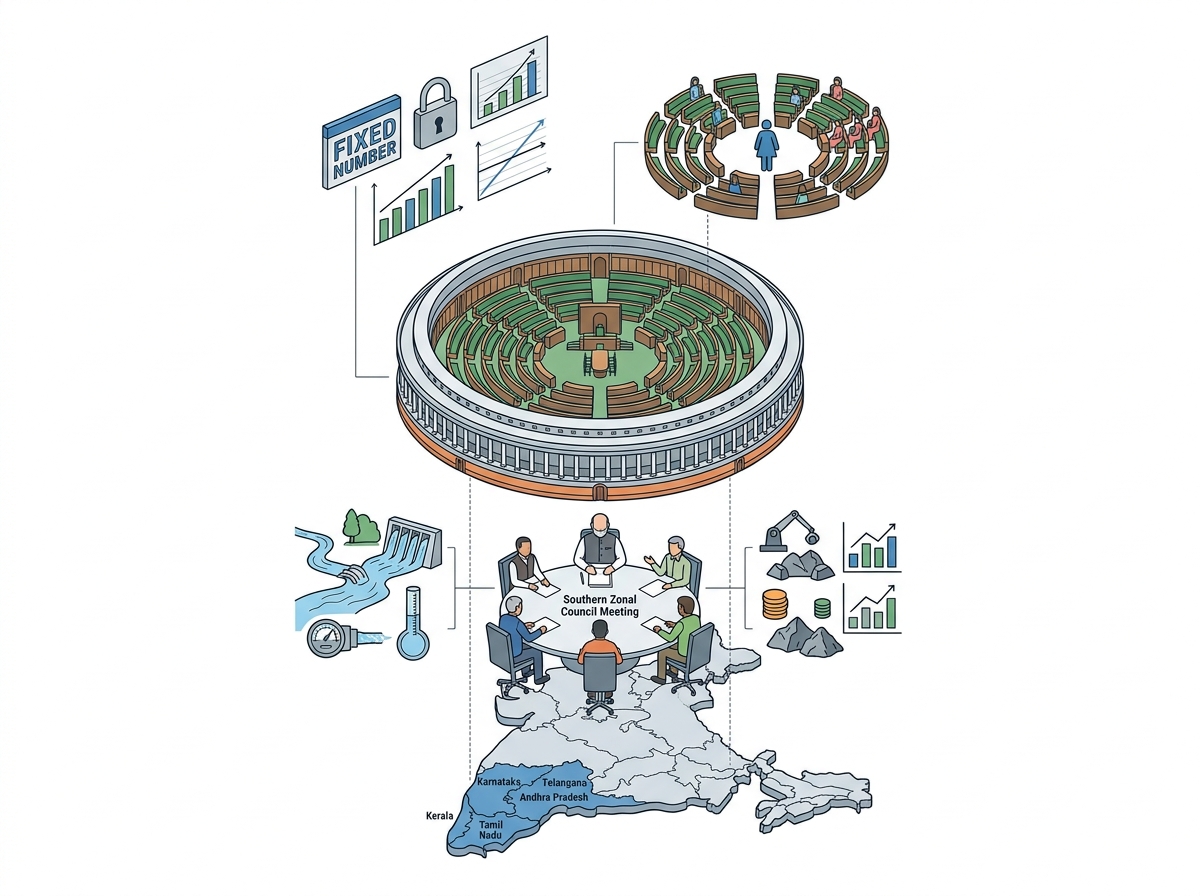
20 Aug Karnataka Demands Lok Sabha Seat Freeze to Protect Southern States’ Voice
Lok Sabha seatsWomen's reservationSouthern statesUnion Home Minister✎ The Lok Sabha’s seat strength is frozen at 543 until the first census after 2026, and women’s reservation must be implemented within the existing framework, while balancing federal principles and constitutional provisions.
Subject Relevance — Where This Topic Fits
- GS Paper II — Parliament and State Legislatures — Structure, Functioning, Conduct of Business, Powers and Privileges | GS Paper III — Government Budgeting and Fiscal Policy | GS Paper II — Constitutional and Non-Constitutional Bodies
- Prelims: Delimitation, Lok Sabha seat strength, Women’s Reservation Bill, Zonal Councils, Mines and Minerals (Development and Regulation) Act, Article 82 of the Constitution, Article 330A of the Constitution
- Essay: Federalism and Centre-State Relations in India, Representation and Inclusivity in Democratic Governance
Quick Revision: The Lok Sabha’s seat strength is frozen at 543 until the first census after 2026, and women’s reservation must be implemented within the existing framework, while balancing federal principles and constitutional provisions.
Why is this in the news?
The Southern Zonal Council meeting, chaired by the Union Home Minister, witnessed a proposal by Karnataka’s Chief Minister to freeze the current strength of the Lok Sabha at 543 seats and implement women’s reservation within the existing framework. This proposal, advanced in the context of concerns over potential reduction in southern states’ representation due to demographic shifts, underscores critical constitutional, federal, and governance dimensions relevant to the Union Public Service Commission (UPSC) syllabus. The discussion also encompassed inter-state water disputes and the allocation of fiscal powers over mineral resources, highlighting the interplay between legislative, executive, and judicial functions in India’s federal structure.
Background
- The Lok Sabha’s current strength of 543 seats has remained unchanged since the 1971 delimitation exercise, which was based on the 1971 Census. Subsequent censuses (1981, 1991, 2001, 2011) have not triggered a fresh delimitation due to the constitutional freeze imposed by the 42nd Amendment Act, 1976, and extended by the 84th Amendment Act, 2001, until the first census after 2026.
- The 84th Amendment Act, 2001, froze the delimitation of parliamentary and assembly constituencies until the first census after 2026, with the exception of readjustment on the basis of the 2001 Census for states having undergone division (e.g., Jharkhand, Chhattisgarh, Uttarakhand).
- Women’s reservation in Parliament has been a long-standing demand, with the Constitution (108th Amendment) Bill, 2008, introduced to reserve one-third of seats in the Lok Sabha and State Legislative Assemblies for women. The Bill lapsed but remains a key policy discourse.
- Zonal Councils, established under the States Reorganisation Act, 1956, are advisory bodies comprising Chief Ministers and Union Ministers to discuss and resolve inter-state issues. The Southern Zonal Council includes Karnataka, Tamil Nadu, Kerala, Andhra Pradesh, Telangana, and Puducherry.
- Inter-state river water disputes, such as the Mekedatu project between Karnataka and Tamil Nadu, are adjudicated under the Inter-State Water Disputes Act, 1956, and often escalate to judicial or political forums for resolution.
Key Constitutional and Governance Aspects of the Proposal
- **Lok Sabha Seat Freeze and Delimitation**: The current strength of the Lok Sabha (543 seats) is frozen until the first census after 2026, as per the 84th Amendment Act, 2001. This freeze prevents automatic readjustment of seats based on population changes, which could otherwise reduce the relative representation of states with lower population growth.
- **Women’s Reservation**: The proposal advocates for women’s reservation within the existing 543 seats, aligning with the constitutional principle of inclusivity. The Constitution (108th Amendment) Bill, 2008, sought to reserve 33% of seats for women but lapsed. The current discourse reflects a renewed push for its implementation within the existing framework.
- **Federalism and Centre-State Relations**: The proposal raises questions about the balance of powers between the Union and States. States argue that demographic shifts should not disproportionately reduce their political voice, while the Union may prioritise national uniformity in representation.
- **Inter-State Water Disputes**: The Mekedatu project, proposed by Karnataka, has been a point of contention with Tamil Nadu. Such disputes are governed by the Inter-State Water Disputes Act, 1956, and often require mediation or adjudication by tribunals or the Supreme Court.
- **Zonal Councils as Advisory Forums**: The Southern Zonal Council serves as a platform for discussing inter-state issues, including representation, resource allocation, and disputes. Its role is advisory, with decisions requiring consensus among member states and the Union.
- **Constitutional Provisions**: Article 82 of the Constitution empowers Parliament to readjust the number of seats in the Lok Sabha after each census. However, the 84th Amendment Act, 2001, has deferred this process until after the 2026 Census.
- **Judicial Precedents**: The Supreme Court’s interpretation of the distribution of legislative and executive powers between the Union and States, particularly in cases involving the Seventh Schedule, provides critical context for disputes over fiscal and regulatory powers.
Key Features
| Feature | Significance |
|---|---|
| Lok Sabha seat freeze proposal | Ensures stable representation of states in Parliament, preventing demographic shifts from reducing southern states’ political voice. |
| Women’s reservation within existing seats | Implements constitutional mandate for 33% reservation for women in Lok Sabha without altering total seat count. |
| Supreme Court’s nine-judge bench ruling on mineral taxation | Affirms states’ fiscal autonomy over mineral rights, a critical revenue source for resource-rich states. |
| Southern Zonal Council deliberations | Provides a constitutional platform for inter-state and Centre-state dialogue on shared governance issues. |
| Mekedatu dam project | Demonstrates inter-state river water sharing dynamics, highlighting federal cooperation in water resource management. |
Why it Matters
Political Representation
- Southern states have achieved demographic stability through effective population control measures, yet face potential under-representation due to delimitation based on latest census data.
- A freeze on Lok Sabha seats ensures proportional representation aligns with states’ contributions to national growth, addressing concerns of ‘demographic punishment’ for successful governance.
- Women’s reservation within existing seats operationalises constitutional intent without diluting state-wise representation ratios.
Fiscal Federalism
- The Mines and Minerals (Development and Regulation) Bill 2026 seeks to centralise mineral revenue collection, potentially undermining states’ fiscal autonomy guaranteed by judicial precedent.
- States like Karnataka rely on mineral royalties for development funding; centralisation risks fiscal imbalances in resource-rich regions.
- Supreme Court’s 2012 nine-judge bench ruling in *State of West Bengal v. Kesoram Industries* upheld states’ rights to levy taxes on mineral-bearing lands, a precedent under threat.
Inter-State Cooperation
- Southern Zonal Council meetings facilitate consensus-building on contentious issues like river water sharing and economic policies, reducing Centre-state friction.
- The Mekedatu dam project exemplifies cooperative federalism, where Karnataka’s water management benefits downstream states like Tamil Nadu and Puducherry.
Constitutional Governance
- The proposal reflects the principle of ‘cooperative federalism’ enshrined in the Constitution, balancing Centre-state powers through institutional mechanisms.
- Women’s reservation aligns with the 73rd and 74th Constitutional Amendments, extending gender inclusivity to national legislative bodies.
Challenges
1. Demographic Imbalance in Representation
- Delimitation based on projected population growth may reduce southern states’ Lok Sabha seats, disproportionately affecting their political voice despite lower fertility rates.
- Southern states’ success in population control could paradoxically lead to under-representation, undermining the principle of equitable governance.
UPSC Link: GS-II: Federalism, Representation
2. Centralisation of Mineral Revenue
- The Mines and Minerals (Development and Regulation) Bill 2026 seeks to restrict states’ power to levy taxes on mineral rights, contrary to Supreme Court rulings.
- Loss of fiscal autonomy may exacerbate regional economic disparities, particularly in mineral-rich states like Karnataka and Odisha.
UPSC Link: GS-II: Fiscal Federalism, Centre-State Relations
3. Inter-State Water Disputes
- The Mekedatu dam project faces opposition from Tamil Nadu, highlighting persistent challenges in inter-state river water sharing under the Inter-State Water Disputes Act, 1956.
- Balancing developmental needs with equitable water distribution remains a critical governance challenge.
UPSC Link: GS-II: Water Resources, Cooperative Federalism
4. Implementation of Women’s Reservation
- Reserving seats within the existing Lok Sabha strength requires precise legislative and administrative coordination to avoid unintended dilution of state-wise representation.
- Ensuring effective participation of women in Parliament requires systemic support beyond reservation, including electoral reforms and capacity-building.
UPSC Link: GS-I: Social Justice, Gender Empowerment
5. Zonal Council Effectiveness
- Zonal Councils, while advisory, often lack binding authority, limiting their ability to resolve contentious Centre-state disputes promptly.
- Strengthening these institutions could enhance cooperative federalism and reduce litigation over governance issues.
UPSC Link: GS-II: Federalism, Inter-State Relations
Challenges — UPSC Perspective
| Issue | Concern |
|---|---|
| Delimitation-driven seat reduction | Risk of southern states losing political voice despite demographic discipline |
| Mines and Minerals Bill 2026 | Centralisation of mineral taxation undermines states’ fiscal autonomy |
| Mekedatu dam opposition | Inter-state water sharing disputes threaten cooperative federalism |
| Women’s reservation implementation | Logistical and administrative challenges in reserving seats without altering total strength |
| Zonal Council limitations | Advisory nature restricts resolution of Centre-state conflicts |
Way Forward
- Constitute a high-powered committee under Article 263 to examine delimitation-linked representation concerns and propose safeguards for southern states.
- Amend the Mines and Minerals (Development and Regulation) Act, 1957, to explicitly recognise states’ rights to levy taxes on mineral-bearing lands, in line with judicial precedents.
- Establish a permanent inter-state water tribunal under the Inter-State Water Disputes Act to expedite resolution of river water disputes.
- Enact enabling legislation to operationalise women’s reservation within the existing Lok Sabha strength, ensuring minimal disruption to state-wise representation ratios.
- Strengthen Zonal Councils by granting them advisory powers with mandatory consultations for Centre-state disputes, enhancing cooperative federalism.
- Develop a national demographic policy to incentivise balanced population growth across states, reducing future representation disparities.
- Promote state-led initiatives for sustainable resource management, ensuring fiscal autonomy while aligning with national development goals.
- Enhance data transparency in census and delimitation processes to build trust among states and prevent perception-driven conflicts.
UPSC Value Addition
Keywords for Mains Answer-Writing
Lok Sabha seat freeze · Delimitation Commission · Southern Zonal Council · Women’s Reservation in Parliament · Representation of States in Lok Sabha · Mines and Minerals (Development and Regulation) Act · Federalism and Centre-State Relations · Constitutional provisions on inter-state water disputes · Mekedatu Project · Demographic Dividend and Political Representation
Constitutional & Policy Linkages
- Article 81: Composition of the Lok Sabha and delimitation provisions.
- Article 263: Provision for Zonal Councils to promote inter-state cooperation.
- Article 243M: Reservation of seats for women in local bodies, analogous to proposed Lok Sabha reservation.
- Seventh Schedule: Division of powers between Centre and states, including mineral taxation (Entry 50, State List).
- Article 262: Adjudication of disputes relating to inter-state rivers.
Concept Flow
Southern states achieve demographic stability through effective population control measures → Potential under-representation in Lok Sabha due to delimitation based on latest census → Proposal to freeze Lok Sabha seats to preserve proportional representation → Women’s reservation implemented within existing seats to meet constitutional mandate → Southern Zonal Council deliberates on Centre-state fiscal and water-sharing issues → Mines and Minerals Bill 2026 centralises mineral taxation, challenging states’ fiscal autonomy → Mekedatu dam project highlights inter-state water-sharing dynamics → Need for constitutional and legislative safeguards to balance federalism and equity.
Prelims Practice Questions
Q1. Consider the following statements regarding the Lok Sabha seat freeze proposal made by Karnataka:
1. The proposal seeks to freeze the total number of Lok Sabha seats at the current level of 543.
2. The proposal includes the implementation of women’s reservation within the existing number of seats.
3. The proposal was made during the Southern Zonal Council meeting chaired by the Union Home Minister.
How many of the above statements are correct?
- Only one
- Only two
- All three
- None
Answer: All three — Statements 1 and 2 are correct as per the report. Statement 3 is also correct, as the meeting was chaired by the Union Home Minister. Thus, two statements are correct.
Q2. Assertion (A): The Mines and Minerals (Development and Regulation) Bill 2026 seeks to prohibit states from imposing specified levies on mineral rights.
Reason (R): The Bill aims to centralize the taxation powers related to major minerals to ensure uniformity in mineral resource governance across India.
- Both A and R are true, and R is the correct explanation of A.
- Both A and R are true, but R is not the correct explanation of A.
- A is true, but R is false.
- A is false, but R is true.
Answer: Both A and R are true, but R is not the correct explanation of A. — The Bill prohibits states from imposing specified levies on mineral rights except as prescribed by the Centre, centralizing taxation powers. Thus, both assertion and reason are true, and the reason correctly explains the assertion.
Q3. Which of the following is NOT a function of the Zonal Councils in India?
- Advisory forums for Centre-State and inter-state cooperation
- Discussion of matters of common interest to states in a zone
- Resolution of disputes between states through binding orders
- Coordination of efforts to tackle common problems
Answer: Resolution of disputes between states through binding orders — Zonal Councils are advisory forums and do not have the power to issue binding orders. They facilitate discussion and coordination but do not resolve disputes through binding mechanisms.
Mains Practice Question
✍ The demand for a freeze in the number of Lok Sabha seats and the implementation of women’s reservation within the existing seats reflects underlying tensions in India’s federal structure. Critically examine the constitutional, political, and demographic dimensions of this demand. (15 Marks)
Approach: MODEL-ANSWER SKELETON:
1. **Constitutional Basis**:
– Article 81 of the Constitution (as amended) provides for the composition of the Lok Sabha, including the total number of seats and their allocation among states.
– The 84th Amendment Act, 2001 froze the delimitation of Lok Sabha seats until after the first census post-2026, reflecting a balance between population growth and political representation.
– The demand for a freeze aligns with the principle of ‘one person, one vote’ but raises questions about proportionality.
2. **Federalism and Representation**:
– Southern states argue that their disciplined population control has not translated into proportional political voice, citing demographic shifts favoring northern states.
– The demand challenges the Delimitation Commission’s mandate to redraw constituencies based on population data, which could reduce southern states’ relative representation.
3. **Women’s Reservation**:
– The Women’s Reservation Bill (128th Amendment), if enacted, will reserve 33% of seats for women within the existing or increased number of seats.
– The demand to implement women’s reservation within the current seat count addresses concerns about reducing southern states’ voice while ensuring gender inclusivity.
4. **Demographic Dividend and Political Voice**:
– Southern states highlight their higher per capita income, lower fertility rates, and greater contribution to national GDP as justification for maintaining their political voice.
– Critics argue that freezing seats may perpetuate under-representation of states with higher population growth, potentially violating the principle of equitable representation.
5. **Balancing Views**:
– Proponents: Emphasize the need to protect the political voice of states that have demonstrated responsible demographic policies.
– Opponents: Argue that freezing seats may lead to disproportionate representation favoring slower-growing states, undermining the democratic principle of ‘one person, one vote’.
6. **Conclusion**:
– The demand reflects a tension between federal equity and demographic realities. A solution may require a nuanced approach, such as phased implementation of delimitation or alternative mechanisms to ensure proportional representation without diluting southern states’ voice.
Source: The Indian Express
Generated by AanyaAi for educational purpose.


No Comments