


15 Aug Karnataka HC: Caste Abuse by Politicians is Graver Indignity, Rejects Discharge Plea
Special Court of SessionsConstitutional protectionsSC/ST Act✎ Caste-based abuse in public life, especially by political figures, is punishable under the SC/ST (Prevention of Atrocities) Act, 1989, and Section 504 IPC, as it violates constitutional guarantees of dignity (Article 21) and…
Subject Relevance — Where This Topic Fits
- GS Paper II — Fundamental Rights and Constitutional Provisions | GS Paper II — Role of Judiciary in Governance | GS Paper II — Social Justice and Empowerment | GS Paper III — Challenges to Internal Security and Law & Order
- Prelims: Scheduled Castes and Scheduled Tribes (Prevention of Atrocities) Act, 1989, Article 17 of the Constitution (Abolition of Untouchability), Article 21 (Protection of Life and Personal Liberty), Section 504 of the Indian Penal Code (Intentional insult with intent to provoke breach of peace), Forensic Sciences Laboratory (FSL), Special Court under SC/ST Act, Political speech and public order, Caste-based abuse as a cognizable offence
- Essay: The interplay between free speech and social justice in a constitutional democracy, Dignity as a constitutional value: From abolition of untouchability to contemporary jurisprudence
Quick Revision: Caste-based abuse in public life, especially by political figures, is punishable under the SC/ST (Prevention of Atrocities) Act, 1989, and Section 504 IPC, as it violates constitutional guarantees of dignity (Article 21) and equality (Article 17).
Why is this in the news?
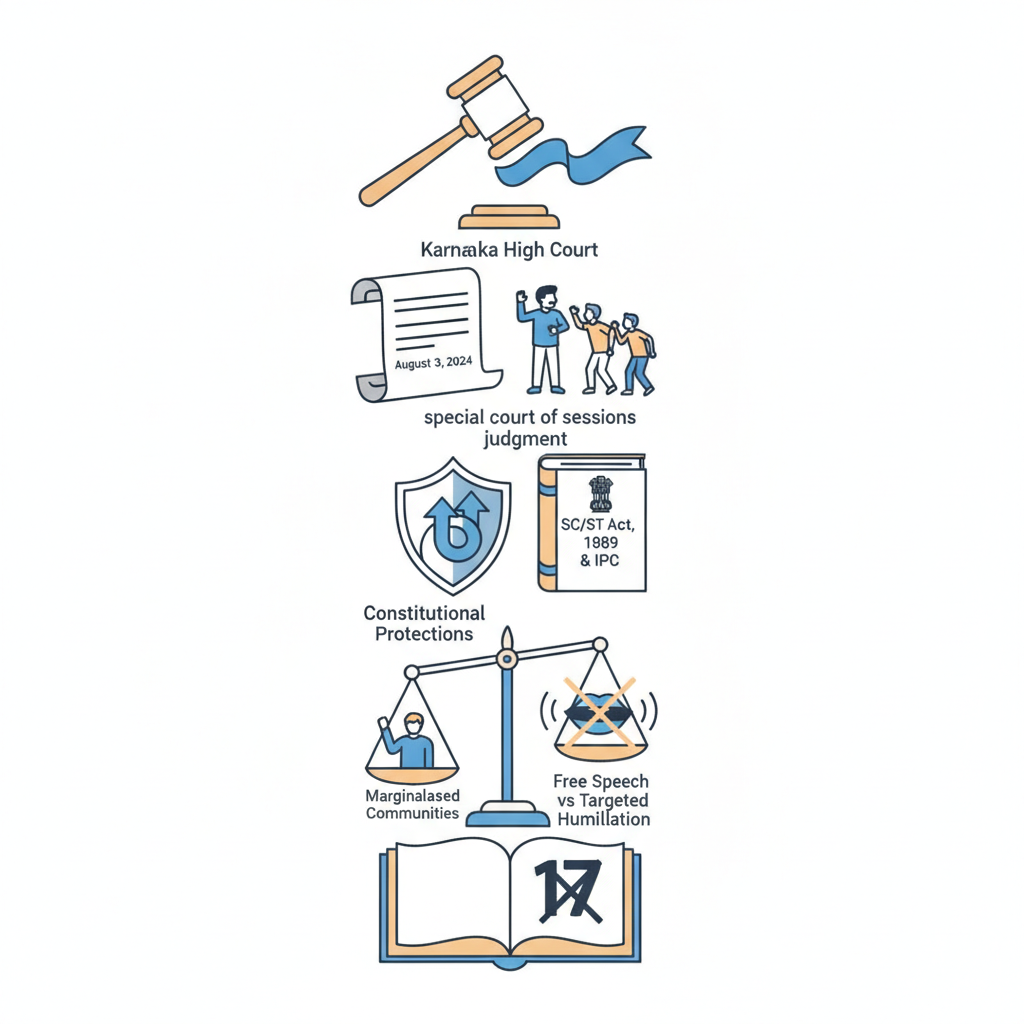
The special court of sessions, in a significant judgment dated August 3, 2024, refused to discharge a former Congress MLA accused of repeatedly hurling caste-based abuses against a Scheduled Caste MLA and his relative during political gatherings. The Karnataka High Court later refused to discharge the former MLA from the charges. The court underscored the graver indignity of caste abuse when perpetrated by those in political power in public spaces, reinforcing constitutional protections under the Scheduled Castes and Scheduled Tribes (Prevention of Atrocities) Act, 1989, and the Indian Penal Code. The judgment highlights the judiciary’s role in balancing free speech with the protection of marginalised communities against targeted humiliation.
Background
- The Constitution of India, through Article 17, explicitly abolishes untouchability and mandates its punishment, reflecting a foundational commitment to social equality.
- The Scheduled Castes and Scheduled Tribes (Prevention of Atrocities) Act, 1989, was enacted to deter and punish crimes against SC/ST communities, including caste-based abuses, humiliation, and intimidation.
- Caste-based abuse in public discourse, particularly by political figures, undermines constitutional values of dignity, fraternity, and equality enshrined in the Preamble and Fundamental Rights.
- The incident in question occurred during political rivalries in Karnataka’s Vijayanagara district, where caste slurs were allegedly used in the presence of public gatherings, including political rallies.
- The case involves cross-examination of audio-video evidence and forensic reports, underscoring the judiciary’s reliance on scientific evidence in cases of caste-based abuse.
Caste-Based Abuse in Public Life: Legal Framework and Constitutional Safeguards
- **Constitutional Provisions**: Article 17 of the Constitution explicitly prohibits untouchability and empowers the state to enforce its abolition. Article 15(2) prohibits discrimination on grounds of caste, while Article 21 guarantees the right to dignity and personal liberty, which includes protection from caste-based humiliation.
- The **Scheduled Castes and Scheduled Tribes (Prevention of Atrocities) Act, 1989** is a special legislation designed to address caste-based atrocities, including verbal abuse, intimidation, and humiliation. Section 3(1)(r) specifically criminalises the use of caste names or caste-based slurs with intent to insult or humiliate a person belonging to a Scheduled Caste or Scheduled Tribe.
- Section 504 of the **Indian Penal Code (IPC)** punishes intentional insult with intent to provoke a breach of peace. Caste-based abuses often fall under this provision due to their potential to incite social disharmony.
- **Public Place and Political Speech**: The Karnataka High Court’s judgment clarifies that political rallies and public gatherings constitute ‘public places’ where caste-based abuses carry graver consequences, as such speech reverberates beyond the immediate target, affecting the dignity of entire communities.
- **Judicial Scrutiny of Evidence**: The court relied on forensic reports, audio-video recordings, and eyewitness testimonies to reject the accused’s discharge plea. This underscores the judiciary’s reliance on scientific and corroborative evidence in cases involving caste-based abuse.
- The **Special Courts** designated under the SC/ST Act are empowered to fast-track trials of atrocity cases, ensuring timely justice and deterring caste-based crimes. These courts operate with reduced procedural formalities to expedite proceedings.
- **Balancing Free Speech and Dignity**: While political speech enjoys constitutional protection under Article 19(1)(a), the judiciary has consistently held that speech inciting hatred, caste-based abuse, or social disharmony is not protected. The Supreme Court, in *Romesh Thappar v. State of Madras* (1950), established that speech threatening public order or morality can be restricted.
Key Features
| Feature | Significance |
|---|---|
| Caste-based abuse in public discourse | Violates constitutional guarantees of equality, dignity, and fraternity; undermines social cohesion and democratic values. |
| Political dais as public platform | Amplifies the impact of derogatory speech due to its reach and visibility, making it a matter of institutional accountability. |
| Forensic and eyewitness evidence | Strengthens judicial scrutiny of caste-based offences, ensuring accountability through corroborative proof. |
| Scheduled Castes and Scheduled Tribes (Prevention of Atrocities) Act, 1989 | Provides legal recourse for caste-based abuses, with stringent provisions for public humiliation and indignity. |
| Judicial interpretation of ‘public place’ | Expands the scope of Section 3(1)(r) of the Atrocities Act to include political gatherings, reinforcing protection against caste-based vitriol. |
Why it Matters
Constitutional and Legal
- The judgment reaffirms the constitutional prohibition of untouchability (Article 17) and upholds the principles of equality (Article 14) and dignity (Article 21).
- It clarifies the application of the SC/ST (Prevention of Atrocities) Act in cases involving public figures, ensuring that political immunity does not shield caste-based abuse.
- The ruling underscores the judiciary’s role in interpreting statutory provisions to address contemporary forms of social discrimination.
Social and Political
- Highlights the persistence of caste-based rhetoric in political discourse despite constitutional safeguards, necessitating systemic introspection.
- Emphasizes the need for political parties to enforce ethical conduct among their members to prevent erosion of public trust.
- Reinforces the idea that public figures bear heightened responsibility to uphold constitutional values in their conduct.
Judicial
- Demonstrates the judiciary’s commitment to addressing caste-based indignities through rigorous legal scrutiny, even in politically sensitive cases.
- Sets a precedent for treating political platforms as public spaces where caste-based abuses carry graver legal consequences.
- Validates the use of forensic evidence and eyewitness accounts in caste-based offence trials, ensuring fair adjudication.
Challenges
1. Normalisation of Caste-Based Rhetoric
- The continued use of caste-based abuses in political discourse despite legal prohibitions reflects deep-rooted societal biases.
- Addressing this challenge requires sustained awareness campaigns and strict enforcement of legal provisions.
- Political parties must adopt internal mechanisms to monitor and penalise such conduct among their members.
UPSC Link: GS-II: Social Justice – Issues relating to SCs and STs
2. Proving Caste-Based Intent in Legal Proceedings
- Establishing intent behind caste-based abuses can be difficult, especially in politically charged environments.
- The reliance on forensic evidence and eyewitness testimonies, as in this case, highlights the need for robust investigative processes.
- Strengthening forensic capabilities and witness protection mechanisms is essential to ensure justice.
UPSC Link: GS-II: Judiciary – Role and Functioning
3. Balancing Free Speech and Accountability
- Distinguishing between political criticism and caste-based abuse remains a complex legal challenge.
- The judiciary must navigate this balance to prevent the misuse of free speech while protecting marginalised communities.
- Clearer guidelines on what constitutes hate speech in political contexts are needed.
UPSC Link: GS-II: Fundamental Rights – Freedom of Speech
4. Public Perception and Social Stigma
- Victims of caste-based abuses often face social stigma, deterring them from reporting such incidents.
- Public awareness campaigns and support systems for victims are critical to overcoming this barrier.
- Media and civil society must play an active role in condemning such abuses and amplifying victims’ voices.
UPSC Link: GS-II: Social Justice – Empowerment of Marginalised Sections
5. Institutional Accountability in Political Parties
- Political parties must enforce ethical codes to prevent caste-based rhetoric among their members.
- Failure to do so risks normalising such conduct and eroding public trust in democratic institutions.
- Independent oversight mechanisms within parties can help address this issue.
UPSC Link: GS-II: Role of Political Parties
Challenges — UPSC Perspective
| Issue | Concern |
|---|---|
| Normalisation of caste-based rhetoric | Undermines constitutional values and social cohesion. |
| Proving intent in legal proceedings | Complicates adjudication and delays justice. |
| Balancing free speech and accountability | Risks either stifling dissent or failing to protect marginalised groups. |
| Public perception and social stigma | Deters victims from reporting abuses. |
| Institutional accountability in political parties | Lack of internal mechanisms to address such conduct. |
Way Forward
- Strengthen enforcement of the SC/ST (Prevention of Atrocities) Act, 1989, with a focus on public platforms like political rallies.
- Mandate forensic audits and eyewitness protection in caste-based abuse cases to ensure robust evidence collection.
- Conduct periodic sensitisation programmes for political parties on constitutional values and ethical conduct.
- Expand public awareness campaigns to educate citizens on the legal and social consequences of caste-based abuses.
- Encourage civil society organisations to document and report caste-based abuses, ensuring victims receive support.
- Develop clearer guidelines for courts to distinguish between political criticism and hate speech in caste-based cases.
- Promote inter-caste dialogue and community engagement to reduce societal acceptance of caste-based rhetoric.
UPSC Value Addition
Keywords for Mains Answer-Writing
Constitutional provisions on equality and dignity · Scheduled Castes and Scheduled Tribes (Prevention of Atrocities) Act, 1989 · Article 17 of the Constitution · Article 21 (Right to Dignity) · Caste-based abuses in political discourse · Public order and hate speech · Judicial interpretation of IPC Section 504 · Forensic evidence in legal proceedings · Political rallies as public spaces · Constitutional morality and public conduct · Protection of civil liberties · Judicial review of legislative immunity · Social justice and political accountability
Constitutional & Policy Linkages
- Article 14: Right to Equality
- Article 17: Prohibition of Untouchability
- Article 21: Right to Dignity
Concept Flow
Political rivalry or disagreement → Use of caste-based abusive language → Public humiliation and indignity → Violation of constitutional principles (Articles 14, 17, 21) → Legal recourse under SC/ST (Prevention of Atrocities) Act, 1989 → Judicial scrutiny of evidence (forensic and eyewitness) → Court’s interpretation of ‘public place’ → Rejection of discharge plea → Trial for accountability.
Prelims Practice Questions
Q1. Consider the following statements regarding the Scheduled Castes and Scheduled Tribes (Prevention of Atrocities) Act, 1989:
1. It criminalises acts of atrocities against SCs and STs.
2. Section 3(1)(r) specifically addresses caste-based abuses.
3. The Act applies only to incidents occurring in public places.
4. The Act empowers the state to grant anticipatory bail to accused persons.
How many of the above statements are correct?
- Only one
- Only two
- Only three
- All four
Answer: Only three — Statements 1 and 2 are correct as the Act criminalises atrocities and Section 3(1)(r) covers caste-based abuses. Statement 3 is incorrect because the Act applies to all places, not just public ones. Statement 4 is incorrect as anticipatory bail is not explicitly empowered under the Act.
Q2. Assertion (A): The Karnataka High Court observed that caste abuses by politicians carry graver indignity due to the public nature of political rallies.
Reason (R): Political rallies are considered public spaces under the Indian Penal Code, and abuses uttered there are amplified by the presence of the public.
In the context of the above statements, which of the following is correct?
- Both A and R are true, and R is the correct explanation of A
- Both A and R are true, but R is not the correct explanation of A
- A is true, but R is false
- A is false, but R is true
Answer: Both A and R are true, but R is not the correct explanation of A — The assertion (A) is true as the court highlighted the public dimension of political rallies. The reason (R) correctly explains why such abuses carry graver indignity, as abuses in public spaces are amplified by the presence of witnesses and the broader community.
Q3. Match the following legal provisions with their corresponding descriptions:
Column I
A. Article 17 of the Constitution
B. Article 21 of the Constitution
C. Section 504 of the IPC
D. Section 3(1)(r) of the SC/ST Act
Column II
1. Criminalises intentional insult or attempt to insult with intent to provoke breach of peace
2. Abolishes untouchability and prohibits its practice in any form
3. Protects the right to life and personal liberty, including dignity
4. Criminalises caste-based abuses and atrocities against SCs and STs
Select the correct match:
- A-2, B-3, C-1, D-4
- A-3, B-2, C-1, D-4
- A-1, B-4, C-2, D-3
- A-4, B-1, C-3, D-2
Answer: A-2, B-3, C-1, D-4 — The correct match is: A (Article 17) with 2 (abolishes untouchability), B (Article 21) with 3 (right to life and dignity), C (Section 504 IPC) with 1 (criminalises insult with intent to provoke breach of peace), and D (Section 3(1)(r) SC/ST Act) with 4 (criminalises caste-based abuses).
Mains Practice Question
✍ The Constitution of India guarantees equality, dignity, and fraternity to all citizens, yet caste-based abuses persist in political discourse. Critically examine the legal and constitutional framework that addresses such abuses, with particular reference to the Scheduled Castes and Scheduled Tribes (Prevention of Atrocities) Act, 1989 and judicial interpretations. Also, analyse the role of public spaces, such as political rallies, in amplifying the impact of such abuses. (15 Marks)
Approach: MODEL-ANSWER SKELETON:
1. **Constitutional Framework**:
– Article 17 (Abolition of Untouchability) and Article 21 (Right to Dignity) as foundational guarantees.
– Constitutional morality and the duty of public representatives under Article 51A (Fundamental Duties).
2. **Legal Framework**:
– Scheduled Castes and Scheduled Tribes (Prevention of Atrocities) Act, 1989: Key provisions (Section 3(1)(r)), objectives, and challenges in implementation.
– Indian Penal Code (IPC) Section 504: Criminalisation of intentional insult with intent to provoke breach of peace.
– Role of forensic evidence and eyewitness testimonies in proving caste-based abuses (as highlighted in the Karnataka High Court judgment).
3. **Judicial Interpretations**:
– Supreme Court and High Court rulings on caste-based abuses in public spaces (e.g., political rallies).
– The Karnataka High Court’s observation on the graver indignity of caste abuses in political contexts (Justice M. Nagaprasanna’s judgment).
– Balancing free speech (Article 19(1)(a)) with the need to prevent hate speech and caste-based insults.
4. **Public Spaces and Amplification**:
– Political rallies as public spaces: Why abuses here carry graver consequences (amplification by public presence, media, and social impact).
– The role of the state in regulating public discourse to prevent caste-based abuses while upholding democratic freedoms.
5. **Challenges and Way Forward**:
– Gaps in enforcement: Underreporting, delayed justice, and political interference.
– Need for sensitisation of political leaders, civil society, and judicial bodies.
– Role of the Election Commission and other institutions in monitoring hate speech during elections.
Balance of views: Acknowledge the tension between free speech and the need to curb caste-based abuses, citing judicial precedents and constitutional principles.
Source: The Hindu
Generated by AanyaAi for educational purpose.

- Gurugram’s groundwater extraction exceeds limit by 212%; HC seeks ban - October 4, 2026
- स्वतंत्रता सेनानी श्यामजी कृष्ण वर्मा की जन्म जयंती पर पीएम का श्रद्धांजलि - October 4, 2026
- KWML’s Feasibility Reports for Water Metro in 18 Cities: UPSC & PCS Insights - October 3, 2026

No Comments