


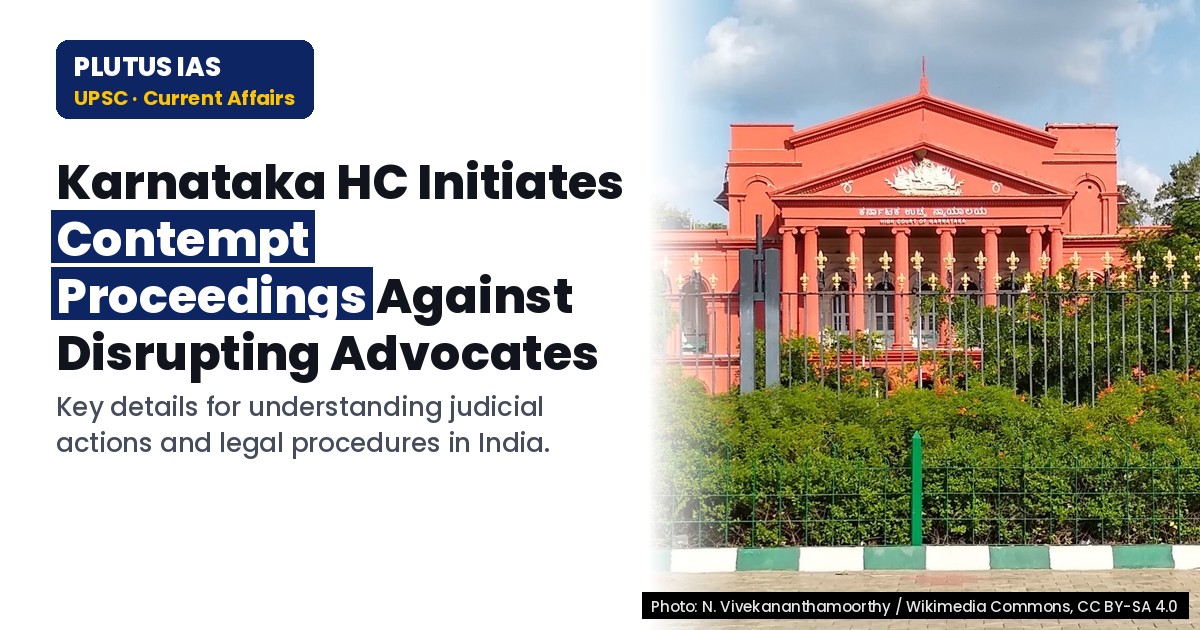
03 Nov Karnataka HC Contempt: Lawyers’ Ruckus in CJ’s Court
✎ Contempt of Court is a legal mechanism to protect the dignity and authority of judicial institutions and ensure the unobstructed administration of justice, with High Courts and the Supreme Court possessing inherent and statutory…
Subject Relevance — Where This Topic Fits
- GS Paper II — Governance, Constitution, Polity, Social Justice | GS Paper IV — Ethics, Integrity, and Aptitude
- Prelims: Contempt of Court Act, 1971, Civil Contempt, Criminal Contempt, Suo Motu action, High Court powers, Advocates Act, 1961, Bar Council of India, Professional ethics
- Essay: The role of the judiciary in upholding the rule of law and constitutional principles., Professional ethics and accountability in public life., Balancing fundamental rights with institutional integrity: The case of legal professionals and the judiciary.
Quick Revision: Contempt of Court is a legal mechanism to protect the dignity and authority of judicial institutions and ensure the unobstructed administration of justice, with High Courts and the Supreme Court possessing inherent and statutory powers to initiate suo motu proceedings for its enforcement.
Why is this in the news?
The Karnataka High Court has initiated suo motu contempt proceedings against unidentified individuals among a group of advocates for disrupting court proceedings in the Chief Justice’s court hall. This action was taken after advocates reportedly barged into courtrooms, compelling other lawyers to leave despite a statewide boycott call by bar associations to protest recent incidents of violence against legal professionals. The High Court viewed this conduct as prima facie contemptuous, underscoring the judiciary’s commitment to maintaining its sanctity and the uninterrupted administration of justice.
Background
- The incident occurred amidst a call for a statewide boycott of court proceedings by various bar associations, including the Advocates’ Association, Bengaluru (AAB), to protest against recent incidents of violence targeting advocates.
- Despite an earlier assurance from the High Court that no adverse orders would be passed against advocates abstaining from proceedings due to the boycott, a group of advocates forcibly entered courtrooms.
- The group compelled other legal professionals, including senior advocates, to vacate the court halls, leading to the abrupt cessation of proceedings in numerous courts.
- The High Court, through a Division Bench, took serious exception to these actions, particularly the disruption within the Chief Justice’s court, and ordered the registration of suo motu contempt proceedings.
- Notice has been issued to the Advocates’ Association, Bengaluru (AAB), indicating the High Court’s intent to address the institutional responsibility in the matter.
- The incident highlights the delicate balance between the right to protest and the imperative to maintain the dignity and functioning of judicial institutions.
Understanding Contempt of Court in India
- Contempt of Court refers to any act that obstructs or interferes with the administration of justice or lowers the authority and dignity of a court.
- The Contempt of Court Act, 1971, governs the law relating to contempt of court in India, defining and limiting the powers of certain courts in punishing contempt.
- It broadly categorises contempt into two types: Civil Contempt and Criminal Contempt.
- Civil Contempt involves willful disobedience to any judgment, decree, direction, order, writ, or other process of a court, or willful breach of an undertaking given to a court.
- Criminal Contempt includes the publication (whether by words, spoken or written, or by signs, or by visible representations, or otherwise) of any matter or the doing of any other act whatsoever which (i) scandalises or tends to scandalise, or lowers or tends to lower the authority of, any court; or (ii) prejudices, or interferes or tends to interfere with, the due course of any judicial proceeding; or (iii) interferes or tends to interfere with, or obstructs or tends to obstruct, the administration of justice in any other manner.
- High Courts and the Supreme Court possess the power to punish for contempt of themselves as well as of subordinate courts. This power is inherent and also enshrined in Article 129 (Supreme Court) and Article 215 (High Courts) of the Constitution of India.
- Suo motu contempt proceedings are initiated by the court on its own motion, without any formal complaint, when it perceives an act of contempt.
- The primary objective of contempt jurisdiction is to safeguard the dignity and authority of the courts and to ensure the smooth and impartial administration of justice, not to protect the personal dignity of judges.
Key Features
| Feature | Significance |
|---|---|
| Suo Motu Contempt Proceedings | Demonstrates the judiciary’s inherent power to protect its dignity and ensure the uninterrupted administration of justice, even without a formal complaint. |
| Disruption of Court Proceedings | Undermines the rule of law, obstructs judicial functions, and infringes upon the fundamental right to access justice for litigants. |
| Boycott Call by Bar Associations | Highlights collective action by legal professionals, but when accompanied by coercion, it raises concerns about professional ethics and the independence of the judiciary. |
| Role of Advocates’ Association, Bengaluru (AAB) | As a representative body, its actions and directives carry significant weight, and its involvement in the incident warrants judicial scrutiny regarding accountability. |
| Video Conference Facility Usage | Illustrates the judiciary’s adaptability in maintaining continuity of proceedings amidst physical disruptions, leveraging technological solutions. |
Why it Matters
Judicial Independence and Dignity
- The initiation of contempt proceedings by the High Court underscores the judiciary’s resolve to safeguard its institutional integrity and uphold the sanctity of court proceedings against any form of intimidation or obstruction.
- Maintaining judicial dignity is paramount for public trust in the justice delivery system, ensuring that decisions are rendered without external pressure or fear.
Rule of Law and Access to Justice
- Disruptions within court premises directly impede the functioning of the justice system, denying litigants their constitutional right to a fair and timely hearing.
- Such incidents challenge the foundational principle of the rule of law, where all individuals and institutions are subject to and accountable under the law.
Professional Ethics and Conduct
- The incident raises critical questions regarding the professional conduct expected of advocates, who are officers of the court and have a duty to uphold the law and assist in the administration of justice.
- The balance between collective protest and individual professional responsibility to the court and clients is a recurring ethical dilemma.
Institutional Accountability
- Issuance of notice to the Advocates’ Association, Bengaluru (AAB) highlights the accountability of professional bodies for the actions of their members, especially when such actions disrupt public institutions.
- It prompts a review of the internal mechanisms within bar associations to ensure adherence to ethical standards and prevent coercive tactics.
Challenges
1. Maintaining Judicial Authority
- Ensuring that judicial pronouncements and court orders are respected and implemented without obstruction, particularly within court premises.
- Countering attempts by any group to undermine the authority of the court through disruptive behaviour.
UPSC Link: Indian Constitution—Judiciary
2. Upholding Professional Ethics
- Addressing instances where advocates, as officers of the court, engage in conduct that obstructs justice or violates professional decorum.
- Balancing the right to protest with the duty to facilitate the administration of justice.
UPSC Link: Ethics and Human Interface
3. Ensuring Access to Justice
- Preventing disruptions that deny litigants their fundamental right to present their cases and receive timely judicial redressal.
- Safeguarding the ability of all parties to access legal representation and judicial forums without coercion.
UPSC Link: Indian Constitution—Fundamental Rights
4. Accountability of Bar Associations
- Defining the scope of responsibility of bar associations for the actions of their members, especially when calls for boycotts lead to coercive behaviour.
- Establishing mechanisms to ensure that such associations promote ethical conduct rather than condoning disruptive activities.
UPSC Link: Statutory, Regulatory and Quasi-Judicial Bodies
Challenges — UPSC Perspective
| Issue | Concern |
|---|---|
| Disruption of Court Proceedings | Directly impedes the administration of justice, causing delays and denying litigants their right to a fair hearing. |
| Coercion of Lawyers | Undermines the independence of individual advocates to perform their professional duties and potentially violates their freedom to practice. |
| Contemptuous Behaviour | Challenges the authority and dignity of the High Court, setting a precedent that could encourage further disregard for judicial processes. |
| Accountability of Professional Bodies | Raises questions about the role of bar associations in maintaining discipline and ensuring ethical conduct among their members. |
| Public Trust in Judiciary | Incidents of disorder within courts can erode public confidence in the judiciary’s ability to maintain order and deliver justice effectively. |
Way Forward
- Strict enforcement of contempt of court provisions to deter future disruptions and uphold judicial authority.
- Strengthening internal disciplinary mechanisms within bar associations to ensure accountability for members’ conduct and adherence to professional ethics.
- Promoting dialogue between the judiciary and bar associations to address grievances and find constructive solutions without resorting to disruptive actions.
- Educating legal professionals on the paramount importance of maintaining court decorum and facilitating the administration of justice.
- Leveraging technology, such as video conferencing, to ensure continuity of judicial proceedings even in the face of physical disruptions.
- Reviewing and updating guidelines for protests and boycotts by legal professionals to ensure they do not impede the functioning of the justice system.
- Enhancing security measures within court premises to prevent unauthorised entry and disruption of proceedings.
UPSC Value Addition
Keywords for Mains Answer-Writing
Contempt of Court · Judicial Independence · Rule of Law · Advocates’ Conduct · Professional Ethics · High Courts · Constitutional Morality · Judicial Proceedings · Bar Associations · Suo Motu Action
Constitutional & Policy Linkages
- {‘article’: ‘Article 129’, ‘note’: ‘Supreme Court as Court of Record’}
- {‘article’: ‘Article 215’, ‘note’: ‘High Courts as Courts of Record’}
- {‘article’: ‘Article 19(1)(a)’, ‘note’: ‘Freedom of Speech and Expression’}
- {‘article’: ‘Article 19(1)(g)’, ‘note’: ‘Right to Practice Profession’}
- {‘article’: ‘Article 21’, ‘note’: ‘Right to Life and Personal Liberty’}
Concept Flow
Advocates’ group calls for boycott of court proceedings. → Group forcibly enters court halls, disrupting proceedings. → Lawyers present are compelled to leave, obstructing justice. → High Court initiates suo motu contempt proceedings. → Court asserts judicial authority and dignity, issues notice.
Prelims Practice Questions
Q1. Consider the following statements regarding ‘Contempt of Court’ in India:
1. The power to punish for contempt of court is derived from the Contempt of Courts Act, 1971.
2. Both the Supreme Court and High Courts have the power to punish for contempt of court.
3. Civil contempt refers to the publication of any matter or the doing of any other act which scandalises or tends to scandalise, or lowers or tends to lower the authority of any court.
How many of the above statements are correct?
- Only one
- Only two
- Only three
- None
Answer: Only two — Statement 1 is correct: The Contempt of Courts Act, 1971, defines and limits the powers of certain courts in punishing contempt of court. Statement 2 is correct: Article 129 and 215 of the Constitution grant the Supreme Court and High Courts, respectively, the power to punish for contempt of themselves. Statement 3 is incorrect: Civil contempt refers to willful disobedience to any judgment, decree, direction, order, writ or other process of a court or willful breach of an undertaking given to a court. The description provided in statement 3 pertains to criminal contempt.
Q2. Which of the following Articles of the Indian Constitution explicitly grants the High Courts the power to punish for contempt of themselves?
- Article 129
- Article 142
- Article 215
- Article 226
Answer: Article 215 — Article 215 of the Indian Constitution states that every High Court shall be a court of record and shall have all the powers of such a court, including the power to punish for contempt of itself. Article 129 grants similar power to the Supreme Court. Article 142 deals with the enforcement of decrees and orders of the Supreme Court, and Article 226 deals with the power of High Courts to issue certain writs.
Mains Practice Question
✍ Critically examine the concept of ‘Contempt of Court’ in India, particularly in the context of maintaining judicial independence and the rule of law. Discuss the challenges posed by actions that disrupt court proceedings and the mechanisms available to address them. (15 Marks)
Approach: MODEL-ANSWER SKELETON: Define Contempt of Court (Civil and Criminal) as per the Contempt of Courts Act, 1971. Discuss its constitutional basis (Articles 129, 215). Explain its rationale: upholding judicial authority, ensuring fair administration of justice, and protecting the rule of law. Analyse the importance of judicial independence and how contempt powers safeguard it. Address challenges posed by disruption of court proceedings, including impact on justice delivery, public trust, and the decorum of the judiciary. Discuss mechanisms to address such disruptions, including suo motu contempt proceedings, powers under the Advocates Act, 1961, and disciplinary actions by Bar Councils. Refer to relevant Supreme Court judgments on contempt and the balance between free speech and judicial authority. Conclude with the need for a balanced approach that ensures accountability while preserving the sanctity of judicial institutions.
Source: The Hindu
Generated by AanyaAi for educational purpose.
Related guides on our sites
- Best PSIR optional coaching for upsc
- Best PSIR optional teacher for upsc
- Best teacher of PSIR optional for upsc
- Best PSIR optional coaching in delhi for UPSC

- Karnataka HC Contempt: Lawyers’ Ruckus in CJ’s Court - November 3, 2026
- बालिका तस्करी: NHRC का स्वतः संज्ञान, मानवाधिकार उल्लंघन पर रिपोर्ट तलब - November 3, 2026
- Bihar-MoRTH MoU: Scientific Desilting for NH Projects - November 3, 2026

No Comments