


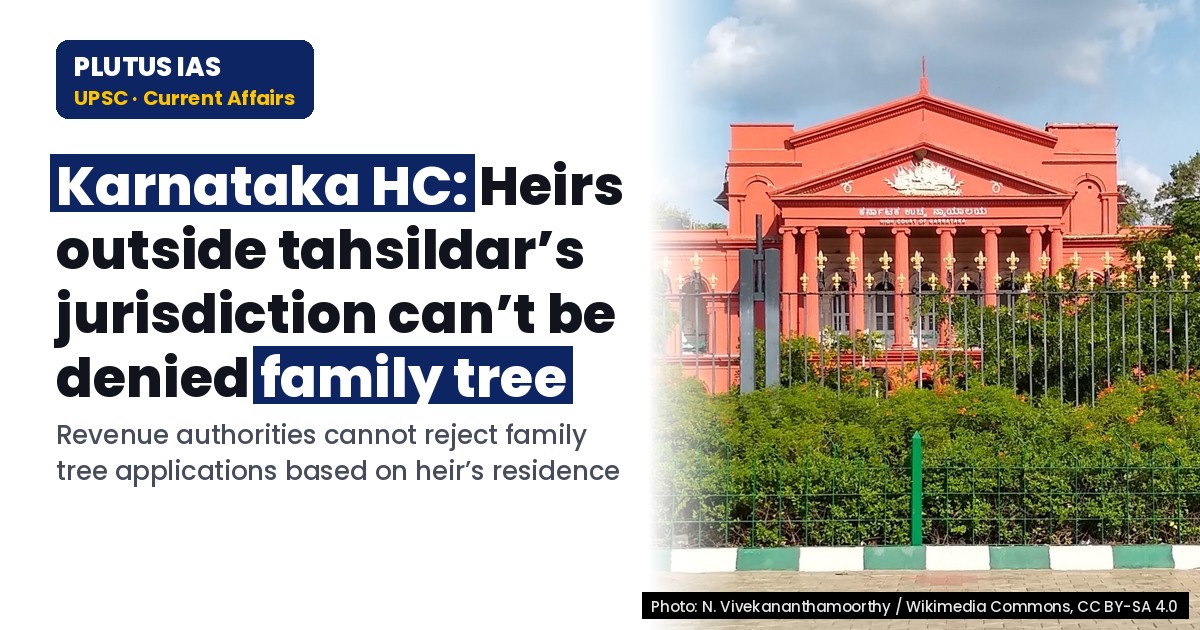
05 Oct Karnataka HC: Heirs Outside Tahsildar’s Jurisdiction Can’t Be Denied Family Tree
✎ The territorial jurisdiction of a tahsildar cannot be a ground to deny issuance of a survivor certificate (family tree/genealogy certificate), as the determining factor is the ancestral place of residence prior to the demise, not…
Subject Relevance — Where This Topic Fits
- GS Paper II — Governance, Constitution and Polity | GS Paper III — Land Reforms and Issues Relating to Land
- Prelims: survivor certificate, genealogy tree, tahsildar’s jurisdiction, Karnataka Sakala Services Act, 2011, revenue records mutation, village accountant, revenue inspector, administrative adjudication
- Essay: The role of judicial review in ensuring administrative fairness in citizen-state interactions, E-governance and service delivery: Bridging the gap between policy and citizen access
Quick Revision: The territorial jurisdiction of a tahsildar cannot be a ground to deny issuance of a survivor certificate (family tree/genealogy certificate), as the determining factor is the ancestral place of residence prior to the demise, not the current residence of individual heirs.
Why is this in the news?
The Karnataka High Court, in a judgment dated October 5, 2026, quashed the rejection of a survivor certificate application by a sub-division tahsildar on the ground that some family members resided outside the tahsildar’s territorial jurisdiction. The ruling underscores the administrative and constitutional principles governing the issuance of family tree certificates, particularly in the context of revenue administration and legal heirship verification. The decision is significant for civil services aspirants as it highlights the interplay between statutory service delivery, administrative circulars, and judicial review in governance.
Background
- The issuance of survivor certificates, commonly referred to as family tree or genealogy certificates, is a critical administrative function under the Revenue Department of Karnataka, enabling legal heirs to establish their claim to property and entitlements post the demise of an ancestor.
- Such certificates are often required for mutation of revenue records, property transactions, employment claims, compensation disbursements, and partition suits, thereby forming a foundational document in land and inheritance governance.
- The Karnataka Sakala Services Act, 2011, provides a statutory framework for time-bound delivery of government services, including the issuance of survivor certificates, though the specific procedure remains largely governed by departmental circulars rather than a dedicated legislative enactment.
- Revenue authorities, including tahsildars, village accountants, and revenue inspectors, play a pivotal role in verifying the claims made by applicants through local inquiries, though such verification is not statutorily mandated but derived from administrative circulars.
- The rejection of the petitioner’s application by the tahsildar on the sole ground of non-residence of some family members within the jurisdiction reflects a narrow interpretation of administrative jurisdiction, prompting judicial intervention.
- The judgment aligns with broader constitutional principles of administrative fairness, non-arbitrariness, and the right to access government services without undue procedural barriers.
What is a Survivor Certificate (Family Tree/Genealogy Certificate)?
- A survivor certificate, also known as a family tree or genealogy certificate, is an official document issued by revenue authorities to establish the legal heirs of a deceased person, thereby facilitating the transfer of property rights and entitlements.
- The certificate serves as prima facie evidence of heirship in administrative and legal proceedings, including mutation of revenue records, property transactions, and claims for employment or compensation.
- The issuance of such certificates is governed by the Karnataka Revenue Department’s administrative circulars and the Karnataka Sakala Services Act, 2011, which mandates time-bound service delivery but does not prescribe a detailed statutory procedure.
- The process typically involves an application by a legal heir, followed by a local inquiry conducted by village accountants or revenue inspectors to verify the claims, though such inquiry is not statutorily mandated.
- The certificate is distinct from a residential certificate, as the place of residence of individual heirs is not the determining factor; instead, the ancestral place of residence prior to the demise of the ancestor is considered.
- The Karnataka High Court’s ruling clarifies that the territorial jurisdiction of the tahsildar cannot be a ground for rejection if the ancestral lineage is traceable within the state, ensuring administrative fairness and preventing arbitrary denials.
- Such certificates are essential for marginalised communities, particularly in rural areas, where land records and inheritance rights are often disputed or inadequately documented.
- The judgment reinforces the principle that administrative authorities must adopt a purposive interpretation of their jurisdiction to ensure that citizens are not deprived of their legitimate entitlements due to procedural technicalities.
Key Features
| Feature | Significance |
|---|---|
| Genealogy/Family Tree Certificate | A legal document establishing the lineage of legal heirs for administrative purposes such as property mutation, employment claims, and compensation after a family member’s demise. |
| Territorial Jurisdiction of Tahsildar | The administrative boundary within which a revenue officer (tahsildar) exercises authority; traditionally used to determine eligibility for local services. |
| Karnataka Sakala Services Act, 2021 | A statutory framework ensuring time-bound delivery of government services, including issuance of revenue certificates like the family tree certificate. |
| Revenue Department Circulars | Administrative guidelines supplementing statutory provisions, particularly for procedures not explicitly codified in law, such as the issuance of family tree certificates. |
| Local Inquiry by Revenue Officials | A process conducted by village accountants or revenue inspectors to verify claims made in applications for family tree certificates, ensuring accuracy of lineage details. |
Why it Matters
Administrative Efficiency
- Ensures uniform and accessible issuance of family tree certificates across jurisdictions, reducing procedural delays for legal heirs.
- Clarifies that territorial jurisdiction is not a limiting factor for revenue authorities, streamlining service delivery under the Sakala Act.
- Reduces dependency on ad-hoc circulars by highlighting the need for a dedicated legislative framework for such certificates.
Legal Certainty
- Affirms that the place of residence of family members is irrelevant to the issuance of a family tree certificate, which is based on lineage rather than residency.
- Emphasizes that the certificate is distinct from a residential certificate, preventing misapplication of residency-based criteria.
- Strengthens the legal basis for family tree certificates by referencing their role in property mutation, employment claims, and compensation processes.
Judicial Precedent
- Sets a binding precedent for revenue authorities across Karnataka to follow uniform procedures while issuing family tree certificates.
- Underscores the judiciary’s role in interpreting administrative procedures to ensure fairness and equity in service delivery.
- Highlights the need for judicial intervention when procedural ambiguities in revenue administration lead to denial of legitimate rights.
Revenue Record Integrity
- Ensures accurate recording of legal heirs in revenue documents, preventing disputes over property rights and inheritance.
- Facilitates smooth mutation of property records post-demise, reducing litigation and administrative bottlenecks.
- Supports transparency in administrative processes by mandating verification of lineage through local inquiries.
Challenges
1. Procedural Ambiguity in Revenue Administration
- Lack of a dedicated statutory framework for issuing family tree certificates, leading to reliance on circulars and inconsistent practices.
- Inconsistent application of territorial jurisdiction criteria by tahsildars, resulting in arbitrary rejections of applications.
- Delays in issuance due to cumbersome verification processes, particularly when family members reside outside the tahsildar’s jurisdiction.
UPSC Link: GS-II: Role of State & Local Administration
2. Dependence on Non-Statutory Circulars
- Over-reliance on administrative circulars rather than statutory provisions creates uncertainty and hampers legal clarity.
- Circulars may not cover all scenarios, leading to gaps in procedure and potential misuse or denial of services.
- Judicial intervention becomes necessary to fill legislative gaps, as seen in this case.
UPSC Link: GS-II: Governance, Transparency & Accountability
3. Verification Challenges for Revenue Officials
- Difficulty in verifying lineage claims when family members reside outside the tahsildar’s jurisdiction, despite the court’s ruling.
- Potential for fraudulent claims if verification processes are not robust or standardized across jurisdictions.
- Resource constraints in revenue departments may hinder thorough local inquiries, affecting the accuracy of issued certificates.
UPSC Link: GS-II: Role of Civil Services in Governance
4. Inter-Jurisdictional Coordination Gaps
- Lack of seamless coordination between tahsildars of different jurisdictions to verify claims made by applicants.
- No standardized mechanism for sharing lineage data across jurisdictions, leading to duplication of efforts or conflicting records.
- Delays in issuance when family members reside in multiple jurisdictions, as verification requires cross-departmental collaboration.
UPSC Link: GS-II: Centre-State Relations & Inter-State Cooperation
5. Public Awareness and Accessibility
- Limited awareness among citizens about the correct procedure for obtaining family tree certificates, leading to rejections or avoidable delays.
- Language barriers and lack of digital literacy may hinder access to services, particularly for rural and marginalized communities.
- Need for simplified, user-friendly guidelines to ensure equitable access to revenue services.
UPSC Link: GS-II: Welfare Schemes & their Implementation
Challenges — UPSC Perspective
| Issue | Concern |
|---|---|
| Lack of Dedicated Legislation | Family tree certificates are issued based on circulars rather than a statutory framework, leading to procedural inconsistencies. |
| Arbitrary Rejections by Tahsildars | Applications are rejected solely because some family members reside outside the tahsildar’s jurisdiction, despite the court’s ruling. |
| Verification Bottlenecks | Local inquiries by revenue officials are time-consuming and may not cover all family members, especially those residing elsewhere. |
| Inter-Jurisdictional Data Gaps | No standardized system exists for sharing lineage data across tahsildar jurisdictions, complicating verification processes. |
| Public Misunderstanding of Procedures | Citizens often lack clarity on the correct procedure for obtaining family tree certificates, leading to avoidable rejections or delays. |
| Resource Constraints in Revenue Departments | Limited manpower and infrastructure in revenue offices hinder efficient issuance and verification of certificates. |
Way Forward
- Amend the Karnataka Revenue Department’s procedural guidelines to explicitly state that territorial jurisdiction is not a criterion for issuing family tree certificates, aligning with the High Court’s ruling.
- Develop a standardized, pan-Karnataka template for family tree certificates to ensure uniformity in format and content across jurisdictions.
- Establish a digital portal for online submission and verification of family tree certificate applications, reducing reliance on physical inquiries and paperwork.
- Conduct capacity-building programs for tahsildars, village accountants, and revenue inspectors on the correct procedures for issuing family tree certificates, emphasizing the court’s ruling.
- Introduce a grievance redressal mechanism within the Sakala Services Act framework to address rejections of family tree certificate applications promptly.
- Collaborate with the Union Government to explore the inclusion of family tree certificates in the Concurrent List of the Constitution, enabling a uniform national framework.
- Publish simplified, multilingual guides for citizens on the procedure for obtaining family tree certificates, including common grounds for rejection and remedies.
- Pilot a blockchain-based system for maintaining and verifying lineage records, ensuring tamper-proof and interoperable data across jurisdictions.
UPSC Value Addition
Keywords for Mains Answer-Writing
Genealogy/family tree certificates · Revenue administration in India · Tahsildar’s jurisdiction · Karnataka Sakala Services Act 2011 · Legal heir certificates · Revenue records mutation · Administrative adjudication · Procedural fairness in revenue governance · Constitutional principles of natural justice · Administrative circulars vs statutory provisions
Constitutional & Policy Linkages
- Article 300A: Right to Property (as it pertains to the protection of legal heirs’ property rights through accurate revenue records).
Concept Flow
Deceased family member → Legal heirs apply for family tree certificate → Tahsildar rejects application citing non-resident family members → Petitioner challenges rejection in High Court → Court rules territorial jurisdiction irrelevant → Sets aside tahsildar’s order → Emphasizes lineage over residency → Highlights procedural gaps in revenue administration → Calls for statutory clarity and standardized procedures.
Prelims Practice Questions
Q1. Consider the following statements regarding the issuance of genealogy/family tree certificates in Karnataka:
1. The Karnataka High Court has ruled that the absence of some family members within the tahsildar’s jurisdiction cannot be grounds for rejecting an application for such a certificate.
2. The procedure for issuance of these certificates is primarily governed by statutory provisions under the Karnataka Revenue Code, 1964.
3. These certificates are typically required for purposes such as mutation of legal heirs’ names in revenue records and claiming employment benefits.
How many of the above statements are correct?
- Only one
- Only two
- All
- None
Answer: Only two — Statement 1 is correct as per the Karnataka High Court ruling. Statement 2 is incorrect because the procedure is largely driven by government circulars rather than statutory provisions. Statement 3 is correct as these certificates serve multiple administrative purposes.
Q2. Assertion (A): The Karnataka High Court has held that the issuance of a genealogy/family tree certificate is analogous to the issuance of a residential certificate.
Reason (R): The place of residence of the family members is irrelevant for determining the issuance of a genealogy/family tree certificate.
Options:
A. Both A and R are true, and R is the correct explanation of A.
B. Both A and R are true, but R is not the correct explanation of A.
C. A is true, but R is false.
D. A is false, but R is true.
Answer: ? — Assertion (A) is false because the court explicitly distinguished genealogy certificates from residential certificates. Reason (R) is true as the court held that the place of residence of family members is irrelevant for such certificates.
Q3. Match the following administrative functions with their corresponding revenue certificates in Karnataka:
Column I (Function) | Column II (Certificate)
— | —
1. Mutation of legal heirs’ names in revenue records | A. Genealogy/family tree certificate
2. Proof of residence for domicile purposes | B. Residential certificate
3. Claiming employment benefits under government schemes | C. Survivor certificate
4. Verification of legal heirs after a death | D. Income certificate
Options:
A. 1-A, 2-B, 3-C, 4-D
B. 1-C, 2-B, 3-A, 4-D
C. 1-A, 2-B, 3-D, 4-C
D. 1-D, 2-A, 3-B, 4-C
Answer: ? — 1-C: Mutation of legal heirs’ names requires a survivor certificate. 2-B: Proof of residence requires a residential certificate. 3-A: Genealogy/family tree certificates are used for claiming employment benefits. 4-D: Income certificates are not directly related to legal heir verification.
Mains Practice Question
✍ The Karnataka High Court has recently held that revenue authorities cannot reject applications for genealogy/family tree certificates merely because some family members reside outside the territorial jurisdiction of the concerned tahsildar. Examine the legal and administrative implications of this judgment in the context of revenue governance and procedural fairness in India. (15 Marks)
Approach: MODEL-ANSWER SKELETON:
1. **Legal Basis**: Cite the Karnataka High Court’s ruling and its distinction between genealogy certificates and residential certificates. Reference the absence of a dedicated statutory framework, reliance on the Karnataka Sakala Services Act, 2011, and government circulars.
2. **Procedural Fairness**: Discuss the principles of natural justice (audi alteram partem) and administrative adjudication. Highlight how arbitrary rejections undermine fairness and transparency in revenue administration.
3. **Administrative Challenges**: Explain the practical difficulties in revenue governance, such as verifying family details across jurisdictions, and the role of village accountants/revenue inspectors in local inquiries.
4. **Broader Implications**:
– **Legal Certainty**: Emphasise the need for a statutory framework to replace circulars for consistency.
– **Access to Entitlements**: Link genealogy certificates to essential services (employment, property transactions, compensation claims) and the judgment’s role in reducing bureaucratic hurdles.
– **Judicial Activism**: Discuss how judicial interventions can correct procedural lacunae in governance.
5. **Balanced View**: Acknowledge the challenges in balancing procedural rigor with citizen convenience, citing examples of similar reforms in other states (e.g., digitisation of land records).
6. **Conclusion**: Summarise the judgment’s contribution to procedural fairness and recommend legislative codification for nationwide applicability.
Source: The Hindu
Karnataka PCS (KPSC) — State PCS Practice
Prelims: According to a recent Karnataka High Court ruling, what is the legal position regarding the inclusion of heirs not residing in the jurisdiction of a Tahsildar when preparing a family tree?
- Heirs not residing in the Tahsildar’s jurisdiction can be denied inclusion in the family tree if their presence is not verified locally.
- Heirs not residing in the Tahsildar’s jurisdiction cannot be denied inclusion in the family tree solely on that ground.
- The Tahsildar has absolute discretion to exclude heirs based on their place of residence.
- Only heirs residing within the state of Karnataka can be included in the family tree.
Answer: Heirs not residing in the Tahsildar’s jurisdiction cannot be denied inclusion in the family tree solely on that ground. — The Karnataka High Court ruled that the absence of heirs from the Tahsildar’s jurisdiction cannot be a ground to deny their inclusion in the family tree.
Mains: Critically analyze the implications of the Karnataka High Court’s judgment on the preparation of family trees by Tahsildars, with special reference to the rights of heirs residing outside the jurisdiction. Discuss the potential challenges in its implementation and suggest measures to ensure equitable access to family tree records for all eligible heirs in Karnataka.
Generated by AanyaAi for educational purpose.
Related guides on our sites
- Current affairs for upsc 2026
- Best PSIR optional coaching for upsc
- Best PSIR optional teacher for upsc
- Best teacher of PSIR optional for upsc

- Karnataka HC: Heirs Outside Tahsildar’s Jurisdiction Can’t Be Denied Family Tree - October 5, 2026
- महाराष्ट्र में 16 अक्टूबर से 10% जल कटौती, सूखे और एल नीनो के कारण - October 5, 2026
- SC Directives to Curb Women Safety Issues in Delhi-NCR - October 5, 2026

No Comments