


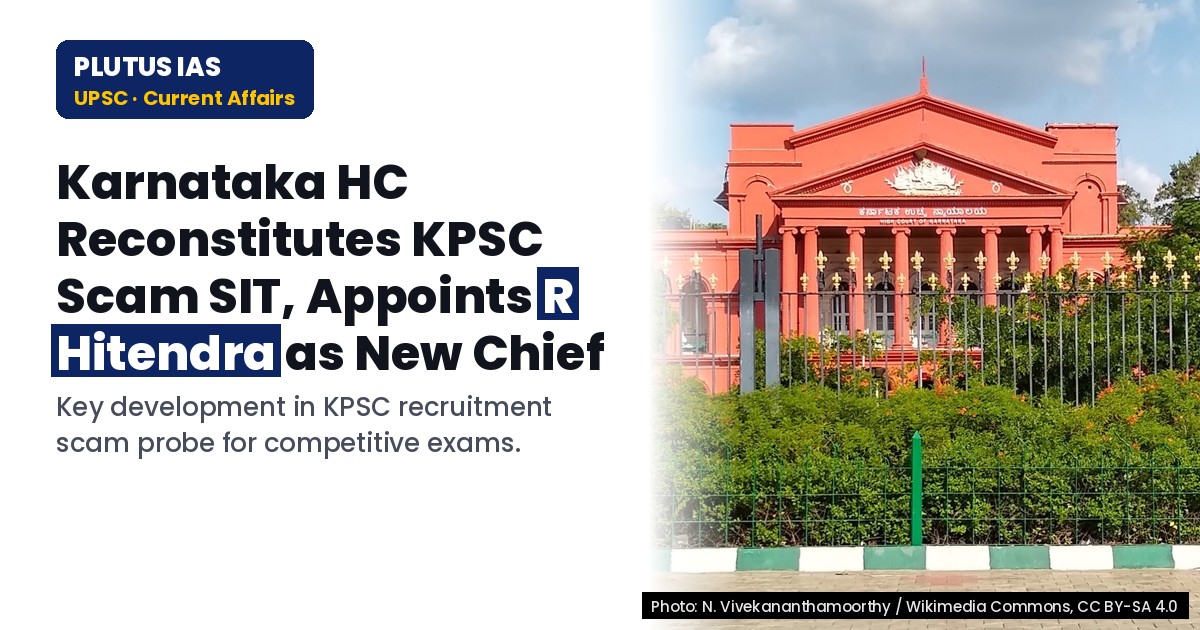
03 Nov Karnataka HC Reconstitutes KPSC Scam SIT, Names New Chief
✎ The Karnataka High Court reconstituted a Special Investigation Team (SIT) to ensure an independent and credible investigation into alleged KPSC recruitment irregularities, aligning with Supreme Court directives for further…
Subject Relevance — Where This Topic Fits
- GS Paper II — Polity and Governance | GS Paper IV — Ethics, Integrity, and Aptitude
- Prelims: Karnataka Public Service Commission (KPSC), Special Investigation Team (SIT), Judicial Review, Enforcement Directorate (ED), Criminal Investigation Department (CID), Public Accountability, Recruitment Scams, High Court Jurisdiction
- Essay: The role of independent institutions in upholding public trust and accountability., Ensuring integrity in public service recruitment: Challenges and solutions.
Quick Revision: The Karnataka High Court reconstituted a Special Investigation Team (SIT) to ensure an independent and credible investigation into alleged KPSC recruitment irregularities, aligning with Supreme Court directives for further investigation rather than a de novo probe.
Why is this in the news?
The Karnataka High Court recently reconstituted a Special Investigation Team (SIT) tasked with probing alleged recruitment irregularities within the Karnataka Public Service Commission (KPSC). This action involved appointing new senior officers to lead the SIT, following the state government’s objections to previous appointments and a Supreme Court directive to continue, rather than initiate de novo, the investigation from the point where the prior agency concluded its work. The court emphasised the imperative for an independent and credible investigation, insulated from past influences, to restore public confidence in the recruitment process.
Background
- Allegations of recruitment irregularities and ‘scams’ within the Karnataka Public Service Commission (KPSC) have prompted judicial intervention.
- The Karnataka High Court had previously ordered a fresh investigation into these alleged scams, leading to the initial constitution of an SIT.
- The state government challenged the High Court’s initial order, particularly concerning the appointment of a DGP-rank officer to head the SIT without prior consultation with state authorities.
- The Supreme Court, in its October 13 ruling, upheld the constitution of the SIT but modified the High Court’s directive, stipulating that the SIT should continue the investigation from the stage left by the previous agency (CID), rather than commencing a de novo probe.
- The High Court’s recent action involves reconstituting the SIT, appointing new leadership, and stressing the need for parallel and independent investigations by both the SIT and the Enforcement Directorate (ED), ensuring cooperation without jurisdictional conflict.
- The court underscored that the investigation must be independent, command confidence and credibility, and remain impervious to institutional or extraneous influences.
Understanding Special Investigation Teams (SITs) and Judicial Oversight
- A Special Investigation Team (SIT) is typically constituted to investigate complex, sensitive, or high-profile cases that require specialised expertise or a focused approach beyond the scope of regular police investigations.
- SITs can be formed by government orders or, crucially, by judicial directives from High Courts or the Supreme Court, particularly when there are concerns about the impartiality or effectiveness of existing investigative agencies.
- The formation of an SIT by a court often reflects the judiciary’s exercise of its power of judicial review and its role as a guardian of fundamental rights and public interest, ensuring fair and impartial investigations.
- Judicial oversight in such cases extends to monitoring the progress of investigations, issuing specific directions to the SIT, and ensuring accountability of the investigative process.
- The Supreme Court and High Courts possess inherent powers under Articles 32 and 226 respectively, to issue writs and directions, including those for constituting SITs, to uphold justice and the rule of law.
- The principle of ‘de novo’ investigation implies starting an investigation afresh, while ‘further investigation’ entails continuing from the point where a previous agency concluded its work, often with a different investigative approach or team.
- The KPSC, like other State Public Service Commissions, is a constitutional body established under Article 315 of the Constitution of India, responsible for conducting examinations for appointments to state services and advising the state government on various service matters.
Key Features
| Feature | Significance |
|---|---|
| Reconstitution of Special Investigation Team (SIT) | Aims to ensure renewed independence and credibility in the investigation of alleged recruitment scams within the Karnataka Public Service Commission (KPSC). |
| Appointment of R Hitendra as SIT Head | Addresses previous objections regarding the appointment of a DGP-rank officer without consultation, seeking to establish a more acceptable leadership for the probe. |
| Exclusion of previous investigating officers | Ensures the new SIT is insulated from any perceived shadow or influence of prior investigations conducted by the CID, fostering an unbiased approach. |
| Parallel investigations by SIT and ED | Mandates independent yet cooperative probes by both agencies, ensuring comprehensive pursuit of truth without jurisdictional conflicts. |
| Supreme Court’s directive on investigation scope | Clarifies that the SIT should continue the investigation from the stage where the previous agency concluded, rather than initiating a de novo probe. |
| Judicial oversight of probe progress | Requires the Enforcement Directorate (ED) to submit progress reports to the High Court, ensuring accountability and adherence to judicial directives. |
Why it Matters
Governance and Public Administration
- Upholds the principle of accountability in public service recruitment processes, essential for maintaining public trust in government institutions.
- Reinforces the role of the judiciary in overseeing investigative agencies to ensure fairness, independence, and adherence to due process.
- Highlights the imperative for transparent and merit-based selection mechanisms in public employment, crucial for efficient administration.
Rule of Law and Justice Delivery
- Demonstrates the judiciary’s commitment to addressing allegations of corruption and malpractice, thereby strengthening the rule of law.
- Emphasises the importance of an impartial and independent investigation to uncover facts and bring perpetrators to justice.
- Illustrates the checks and balances within the Indian legal system, where higher courts can intervene to ensure the integrity of investigations.
Institutional Integrity
- Aims to restore confidence in the Karnataka Public Service Commission (KPSC), an institution vital for state-level recruitment.
- Sets a precedent for how allegations of systemic corruption in public bodies should be investigated, stressing independence and thoroughness.
- Promotes ethical conduct within government agencies and discourages malpractices that undermine institutional credibility.
Challenges
1. Maintaining Investigative Independence
- Ensuring that the reconstituted SIT operates without external pressures or internal biases, especially given the high-profile nature of the alleged scams.
- Preventing any interference from political or administrative entities that could compromise the integrity and impartiality of the investigation.
UPSC Link: Ethics, Integrity, and Aptitude; Governance
2. Coordination between Agencies
- Facilitating seamless cooperation between the SIT and the Enforcement Directorate (ED) while maintaining their statutory independence, to avoid jurisdictional disputes.
- Ensuring that information sharing and evidence collection are harmonised to build a comprehensive case, without duplication or omission.
UPSC Link: Indian Polity; Governance
3. Public Trust and Confidence
- Restoring public faith in the KPSC and the state’s recruitment processes, which may have been eroded by repeated allegations of scams.
- Communicating the progress and findings of the investigation transparently to assure the public of a fair and just outcome.
UPSC Link: Governance; Public Administration
4. Timely Resolution of Cases
- Expediting the investigation and subsequent legal proceedings to ensure that justice is delivered promptly, preventing undue delays.
- Addressing the backlog of cases and ensuring that the new investigation does not further prolong the resolution for affected candidates.
UPSC Link: Indian Polity; Governance
Challenges — UPSC Perspective
| Issue | Concern |
|---|---|
| Alleged Recruitment Scams | Undermines meritocracy, fairness, and public trust in government employment processes. |
| Government’s objection to SIT chief | Highlights potential friction between judicial directives and executive prerogatives in appointments, impacting investigative autonomy. |
| Previous CID investigation | Concerns regarding its thoroughness or independence, necessitating a fresh perspective from the reconstituted SIT. |
| Jurisdictional assertion between SIT and ED | Risk of competing investigations rather than complementary ones, potentially hindering the overall pursuit of truth. |
| Impact on affected candidates | Prolonged uncertainty and injustice for individuals whose careers are stalled due to alleged irregularities in recruitment. |
| Credibility of Public Service Commissions | Repeated allegations of malpractices erode the foundational trust in institutions responsible for selecting public servants. |
Way Forward
- Implement robust internal vigilance mechanisms within Public Service Commissions to detect and prevent recruitment irregularities proactively.
- Strengthen the legal framework governing recruitment processes to ensure stricter penalties for malpractices and faster adjudication of cases.
- Enhance transparency in all stages of recruitment, including examination conduct, evaluation, and result declaration, to minimise scope for manipulation.
- Establish clear protocols for inter-agency cooperation in investigations, ensuring seamless information exchange while respecting statutory mandates.
- Provide adequate resources and training to investigative agencies to equip them with the necessary tools and expertise for complex corruption probes.
- Regularly review and update recruitment policies to adapt to evolving challenges and incorporate best practices from other jurisdictions.
- Foster a culture of ethical conduct and accountability among public servants involved in recruitment processes through continuous sensitisation and oversight.
UPSC Value Addition
Keywords for Mains Answer-Writing
Judicial oversight · Special Investigation Team (SIT) · Recruitment irregularities · Public Service Commissions (PSCs) · Rule of law · Accountability in governance · Separation of powers · Judicial activism · Constitutional courts · Fair investigation
Constitutional & Policy Linkages
- {‘article’: ‘Article 315-323’, ‘note’: ‘Pertains to Public Service Commissions’}
- {‘article’: ‘Article 226’, ‘note’: “High Court’s writ jurisdiction”}
- {‘article’: ‘Article 142’, ‘note’: “Supreme Court’s complete justice power”}
Concept Flow
Allegations of recruitment scams in KPSC surface. → Karnataka High Court orders SIT formation for probe. → State government challenges SIT chief appointment. → Supreme Court upholds SIT, modifies investigation scope. → High Court reconstitutes SIT with new leadership. → SIT and ED conduct parallel, cooperative investigations. → Investigation aims to ensure justice and restore institutional integrity.
Prelims Practice Questions
Q1. Consider the following statements regarding Special Investigation Teams (SITs) in India:
1. An SIT can be constituted by the Supreme Court or a High Court to investigate specific cases.
2. The composition and powers of an SIT are explicitly defined under the Code of Criminal Procedure, 1973.
3. SITs are typically formed when existing investigative agencies are perceived to be inadequate or compromised.
How many of the above statements are correct?
- Only one
- Only two
- Only three
- None
Answer: Only two — Statement 1 is correct: Both the Supreme Court and High Courts exercise inherent powers under Article 32 and Article 226 respectively to constitute SITs for ensuring fair and impartial investigations. Statement 2 is incorrect: The Code of Criminal Procedure, 1973, does not explicitly define the composition and powers of SITs; rather, their constitution and mandate are typically determined by the court order establishing them. Statement 3 is correct: SITs are often formed in cases of significant public interest or when there are concerns about the impartiality or effectiveness of regular investigative bodies.
Q2. Which of the following constitutional provisions empowers High Courts to issue directions, orders, or writs for the enforcement of fundamental rights and for any other purpose?
- Article 32
- Article 136
- Article 226
- Article 227
Answer: Article 226 — Article 226 of the Constitution of India empowers High Courts to issue directions, orders, or writs, including writs in the nature of habeas corpus, mandamus, prohibition, quo warranto, and certiorari, for the enforcement of any of the rights conferred by Part III and for any other purpose. Article 32 grants similar powers to the Supreme Court. Article 136 deals with special leave to appeal by the Supreme Court. Article 227 deals with the power of superintendence by the High Court over all courts and tribunals within its territorial jurisdiction.
Mains Practice Question
✍ The recent reconstitution of a Special Investigation Team (SIT) by a High Court underscores the judiciary’s role in ensuring independent and credible investigations into allegations of administrative malfeasance. Discuss the constitutional basis and implications of judicial intervention in the investigative process, particularly in cases involving public service commissions. (15 Marks)
Approach: MODEL-ANSWER SKELETON:
1. **Introduction**: Briefly define judicial intervention in investigations and its context in ensuring justice and accountability, referencing the news story’s essence.
2. **Constitutional Basis for Judicial Intervention**:
* **Article 32 (Supreme Court)** and **Article 226 (High Courts)**: Power to issue writs (Mandamus, Certiorari, Quo Warranto) to compel performance of public duty or quash illegal actions, and to ensure fundamental rights.
* **Judicial Review**: Power to review executive and legislative actions, including the conduct of investigations.
* **Separation of Powers**: Explain how judicial intervention, while respecting separation of powers, acts as a check and balance to ensure executive accountability.
3. **Implications of Judicial Intervention in Investigative Process**:
* **Ensuring Independence and Credibility**: Prevents executive overreach or political interference in sensitive cases.
* **Restoring Public Faith**: Enhances trust in institutions and the justice delivery system, especially in cases of alleged corruption or recruitment scams.
* **Accountability**: Holds investigative agencies and public bodies accountable for their actions and inactions.
* **Setting Precedents**: Judicial pronouncements guide future investigations and administrative conduct.
* **Potential Challenges**: Discuss concerns about judicial overreach, delays in investigation, and resource allocation.
4. **Specific Context of Public Service Commissions (PSCs)**:
* **Constitutional Mandate of PSCs**: Articles 315-323, ensuring independent and impartial recruitment.
* **Importance of Judicial Scrutiny**: Essential to uphold the integrity of the recruitment process, which is crucial for good governance and meritocracy.
* **Impact of Scams**: Undermines public trust, demoralizes aspirants, and compromises administrative quality.
* **Role of SITs**: How court-mandated SITs, like in the Karnataka KPSC case, address specific allegations of fraud and ensure a fair probe where regular agencies might be perceived as compromised.
5. **Conclusion**: Summarize the critical role of judicial oversight in upholding the rule of law, ensuring fair investigations, and safeguarding the integrity of constitutional bodies like PSCs, while maintaining a balance with executive functions.
Source: The Indian Express
Karnataka PCS (KPSC) — State PCS Practice
Prelims: The Karnataka High Court recently reconstituted the Special Investigation Team (SIT) probing alleged irregularities in the Karnataka Public Service Commission (KPSC). Who has been appointed as the new head of this reconstituted SIT?
- Praveen Sood
- R Hitendra
- Kamal Pant
- Alok Mohan
Answer: R Hitendra — R Hitendra has been appointed as the new chief of the reconstituted SIT by the Karnataka High Court to probe KPSC irregularities.
Mains: Analyze the significance of the Karnataka High Court’s decision to reconstitute the KPSC probe SIT, considering its implications for transparency, accountability, and public trust in state administrative recruitment processes.
Generated by AanyaAi for educational purpose.
Related guides on our sites
- Current affairs for upsc 2026
- Best PSIR optional coaching for upsc
- Best PSIR optional teacher for upsc
- Best teacher of PSIR optional for upsc

- Karnataka HC Reconstitutes KPSC Scam SIT, Names New Chief - November 3, 2026
- संयुक्त राष्ट्र रिपोर्ट: 2030 तक ‘जीरो हंगर’ लक्ष्य पर संकट - November 3, 2026
- Cyclone Murasu: AP’s Disaster Preparedness & Power Resilience - November 3, 2026

No Comments