


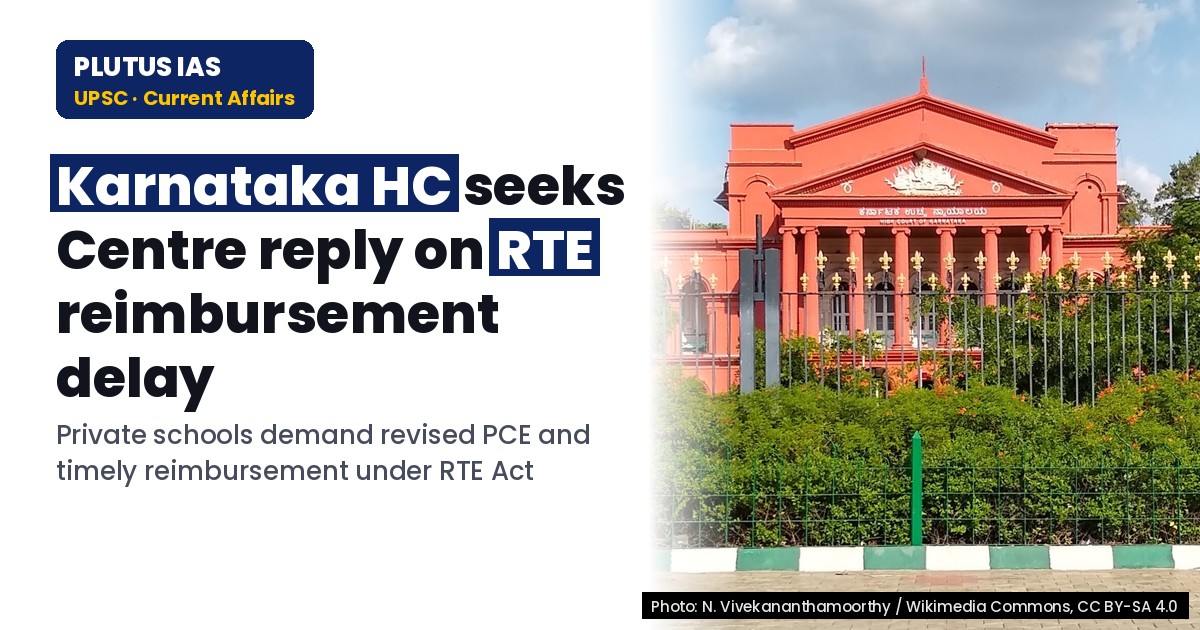
14 Oct Karnataka HC seeks response on RTE reimbursement delay for private schools
✎ Per Child Expenditure (PCE) under the RTE Act is the annually notified reimbursement rate per student admitted under the 25% quota, calculated as total recurring expenditure divided by enrolment, and must be notified before the…
Subject Relevance — Where This Topic Fits
- GS Paper II — Constitutional and Statutory Provisions | GS Paper III — Government Budgeting and Financial Management | GS Paper IV — Ethical Governance and Accountability
- Prelims: Right to Education Act, 2009, Section 12(2) of RTE Act, Per Child Expenditure (PCE), Karnataka RTE Rules, 2012, Disadvantaged Groups and Weaker Sections, Reimbursement Mechanism, Judicial Review of Executive Actions
- Essay: The Role of Judicial Intervention in Ensuring Equitable Access to Education, Balancing Fiscal Responsibility and Social Justice in Public Policy
Quick Revision: Per Child Expenditure (PCE) under the RTE Act is the annually notified reimbursement rate per student admitted under the 25% quota, calculated as total recurring expenditure divided by enrolment, and must be notified before the academic year to ensure fiscal fairness and compliance with Section 12(2) of the RTE Act.
Why is this in the news?
The Karnataka High Court has issued notices to the State and Central governments on a petition filed by private unaided schools seeking the fixation of Per Child Expenditure (PCE) and reimbursement for students admitted under the 25% RTE quota for the academic year 2026-27. The petition highlights the financial strain on schools due to delayed and outdated PCE notifications, despite statutory mandates for annual revisions, raising critical questions about the implementation of the RTE Act and the fiscal governance of education policies.
Background
- The Right of Children to Free and Compulsory Education (RTE) Act, 2009, mandates that private unaided schools reserve 25% of their seats for children from disadvantaged groups and weaker sections, with the government reimbursing the schools for the expenditure incurred.
- Section 12(2) of the RTE Act requires the appropriate government to notify the Per Child Expenditure (PCE) annually before the commencement of the academic year, which serves as the basis for reimbursement to schools.
- Rule 8 of the Karnataka RTE Rules, 2012, prescribes a formula for calculating PCE, defined as the total annual recurring expenditure divided by total enrolment, but lacks detailed accounting safeguards or scientific methodology.
- The last revision of PCE in Karnataka was in 2017-18, with rates of ₹16,000 for primary classes and ₹8,000 for higher primary classes, and subsequent notifications have merely repeated these figures without adjustment for inflation or rising costs.
- Private unaided schools argue that non-reimbursement and outdated PCE rates impose financial burdens, potentially leading to fee hikes for non-RTE students or compromising educational quality.
- The petition also seeks a national protocol for determining PCE, including parameters such as uniform accounting standards, independent certification, and mechanisms for delayed reimbursement.
What is Per Child Expenditure (PCE) under the RTE Act?
- PCE is the pre-determined annual expenditure per student that the government reimburses to private unaided schools for admitting students under the 25% RTE quota, as mandated by Section 12(2) of the RTE Act.
- The PCE is intended to cover the recurring costs incurred by schools for educating RTE quota students, including salaries, infrastructure maintenance, and teaching materials, ensuring that schools are not financially disadvantaged by admitting these students.
- Under Rule 8 of the Karnataka RTE Rules, 2012, PCE is calculated as the total annual recurring expenditure of a school divided by its total enrolment, though this formula lacks detailed accounting safeguards or minimum standards.
- The PCE must be notified annually before the academic year begins, as per statutory requirements, to enable schools to plan their finances and ensure timely reimbursement.
- The absence of updated PCE notifications or delayed reimbursements places a financial burden on schools, which may lead to cost-cutting measures or increased fees for non-RTE students, undermining the equity objectives of the RTE Act.
- A national protocol for determining PCE is sought to standardise the process across states, including uniform definitions of eligible recurring heads, audited year-end reconciliation, and independent certification to ensure transparency and accountability.
- The PCE mechanism is a critical link between the RTE Act’s equity goals and the fiscal sustainability of private unaided schools, requiring a balance between social justice and financial viability.
- Judicial intervention, as seen in the Karnataka HC case, underscores the role of the judiciary in ensuring that executive actions comply with statutory mandates and constitutional principles.
Key Features
| Feature | Significance |
|---|---|
| Right of Children to Free and Compulsory Education (RTE) Act, 2009 | Mandates 25% reservation in private unaided schools for disadvantaged groups and weaker sections, with reimbursement of expenditure by the State. |
| Per Child Expenditure (PCE) | Determines the quantum of reimbursement to schools under RTE Section 12(2); basis for financial viability of schools implementing the quota. |
| Karnataka RTE Rules, 2012 (Rule 8) | Prescribes the formula for calculating PCE—total annual recurring expenditure divided by total enrolment—but lacks detailed accounting safeguards. |
| Judicial intervention (Karnataka HC) | Provides constitutional remedy for delays in statutory obligations; ensures adherence to RTE provisions through judicial directives. |
| National protocol for PCE determination | Proposed uniform methodology for calculating PCE across states, including audited reconciliation and delayed reimbursement interest. |
Why it Matters
Legal and Constitutional
- The RTE Act, 2009, under Section 12(2), imposes a statutory obligation on States to reimburse private unaided schools for students admitted under the 25% quota, ensuring compliance with the Fundamental Right to Education (Article 21A).
- Judicial oversight via the Karnataka High Court reinforces the enforceability of statutory timelines, protecting the rights of both schools and disadvantaged students.
- The absence of a national protocol for PCE determination creates inter-state disparities, undermining the uniformity envisaged under the RTE Act.
Economic
- Delayed or inadequate reimbursement imposes a financial burden on private unaided schools, potentially leading to fee hikes for non-RTE students or reduced quality of infrastructure and pedagogy.
- Rising costs of salaries, infrastructure, and welfare schemes (e.g., teacher salaries under 7th Pay Commission) necessitate periodic revision of PCE to maintain fiscal sustainability for schools.
- Non-reimbursement acts as an implicit subsidy from private schools to the State, distorting market-based education provision and discouraging participation in the RTE quota.
Administrative and Governance
- The Karnataka government’s failure to revise PCE since 2017-18 despite rising costs reflects administrative inertia and weak fiscal governance in implementing statutory obligations.
- The lack of a structured methodology for PCE calculation (e.g., absence of minimum accounting safeguards) undermines transparency and accountability in fund disbursement.
- A national protocol would standardise PCE determination, reducing litigation and ensuring equitable treatment of schools across states.
Social
- Timely reimbursement ensures that private unaided schools can sustain the inclusion of disadvantaged students without compromising educational quality or imposing undue financial strain.
- Delays disproportionately affect schools with higher RTE admissions, exacerbating inequities in access to quality education for marginalised groups.
- The RTE quota aims to bridge socio-economic divides; non-compliance with reimbursement obligations undermines this objective.
Challenges
1. Delay in PCE Notification and Reimbursement
- Failure to revise PCE since 2017-18 despite rising costs, leading to financial strain on schools.
- Non-reimbursement forces schools to cross-subsidise RTE students, distorting their financial viability.
- Potential fee hikes for non-RTE students to offset losses, contradicting the RTE Act’s intent of affordable education.
UPSC Link: GS-II: Government Policies and Interventions
2. Lack of Standardised Methodology for PCE Determination
- Rule 8 of Karnataka RTE Rules provides a broad formula but lacks minimum accounting safeguards or scientific rigour.
- Absence of a national protocol leads to inter-state disparities and litigation.
- No provision for audited year-end reconciliation or provisional pre-academic-year notification, causing delays and disputes.
UPSC Link: GS-II: Government Policies and Interventions
3. Administrative and Fiscal Governance Gaps
- State governments exhibit inertia in revising PCE, reflecting weak fiscal governance and lack of accountability.
- No mechanism for independent certification or interest on delayed reimbursements, disincentivising timely disbursement.
- Over-reliance on ad-hoc notifications rather than structured, data-driven PCE determination.
UPSC Link: GS-II: Government Policies and Interventions
4. Judicial Overreach vs. Executive Inaction
- Judicial intervention (Karnataka HC) highlights the judiciary’s role in enforcing statutory obligations when the executive fails to act.
- Risks of judicial overreach if courts prescribe detailed administrative procedures, encroaching on executive domain.
- Need for a balanced approach where courts ensure compliance without micromanaging governance.
UPSC Link: GS-II: Judiciary and Judicial Review
5. Equity vs. Viability Trade-off
- Balancing the inclusion of disadvantaged students with the financial sustainability of private unaided schools.
- Risk of schools reducing RTE admissions or compromising quality to offset financial losses.
- Need for a sustainable funding model to ensure long-term participation of private schools in the RTE quota.
UPSC Link: GS-II: Social Sector and Welfare
Challenges — UPSC Perspective
| Issue | Concern |
|---|---|
| Delay in PCE notification | Financial strain on schools; potential fee hikes; erosion of trust in RTE implementation. |
| Absence of national protocol | Inter-state disparities; litigation; lack of transparency in PCE determination. |
| Weak administrative governance | Inertia in revising PCE; ad-hoc notifications; no audited reconciliation. |
| Judicial intervention | Courts stepping in to enforce statutory obligations; risk of overreach. |
| Equity-viability trade-off | Private schools may reduce RTE admissions or compromise quality to offset losses. |
Way Forward
- The Union and State governments should collaborate to draft a **national protocol** for PCE determination under Section 12(2) of the RTE Act, incorporating parameters such as audited year-end reconciliation, provisional pre-academic-year notification, and independent certification.
- States must **revise PCE annually** in line with inflation, rising costs of salaries, and infrastructure expenditure, with a transparent methodology published in advance of each academic year.
- The **Karnataka government** should expedite the notification of PCE for 2026-27 and clear pending reimbursements to schools, ensuring compliance with Rule 8 of the Karnataka RTE Rules.
- The **Union Ministry of Education** should establish a **monitoring mechanism** to track PCE revisions and reimbursement timelines across states, with penalties for non-compliance.
- Schools should be **incentivised** to participate in the RTE quota through tax benefits, grants for infrastructure upgradation, or direct subsidies to offset costs.
- The **Comptroller and Auditor General (CAG)** should conduct **periodic audits** of PCE determination processes to ensure transparency and accountability in fund disbursement.
- A **grievance redressal mechanism** should be established for schools to report delays or disputes in reimbursement, with a time-bound resolution framework.
- The **Supreme Court** could issue **guidelines** on the scope of judicial intervention in RTE-related disputes, balancing enforcement with executive autonomy.
UPSC Value Addition
Keywords for Mains Answer-Writing
Right of Children to Free and Compulsory Education (RTE) Act, 2009 · Per Child Expenditure (PCE) · Section 12(2) of the RTE Act · Karnataka RTE Rules, 2012 · Right to Education (RTE) quota · Unaided private schools · Disadvantaged groups and weaker sections · Financial sustainability of private schools · Judicial review of executive inaction · Constitutional obligation of state under Article 21A
Constitutional & Policy Linkages
- [‘Article 21A’, ‘Fundamental Right to Education.’]
- [‘Article 14’, ‘Equality before law; non-arbitrary state action.’]
- [‘Article 15(5)’, ‘Reservation for socially and educationally backward classes in private educational institutions.’]
Concept Flow
Failure to revise PCE since 2017-18 → Rising costs of salaries and infrastructure → Delayed or inadequate reimbursement → Financial strain on private unaided schools → Financial strain → Potential fee hikes for non-RTE students or reduced quality of education → Contradiction with RTE Act’s intent of affordable education → Lack of national protocol → Inter-state disparities in PCE determination → Litigation and administrative inefficiency → Judicial intervention (Karnataka HC) → Issue of notice to State and Central governments → Demand for national protocol and timely reimbursement → Proposed national protocol → Standardised methodology for PCE determination → Transparency and accountability in fund disbursement → Revised PCE and timely reimbursement → Financial viability of schools → Sustained participation in RTE quota → Achievement of social equity in education
Prelims Practice Questions
Q1. Consider the following statements regarding the Right of Children to Free and Compulsory Education (RTE) Act, 2009:
1. Section 12(2) mandates that private unaided schools reserve 25% of their seats for children from disadvantaged groups and weaker sections.
2. The Per Child Expenditure (PCE) under the RTE Act is required to be notified annually by the state governments.
3. The PCE is determined solely by the Central Government and is uniform across all states.
4. Rule 8 of the Karnataka RTE Rules, 2012, prescribes a formula for calculating the PCE based on total annual recurring expenditure divided by total enrolment.
How many of the above statements are correct?
- Only one
- Only two
- Only three
- All four
Answer: Only three — Statements 1 and 4 are correct. Statement 2 is correct as the RTE Act mandates annual notification of PCE by state governments. Statement 3 is incorrect as the PCE is determined by state governments, not the Central Government, and varies across states.
Q2. Assertion (A): The Right of Children to Free and Compulsory Education (RTE) Act, 2009, imposes a constitutional obligation on the state to provide free and compulsory education to all children aged 6-14 years.
Reason (R): Article 21A of the Constitution of India explicitly guarantees the right to education as a fundamental right.
Codes:
A. Both A and R are true, and R is the correct explanation of A.
B. Both A and R are true, but R is not the correct explanation of A.
C. A is true, but R is false.
D. A is false, but R is true.
- A
- B
- C
- D
Answer: A — Both Assertion (A) and Reason (R) are true, and R correctly explains A. Article 21A of the Constitution, inserted by the 86th Amendment Act, 2002, guarantees the right to free and compulsory education to children aged 6-14 years, and the RTE Act, 2009, operationalises this constitutional obligation.
Q3. Match the following provisions of the Right of Children to Free and Compulsory Education (RTE) Act, 2009 with their corresponding descriptions:
Column I (Provision)
1. Section 12(2)
2. Section 12(1)(c)
3. Article 21A
4. Rule 8 of Karnataka RTE Rules, 2012
Column II (Description)
A. Mandates 25% reservation for disadvantaged groups in private unaided schools
B. Guarantees right to free and compulsory education as a fundamental right
C. Prescribes the formula for calculating Per Child Expenditure (PCE)
D. Provides for the admission of children with disabilities in neighbourhood schools
- 1-A, 2-D, 3-B, 4-C; 1-B, 2-A, 3-D, 4-C; 1-C, 2-D, 3-A, 4-B; 1-D, 2-A, 3-B, 4-C
- answer_letter_indexes_in_options_array_above_is_0
- explain_match_pairs_correctly_in_explain_field
- format
Answer: 1-A, 2-D, 3-B, 4-C; 1-B, 2-A, 3-D, 4-C; 1-C, 2-D, 3-A, 4-B; 1-D, 2-A, 3-B, 4-C —
Q4. Which of the following best describes the primary grievance of private unaided schools in the petition filed before the Karnataka High Court regarding the Right of Children to Free and Compulsory Education (RTE) Act, 2009?
- A. Delay in reimbursement of expenditure for RTE quota students due to non-revision of Per Child Expenditure (PCE)
- B. Excessive burden of 25% reservation on unaided schools leading to closure of institutions
- C. Lack of autonomy in admissions under the RTE quota
- D. Absence of a national policy for determining the age of admission under the RTE Act
Answer: A. Delay in reimbursement of expenditure for RTE quota students due to non-revision of Per Child Expenditure (PCE) — The primary grievance of private unaided schools in the petition is the delay in reimbursement of expenditure for RTE quota students, which has been attributed to the non-revision of the Per Child Expenditure (PCE) since 2017-18 despite rising costs.
Mains Practice Question
✍ The failure of state governments to notify the Per Child Expenditure (PCE) annually under the Right of Children to Free and Compulsory Education (RTE) Act, 2009, has led to financial strain on private unaided schools. Critically examine the constitutional and legal framework governing the PCE, the obligations of the state, and the implications of such inaction on the right to education and the financial sustainability of private institutions. (15 Marks)
Approach: [‘Article 21A of the Constitution of India, inserted by the 86th Amendment Act, 2002, guarantees the right to free and compulsory education to children aged 6-14 years as a fundamental right.’, ‘The RTE Act, 2009, operationalises this constitutional obligation by mandating 25% reservation in private unaided schools for children from disadvantaged groups and weaker sections under Section 12(2).’, ‘Article 14 (Right to Equality) and Article 15(5) (Reservation in educational institutions) provide the constitutional basis for affirmative action under the RTE Act.’] [‘Section 12(2) of the RTE Act, 2009, mandates that private unaided schools admit 25% of their students from disadvantaged groups and weaker sections and reimburses the expenditure incurred by the state.’, ‘Rule 8 of the Karnataka RTE Rules, 2012, prescribes a formula for calculating the PCE: total annual recurring expenditure divided by total enrolment. However, the rule lacks minimum accounting safeguards and scientific methodology.’, ‘The PCE is required to be notified annually by the state governments before the commencement of the academic year, as per the RTE Act and state rules.’] [‘The Supreme Court of India in *Society for Unaided Private Schools of Rajasthan v. Union of India* (2012) upheld the constitutional validity of Section 12(2) of the RTE Act, 2009, and directed states to implement the provision.’, “The Karnataka High Court’s order in the present case reflects judicial review of executive inaction, directing the state government to issue a fresh notification for PCE and to the Central Government for a national protocol.”] [‘The state has a constitutional obligation under Article 21A to provide free and compulsory education and to reimburse private unaided schools for the expenditure incurred under Section 12(2).’, ‘Failure to notify the PCE annually violates the statutory mandate under the RTE Act and state rules, leading to financial strain on private institutions.’, ‘The state must ensure timely reimbursement to prevent fee hikes for the remaining 75% of students, which could disproportionately affect economically weaker sections.’] [‘Financial strain on private unaided schools due to non-reimbursement, leading to potential fee hikes and reduced access to quality education for non-RTE students.’, ‘Undermining the right to education for children from disadvantaged groups due to delayed or inadequate reimbursement, affecting the quality of education provided in private institutions.’, “Erosion of trust in the RTE Act’s implementation, with potential long-term consequences for the viability of the 25% reservation policy.”, ‘Need for a national protocol to standardise PCE determination, including minimum accounting safeguards, audited reconciliation, and interest for delayed reimbursement.’] [‘Proponents argue that timely reimbursement and a scientific methodology for PCE determination are essential for the financial sustainability of private unaided schools and the effective implementation of the RTE Act.’, ‘Critics contend that the current system places an undue financial burden on private institutions, particularly smaller schools, and may lead to reduced quality of education or even closures.’, “The judiciary’s role in reviewing executive inaction ensures accountability and reinforces the constitutional obligation of the state to uphold the right to education.”] [‘The inaction in notifying the PCE annually violates the statutory and constitutional framework, undermining the right to education and the financial sustainability of private institutions.’, ‘A national protocol for PCE determination, with minimum accounting safeguards and timely reimbursement, is essential to balance the interests of private schools, students, and the state.’]
Source: The Hindu
Karnataka PCS (KPSC) — State PCS Practice
Prelims: Which constitutional provision is primarily cited by private unaided schools in Karnataka to challenge the delay in reimbursement of expenditure for students admitted under the RTE quota?
- Article 19(1)(g) – Right to practice any profession, or to carry on any occupation, trade or business
- Article 21A – Right to Education
- Article 30(1) – Right of minorities to establish and administer educational institutions
- Article 14 – Right to Equality
Answer: Article 19(1)(g) – Right to practice any profession, or to carry on any occupation, trade or business — Private unaided schools argue that delayed reimbursement under RTE violates their fundamental right to carry on business under Article 19(1)(g).
Mains: Analyze the legal and administrative challenges faced by the Karnataka government in ensuring timely reimbursement to private unaided schools under the RTE quota. Suggest measures to address these issues while balancing the rights of schools and the welfare of disadvantaged students.
Generated by AanyaAi for educational purpose.
Related guides on our sites
- Best schools in India
- Best sociology optional coaching
- Best coaching for sociology optional
- Best sociology optional coaching online

- India-Australia AUSTRAHIND 2026 Exercise: Key Highlights for UPSC & State PCS - October 22, 2026
- एससीओ बैठक में भारत का आतंकवाद विरोध: क्षेत्रीय सहयोग पर जोर - October 22, 2026
- SEC Directs Strict SC Order Compliance for Andhra ULB Polls - October 22, 2026

No Comments