


19 Sep Karnataka HC Stays Circulars on Withholding Salaries for Contract Employees
✎ Minimum wages notified under the Minimum Wages Act, 1948, acquire statutory force and become enforceable as a vested right of workers; administrative circulars cannot override these statutory provisions.
Subject Relevance — Where This Topic Fits
- GS Paper II — Fundamental Rights and Directive Principles of State Policy | GS Paper III — Labour, Social Security and Employment
- Prelims: Minimum Wages Act, 1948, Article 21 of the Constitution, Article 39(e) and (f), Contract Labour (Regulation and Abolition) Act, 1970, Statutory vs. Administrative Instructions, Vested Rights, Subordinate Legislation
- Essay: The role of judicial review in protecting labour rights: Balancing administrative efficiency and constitutional guarantees, Social justice and economic democracy: The imperative of fair wages in India
Quick Revision: Minimum wages notified under the Minimum Wages Act, 1948, acquire statutory force and become enforceable as a vested right of workers; administrative circulars cannot override these statutory provisions.
Why is this in the news?
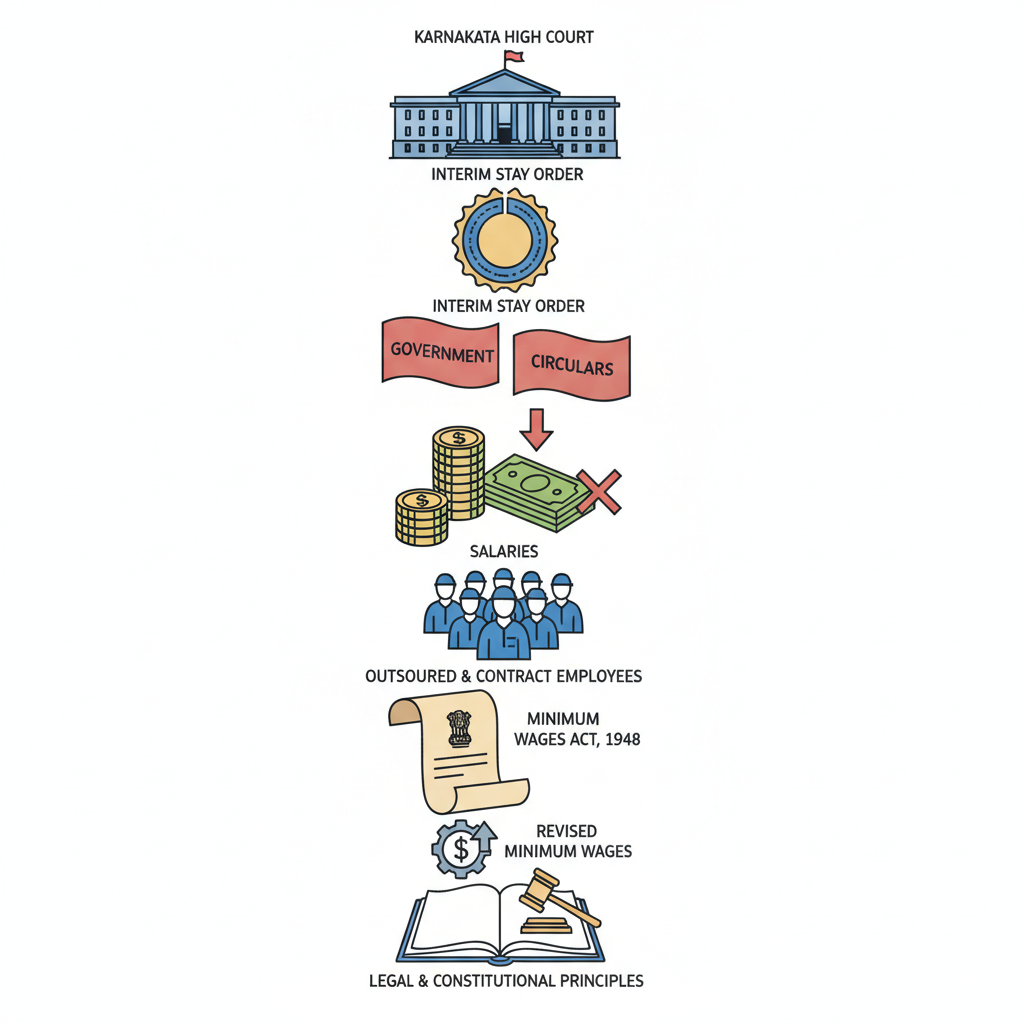
The Karnataka High Court has issued an interim stay on government circulars directing the withholding of salaries for outsourced, contract, and daily wage employees based on revised minimum wages. This development underscores the legal and constitutional principles governing the enforcement of minimum wages, the hierarchy of statutory and administrative instruments, and the protection of workers’ rights under the Minimum Wages Act, 1948.
Background
- The Minimum Wages Act, 1948, was enacted to ensure that workers receive a fair wage that meets their basic needs.
- The Act empowers the appropriate government to fix minimum rates of wages for scheduled employments, which are notified through official gazette notifications under Section 5 of the Act.
- Once notified, minimum wages acquire statutory force and become enforceable as a vested right of the workers, subject to judicial scrutiny.
- The Karnataka government had revised the minimum wages for outsourced, contract, and daily wage employees, effective from May 22, 2026.
- Subsequently, the Karnataka State Audit and Accounts Department issued circulars directing departments to withhold salary payments based on the revised minimum wages, citing oral instructions from the Finance Department.
- The petitioner unions challenged these circulars, arguing that they lack statutory authority and violate the vested rights of workers under the Minimum Wages Act, 1948.
What is the legal framework governing minimum wages in India?
- The Minimum Wages Act, 1948, is the primary legislation governing the fixation and enforcement of minimum wages in India, applicable to both scheduled and non-scheduled employments.
- Under Section 5 of the Act, the appropriate government (Central or State) fixes minimum wages for scheduled employments through notifications published in the official gazette. These notifications are subordinate legislation and derive their authority from the Act itself.
- Once notified, minimum wages become enforceable as a matter of right for the workers, and any deviation or dilution requires statutory amendment or judicial approval.
- The Act mandates that wages must be paid in cash and cannot be withheld or reduced arbitrarily by the employer or the government.
- The Supreme Court, in various judgments such as *Unichoyi v. State of Kerala* (1961) and *Bandhua Mukti Morcha v. Union of India* (1984), has held that minimum wages are a fundamental right under Article 21 of the Constitution, ensuring the right to live with human dignity.
- Administrative circulars or executive instructions cannot override the statutory provisions of the Minimum Wages Act, as they lack the force of law unless they are issued under the authority of the Act itself.
- Judicial review plays a critical role in ensuring that administrative actions comply with statutory provisions and constitutional guarantees, particularly in matters concerning labour rights.
Key Features
| Feature | Significance |
|---|---|
| Interim Stay by Karnataka High Court | The High Court’s interim order halts the operation of government circulars that sought to withhold salary payments to outsourced and contract employees based on revised minimum wages, pending further judicial scrutiny. |
| Petitioners: Trade Union Federations | The All India Trade Union Congress, Karnataka Rajya Sarkari Khayametharara Noukarara Okkuta, and the All India Central Council of Trade Unions filed petitions, challenging the legality of the circulars on grounds of statutory violation and vested rights. |
| Revised Minimum Wages Notification | The revised minimum wages, notified under Section 5 of the Minimum Wages Act, 1948, came into effect on May 22, 2026, and were initially implemented for a month before the withholding circulars were issued. |
| Circulars Issued by Audit and Departments | The Karnataka State Audit and Accounts Department issued a circular on July 29, followed by departmental circulars on August 10 and 28, directing withholding of revised wages and payment of pre-revision amounts. |
| Alleged ‘Oral Instructions’ Basis | The petitioners contended that the Audit Department’s circular was based on ‘oral instructions’ from the Finance Department, which they argued lacked legal authority and violated the statutory framework. |
Why it Matters
Legal and Statutory
- The case underscores the primacy of statutory notifications under the Minimum Wages Act, 1948, over executive or administrative instructions, reinforcing the doctrine of subordinate legislation and its enforceability.
- The High Court’s interim stay highlights the judiciary’s role in protecting vested rights of workers, as minimum wages notified under the Act are considered legally enforceable entitlements.
- The dispute raises questions about the validity of executive circulars issued without formal notification or statutory backing, particularly when they seek to reverse or dilute notified provisions.
Economic and Labour Rights
- The withholding of revised minimum wages directly impacts the livelihoods of outsourced, contract, and daily wage employees, who form a significant segment of the informal workforce in Karnataka.
- The case reflects broader tensions between fiscal prudence and labour rights, particularly in the context of contractual employment where wage revisions are critical for workers’ economic security.
- The initial implementation of revised wages for a month suggests that administrative delays or policy reversals can disrupt wage compliance, affecting worker morale and productivity.
Administrative and Governance
- The reliance on ‘oral instructions’ to issue circulars raises concerns about transparency and accountability in administrative decision-making, particularly in matters affecting public funds and labour rights.
- The case exemplifies the need for inter-departmental coordination to ensure that wage revisions are implemented uniformly and without arbitrary deviations.
- The High Court’s intervention highlights the judiciary’s role in resolving disputes arising from administrative actions that may conflict with statutory obligations.
Challenges
1. Legal Validity of Administrative Circulars
- The challenge lies in determining whether executive circulars can override or dilute statutory notifications, particularly under labour laws where minimum wages are legally enforceable.
- The case raises questions about the authority of administrative instructions issued without formal notification, especially when they conflict with existing statutory provisions.
UPSC Link: Constitutional Law: Doctrine of Subordinate Legislation
2. Protection of Vested Labour Rights
- The withholding of revised wages undermines the legal entitlement of workers to minimum wages, as notified under the Minimum Wages Act, 1948.
- The case highlights the need for robust mechanisms to ensure that wage revisions are implemented without undue delays or administrative reversals.
UPSC Link: Labour Laws: Minimum Wages Act, 1948
3. Administrative Transparency and Accountability
- The reliance on ‘oral instructions’ to issue circulars raises concerns about the lack of transparency and formal documentation in administrative decision-making.
- The case underscores the need for clear, written directives in matters affecting public funds and labour rights to avoid arbitrary or inconsistent implementation.
UPSC Link: Governance: Administrative Law and Rule of Law
4. Fiscal Prudence vs. Labour Rights
- The dispute reflects the tension between fiscal constraints and the imperative to uphold labour rights, particularly in the context of contractual employment.
- The case highlights the need for balanced policy approaches that reconcile economic considerations with the protection of workers’ entitlements.
UPSC Link: Economic Governance: Fiscal Federalism and Labour Policies
5. Judicial Role in Labour Disputes
- The High Court’s interim stay demonstrates the judiciary’s role in resolving disputes arising from administrative actions that may conflict with statutory obligations.
- The case raises questions about the extent of judicial intervention in labour disputes, particularly when they involve fiscal or administrative concerns.
UPSC Link: Judicial Process: Judicial Review and Labour Jurisprudence
Challenges — UPSC Perspective
| Issue | Concern |
|---|---|
| Legal Authority of Circulars | Whether administrative circulars can override or dilute statutory notifications under labour laws. |
| Protection of Vested Rights | The risk of administrative reversals undermining legally enforceable minimum wage entitlements. |
| Administrative Transparency | The lack of formal documentation or written directives in issuing wage-related circulars. |
| Fiscal vs. Labour Priorities | Balancing fiscal prudence with the imperative to protect workers’ economic rights. |
| Judicial Intervention | The role of the judiciary in resolving disputes between administrative actions and statutory obligations. |
Way Forward
- The Karnataka government should issue formal, written notifications to clarify the legal basis for any wage-related circulars, ensuring compliance with the Minimum Wages Act, 1948.
- Departments must coordinate to ensure uniform implementation of wage revisions, avoiding arbitrary reversals or delays that disrupt workers’ entitlements.
- Trade unions and workers’ associations should be consulted in the drafting and implementation of wage policies to ensure transparency and accountability.
- The High Court’s final judgment should be awaited to establish legal precedents on the validity of administrative circulars in labour disputes.
- Administrative training programmes should be conducted to sensitise officials on the legal framework governing minimum wages and labour rights.
- A mechanism for grievance redressal should be established to address disputes arising from wage revisions or administrative actions affecting workers.
- The state should consider legislative amendments, if necessary, to strengthen the enforcement of minimum wages and prevent arbitrary reversals.
UPSC Value Addition
Keywords for Mains Answer-Writing
Minimum Wages Act, 1948 · statutory vesting of rights · executive instructions vs subordinate legislation · contract and outsourced employees · judicial review of executive circulars · minimum wages as vested right · Section 5 of the Minimum Wages Act, 1948 · Karnataka High Court · trade union rights · executive overreach in labour governance
Constitutional & Policy Linkages
- Article 39: Directive Principles of State Policy concerning workers’ rights and fair wages.
Concept Flow
Notification of revised minimum wages under Minimum Wages Act, 1948 (May 22, 2026) → Implementation for one month → Issuance of circulars by Audit Department (July 29, 2026) and departments (August 10 & 28, 2026) to withhold revised wages → Petitions filed by trade unions challenging legality of circulars → High Court grants interim stay (September 2026) → Judicial scrutiny of administrative vs. statutory authority.
Prelims Practice Questions
Q1. Consider the following statements regarding the Minimum Wages Act, 1948:
1. The Act empowers the appropriate government to fix minimum wages for scheduled employments.
2. The Act provides for the appointment of Advisory Boards to advise on minimum wage fixation.
3. The Act mandates that minimum wages once notified cannot be revised downward by executive instructions.
4. The Act applies only to permanent employees and excludes contract and outsourced workers.
How many of the above statements are correct?
- Only one
- Only two
- Only three
- All four
Answer: Only three — Statements 1, 2, and 3 are correct. Statement 4 is incorrect as the Act applies to all classes of workers, including contract and outsourced employees, as clarified by judicial precedents.
Q2. Assertion (A): Executive circulars issued by the Finance Department can override a notification issued under Section 5 of the Minimum Wages Act, 1948.
Reason (R): The Minimum Wages Act, 1948, is a central legislation and executive circulars are subordinate to it.
Options:
A. Both A and R are true, and R is the correct explanation of A.
B. Both A and R are true, but R is not the correct explanation of A.
C. A is true, but R is false.
D. A is false, but R is true.
Answer: ? — Assertion (A) is false because executive circulars cannot override a statutory notification issued under Section 5 of the Minimum Wages Act, 1948. Reason (R) is true as the Act is central legislation and executive instructions are subordinate to it.
Q3. Match the following provisions of the Minimum Wages Act, 1948 with their correct descriptions:
Column I (Provision) | Column II (Description)
1. Section 3 | A. Fixing of minimum rates of wages
2. Section 5 | B. Advisory Boards
3. Section 9 | C. Payment of minimum wages
4. Section 12 | D. Revision of minimum rates of wages
Options:
A. 1-A, 2-D, 3-B, 4-C
B. 1-B, 2-D, 3-A, 4-C
C. 1-A, 2-B, 3-D, 4-C
D. 1-D, 2-A, 3-B, 4-C
Answer: ? — Section 3 of the Act empowers the appropriate government to fix minimum rates of wages. Section 5 provides for the revision of minimum rates of wages. Section 9 mandates the payment of minimum wages. Section 12 deals with the advisory boards.
Mains Practice Question
✍ The Karnataka High Court has stayed executive circulars that sought to withhold the payment of salaries to outsourced and contract employees based on the revised minimum wages notified under the Minimum Wages Act, 1948. Critically examine the legal and constitutional implications of this judicial intervention in the context of executive overreach and the statutory vesting of labour rights. (15 Marks)
Approach: MODEL-ANSWER SKELETON:
1. **Statutory Framework**:
– Section 5 of the Minimum Wages Act, 1948 empowers the state government to revise minimum wages after consulting the Advisory Board (Section 9).
– Notifications under Section 5 are subordinate legislation with statutory force (e.g., *State of Gujarat v. Vora Fiddali Chhotabhai*, 1964).
2. **Executive Overreach**:
– Executive circulars issued under ‘oral instructions’ (as alleged in the case) cannot override statutory notifications.
– The doctrine of *colourable legislation* and *subordinate legislation* restricts executive power to dilute statutory rights (e.g., *S.R. Bommai v. Union of India*, 1994).
3. **Judicial Review and Vested Rights**:
– Minimum wages, once notified, become a *vested right* of the employees (e.g., *Sanchalak v. State of Rajasthan*, 2019).
– The High Court’s interim order upholds the principle that executive instructions cannot defer or dilute vested rights.
4. **Trade Union Rights and Labour Governance**:
– The case highlights the tension between executive discretion and statutory rights of workers.
– Article 23 (prohibition of forced labour) and Article 24 (prohibition of child labour) read with Directive Principles (Articles 39(e), 41, 42) underscore the state’s obligation to ensure fair wages.
5. **Contemporary Relevance**:
– Aligns with judicial trends reinforcing *rule of law* over executive fiat (e.g., *Romila Thapar v. Union of India*, 2018).
– Emphasises the role of the judiciary in protecting labour rights against arbitrary executive actions.
6. **Conclusion**:
– The judicial intervention reinforces the supremacy of statutory law over executive instructions.
– Balances executive efficiency with constitutional guarantees of fair wages and labour rights.
Source: The Hindu
Karnataka PCS (KPSC) — State PCS Practice
Prelims: Which of the following statements is correct regarding the Karnataka High Court’s recent order on the payment of salaries to outsourced and contract employees based on revised minimum wages?
- The Karnataka High Court has stayed the implementation of all circulars that withhold salary payments to outsourced and contract employees due to revised minimum wages.
- The Karnataka High Court has directed the state government to immediately release all pending salaries to outsourced and contract employees without any conditions.
- The Karnataka High Court has upheld the state government’s circulars withholding salary payments to outsourced and contract employees as per revised minimum wages.
- The Karnataka High Court has asked the state government to form a committee to review the revised minimum wages before releasing any pending salaries.
Answer: The Karnataka High Court has stayed the implementation of all circulars that withhold salary payments to outsourced and contract employees due to revised minimum wages. — The Karnataka High Court has stayed the circulars issued by the state government that withhold salary payments to outsourced and contract employees based on the revised minimum wages.
Mains: Critically analyze the implications of the Karnataka High Court’s stay on circulars withholding salary payments to outsourced and contract employees in the context of labor rights and state government policies. Suggest measures to ensure timely and fair wage disbursement while balancing fiscal constraints.
Generated by AanyaAi for educational purpose.
Related guides on our sites
- Current affairs for upsc 2026
- Best PSIR optional coaching for upsc
- Best PSIR optional teacher for upsc
- Best teacher of PSIR optional for upsc

- केरल लोक सेवा आयोग ने उच्च न्यायालय में दायर किया मामला, सदस्यों के खिलाफ मामला रद्द करने की मांग - September 23, 2026
- KPSC Challenges Prosecution Sanction in Kerala High Court: Key UPSC Polity Insight - September 23, 2026
- केरल में एंटीमाइक्रोबियल रेजिस्टेंस: सरकारी रिपोर्ट में चौंकाने वाले आँकड़े सामने - September 23, 2026

No Comments