


10 Sep Karnataka HC Strikes Down 2% Cess on Movie Tickets: UPSC Exam Analysis
✎ The enforcement of a state legislation imposing a welfare cess is contingent upon the issuance of a gazette notification specifying the date of enforcement, failing which the levy cannot be legally enforced.
Subject Relevance — Where This Topic Fits
- GS Paper II — Functions and Responsibilities of the Union and the States, Issues and Challenges Pertaining to the Federal Structure | GS Paper III — Government Budgeting and Fiscal Policy, Issues Relating to Development and Management of Social Sector/Services Relating to Health, Education, Human Resources
- Prelims: Cine and Cultural Activists (Welfare) Act, 2024, Welfare Cess, Karnataka High Court, Code on Social Security, 2020, Federal Structure, Legislative Competence, Gazette Notification, Governor’s Assent
- Essay: Federalism and Cooperative Governance in India: Balancing State Autonomy and National Policy Frameworks, The Role of Judicial Review in Upholding Constitutional Principles: A Case Study of the Karnataka Cine Act
Quick Revision: The enforcement of a state legislation imposing a welfare cess is contingent upon the issuance of a gazette notification specifying the date of enforcement, failing which the levy cannot be legally enforced.
Why is this in the news?
The Karnataka High Court’s quashing of notices demanding a 2% welfare cess from movie tickets under the Karnataka Cine and Cultural Activists (Welfare) Act, 2024, highlights critical constitutional and administrative law issues. The judgment underscores the necessity of proper legislative enforcement, including gazette notifications, before statutory provisions can be operationalised. It also raises questions about the legislative competence of state legislatures to impose levies overlapping with central enactments, such as the Code on Social Security, 2020.
Background
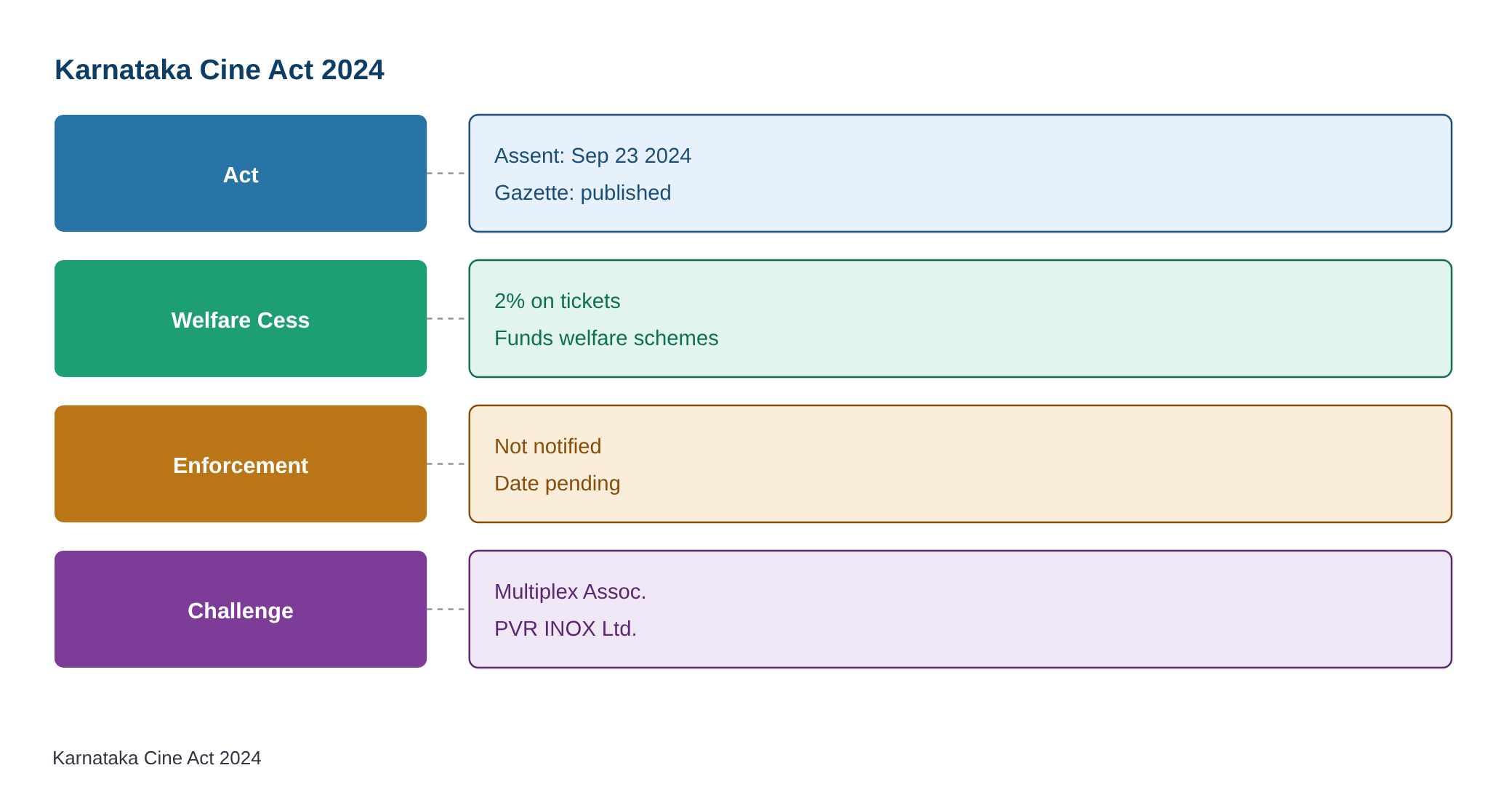
- The Karnataka Cine and Cultural Activists (Welfare) Act, 2024, received the Governor’s assent on September 23, 2024, and was published in the Gazette, but the State government had not notified the date from which it would come into force as of September 10, 2026.
- The Act envisages a 2% welfare cess on movie tickets to fund welfare schemes for cine and cultural workers, including health, education, and social security benefits.
- The Multiplex Association of India and PVR INOX Ltd. filed a petition challenging the legality of circulars and notices issued by regulatory authorities demanding the cess, arguing that the Act had not been enforced due to the absence of a gazette notification.
- The State government admitted in court that the gazette notification announcing the enforcement date was yet to be issued, leading to the withdrawal of notices on September 9, 2026.
- The petitioners also contended that the State legislature lacked competence to impose the cess, citing the Code on Social Security, 2020, as occupying the field on social security for workers, including cine workers.
- The High Court reserved the petitioners’ liberty to challenge the legality of the Act once it is enforced, deferring examination of the Act’s validity until such time.
What is the Karnataka Cine and Cultural Activists (Welfare) Act, 2024?
- The Act was enacted by the Karnataka State Legislature to provide welfare measures for cine and cultural workers, including financial assistance, health benefits, and social security schemes.
- It mandates the imposition of a 2% cess on movie tickets to fund these welfare initiatives, with the revenue earmarked for the welfare of workers in the cine and cultural sectors.
- The Act received the Governor’s assent on September 23, 2024, and was published in the Gazette, but its enforcement requires a separate gazette notification specifying the date from which it would come into force.
- The Act is part of the State’s legislative efforts to address the socio-economic vulnerabilities of cine and cultural workers, who often lack formal employment benefits and social security coverage.
- The levy of a cess on movie tickets reflects a broader trend of earmarking specific revenue streams for targeted welfare schemes, similar to the Swachh Bharat Cess or the Education Cess in the central context.
- The Act’s provisions must align with the constitutional framework governing legislative competence, fiscal policy, and the federal structure, particularly in relation to overlapping central enactments.
- The enforcement of the Act is contingent upon compliance with constitutional and administrative law requirements, including the issuance of gazette notifications and the absence of legal impediments to its implementation.
Key Features
| Feature | Significance |
|---|---|
| Quashing of notices by Karnataka HC | Upholds the principle that executive actions must conform to legislative intent; prevents coercive measures in the absence of notified enforcement. |
| Government admission of non-enforcement | Demonstrates the necessity of gazette notification for legal enforceability; highlights procedural lapses in implementation of welfare legislation. |
| Petitioners’ challenge on legislative competence | Raises critical question of federalism: whether state legislature can legislate on matters already covered by central legislation (Code on Social Security, 2020). |
| Reserved liberty to challenge Act’s legality | Preserves judicial scrutiny for future enforcement; ensures constitutional validity can be tested when the Act is enforced. |
| Cine and Cultural Activists (Welfare) Act, 2024 | Represents state’s attempt to institutionalise welfare measures for cine workers; reflects evolving labour policy in entertainment sector. |
Why it Matters
Legal and Judicial
- The judgment reinforces the doctrine that laws must be enforced only after proper notification, preventing arbitrary imposition of financial burdens on citizens.
- It underscores the judiciary’s role in safeguarding citizens from executive overreach when statutory frameworks are incomplete or unenforced.
- The case highlights the importance of legislative competence in federal structures, particularly in overlapping domains of social security and labour welfare.
Economic
- The imposition of a 2% cess on movie tickets, if enforced, would have increased the cost of entertainment, potentially affecting box-office revenues and consumer welfare.
- The ruling prevents an additional financial burden on the entertainment industry during a period of recovery post-pandemic and amid evolving consumer preferences.
- It sets a precedent for how welfare levies are introduced, ensuring that economic policies are implemented only after due process and stakeholder consultation.
Governance and Policy
- The case exemplifies the challenges in translating legislative intent into executive action, particularly in welfare-oriented legislation.
- It highlights the need for inter-ministerial and inter-state coordination in matters of social security, where central and state laws may overlap.
- The delay in gazette notification suggests systemic issues in policy implementation timelines, which can undermine public trust in governance.
Challenges
1. Federalism and Legislative Competence
- Determining whether the state legislature has the competence to legislate on social security for cine workers when Parliament has enacted the Code on Social Security, 2020.
- Potential conflict between state welfare measures and central labour laws, requiring clarity on the distribution of legislative powers under the Constitution.
- Risk of overlapping jurisdictions leading to legal uncertainty and compliance burdens for industries operating across states.
UPSC Link: GS II: Federal Structure, Distribution of Legislative Powers
2. Implementation Lag in Welfare Legislation
- Delay in gazette notification for enforcement of the Karnataka Cine and Cultural Activists (Welfare) Act, 2024, despite receiving Governor’s assent in September 2024.
- Inability of the executive to align implementation timelines with legislative intent, resulting in legal and economic disruptions.
- Need for robust institutional mechanisms to ensure timely enforcement of welfare-oriented legislation.
UPSC Link: GS II: Government Policies and Interventions
3. Economic Impact of Unenforced Levies
- Potential financial burden on consumers and businesses due to uncoordinated imposition of cess or levies without proper notification.
- Risk of reputational damage to the state government for perceived arbitrary or hasty policy measures.
- Challenges in balancing welfare objectives with economic feasibility, particularly in labour-intensive sectors like entertainment.
UPSC Link: GS III: Indian Economy and Issues Relating to Planning, Mobilisation of Resources
4. Judicial Scrutiny of Executive Actions
- Ensuring that executive actions, such as issuance of notices, are legally valid and do not exceed the scope of enabling legislation.
- Role of the judiciary in protecting citizens from coercive measures in the absence of clear statutory authority.
- Need for judicial restraint in matters of legislative competence, deferring to the legislature’s wisdom unless constitutional violations are evident.
UPSC Link: GS II: Separation of Powers between various organs
Challenges — UPSC Perspective
| Issue | Concern |
|---|---|
| Lack of gazette notification | Legal enforceability of the Act remains suspended, rendering executive actions ultra vires. |
| Overlap with central legislation | Potential conflict with the Code on Social Security, 2020, raising questions of legislative competence. |
| Economic burden on stakeholders | Unenforced cess could have imposed additional costs on consumers and businesses without due process. |
| Systemic delays in policy implementation | Delays in enforcement undermine public trust and the efficacy of welfare legislation. |
| Judicial intervention in executive actions | Need to balance judicial review with respect for legislative intent and separation of powers. |
Way Forward
- The Karnataka government must expedite the gazette notification for the Cine and Cultural Activists (Welfare) Act, 2024, to ensure legal enforceability and clarity on implementation timelines.
- A consultative process involving stakeholders from the entertainment industry, labour unions, and legal experts should be initiated to align state welfare measures with central legislation.
- The Union and State governments should establish a mechanism for periodic review of welfare legislation to prevent implementation lags and ensure timely enforcement.
- Parliament and State Legislatures should consider amending the Concurrent List to provide clearer demarcation of powers in matters of social security, particularly for specialised sectors like cinema.
- The judiciary should continue to uphold the principle that executive actions must derive authority from clearly notified laws, reinforcing the rule of law.
- States should adopt a phased approach to welfare legislation, ensuring that notifications and enforcement mechanisms are in place before imposing financial obligations on citizens.
- The entertainment industry should proactively engage with policymakers to provide inputs on the feasibility and impact of welfare levies, ensuring balanced policy outcomes.
UPSC Value Addition
Keywords for Mains Answer-Writing
Cess, Welfare Cess, Karnataka Cine and Cultural Activists (Welfare) Act, 2024 · Legislative competence, State vs Concurrent List · Gazette notification, enforcement of legislation · Judicial review of legislative enactments · Code on Social Security, 2020 · Doctrine of colourable legislation · Federalism in India · Welfare legislation for cine workers · Judicial interpretation of legislative intent · Constitutional validity of cess
Constitutional & Policy Linkages
- Article 246: Distribution of Legislative Powers between Union and States
- Article 254: Inconsistency between laws made by Parliament and laws made by the Legislatures of States
Concept Flow
Enactment of Karnataka Cine and Cultural Activists (Welfare) Act, 2024 → Governor’s assent received (September 2024) → Publication in Gazette → Delay in gazette notification for enforcement → Executive issues circulars/notices imposing 2% cess → Petitioners challenge legality → Karnataka HC quashes notices as Act is not enforced → Government admits non-enforcement → Judicial scrutiny preserved for future enforcement.
Prelims Practice Questions
Q1. Consider the following statements regarding the enforcement of legislation in India:
1. A law comes into force only upon its publication in the Official Gazette.
2. The Governor’s assent is required for a State Act to become law.
3. A law may be enforced even if the date of enforcement is not notified.
How many of the above statements are correct?
- Only one
- Only two
- Only three
- None
Answer: Only two — Statement 1 is correct: A law comes into force only upon its publication in the Official Gazette. Statement 2 is correct: The Governor’s assent is required for a State Act to become law. Statement 3 is incorrect: A law cannot be enforced unless the date of enforcement is notified.
Q2. Assertion (A): The Parliament has exclusive competence to legislate on social security matters under the Concurrent List.
Reason (R): The Code on Social Security, 2020 occupies the field relating to social security of workers, including cine workers.
In the context of the above two statements, which one of the following is correct?
- Both A and R are true, and R is the correct explanation of A
- Both A and R are true, but R is not the correct explanation of A
- A is true, but R is false
- A is false, but R is true
Answer: A is true, but R is false — Assertion (A) is false: Parliament does not have exclusive competence; social security is on the Concurrent List, allowing both Parliament and State legislatures to legislate. Reason (R) is true: The Code on Social Security, 2020, is a central legislation that occupies the field, but it does not exclude State legislatures entirely.
Q3. Match the following pairs regarding legislative processes in India:
Column I
A. Gazette notification
B. Governor’s assent
C. Enforcement of a law
D. Legislative competence
Column II
1. Required for a State Act to become law
2. Determines when a law comes into force
3. Publication in the Official Gazette
4. Jurisdiction to legislate on a subject
Select the correct match:
- A-3, B-1, C-2, D-4
- A-1, B-3, C-2, D-4
- A-2, B-1, C-3, D-4
- A-3, B-2, C-1, D-4
Answer: A-3, B-1, C-2, D-4 — A. Gazette notification (3) is the publication in the Official Gazette. B. Governor’s assent (1) is required for a State Act to become law. C. Enforcement of a law (2) determines when a law comes into force. D. Legislative competence (4) refers to the jurisdiction to legislate on a subject.
Mains Practice Question
✍ The Karnataka Cine and Cultural Activists (Welfare) Act, 2024, envisages a 2% welfare cess on movie tickets. Critically examine the constitutional validity of such a levy, with particular reference to the doctrine of legislative competence and the Code on Social Security, 2020. Also, elucidate the procedural requirements for the enforcement of a State legislation in India. (15 Marks)
Approach: MODEL-ANSWER SKELETON:
1. **Doctrine of Legislative Competence**:
– Social security is on the Concurrent List (Entry 23).
– Parliament’s Code on Social Security, 2020, occupies the field, creating a presumption against State legislation on the same subject (colourable legislation doctrine).
– However, State legislatures can legislate if the central law is silent or allows for complementary measures.
2. **Constitutional Validity of the Cess**:
– The cess is a tax under Article 265, requiring legislative competence and a valid nexus with the object (welfare of cine workers).
– The Act must not be a colourable exercise of power; its object must be distinct from the central law.
– Judicial review: Courts examine whether the State legislature has transgressed its competence.
3. **Procedural Requirements for Enforcement**:
– A law comes into force only upon publication in the Official Gazette (Article 245(2)).
– The Governor’s assent is mandatory for State Acts (Article 200).
– The date of enforcement must be notified; without it, the law remains unenforceable.
– The Karnataka government admitted in court that the gazette notification for enforcement was pending, rendering the circulars illegal.
4. **Judicial Intervention**:
– The Karnataka High Court quashed the notices, citing the absence of enforcement.
– The court reserved the right to examine the Act’s validity once enforced, highlighting the importance of procedural compliance.
5. **Balance of Views**:
– Proponents argue that State legislation can complement central laws for local welfare needs.
– Critics contend that overlapping legislation risks fiscal and administrative confusion, undermining the Code on Social Security, 2020.
6. **Conclusion**:
– The constitutional validity hinges on whether the cess is a valid tax and whether the State Act intrudes upon Parliament’s exclusive domain.
– Procedural lapses (non-notification) render the levy unenforceable, underscoring the need for strict compliance with constitutional and statutory requirements.
Source: The Hindu
Karnataka PCS (KPSC) — State PCS Practice
Prelims: Which of the following statements is correct regarding the Karnataka High Court’s recent order on the 2% cess on movie tickets?
- The Karnataka High Court quashed notices demanding 2% cess from movie tickets as the government admitted the law was not enforced.
- The Karnataka High Court directed the government to immediately enforce the 2% cess on all movie tickets.
- The Karnataka High Court upheld the legality of the 2% cess on movie tickets despite government’s admission of non-enforcement.
- The Karnataka High Court imposed a fine on the government for failing to enforce the 2% cess on movie tickets.
Answer: The Karnataka High Court quashed notices demanding 2% cess from movie tickets as the government admitted the law was not enforced. — The Karnataka High Court quashed notices demanding 2% cess from movie tickets as the state government admitted that the law mandating the cess was yet to be enforced.
Mains: Analyze the legal and administrative implications of the Karnataka High Court’s order quashing notices demanding 2% cess from movie tickets, considering the government’s admission of non-enforcement of the law. Suggest measures to ensure compliance with such statutory provisions in the future.
Generated by AanyaAi for educational purpose.
Related guides on our sites
- Current affairs for upsc 2026
- Best sociology optional coaching for upsc
- Which is best sociology optional coaching for upsc
- Best economics optional coaching for upsc

- Gurugram’s groundwater extraction exceeds limit by 212%; HC seeks ban - October 4, 2026
- स्वतंत्रता सेनानी श्यामजी कृष्ण वर्मा की जन्म जयंती पर पीएम का श्रद्धांजलि - October 4, 2026
- KWML’s Feasibility Reports for Water Metro in 18 Cities: UPSC & PCS Insights - October 3, 2026

No Comments