


08 Aug Karnataka HC Upholds Royal Estate Succession Exemption Post-Privy Purse Abolition
✎ Section 5(ii) of the Hindu Succession Act, 1956, exempts certain estates of former princely states from partition, and its validity is unaffected by the abolition of privy purses and state privileges under the 26th Constitutional…
Subject Relevance — Where This Topic Fits
- GS Paper II — Polity and Governance (Constitutional Amendments, Fundamental Rights, and State Succession) | GS Paper III — Land Reforms and Property Rights
- Prelims: Hindu Succession Act, 1956, Article 363-A of the Constitution, Privy purse, Impartible estate, Gaddi (ceremonial throne), Mysore State merger agreement, Sandur State merger agreement
- Essay: Land reforms and the interplay between customary rights and statutory law in India, The evolution of constitutional guarantees for erstwhile princely states and their legal legacy
Quick Revision: Section 5(ii) of the Hindu Succession Act, 1956, exempts certain estates of former princely states from partition, and its validity is unaffected by the abolition of privy purses and state privileges under the 26th Constitutional Amendment.
Why is this in the news?
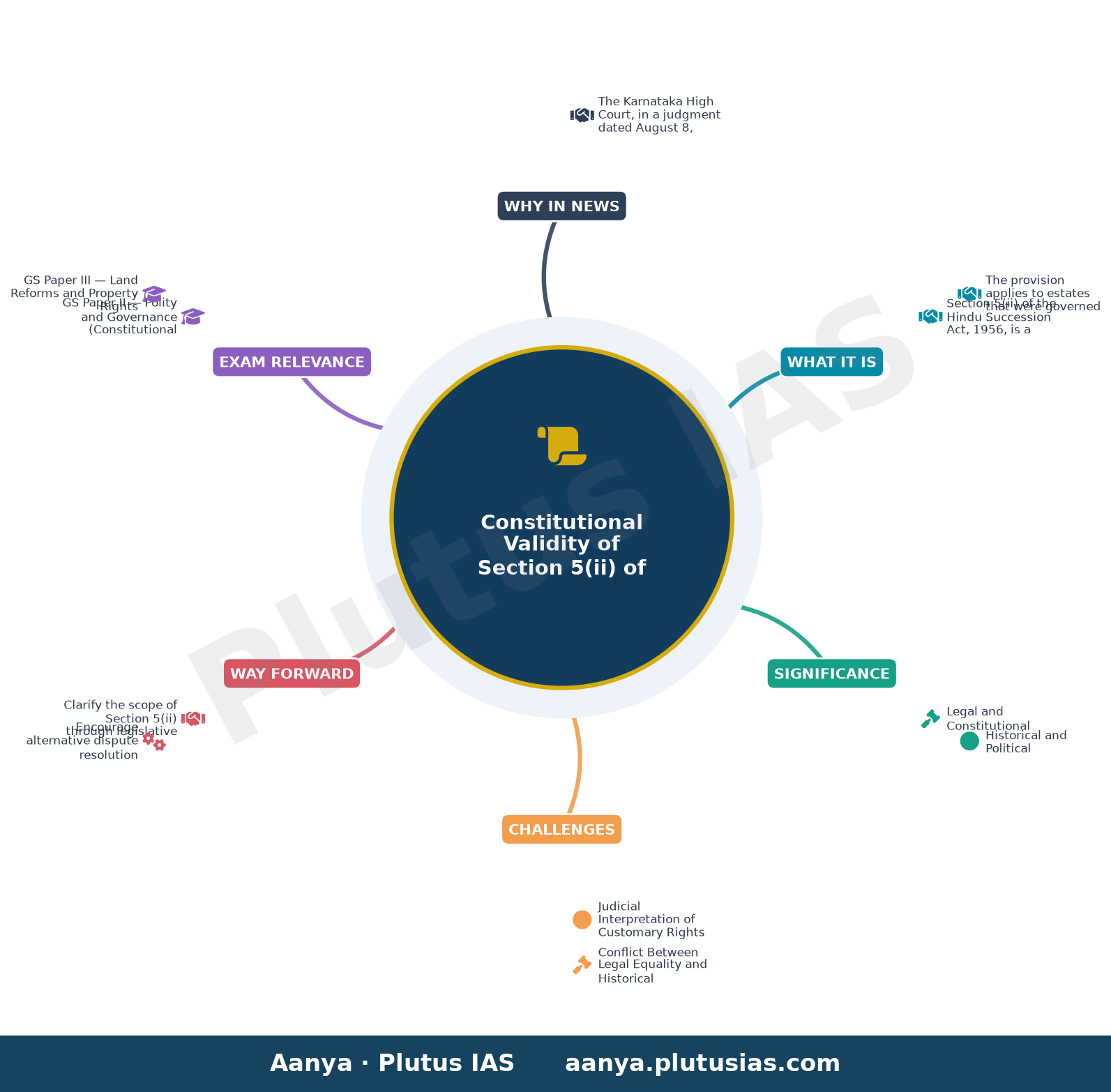
The Karnataka High Court, in a judgment dated August 8, 2026, upheld the constitutional validity of Section 5(ii) of the Hindu Succession Act, 1956, which exempts certain estates of former royal families from partition under the Act. The ruling clarifies that the abolition of privy purses and royal privileges through the 26th Constitutional Amendment (1971) does not invalidate the special provision governing succession to impartible estates, thereby preserving the customary legal framework governing such properties despite the loss of state privileges.
Background
- The Hindu Succession Act, 1956, was enacted to codify and reform succession laws among Hindus, but it included exemptions for certain estates governed by pre-existing agreements or customary practices, notably those of former princely states.
- The Constitution of India, through Articles 291 and 362, initially guaranteed privy purses, privileges, and rights to erstwhile rulers of princely states as part of the integration process post-Independence.
- The 26th Constitutional Amendment (1971) abolished privy purses and privileges under Articles 291 and 362, inserting Article 363-A to nullify these guarantees, but did not address the legal status of private properties or customary succession rights.
- The merger agreements of princely states like Mysore and Sandur with the Dominion of India (later the Republic of India) explicitly distinguished between privy purses, private properties, and the succession to the Gaddi (ceremonial throne), ensuring continuity of certain property rights.
- Section 5(ii) of the Hindu Succession Act, 1956, exempts estates descending to a single heir under the terms of covenants or agreements entered into by rulers with the Government of India or under pre-Independence enactments, thereby preserving the concept of impartible estates.
- Disputes over the partition of such estates have persisted among heirs of former royal families, leading to legal challenges questioning the relevance of Section 5(ii) in the absence of state privileges.
What is Section 5(ii) of the Hindu Succession Act, 1956, and its relevance to former princely states?
- Section 5(ii) of the Hindu Succession Act, 1956, is a statutory exemption that excludes certain estates from the general provisions of the Act, particularly those descending to a single heir under pre-existing agreements or customary practices.
- The provision applies to estates that were governed by covenants or agreements entered into by the rulers of Indian States with the Government of India or by pre-Independence enactments, such as the merger agreements of princely states.
- Impartible estates are properties that, by custom or agreement, descend to a single heir without partition, ensuring the preservation of the estate’s integrity and the continuity of its management.
- The Gaddi, or ceremonial throne, is a symbolic representation of the ruler’s authority and is often linked to the succession of the estate, though its legal significance is distinct from the privy purse or state privileges.
- The provision does not confer any new rights but preserves existing legal structures that predate the Constitution and the Hindu Succession Act, thereby maintaining continuity in property succession.
- The Karnataka High Court’s ruling clarifies that the abolition of privy purses and state privileges does not invalidate the legal framework governing the succession of such estates, as these are private properties and not state-guaranteed rights.
- The judgment underscores the distinction between state privileges (abolished in 1971) and private property rights, which remain protected under the law unless explicitly repealed.
- The ruling reaffirms the principle that customary and contractual rights, once legally recognized, are not automatically extinguished by broader constitutional changes unless such changes explicitly address them.
Key Features
| Feature | Significance |
|---|---|
| Section 5(ii) of the Hindu Succession Act, 1956 | Excludes certain royal estates from partition under the Act, preserving their impartible status as per pre-Independence agreements. |
| Impartible Estate | A property that descends to a single heir by custom or agreement, preventing division among multiple heirs. |
| Gaddi (Ceremonial Throne) | Symbolic seat of authority in princely States; retains customary relevance despite abolition of formal privileges. |
| Constitutional Abolition of Privy Purses (26th Amendment, 1971) | Removed financial privileges of erstwhile rulers but did not invalidate pre-existing property agreements. |
| Karnataka High Court Judgment (2026) | Reaffirms the validity of Section 5(ii) and the continuity of impartible estates despite changes in constitutional guarantees. |
Why it Matters
Legal and Constitutional
- Reinforces the principle that constitutional amendments do not automatically invalidate pre-existing property rights established under agreements or covenants.
- Clarifies the distinction between abolished privileges (Article 291, 362) and preserved property rights under Section 5(ii).
- Upholds the sanctity of merger agreements between princely States and the Government of India, ensuring continuity in succession laws for specific estates.
Historical and Political
- Highlights the enduring legacy of pre-Independence property arrangements in post-colonial India, reflecting the negotiated nature of State integration.
- Demonstrates the judicial approach to balancing modern egalitarian laws (Hindu Succession Act) with historical customary practices.
Social and Cultural
- Preserves the cultural and symbolic significance of the Gaddi in certain princely States, despite the loss of formal regal authority.
- Recognises the practical relevance of traditional succession practices in specific communities, even as broader legal frameworks evolve.
Challenges
1. Judicial Interpretation of Customary Rights
- Balancing modern succession laws with historical customary practices poses interpretative challenges for courts.
- Risk of inconsistent judgments across States with similar historical contexts.
UPSC Link: GS Paper 2: Judiciary
2. Conflict Between Legal Equality and Historical Privileges
- Tension between the Hindu Succession Act’s egalitarian principles and the preservation of impartible estates under Section 5(ii).
- Potential for disputes among heirs over the interpretation of pre-Independence agreements.
UPSC Link: GS Paper 2: Fundamental Rights
3. Erosion of Customary Practices in Modern India
- Gradual decline in the relevance of traditional institutions like the Gaddi in contemporary governance.
- Risk of legal frameworks lagging behind societal changes in recognizing customary rights.
UPSC Link: GS Paper 1: Indian Society
4. Disputes Over Property Rights Among Heirs
- Complexity in resolving partition disputes in royal families due to the interplay of legal, historical, and customary factors.
- Potential for prolonged litigation, as seen in the Mysore and Sandur cases.
UPSC Link: GS Paper 2: Dispute Resolution
Challenges — UPSC Perspective
| Issue | Concern |
|---|---|
| Interpretation of Section 5(ii) | Ensuring consistent judicial interpretation of the provision across States with historical royal estates. |
| Conflict with Modern Succession Laws | Balancing the preservation of impartible estates with the egalitarian objectives of the Hindu Succession Act. |
| Cultural Relevance of Gaddi | Reconciling the symbolic importance of the Gaddi with its diminished practical role in modern governance. |
| Heir Disputes | Managing complex property disputes among heirs of erstwhile royal families. |
| Judicial Precedent | Avoiding conflicting judgments that could undermine legal certainty in similar cases. |
| Constitutional Amendments | Understanding the limited scope of constitutional changes in altering pre-existing property rights. |
Way Forward
- Clarify the scope of Section 5(ii) through legislative amendments to address ambiguities in its application to modern contexts.
- Encourage alternative dispute resolution mechanisms (e.g., mediation) to resolve partition disputes among heirs of royal estates efficiently.
- Conduct a comprehensive review of all pre-Independence property agreements to identify and resolve potential conflicts with modern laws.
- Enhance judicial training on historical and customary practices to ensure consistent interpretation of Section 5(ii) across States.
- Promote public awareness campaigns to educate stakeholders on the legal and historical context of impartible estates.
- Strengthen documentation of customary practices (e.g., Gaddi) to preserve their cultural significance while adapting to modern legal frameworks.
- Explore the possibility of a uniform succession law for royal estates, balancing historical rights with contemporary egalitarian principles.
UPSC Value Addition
Keywords for Mains Answer-Writing
Hindu Succession Act, 1956 · Section 5(ii) of the Hindu Succession Act · Karnataka High Court judgment on royal estates · Abolition of privy purses and privileges · Constitutional Amendment 26th (Article 363-A) · Impartible estates and customary succession · Princely States merger agreements · Gaddi and ceremonial throne · Hindu personal laws and customary rights · Judicial interpretation of statutory provisions
Constitutional & Policy Linkages
- Article 363-A: Abolition of Privy Purses and Privileges (Constitutional Amendment)
Concept Flow
Pre-Independence Agreements → Mergers of Princely States with Dominion of India → Constitution (26th Amendment) Abolishes Privy Purses and Privileges → Hindu Succession Act, 1956 Enacts Section 5(ii) to Preserve Impartible Estates → Constitutional Changes Do Not Invalidate Pre-Existing Property Rights → Karnataka High Court Upholds Section 5(ii) in 2026 Judgment → Continuity of Customary Succession Practices
Prelims Practice Questions
Q1. Consider the following statements regarding the Hindu Succession Act, 1956:
1. Section 5(ii) excludes certain estates from being partitioned under the Act.
2. The provision applies to all properties inherited by a single heir without exception.
3. The validity of Section 5(ii) was upheld by the Karnataka High Court despite the abolition of privy purses.
4. The provision is applicable only to properties acquired after the commencement of the Act.
How many of the above statements are correct?
- Only one
- Only two
- Only three
- All
Answer: Only three — Statements 1 and 3 are correct. Statement 2 is incorrect as Section 5(ii) applies only to estates that descend to a single heir by specific covenants or agreements. Statement 4 is incorrect as the provision applies to pre-existing estates as well.
Q2. Assertion (A): The 26th Constitutional Amendment (Article 363-A) abolished the privy purses and privileges of erstwhile rulers.
Reason (R): The amendment did not affect the validity of Section 5(ii) of the Hindu Succession Act, 1956, which pertains to impartible estates.
Options:
A. Both A and R are true, and R is the correct explanation of A.
B. Both A and R are true, but R is not the correct explanation of A.
C. A is true, but R is false.
D. A is false, but R is true.
- A
- B
- C
- D
Answer: C — Assertion (A) is true as the 26th Amendment abolished privy purses and privileges. Reason (R) is also true but does not explain (A), as Section 5(ii) pertains to a separate legal provision unrelated to the abolition of privy purses.
Q3. Match the following provisions with their respective descriptions:
Column I (Provision)
1. Article 291
2. Article 362
3. Article 363-A
4. Section 5(ii) of the Hindu Succession Act
Column II (Description)
A. Abolished privy purses and privileges of erstwhile rulers
B. Guaranteed payment of privy purse to rulers of princely States
C. Excludes certain estates from partition under the Hindu Succession Act
D. Rights and privileges of rulers of Indian States
- 1-B, 2-D, 3-A, 4-C; 1-A, 2-B, 3-D, 4-C; 1-B, 2-A, 3-D, 4-C; 1-D, 2-B, 3-A, 4-C
Answer: 1-B, 2-D, 3-A, 4-C; 1-A, 2-B, 3-D, 4-C; 1-B, 2-A, 3-D, 4-C; 1-D, 2-B, 3-A, 4-C — The correct match is: 1-B (Article 291 guaranteed privy purse), 2-D (Article 362 dealt with rights and privileges), 3-A (Article 363-A abolished these), and 4-C (Section 5(ii) excludes certain estates from partition).
Mains Practice Question
✍ Critically examine the constitutional and legal validity of Section 5(ii) of the Hindu Succession Act, 1956, in the context of the Karnataka High Court’s recent judgment on impartible estates of erstwhile royal families. (15 Marks)
Approach: MODEL-ANSWER SKELETON:
1. **Introduction**: Briefly define Section 5(ii) of the Hindu Succession Act, 1956, and its purpose — to exclude certain estates from partition under the Act, particularly those descending to a single heir by covenant or agreement.
2. **Constitutional Context**:
– Discuss the abolition of privy purses and privileges through the 26th Constitutional Amendment (Article 363-A).
– Highlight the distinction between privy purses (Article 291) and private properties/Gaddi estates.
– Reference the merger agreements of princely States (e.g., Mysore and Sandur) with the Government of India, which dealt separately with privy purses, private properties, and succession to the Gaddi.
3. **Judicial Reasoning**:
– Explain the Karnataka High Court’s reasoning: Articles 291 and 362 were only guarantees of privy purse and privileges, not private properties or Gaddi estates.
– Emphasise that Section 5(ii) is rooted in pre-Independence covenants and agreements, not in post-Constitution privileges.
– Address the petitioners’ contention that the ‘Gaddi’ concept has lost its relevance — counter with the court’s view that customary practical relevance persists.
4. **Legal and Customary Perspectives**:
– Discuss the concept of ‘impartible estates’ and their legal recognition under customary law.
– Reference the Supreme Court’s stance on customary rights and their protection under Article 13(3) of the Constitution (e.g., in the case of *State of Maharashtra v. Narayan Rao Sham Rao Deshmukh*, 1986).
– Contrast with the abolition of privy purses, which were political guarantees, not property rights.
5. **Critical Analysis**:
– Weigh the argument that Section 5(ii) is anachronistic in modern India against the counter-argument that it preserves historical and customary rights.
– Discuss the tension between uniform civil laws and customary rights, especially in the context of personal laws and property rights.
6. **Conclusion**:
– Summarise the court’s position: Section 5(ii) remains valid as it is not tied to abolished privileges but to pre-existing covenants.
– Conclude with the broader implication: the judgment reinforces the sanctity of historical agreements and customary succession laws, even in post-Independence India.
Source: The Hindu
Generated by AanyaAi for educational purpose.

- आरबीआई ने सरकारी प्रतिभूतियों की ओएमओ बिक्री की घोषणा, जानिए पूरा विवरण - September 23, 2026
- RBI to Sell ₹25,000 Crore Govt Securities via OMO on Sept 28, 2026 - September 23, 2026
- भारत-श्रीलंका नौसैनिक अभ्यास ‘स्लाईनेक्स-26’: विशाखापत्तनम में संपन्न, जानें प्रमुख बिंदु - September 23, 2026

No Comments