


10 Sep Karnataka Model Unveiled: 5 Lakh Sites & Digital Governance in 100 Days
✎ The ‘Karnataka Model’ integrates digital governance (Seva One), inclusive housing (5 lakh sites), agricultural support (Raitha Chaitanya), investment promotion (Global Investors Department), and regional balance (Beyond…
Subject Relevance — Where This Topic Fits
- GS Paper II — Governance, Constitution and Polity (State Governance, Federalism, E-Governance) | GS Paper III — Economy (Public Expenditure, Investment Promotion, Infrastructure Development) | GS Paper IV — Ethics, Integrity and Aptitude (Public Service Delivery, Citizen-Centric Governance)
- Prelims: Karnataka Model, Seva One platform, BMTC 2.0, Raitha Chaitanya scheme, Global Investors Department, NRI Department, CSR portal, Retrofit Emission Control Device (RECD), Sainik Samman scheme, Drudha Karnataka Sankalpa
- Essay: The Role of State Governments in Realising Inclusive Development: Lessons from Karnataka’s ‘Model State’ Vision, Digital Governance as a Catalyst for Public Service Transformation in India
Quick Revision: The ‘Karnataka Model’ integrates digital governance (Seva One), inclusive housing (5 lakh sites), agricultural support (Raitha Chaitanya), investment promotion (Global Investors Department), and regional balance (Beyond Bengaluru) to transform the state into a model of equitable and sustainable development.
Why is this in the news?
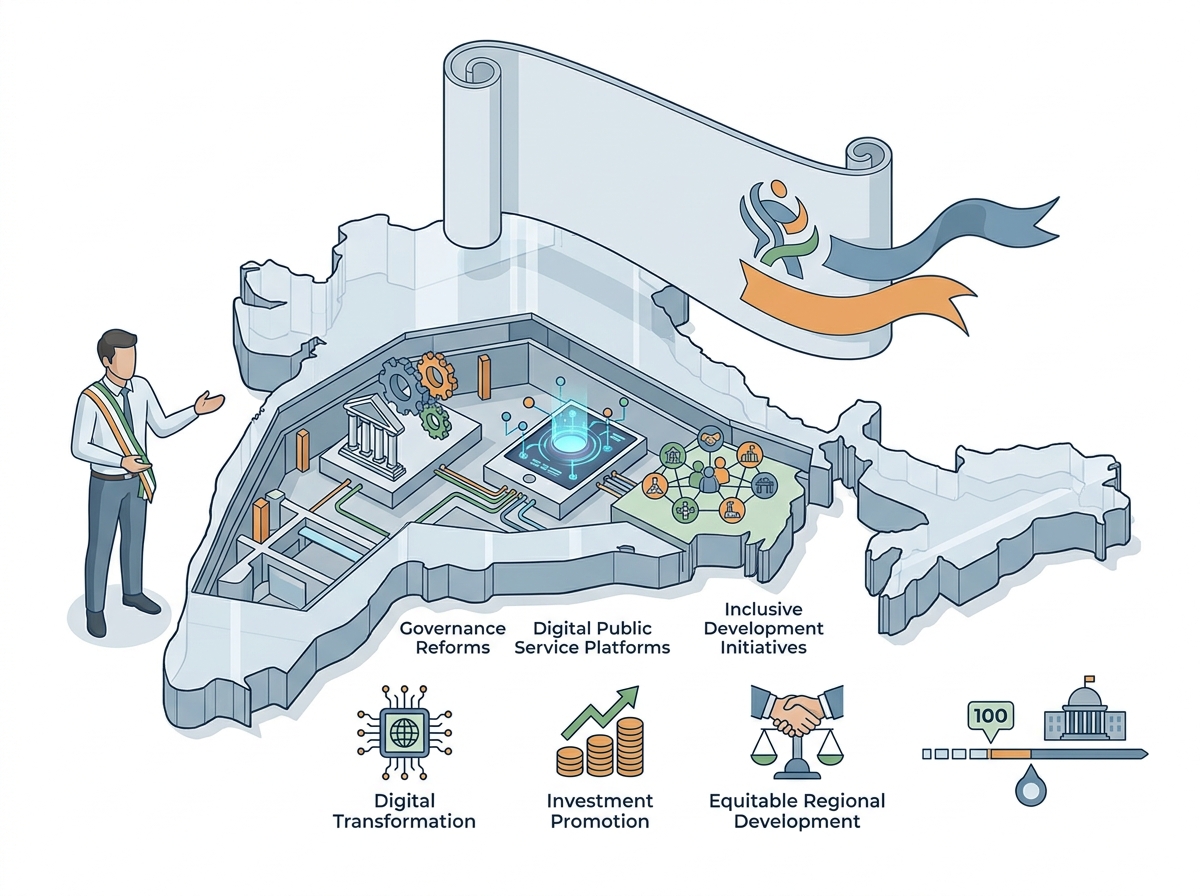
The Chief Minister of Karnataka, D.K. Shivakumar, unveiled the ‘Karnataka Model’ during the 100-day milestone of his government, introducing a suite of governance reforms, digital public service platforms, and inclusive development initiatives. The announcement, framed under the tagline ‘Drudha Karnataka Sankalpa’ (Firm Resolution for a Prosperous Karnataka), underscores the state’s commitment to digital transformation, investment promotion, and equitable regional development, while reinforcing existing welfare schemes and introducing new institutional mechanisms for citizen-centric governance.
Background
- Karnataka, a southern state with a GDP of over ₹20 lakh crore (2023-24), has historically been a hub for IT, biotechnology, and manufacturing, contributing significantly to India’s exports and innovation ecosystem.
- The state has implemented several flagship welfare schemes, including the ‘Five Guarantee Schemes’ (Anna Bhagya, Gruha Jyothi, Shakti, and Yuvanidhi), which collectively aim to address food security, housing, women’s empowerment, and youth employment.
- Karnataka’s urban-rural divide and regional imbalances, particularly in northern and coastal districts, have been a longstanding challenge, necessitating targeted interventions for inclusive growth.
- The state has been a pioneer in digital governance, with initiatives like Bhoomi (land records digitisation) and Karnataka One (multi-service delivery centres) setting benchmarks for other states.
- Inter-state river water disputes, particularly with Andhra Pradesh and Telangana over the Tungabhadra Dam, have required collaborative governance mechanisms to balance agricultural, ecological, and hydrological priorities.
- The COVID-19 pandemic and subsequent global economic slowdown have underscored the need for states to adopt adaptive governance frameworks to mitigate socio-economic disruptions.
What constitutes the ‘Karnataka Model’?
- **Digital Governance and Citizen-Centric Services**: The ‘Seva One’ platform, described as ‘One Government, One Digital’, aims to integrate multiple public services into a unified digital interface, reducing bureaucratic silos and enhancing accessibility for citizens. This aligns with the broader national vision of ‘Digital India’ and leverages Karnataka’s existing IT infrastructure.
- **Inclusive Housing and Land Reforms**: A new scheme to distribute five lakh housing sites to landless individuals, prioritising rural areas, seeks to address landlessness and informal settlements, while complementing the state’s housing policies under the Pradhan Mantri Awas Yojana (PMAY).
- **Agricultural and Rural Development**: The ‘Chief Minister Raitha Chaitanya’ scheme focuses on enhancing farmer welfare through income support, input subsidies, and market linkages.
- **Investment Promotion and Economic Growth**: The establishment of a ‘Global Investors Department’ and an ‘NRI Department’ signals Karnataka’s intent to attract foreign direct investment (FDI) and diaspora capital, particularly in sectors like IT, manufacturing, and renewable energy.
- **Public-Private Partnerships and CSR Integration**: The launch of a Corporate Social Responsibility (CSR) portal aims to channel private sector funds into the development of 1,000 government schools, fostering public-private collaboration in education and social infrastructure.
- **Urban and Regional Development**: The ‘Beyond Bengaluru’ initiative targets the development of five secondary growth centres (e.g., Mysuru, Hubballi-Dharwad, Mangaluru, Shivamogga, and Belagavi) to decentralise economic activity and reduce pressure on Bengaluru, while also promoting coastal tourism.
- **Women’s Safety and Law Enforcement**: The proposal to establish squads in every police circle and station to combat gangs, extortionists, and habitual offenders reflects a zero-tolerance approach to crime, particularly against women and marginalised groups.
- **Inter-State Collaboration**: The joint address by Karnataka, Andhra Pradesh, and Telangana at the Tungabhadra Dam gates highlights the state’s commitment to cooperative federalism in managing shared natural resources and addressing transboundary challenges.
Key Features
| Feature | Significance |
|---|---|
| Seva One Digital Platform | A unified digital governance portal designed to integrate citizen services under a single interface, enhancing accessibility and reducing bureaucratic delays through ‘One Government, One Digital’ principle. |
| Chief Minister Raitha Chaitanya Scheme | A farmer-centric initiative aimed at revitalising agricultural productivity and ensuring timely support to cultivators, reflecting the government’s commitment to rural welfare. |
| BMTC 2.0 Mobile Application | An upgraded public transport application to improve commuter experience, streamline ticketing, and enhance the efficiency of the Bangalore Metropolitan Transport Corporation’s services. |
| Five Lakh Housing Sites Distribution Scheme | A targeted policy to address landlessness in rural Karnataka by allocating residential plots to economically disadvantaged households, aligning with the ‘No one left behind’ principle. |
| Global Investors Department & NRI Department | Institutional mechanisms to attract foreign direct investment and leverage the diaspora’s resources for state development, fostering economic growth and job creation. |
| CSR Portal for Government Schools | A digital platform to facilitate corporate partnerships in upgrading 1,000 government schools, promoting public-private collaboration in education infrastructure. |
| Karnataka Model Vision Statement | A governance framework based on equity (‘No one left behind’), regional balance (‘Every region moving forward’), and unified development (‘One vision for Karnataka’). |
| Beyond Bengaluru Initiative | A regional development strategy to decentralise growth by identifying five cities as growth centres and leveraging coastal tourism potential. |
| One Karnataka Mobility App | A state-wide mobility solution integrating public transport options to improve inter-city connectivity and reduce congestion in Bengaluru. |
| Retrofit Emission Control Device (RECD) Initiative | A policy to reduce vehicular emissions by mandating retrofitting of diesel vehicles, contributing to air quality improvement and environmental sustainability. |
Why it Matters
Economic Development
- Accelerates investment inflows through dedicated departments for global investors and NRIs, potentially boosting GDP growth and employment.
- Leverages CSR funding for critical infrastructure like schools, reducing fiscal burden while enhancing service delivery.
- Housing site distribution stimulates rural economies by providing asset ownership and collateral for credit access.
Digital Governance
- Seva One platform exemplifies the ‘Digital India’ vision by integrating services, reducing red tape, and improving citizen-government interface.
- BMTC 2.0 and One Karnataka Mobility App enhance urban mobility and reduce inefficiencies in public transport systems.
Social Inclusion
- Five guarantee schemes’ continuation and housing distribution target marginalised groups, ensuring equitable development.
- Focus on women’s safety through police squads aligns with constitutional directives on gender justice and public order.
Regional Balance
- Beyond Bengaluru initiative counters urban-centric growth by promoting tier-II cities and coastal tourism, fostering balanced regional development.
- Inter-state collaboration on Tungabhadra Dam gates highlights cooperative federalism in water resource management.
Environmental Sustainability
- RECD initiative for diesel vehicles addresses air pollution, aligning with national and state environmental commitments.
- Tourism development in coastal regions must incorporate eco-sensitive practices to avoid ecological degradation.
Challenges
1. Implementation Bottlenecks in Digital Platforms
- Risk of digital divide excluding rural and elderly populations from accessing Seva One and mobility apps.
- Data privacy and cybersecurity concerns in a unified digital governance system require robust safeguards.
- Training and capacity-building for government officials to ensure seamless adoption of digital tools.
UPSC Link: GS-II, Governance
2. Equitable Distribution of Housing Sites
- Land records discrepancies and legal disputes may delay or complicate site allocation processes.
- Ensuring transparency in beneficiary selection to prevent elite capture or political patronage.
- Post-allocation support, such as infrastructure development, is critical to avoid creating ‘dormitory’ settlements.
UPSC Link: GS-II, Welfare Schemes
3. Attracting Sustainable Investments
- Global economic uncertainties may dampen investor confidence despite institutional mechanisms.
- Balancing rapid industrialisation with environmental regulations to avoid ecological harm.
- Ensuring that investments translate into local employment rather than benefiting external entities.
UPSC Link: GS-III, Investment Models
4. Balancing Urban and Rural Development
- Over-concentration of resources in Bengaluru may exacerbate regional disparities despite ‘Beyond Bengaluru’ initiatives.
- Agricultural revival under Raitha Chaitanya must address input costs, market access, and climate vulnerabilities.
- Tourism-led growth in coastal regions requires careful planning to avoid displacing local communities.
UPSC Link: GS-I, Regional Development
5. Environmental and Social Trade-offs
- Retrofitting diesel vehicles may face resistance from commercial operators due to cost implications.
- Industrial expansion under Global Investors Department could strain natural resources like water and land.
- Tourism infrastructure development may lead to land encroachments or pollution in ecologically sensitive zones.
UPSC Link: GS-III, Environment
Challenges — UPSC Perspective
| Issue | Concern |
|---|---|
| Digital Literacy Gaps | Exclusion of rural and elderly citizens from accessing digital governance platforms. |
| Land Tenure Insecurity | Potential disputes over land records delaying housing site distribution. |
| Investor Reluctance | Global economic conditions may deter foreign and NRI investments despite state incentives. |
| Urban-Rural Divide | Risk of Bengaluru’s dominance overshadowing regional development goals. |
| Environmental Degradation | Industrial and tourism growth may conflict with sustainability objectives. |
| Bureaucratic Resistance | Slow adoption of digital tools by government departments due to inertia or lack of training. |
| Beneficiary Identification | Ensuring fairness in selecting recipients for housing sites and school upgrades. |
| Inter-State Water Disputes | Long-term cooperation required to sustain collaborative water management efforts. |
Government Initiatives — Must-Memorise for Prelims
- Seva One Digital Platform
- Chief Minister Raitha Chaitanya Scheme
- BMTC 2.0 Mobile Application
- Five Lakh Housing Sites Distribution Scheme
- Global Investors Department
- NRI Department
- CSR Portal for Government Schools
Way Forward
- Establish a dedicated task force to monitor the implementation of Seva One, ensuring real-time feedback and iterative improvements.
- Conduct periodic audits of land records to resolve discrepancies and expedite housing site allocations.
- Launch digital literacy campaigns in rural districts to bridge the gap in platform accessibility.
- Create a single-window clearance mechanism for investors to streamline approvals and reduce bureaucratic delays.
- Develop a performance dashboard for the Beyond Bengaluru initiative, tracking progress in identified growth centres and coastal tourism.
- Institutionalise inter-state water cooperation mechanisms to sustain collaborative projects like the Tungabhadra Dam gates.
- Integrate environmental impact assessments into the Global Investors Department’s approval process to ensure sustainable investments.
- Expand the RECD initiative to include public transport fleets, maximising emission reduction benefits.
- Strengthen police squads for women’s safety with regular training on gender-sensitive policing and victim support.
UPSC Value Addition
Keywords for Mains Answer-Writing
Karnataka Model of Governance · Digital governance platforms · Citizen-centric service delivery · Landless housing schemes · Guarantee schemes in Karnataka · Urban-rural convergence · Investment facilitation mechanisms · Women’s safety initiatives · Inter-state river water governance · Decentralised governance and urban development
Concept Flow
State government announces ‘Karnataka Model’ under ‘Drudha Karnataka Sankalpa’ tagline → → Digital governance initiatives (Seva One, mobility apps) aim to reduce administrative delays and improve service delivery → → Social welfare schemes (housing, agriculture, CSR for schools) target marginalised groups to ensure inclusive growth → → Economic strategies (investor departments, tourism focus) seek to diversify revenue streams and create employment → → Regional balance initiatives (Beyond Bengaluru) aim to decentralise development and reduce urban-rural disparities → → Environmental policies (RECD, water cooperation) address sustainability concerns while promoting growth → → Implementation challenges (digital divide, land disputes) require institutional reforms and capacity-building → → Outcome: Equitable, sustainable, and digitally enabled governance model for Karnataka.
Prelims Practice Questions
Q1. Consider the following statements regarding the ‘Karnataka Model’ unveiled by the State Government:
1. The ‘Seva One’ platform is designed to integrate all digital citizen services under a single portal.
2. The ‘Chief Minister Raitha Chaitanya’ scheme focuses exclusively on urban agricultural development.
3. The distribution of five lakh housing sites to landless people is a key component of the model.
4. The ‘BMTC 2.0’ mobile application is aimed at improving public transport efficiency in Bengaluru.
How many of the above statements are correct?
- Only one
- Only two
- Only three
- All
Answer: All — Statements 1, 3, and 4 are correct. Statement 2 is incorrect as the scheme targets rural agricultural development.
Q2. Assertion (A): The ‘Drudha Karnataka Sankalpa’ initiative aims to ensure that no region in Karnataka is left behind in development.
Reason (R): The initiative includes the ‘Beyond Bengaluru’ programme to develop five cities as growth centres and tap tourism potential in coastal regions.
Options:
A. Both A and R are true, and R is the correct explanation of A.
B. Both A and R are true, but R is NOT the correct explanation of A.
C. A is true but R is false.
D. A is false but R is true.
Answer: ? — Both the assertion and reason are true, and the reason correctly explains the assertion as the ‘Beyond Bengaluru’ programme is a direct measure to ensure regional equity.
Q3. Match the following initiatives launched under the ‘Karnataka Model’ with their respective objectives:
Column I (Initiative) | Column II (Objective)
1. Seva One | A. Distribution of housing sites to landless people
2. CM Raitha Chaitanya | B. Integration of digital citizen services
3. Five lakh housing sites scheme | C. Agricultural development and farmer support
4. BMTC 2.0 | D. Enhancing public transport efficiency
Options:
A. 1-B, 2-C, 3-A, 4-D
B. 1-A, 2-B, 3-C, 4-D
C. 1-D, 2-C, 3-B, 4-A
D. 1-C, 2-D, 3-A, 4-B
Answer: ? — Correct matching: 1-B (Seva One integrates digital services), 2-C (CM Raitha Chaitanya focuses on agriculture), 3-A (Five lakh housing sites scheme), 4-D (BMTC 2.0 enhances public transport).
Mains Practice Question
✍ The ‘Karnataka Model’ of governance, as unveiled by the State Government, emphasizes digital transformation, inclusive development, and regional equity. Critically examine the significance of this model in the context of India’s federal structure and the challenges it may face in implementation. (15 Marks)
Approach: MODEL-ANSWER SKELETON:
1. **Introduction**: Define the ‘Karnataka Model’ and its core pillars (digital governance, inclusive development, regional equity).
2. **Federal Structure Context**:
– Explain how the model aligns with the principles of cooperative federalism (Article 263, NITI Aayog).
– Discuss the role of state-led innovation in India’s federal system (e.g., Gujarat Model, Kerala Model).
3. **Digital Governance**:
– Highlight the ‘Seva One’ platform as a case study in integrated digital service delivery (similar to Kerala’s e-governance initiatives).
– Discuss challenges: digital divide, cybersecurity, and interoperability with central schemes (e.g., DigiLocker).
4. **Inclusive Development**:
– Examine the five lakh housing sites scheme and its impact on landless populations (link to Article 39(b) of the Directive Principles).
– Critique: land ceiling laws, bureaucratic delays, and land titling issues.
5. **Regional Equity**:
– Analyze the ‘Beyond Bengaluru’ programme and its potential to reduce regional disparities (reference to Gadgil-Mukherjee formula for devolution).
– Challenges: fiscal federalism, resource allocation, and political will.
6. **Conclusion**: Weigh the model’s potential as a template for other states against implementation hurdles, suggesting measures for scalability (e.g., PPP models, capacity building).
Source: The Hindu
Karnataka PCS (KPSC) — State PCS Practice
Prelims: Which of the following is NOT a key feature of the ‘Karnataka Model’ unveiled by Chief Minister D.K. Shivakumar during his government’s 100-day milestone?
- A. Focus on decentralized governance through Gram Panchayats and urban local bodies
- B. Introduction of a universal basic income scheme for all citizens
- C. Strengthening of the ‘One District, One Product’ initiative to boost local industries
- D. Emphasis on sustainable agriculture and farmer welfare programs
Answer: B. Introduction of a universal basic income scheme for all citizens — The ‘Karnataka Model’ emphasizes decentralized governance, local product promotion, and sustainable agriculture, but does not include a universal basic income scheme.
Mains: Critically analyze the ‘Karnataka Model’ unveiled by Chief Minister D.K. Shivakumar in the context of Karnataka’s socio-economic development. How does this model align with the state’s long-term vision for inclusive growth and governance?
Generated by AanyaAi for educational purpose.
Related guides on our sites
- Best PSIR optional coaching for upsc
- Best PSIR optional teacher for upsc
- Best teacher of PSIR optional for upsc
- Best PSIR optional coaching in delhi for UPSC

- Gurugram’s groundwater extraction exceeds limit by 212%; HC seeks ban - October 4, 2026
- स्वतंत्रता सेनानी श्यामजी कृष्ण वर्मा की जन्म जयंती पर पीएम का श्रद्धांजलि - October 4, 2026
- KWML’s Feasibility Reports for Water Metro in 18 Cities: UPSC & PCS Insights - October 3, 2026

No Comments