


12 Aug Karnataka to Move Supreme Court Against Cauvery Water Order
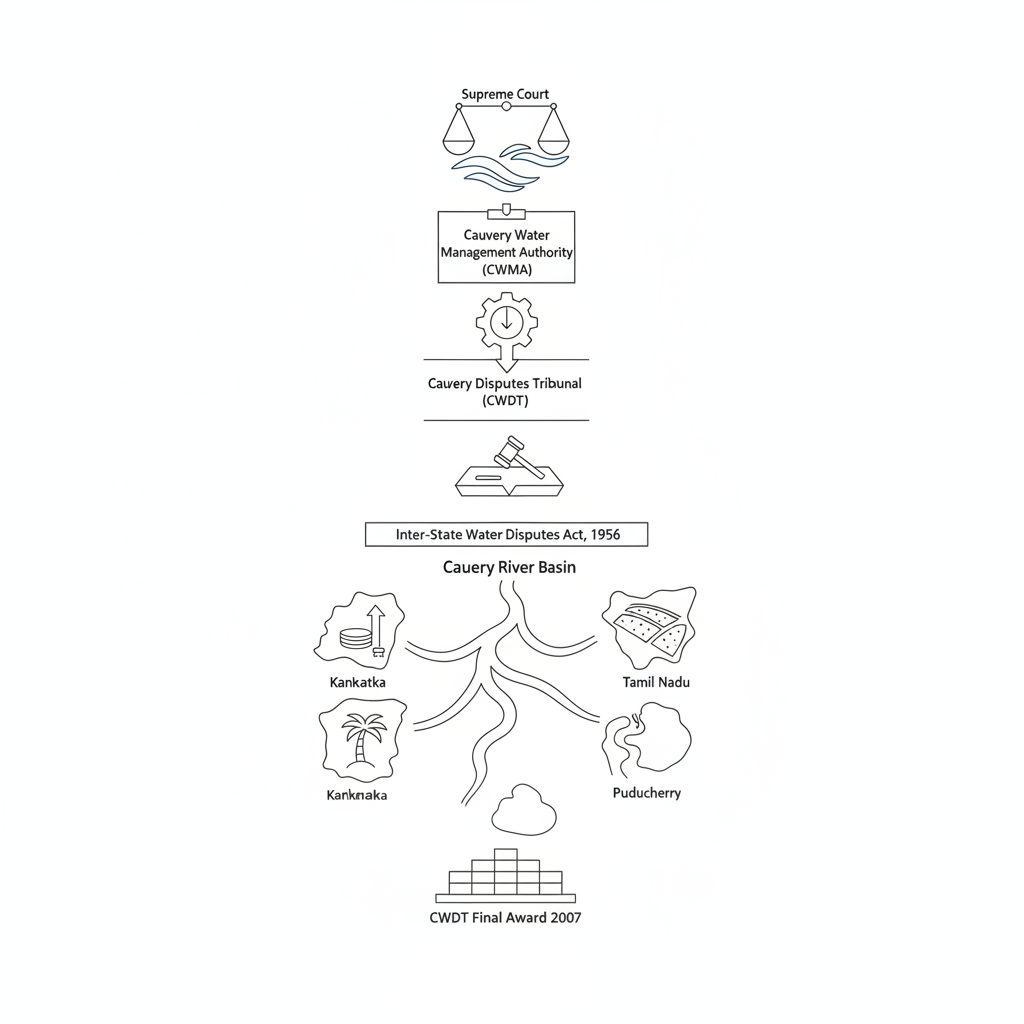
Cauvery River basinCWMA directiveSupreme CourtCWDT awardKarnataka governmentTamil Nadu✎ The Cauvery Water Management Authority (CWMA) and Cauvery Water Regulation Committee (CWRC) are statutory bodies constituted to implement the Cauvery Water Disputes Tribunal (CWDT) award of 2007, with the Supreme Court acting as…
Subject Relevance — Where This Topic Fits
- GS Paper II — Functions and Responsibilities of the Union and the States, Issues and Challenges Pertaining to the Federal Structure | GS Paper III — Conservation, Environmental Pollution and Degradation, Environmental Impact Assessment
- Prelims: Cauvery Water Disputes Tribunal (CWDT), Cauvery Water Management Authority (CWMA), Cauvery Water Regulation Committee (CWRC), Inter-State Water Disputes Act, 1956, Supreme Court’s jurisdiction under Article 136, Tamil Nadu-Karnataka water sharing, cusecs (cubic feet per second), tmcft (thousand million cubic feet), monsoon-dependent agriculture, inter-state water governance
- Essay: Federalism and Centre-State Relations in Water Governance, Sustainable Management of Transboundary River Basins in India
Quick Revision: The Cauvery Water Management Authority (CWMA) and Cauvery Water Regulation Committee (CWRC) are statutory bodies constituted to implement the Cauvery Water Disputes Tribunal (CWDT) award of 2007, with the Supreme Court acting as the final appellate authority under Article 136.
Why is this in the news?
Karnataka’s decision to approach the Supreme Court against the Cauvery Water Management Authority’s (CWMA) directive to release 12,000 cusecs of water daily to Tamil Nadu for 15 days underscores the persistent challenges in inter-state river water governance. The dispute highlights the tension between statutory obligations under the Cauvery Water Disputes Tribunal (CWDT) awards and the exigencies of local water security, particularly in the face of deficient monsoon forecasts and competing demands for drinking water.
Background
- The Cauvery river basin is a shared resource between Karnataka, Tamil Nadu, Kerala, and the Union Territory of Puducherry, with its waters governed by the Cauvery Water Disputes Tribunal (CWDT) established in 1990 under the Inter-State Water Disputes Act, 1956.
- The CWDT, in its final award of 2007, allocated specific water shares to each riparian state, including Karnataka’s obligation to release 12,000 cusecs of water to Tamil Nadu during the monsoon season under certain conditions.
- The Cauvery Water Management Authority (CWMA) and the Cauvery Water Regulation Committee (CWRC) were constituted in 2018 to implement the CWDT award and regulate water releases, respectively.
- Karnataka has historically contested the feasibility of meeting CWMA directives, citing deficits in monsoon rainfall, agricultural demands, and drinking water shortages in its own districts.
- The Supreme Court, in 2018, upheld the CWDT award while modifying certain aspects, thereby reinforcing the legal framework governing the dispute.
- Recent monsoon forecasts for Karnataka indicate deficient rainfall in August and September 2026, exacerbating the state’s water stress and complicating compliance with CWMA directives.
What is the Cauvery Water Governance Framework?
- The Cauvery Water Disputes Tribunal (CWDT): Established under the Inter-State Water Disputes Act, 1956, the CWDT adjudicated the long-standing dispute between Karnataka, Tamil Nadu, Kerala, and Puducherry, delivering its final award in 2007.
- The Cauvery Water Management Authority (CWMA): Constituted in 2018, the CWMA is tasked with implementing the CWDT award, monitoring water releases, and ensuring compliance by riparian states.
- The Cauvery Water Regulation Committee (CWRC): A statutory body under the CWMA, the CWRC regulates day-to-day water releases from Karnataka’s reservoirs to Tamil Nadu, based on hydrological conditions and the CWDT award.
- Legal Framework: The governance of the Cauvery basin is governed by the Inter-State Water Disputes Act, 1956, the CWDT award (2007), and the Supreme Court’s 2018 judgment, which collectively delineate water-sharing obligations and dispute resolution mechanisms.
- Water Allocation: The CWDT award allocates Karnataka 270 tmcft, Tamil Nadu 419 tmcft, Kerala 30 tmcft, and Puducherry 7 tmcft annually, with specific provisions for distress conditions and monsoon-dependent releases.
- Distress Conditions: The CWDT award and subsequent legal judgments provide for adjustments in water releases during periods of deficient rainfall or extreme water stress, subject to mutual agreement or judicial intervention.
- Supreme Court’s Role: The Supreme Court, under Article 136, has appellate jurisdiction over inter-state water disputes, enabling states to seek redressal for perceived injustices or impractical directives from statutory bodies like the CWMA.
Key Features
| Feature | Significance |
|---|---|
| Cauvery Water Management Authority (CWMA) | Constitutional body established under the Inter-State River Water Disputes Act, 1956, to implement and monitor the final award of the Cauvery Water Disputes Tribunal (2007). |
| Cauvery Water Regulation Committee (CWRC) | Executive arm of CWMA responsible for day-to-day regulation of Cauvery water releases based on real-time hydrological data and tribunal directives. |
| Inter-State Water Disputes Act, 1956 | Legal framework governing the adjudication and resolution of inter-state river water disputes, including the Cauvery dispute. |
| Final Award of the Cauvery Water Disputes Tribunal (2007) | Binding adjudication determining water-sharing ratios among Karnataka, Tamil Nadu, Kerala, and Puducherry during deficit and surplus periods. |
| Supreme Court’s appellate jurisdiction | Constitutional power under Article 136 to hear appeals against orders of CWMA/CWRC, particularly in matters of inter-state water disputes. |
Why it Matters
Inter-State Water Governance
- Demonstrates the operational challenges in implementing inter-state water-sharing agreements, where technical directives (e.g., 12,000 cusecs release) may conflict with state-level priorities (e.g., drinking water needs).
- Highlights the role of constitutional bodies (CWMA/CWRC) in balancing equitable distribution with hydrological realities, necessitating judicial oversight when disputes arise.
Hydrological and Agricultural Impact
- Exposes the vulnerability of agricultural and drinking water security in Karnataka during monsoon deficits, particularly in the Cauvery basin districts.
- Raises questions about long-term water resource planning, including the need for integrated basin management and drought mitigation strategies.
Judicial-Administrative Interface
- Illustrates the interplay between judicial adjudication (Supreme Court) and executive implementation (CWMA/CWRC), where technical decisions may require judicial review to resolve conflicts.
- Underscores the necessity of transparent, data-driven decision-making in water governance to maintain public trust and inter-state cooperation.
Challenges
1. Hydrological Deficit and Storage Constraints
- Karnataka’s storage levels are insufficient to meet the CWRC’s directive of releasing 12,000 cusecs daily for 15 days, risking drinking water shortages for its own population.
- Monsoon forecasts for August–September 2026 indicate below-normal rainfall, exacerbating water scarcity in the Cauvery basin.
- Prioritization dilemma: Balancing inter-state obligations (Tamil Nadu’s entitlement) with intra-state needs (drinking water for Karnataka’s citizens).
UPSC Link: Geographical factors affecting water availability
2. Legal and Institutional Coordination
- Conflict between CWRC’s regulatory directives and Karnataka’s administrative capacity to implement them, necessitating judicial intervention.
- Lack of a permanent, consensus-driven mechanism for real-time adjustments in water releases during extreme hydrological events.
UPSC Link: Inter-State Water Disputes Act, 1956
3. Public Policy and Equity
- Perceived inequity in water allocation when Karnataka’s storage is lower than Tamil Nadu’s, despite Karnataka’s higher upstream dependency.
- Risk of public unrest and political pressure influencing water-sharing decisions, undermining long-term governance frameworks.
UPSC Link: Equitable distribution of resources
4. Data Transparency and Stakeholder Trust
- Need for real-time, verifiable hydrological data shared across states to build trust in CWMA/CWRC decisions.
- Lack of a standardized methodology for calculating water entitlements during deficit periods, leading to disputes.
UPSC Link: Role of data in policy formulation
Challenges — UPSC Perspective
| Issue | Concern |
|---|---|
| Storage Deficit in Karnataka | Inability to meet CWRC’s release directive without compromising drinking water security for its population. |
| Monsoon Forecast Uncertainty | Below-normal rainfall predictions for August–September 2026 increase the risk of water scarcity in the basin. |
| Inter-State Obligation vs. Intra-State Need | Conflict between fulfilling Tamil Nadu’s entitlement and prioritizing Karnataka’s domestic water requirements. |
| Legal Recourse and Delays | Time taken for judicial resolution may exacerbate water scarcity, especially during peak demand periods. |
| Lack of Dynamic Water Allocation Framework | Absence of mechanisms to adjust water releases in real-time based on hydrological conditions. |
Way Forward
- Constitute a high-powered technical committee comprising hydrologists, agricultural experts, and state representatives to review CWMA/CWRC directives in light of real-time storage and rainfall data.
- Develop a dynamic water-sharing protocol that allows for proportional adjustments in releases during extreme hydrological events, with pre-defined triggers and stakeholder consensus.
- Enhance transparency by mandating the publication of real-time storage levels, rainfall data, and release calculations for all basin states on a unified digital platform.
- Strengthen inter-state coordination through regular meetings of the Cauvery Basin States Authority to discuss emerging challenges and preempt disputes.
- Invest in basin-wide water conservation measures, including rainwater harvesting, groundwater recharge, and micro-irrigation, to reduce dependency on surface water during deficits.
- Formulate a drought management plan for the Cauvery basin, outlining phased water rationing, alternative water sources, and public awareness campaigns.
- Explore the feasibility of inter-basin water transfers or desalination projects in water-stressed districts to supplement Cauvery supplies.
- Conduct a joint audit of water usage across basin states to identify inefficiencies and ensure equitable distribution in line with the tribunal’s award.
UPSC Value Addition
Keywords for Mains Answer-Writing
Inter-State Water Disputes Act, 1956 · Cauvery Water Disputes Tribunal (CWDT) · Cauvery Water Management Authority (CWMA) · Cauvery Water Regulation Committee (CWRC) · Supreme Court jurisdiction under Article 136 · Inter-State River Water Disputes (Amendment) Act, 2019 · Doctrine of Priority of Uses in water law · Federalism and Centre-state relations in water governance · Judicial review of executive/administrative orders
Constitutional & Policy Linkages
- Article 262: Exclusion of jurisdiction of courts in inter-state water disputes, empowering Parliament to adjudicate via tribunals.
- Article 263: Provision for the establishment of an Inter-State Council to coordinate policies and disputes among states.
Concept Flow
Monsoon deficit in Cauvery basin → Reduced inflows into Karnataka’s reservoirs → CWRC directives for water release to Tamil Nadu → Karnataka’s inability to comply due to storage constraints → State approaches Supreme Court for judicial review → Supreme Court’s appellate jurisdiction invoked → Potential re-evaluation of CWRC directives → Implementation of revised water-sharing plan.
Prelims Practice Questions
Q1. Consider the following statements regarding the Cauvery Water Disputes Tribunal (CWDT):
1. The CWDT was constituted under the Inter-State Water Disputes Act, 1956.
2. The CWDT’s award was notified by the Government of India in 2013.
3. The CWDT is empowered to enforce its award without judicial intervention.
How many of the above statements are correct?
- Only one
- Only two
- All three
- None
Answer: Only two — Statement 1 is correct; the CWDT was constituted under the Inter-State Water Disputes Act, 1956. Statement 2 is correct; the CWDT’s final award was notified by the Government of India in 2013. Statement 3 is incorrect; the CWDT’s award is subject to judicial review and enforcement through the Supreme Court.
Q2. Assertion (A): The Cauvery Water Management Authority (CWMA) was established under the Inter-State River Water Disputes (Amendment) Act, 2019.
Reason (R): The Amendment Act, 2019 replaced the Cauvery Water Disputes Tribunal (CWDT) with the CWMA to manage the implementation of the Tribunal’s award.
- Both A and R are true, and R is the correct explanation of A
- Both A and R are true, but R is not the correct explanation of A
- A is true, but R is false
- A is false, but R is true
Answer: Both A and R are true, but R is not the correct explanation of A — Assertion (A) is true: the CWMA was established under the Inter-State River Water Disputes (Amendment) Act, 2019. Reason (R) is also true: the Amendment Act, 2019 replaced the CWDT’s role with the CWMA to implement the Tribunal’s award. However, R does not fully explain A, as the CWMA’s role is administrative, not a replacement of the Tribunal itself.
Q3. Which of the following constitutional provisions empowers the Supreme Court to grant special leave to appeal in inter-state water disputes?
- Article 32
- Article 131
- Article 136
- Article 262
Answer: Article 136 — Article 136 of the Constitution of India empowers the Supreme Court to grant special leave to appeal from any judgment, decree, determination, sentence, or order in any cause or matter passed or made by any court or tribunal in India, including inter-state water disputes.
Mains Practice Question
✍ The Cauvery Water Management Authority (CWMA) recently upheld the Cauvery Water Regulation Committee’s (CWRC) direction to Karnataka to release 12,000 cusecs of water daily to Tamil Nadu for 15 days. Critically examine the constitutional and legal framework governing inter-state river water disputes in India, with particular reference to the role of the Supreme Court in resolving such disputes. (15 Marks)
Approach: MODEL-ANSWER SKELETON:
1. **Constitutional Framework**:
– Article 262 of the Constitution: Exclusion of jurisdiction of courts in inter-state water disputes (except for enforcement of any award).
– Inter-State Water Disputes Act, 1956: Provides for the adjudication of disputes by tribunals.
– Inter-State River Water Disputes (Amendment) Act, 2019: Establishes the CWMA and CWRC for the implementation of Tribunal awards.
2. **Role of the Cauvery Water Disputes Tribunal (CWDT)**:
– Constituted under the 1956 Act; delivered its final award in 2007, later modified in 2018.
– Award notified by the Government of India in 2013; binding on the states.
3. **Judicial Review and Supreme Court Jurisdiction**:
– Article 136: Supreme Court’s power to grant special leave to appeal against orders of tribunals or committees (e.g., CWRC).
– Judicial review of executive/administrative decisions under Article 226/227 of the Constitution.
– Recent judgments (e.g., *State of Karnataka v. State of Tamil Nadu & Ors.*, 2023) reaffirming the supremacy of judicial review in water disputes.
4. **Doctrine of Priority of Uses**:
– Water allocation principles: drinking water > irrigation > industrial use.
– Application in the Cauvery dispute: Karnataka’s argument of prioritising drinking water and storage deficits.
5. **Federalism and Centre-State Relations**:
– Tension between state autonomy and central oversight in water governance.
– Role of the CWMA as a statutory body under the 2019 Amendment Act.
6. **Critical Analysis**:
– Strengths: Legal certainty through tribunal awards and judicial review; institutional mechanisms (CWMA/CWRC).
– Challenges: Delay in tribunal awards; political sensitivities; enforcement difficulties; climate change impacts on water availability.
7. **Conclusion**:
– The Supreme Court’s role as a constitutional umpire in inter-state disputes is indispensable, but the framework requires reforms for timeliness and enforceability.
Source: The Hindu
Generated by AanyaAi for educational purpose.

- Gurugram’s groundwater extraction exceeds limit by 212%; HC seeks ban - October 4, 2026
- स्वतंत्रता सेनानी श्यामजी कृष्ण वर्मा की जन्म जयंती पर पीएम का श्रद्धांजलि - October 4, 2026
- KWML’s Feasibility Reports for Water Metro in 18 Cities: UPSC & PCS Insights - October 3, 2026

No Comments