


15 Aug Karnataka’s ₹1.34L crore guarantee schemes: A model for UPSC & PCS aspirants
✎ Karnataka’s guarantee schemes exemplify a rights-based approach to welfare, leveraging Direct Benefit Transfer (DBT) and entitlement frameworks to deliver social protection, with cumulative expenditure of ₹1.34 lakh crore and…
Subject Relevance — Where This Topic Fits
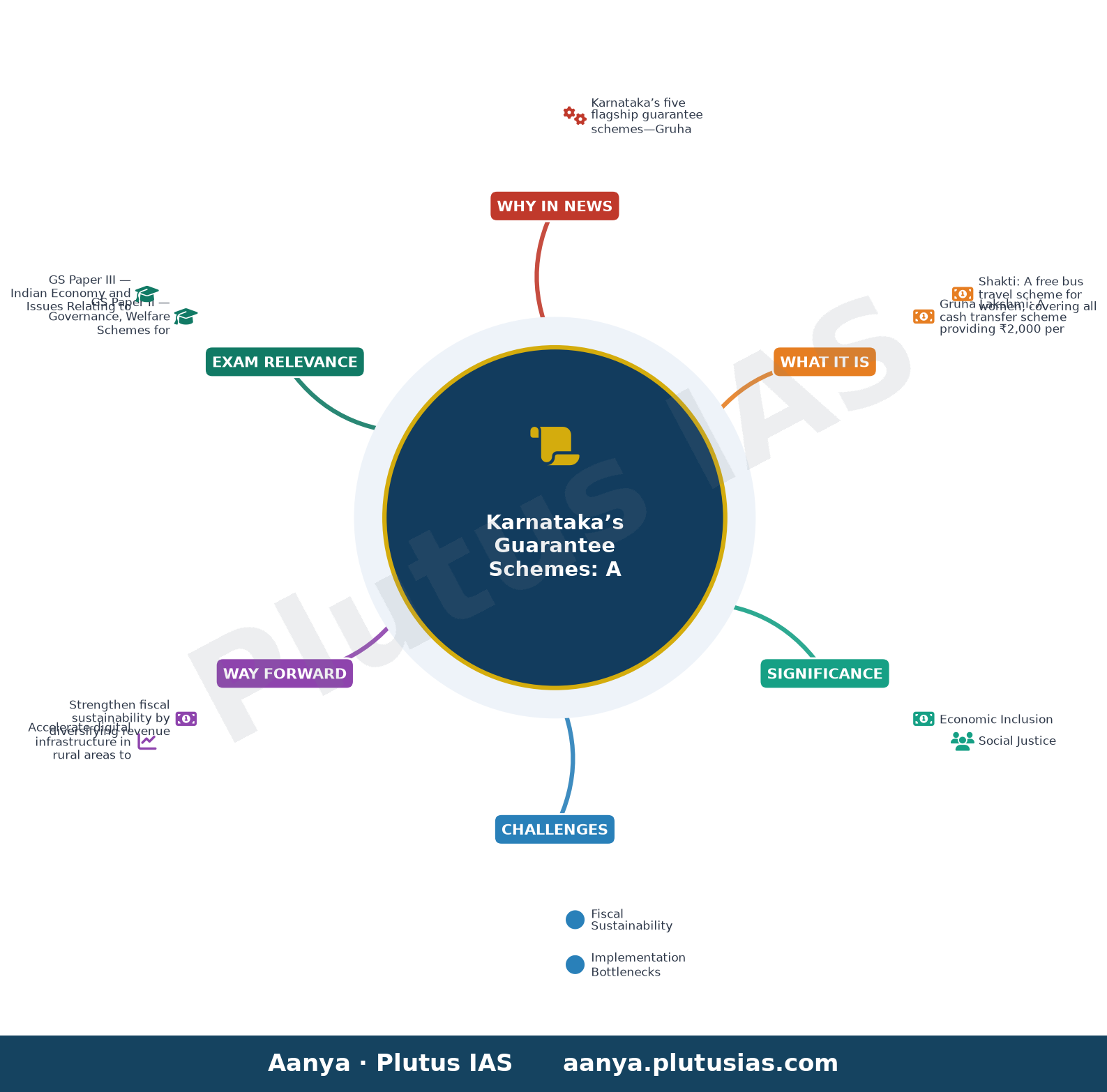
- GS Paper II — Governance, Welfare Schemes for Vulnerable Sections | GS Paper III — Indian Economy and Issues Relating to Planning, Mobilisation of Resources
- Prelims: Direct Benefit Transfer (DBT), Public Distribution System (PDS), Mahatma Gandhi National Rural Employment Guarantee Scheme (MGNREGS), Amrut 2.0, Urban Local Bodies (ULBs), Backward Classes Welfare
- Essay: Role of State-led welfare schemes in achieving inclusive growth, Balancing fiscal prudence with social justice in development policy
Quick Revision: Karnataka’s guarantee schemes exemplify a rights-based approach to welfare, leveraging Direct Benefit Transfer (DBT) and entitlement frameworks to deliver social protection, with cumulative expenditure of ₹1.34 lakh crore and 3,12,152 beneficiaries registered under the Gruha Lakshmi scheme in Koppal district.
Why is this in the news?
Karnataka’s five flagship guarantee schemes—Gruha Lakshmi, Shakti, Anna Bhagya, Yuvanidhi, and Gruha Jyothi—have emerged as a model for other Indian states, with cumulative expenditure exceeding ₹1.34 lakh crore and direct benefits accruing to millions of households. The schemes, implemented under the State’s welfare framework, have been highlighted for their role in poverty alleviation, gender empowerment, and infrastructure development, particularly in districts like Koppal. The announcement of their success during the 80th Independence Day celebrations underscores their significance in contemporary governance and social policy.
Background
- The concept of ‘guarantee schemes’ in Karnataka is rooted in the constitutional directive principles of State Policy (Article 38 and Article 46) and the Mahatma Gandhi National Rural Employment Guarantee Scheme (MGNREGS), which established a legal framework for entitlements-based welfare.
- Karnataka has historically been a pioneer in social welfare schemes, with initiatives like the ‘Karnataka State Rural Livelihood Mission’ (KSRLM) and ‘Indira Canteen’ laying the groundwork for targeted interventions.
- The COVID-19 pandemic accelerated the adoption of cash transfers and in-kind support mechanisms, reinforcing the efficacy of guarantee schemes in mitigating economic shocks.
- The State’s fiscal commitment to these schemes—annual expenditure exceeding ₹50,000 crore—reflects a prioritisation of social sector spending over traditional infrastructure-led growth models.
- Other states, including Rajasthan, Telangana, and Odisha, have subsequently adopted similar models, indicating a potential shift toward entitlement-based welfare across India.
What are Karnataka’s Guarantee Schemes?
- Gruha Lakshmi: A cash transfer scheme providing ₹2,000 per month to women heads of households, aimed at enhancing financial autonomy and household welfare. The scheme targets 1.1 crore women across Karnataka, with funds disbursed directly to beneficiaries’ bank accounts via Direct Benefit Transfer (DBT).
- Shakti: A free bus travel scheme for women, covering all State-run buses (KSRTC, NWKRTC, NEKRTC) to promote gender mobility and reduce transportation costs. The total value of tickets issued under the Shakti scheme was ₹426.39 crore.
- Anna Bhagya: An enhanced Public Distribution System (PDS) initiative, providing 10 kg of additional foodgrains per person per month to Below Poverty Line (BPL) families. The scheme supplements the National Food Security Act (NFSA) by increasing entitlements and reducing food insecurity.
- Yuvanidhi: A unemployment assistance scheme for educated youth (degree/diploma holders). The scheme aims to support youth during job-search periods and aligns with the National Youth Policy’s emphasis on skill development and employment.
- Gruha Jyothi: A subsidy scheme for electricity consumers, offering free power up to 200 units per month. The scheme targets low-income households and reduces the financial burden of utility expenses, with 99.02% of eligible beneficiaries registered under the Gruha Jyothi scheme in the district.
- Fiscal Architecture: The schemes are funded through the State’s own resources, supplemented by central devolution and borrowing, with a focus on fiscal sustainability through targeted expenditure and monitoring mechanisms.
- Implementation Framework: The schemes operate under a decentralised model, with district-level monitoring committees, real-time dashboards for beneficiary tracking, and grievance redressal mechanisms to ensure transparency and accountability.
Key Features
| Feature | Significance |
|---|---|
| Gruha Lakshmi | Direct cash transfer of ₹2,000 per month to women heads of households, enhancing financial autonomy and household welfare. |
| Shakti Scheme | Subsidised bus travel for women, promoting gender-inclusive mobility and reducing transportation costs for economically vulnerable sections. |
| Anna Bhagya | Universal food security through subsidised rice at ₹3 per kg, ensuring nutritional security for low-income families. |
| Yuvanidhi | Unemployment assistance of ₹3,000 per month for graduates and ₹1,500 for diploma holders, addressing youth unemployment. |
| Gruha Jyothi | Subsidised electricity up to 200 units free per month, reducing energy poverty and improving living standards. |
Why it Matters
Economic Inclusion
- Direct benefit transfers (DBT) under these schemes have injected liquidity into rural and semi-urban economies, stimulating local demand and micro-enterprise growth.
- The cumulative expenditure of ₹1.34 lakh crore demonstrates fiscal commitment to social protection, aligning with SDG 1 (No Poverty) and SDG 10 (Reduced Inequalities).
- Empirical evidence from Koppal district shows high uptake (e.g., 99.02% eligibility verification for Gruha Jyothi), indicating effective targeting and reduced exclusion errors.
Social Justice
- Targeted support to women (Gruha Lakshmi, Shakti) and marginalised groups (Anna Bhagya) operationalises constitutional principles of equality (Article 14) and non-discrimination (Article 15).
- Unemployment assistance (Yuvanidhi) addresses structural unemployment among educated youth, a critical demographic challenge in India’s demographic dividend.
Policy Replicability
- Karnataka’s model has catalysed inter-state learning, with States like Rajasthan and Tamil Nadu adopting similar guarantee schemes, demonstrating policy diffusion in Indian federalism.
- The schemes’ design—universal eligibility with progressive targeting—offers a template for Centre-State coordination in social welfare delivery.
Infrastructure Synergy
- Concurrent investments in drinking water projects (Amrut 2.0, multi-village schemes) enhance the welfare impact of guarantee schemes by addressing complementary deprivations (e.g., health, sanitation).
- Multi-sectoral convergence (e.g., water + electricity subsidies) maximises household welfare gains through complementarity effects.
Challenges
1. Fiscal Sustainability
- Annual expenditure exceeding ₹50,000 crore risks straining State finances, particularly amid revenue uncertainties and competing developmental priorities.
- Long-term viability depends on robust tax buoyancy, GST compensation mechanisms, and potential Centre-State fiscal transfers under Finance Commission awards.
UPSC Link: Fiscal Federalism (GS II)
2. Implementation Bottlenecks
- High eligibility verification rates (e.g., 54.48% for Gruha Jyothi) suggest administrative delays, potentially excluding deserving beneficiaries due to bureaucratic inefficiencies.
- Digital divide in rural areas may hinder access to subsidies, particularly for schemes requiring Aadhaar-linked bank accounts or digital authentication.
UPSC Link: Governance (GS II)
3. Inflationary Pressures
- Subsidised goods/services (e.g., rice at ₹3/kg) may distort local markets, creating supply-side constraints or black-market distortions if procurement and distribution systems are weak.
- Electricity subsidies (Gruha Jyothi) could exacerbate DISCOM losses, necessitating cross-subsidisation from industrial/commercial consumers.
UPSC Link: Price Stability (GS III)
4. Targeting Errors
- Universal eligibility (e.g., Anna Bhagya) risks inclusion of non-poor beneficiaries, diluting fiscal efficiency and diverting resources from the most vulnerable.
- Lack of dynamic beneficiary updation (e.g., employment status changes) may lead to over/under-coverage, undermining scheme efficacy.
UPSC Link: Poverty Alleviation (GS II)
5. Centre-State Coordination
- Divergent State models may create fragmentation in welfare delivery, complicating Centre’s role in standardisation (e.g., One Nation One Ration Card vs. State-specific schemes).
- Potential conflicts over fiscal space allocation between Centre and States may arise if guarantee schemes are scaled nationally without adequate devolution.
UPSC Link: Cooperative Federalism (GS II)
Challenges — UPSC Perspective
| Issue | Concern |
|---|---|
| Fiscal Burden | Risk of unsustainable expenditure amid revenue constraints and competing priorities. |
| Administrative Delays | High verification backlogs and digital exclusion may exclude eligible beneficiaries. |
| Market Distortions | Subsidies may create supply-side inefficiencies or black markets in essential goods. |
| Inclusion Errors | Universal eligibility may dilute fiscal efficiency by covering non-poor households. |
| Federal Tensions | Potential Centre-State conflicts over fiscal devolution and scheme standardisation. |
Government Initiatives — Must-Memorise for Prelims
- Gruha Lakshmi
- Shakti Scheme
- Anna Bhagya
- Amrut 2.0
Way Forward
- Strengthen fiscal sustainability by diversifying revenue streams (e.g., GST reforms, disinvestment) and exploring outcome-based funding models.
- Accelerate digital infrastructure in rural areas to reduce exclusion errors and improve service delivery efficiency.
- Enhance inter-departmental convergence (e.g., linking water projects to electricity subsidies) to maximise household welfare gains.
- Institute dynamic beneficiary updation systems to prevent inclusion/exclusion errors and ensure real-time targeting.
- Establish a Centre-State coordination mechanism (e.g., NITI Aayog-led task force) to standardise best practices and avoid policy fragmentation.
- Conduct independent impact assessments to evaluate scheme efficacy, cost-effectiveness, and long-term socio-economic outcomes.
- Expand vocational training linkages under Yuvanidhi to transition unemployment assistance into sustainable employment opportunities.
- Promote public-private partnerships for last-mile delivery of subsidies, leveraging technology (e.g., drones for water project monitoring).
UPSC Value Addition
Keywords for Mains Answer-Writing
Karnataka guarantee schemes · Gruha Lakshmi · Shakti Scheme · Anna Bhagya · Yuvanidhi · Gruha Jyothi · direct benefit transfer · Amrut 2.0 · multi-village drinking water schemes · social welfare policies · fiscal federalism · poverty alleviation · women empowerment · rural infrastructure development
Constitutional & Policy Linkages
- Article 14: Equality before law and equal protection of laws (applies to non-discriminatory welfare delivery).
- Article 15: Prohibition of discrimination on grounds of religion, race, caste, sex, or place of birth (guides targeted schemes for marginalised groups).
- Article 21: Right to life and personal liberty (includes right to dignity and basic necessities like food, shelter, and health).
Concept Flow
State-level political commitment to social justice and poverty alleviation → Design and launch of five guarantee schemes → Direct benefit transfers (DBT) and subsidy delivery → Increased household liquidity and consumption → Stimulation of local economies → Higher tax buoyancy and fiscal capacity → Reinvestment in social welfare → Replicability in other States → Policy diffusion in Indian federalism.
Prelims Practice Questions
Q1. Consider the following statements regarding Karnataka’s guarantee schemes: 1. Gruha Lakshmi provides financial assistance to women heads of households. 2. Shakti Scheme offers free bus travel for women. 3. Anna Bhagya provides subsidised LPG cylinders to BPL families. 4. Yuvanidhi provides unemployment assistance to educated youth. How many of the above statements are correct?
- Only one
- Only two
- Only three
- All four
Answer: All four — Statements 1, 2, and 4 are correct. Statement 3 is incorrect as Anna Bhagya provides subsidised food grains, not LPG cylinders.
Q2. Assertion (A): The Amrut 2.0 scheme focuses on improving water supply and sewerage infrastructure in urban areas. Reason (R): The scheme aims to ensure universal coverage of piped drinking water supply in all statutory towns. Examine the Assertion and Reason and select the correct code:
- Both A and R are true, and R is the correct explanation of A
- Both A and R are true, but R is not the correct explanation of A
- A is true, but R is false
- A is false, but R is true
Answer: Both A and R are true, but R is not the correct explanation of A — Both the Assertion and Reason are true, and the Reason correctly explains the Assertion as Amrut 2.0 is designed to enhance water supply and sewerage in urban areas with a focus on universal coverage.
Q3. Match the following Karnataka guarantee schemes with their primary objectives:
Scheme:
1. Gruha Lakshmi
2. Shakti
3. Anna Bhagya
4. Yuvanidhi
Objective:
A. Unemployment assistance to educated youth
B. Financial assistance to women heads of households
C. Free bus travel for women
D. Subsidised food grains to BPL families
- 1-B, 2-C, 3-D, 4-A; 1-A, 2-B, 3-C, 4-D; 1-D, 2-A, 3-B, 3-C; 1-C, 2-D, 3-A, 4-B
- answer_list_indexes_for_correct_match_ordered_pairs_are_0
- explain_list_in_order_separated_by_semicolons_then_explain_match: 1-B; 2-C; 3-D; 4-A; Correct match is 1-B, 2-C, 3-D, 4-A.
- format_match_the_following
Answer: 1-B, 2-C, 3-D, 4-A; 1-A, 2-B, 3-C, 4-D; 1-D, 2-A, 3-B, 3-C; 1-C, 2-D, 3-A, 4-B —
Mains Practice Question
✍ The adoption of direct benefit transfer (DBT) mechanisms through flagship guarantee schemes has transformed social welfare delivery in Karnataka. Critically examine the efficacy of these schemes in achieving their stated objectives of poverty alleviation, women empowerment, and social inclusion. Also, assess the fiscal implications of such large-scale welfare programmes for state finances. (15 Marks)
Approach: MODEL-ANSWER SKELETON:
1. Introduction: Define DBT and Karnataka’s guarantee schemes (Gruha Lakshmi, Shakti, Anna Bhagya, Yuvanidhi, Gruha Jyothi) with their stated objectives.
2. Efficacy in achieving objectives:
a. Poverty alleviation: Cite data on beneficiary coverage (e.g., 3.12 lakh under Gruha Lakshmi in Koppal) and direct transfers (₹1.853 crore).
b. Women empowerment: Highlight Shakti Scheme’s impact (12.72 crore trips, ₹426.39 crore value) and Gruha Lakshmi’s financial independence for women.
c. Social inclusion: Discuss coverage of vulnerable sections (e.g., Anna Bhagya’s 12 lakh beneficiaries monthly).
3. Challenges: Leakage risks, exclusion errors, administrative bottlenecks, and fiscal sustainability.
4. Fiscal implications: Total expenditure (₹1.34 lakh crore), revenue implications, and potential debt burden.
5. Comparative perspective: Contrast with other states’ welfare models (e.g., Odisha’s Kalia Scheme).
6. Conclusion: Balance between welfare outcomes and fiscal prudence, suggesting reforms like Aadhaar seeding and grievance redressal mechanisms.
Source: The Hindu
Generated by AanyaAi for educational purpose.

- Gurugram’s groundwater extraction exceeds limit by 212%; HC seeks ban - October 4, 2026
- स्वतंत्रता सेनानी श्यामजी कृष्ण वर्मा की जन्म जयंती पर पीएम का श्रद्धांजलि - October 4, 2026
- KWML’s Feasibility Reports for Water Metro in 18 Cities: UPSC & PCS Insights - October 3, 2026

No Comments