


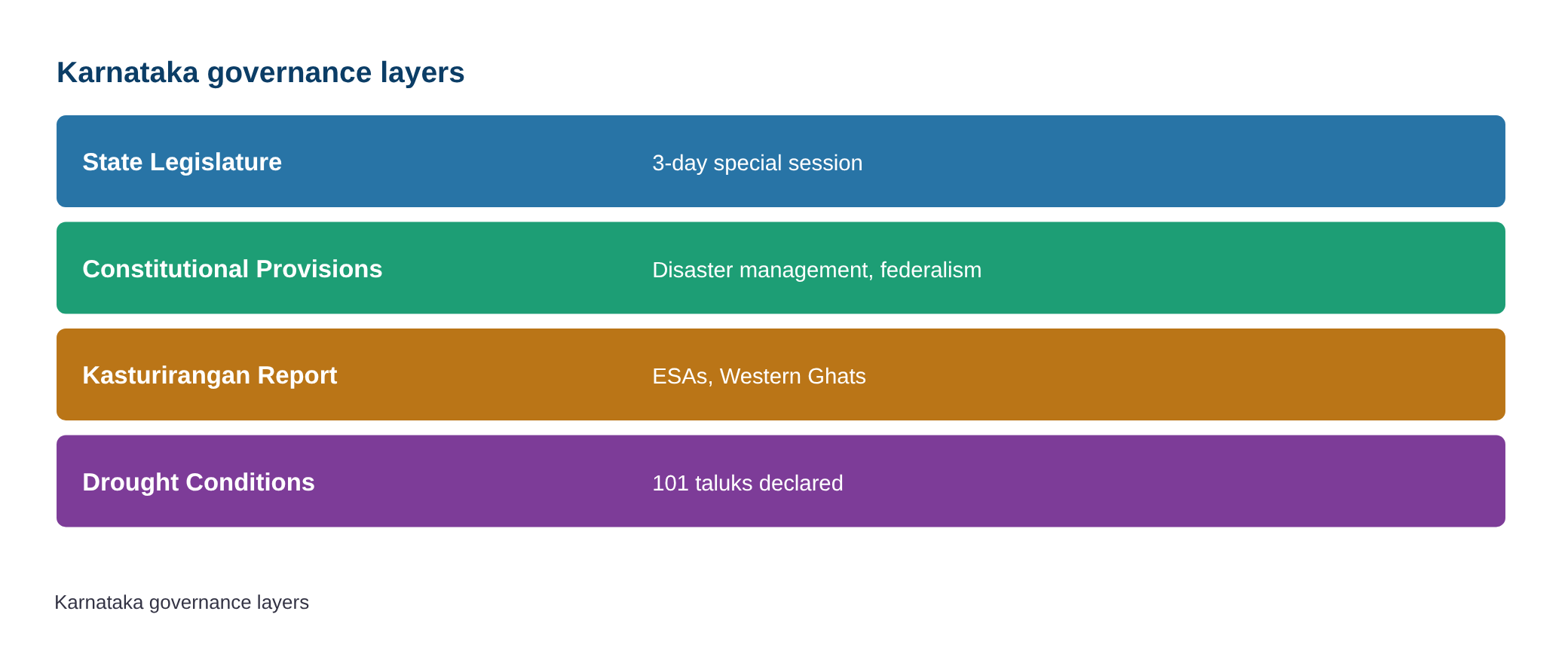
03 Sep Karnataka’s 3-day special session: Drought & Kasturirangan report key focus
✎ The three-day special session in Karnataka will address the intersection of environmental governance (Kasturirangan report), disaster management (Drought Manual 2020), and fiscal federalism (SDRF/NDRF), while also implementing…
Subject Relevance — Where This Topic Fits
- GS Paper II — Functions and Responsibilities of the Union and the States, Issues and Challenges Pertaining to the Federal Structure | GS Paper III — Disaster Management, Conservation, Environmental Pollution and Degradation, Environmental Impact Assessment | GS Paper III — Issues related to Direct and Indirect Farm Subsidies and Minimum Support Prices | GS Paper III — Indian Economy and issues relating to Planning, Mobilisation of Resources, Growth, Development and Employment
- Prelims: Kasturirangan Committee Report, Ecologically Sensitive Areas (ESAs), Drought Manual 2020, State Disaster Relief Fund (SDRF), Bangalore-Mysore Infrastructure Corridor (BMIC) Project, Visvesvaraya Technological University (VTU), Invest Karnataka 2027
- Essay: Federalism and Centre-State Coordination in Disaster Management, Balancing Development and Environmental Conservation: The Case of Ecologically Sensitive Areas
Quick Revision: The three-day special session in Karnataka will address the intersection of environmental governance (Kasturirangan report), disaster management (Drought Manual 2020), and fiscal federalism (SDRF/NDRF), while also implementing land acquisition laws and development priorities under constitutional and statutory frameworks.
Why is this in the news?
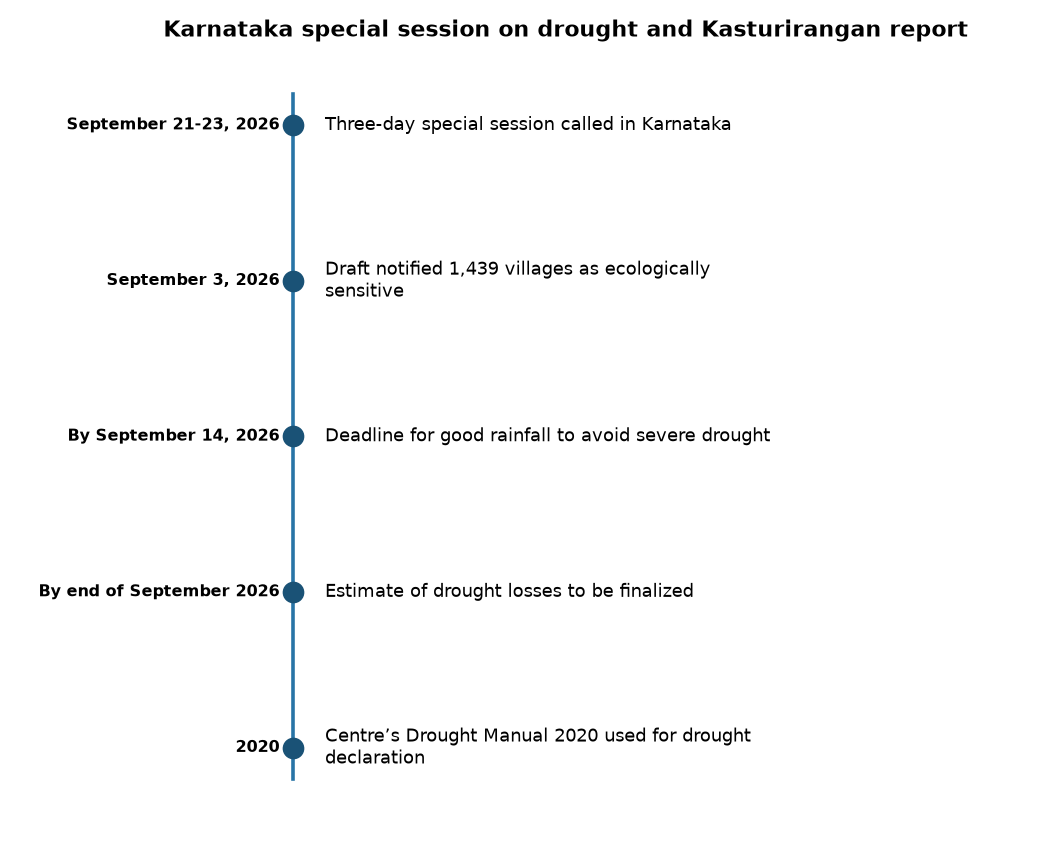
The Karnataka government has convened a three-day special legislative session from September 21 to 23, 2026, to deliberate on two critical governance issues: the state’s worsening drought conditions and the implementation of the Kasturirangan Committee report, which designates ecologically sensitive areas (ESAs). This session assumes significance as it intersects with constitutional provisions on disaster management, fiscal federalism, and environmental governance, while also addressing relief measures, compensation mechanisms, and development planning under fiscal constraints.
Background
- The Kasturirangan Committee, constituted by the Union Ministry of Environment, Forest and Climate Change, submitted its report in 2013, recommending the notification of 1,439 villages in Karnataka as Ecologically Sensitive Areas (ESAs) to protect the Western Ghats, a biodiversity hotspot.
- The notification of ESAs has triggered debates on land-use restrictions, livelihood impacts, and the balance between conservation and developmental activities in the state.
- Karnataka is currently experiencing severe drought conditions, with 101 taluks already declared drought-hit under the Centre’s Drought Manual 2020, and an additional 50–60 taluks likely to be declared in the second round of assessment.
- The state has approved ₹1,229 crore under the State Disaster Relief Fund (SDRF) for drought relief, but it is yet to be released.
- The state cabinet has also approved a ₹249 crore development plan for the University of Visvesvaraya College of Engineering on the IIT model, and a ₹46 crore allocation for trauma centres, including ambulances and medical equipment.
Key Governance Dimensions of Karnataka’s Special Session
- **Ecologically Sensitive Areas (ESAs) and the Kasturirangan Report**: The Kasturirangan Committee’s report aims to safeguard the Western Ghats by designating 1,439 villages as ESAs, subject to restrictions on developmental activities such as mining, construction, and industrial expansion. The report is rooted in the National Forest Policy, 1988, and the Environment Protection Act, 1986, which empower the Union government to regulate activities in ecologically fragile regions.
- The notification of ESAs falls under the purview of the Union Ministry of Environment, Forest and Forest Change, but state governments play a crucial role in implementing land-use regulations and mitigating livelihood impacts on local communities.
- **Drought Management and the Drought Manual 2020**: The Drought Manual 2020, issued by the Union Ministry of Agriculture and Farmers’ Welfare, provides a standardized framework for drought declaration, relief measures, and compensation. It mandates the use of objective indicators such as rainfall deficit, soil moisture, and crop failure to assess drought severity.
- Karnataka’s declaration of 101 drought-hit taluks under this manual triggers the release of funds from the State Disaster Relief Fund (SDRF) and the National Disaster Response Fund (NDRF), as per the Disaster Management Act, 2005.
- The state government’s decision to declare additional taluks is contingent on the manual’s criteria, ensuring transparency and uniformity in relief distribution.
- **Fiscal Federalism and Disaster Relief**: The Disaster Management Act, 2005, delineates the roles of the Union and state governments in disaster management, with the Union providing financial assistance through the NDRF and the state governments managing the SDRF.
- The approval of ₹1,229 crore under the SDRF for Karnataka reflects the state’s fiscal capacity and the Union government’s commitment to sharing disaster-related expenditures, as per the Finance Commission’s recommendations.
- **Development Planning and Fiscal Priorities**: The approval of a ₹249 crore development plan for the University of Visvesvaraya College of Engineering, modeled on IIT standards, aligns with the National Education Policy (NEP) 2020, which emphasizes institutional autonomy, research, and skill development.
- The allocation of ₹46 crore for trauma centres, including ambulances and medical equipment, reflects the state’s priorities in healthcare infrastructure, particularly in rural and peri-urban areas.
- The organization of ‘Invest Karnataka 2027’, scheduled for April 2027, underscores the state’s efforts to attract investment, create employment, and promote industrial growth, while balancing environmental and social considerations.
Key Features
| Feature | Significance |
|---|---|
| Three-day special session (21–23 September 2026) | Provides a dedicated legislative platform to deliberate on drought mitigation and the Kasturirangan Committee report, ensuring policy coherence and inter-departmental coordination. |
| Draft notification of 1,439 ecologically sensitive villages | Triggers legal and administrative responses under environmental governance frameworks, including restrictions on land use and development activities. |
| Centre’s Drought Manual 2020 compliance | Establishes a standardized process for declaring drought-affected taluks, enabling systematic relief measures and Centre-State fund disbursement. |
| State Disaster Relief Fund (₹1,229 crore) | Acts as a financial buffer for emergency drought response, though delayed release may hinder immediate relief operations. |
| Allotment of sites to 1,453 farmers (NICE road project) | Addresses land acquisition disputes by providing compensatory housing plots, aligning with judicial directives on rehabilitation. |
Why it Matters
Environmental Governance
- The Kasturirangan Committee report on the Western Ghats highlights the tension between conservation imperatives and developmental pressures, necessitating evidence-based policy trade-offs.
- Notification of ecologically sensitive areas under the Environment Protection Act, 1986, empowers the State to regulate activities that may exacerbate drought vulnerability through ecological degradation.
Disaster Management
- Drought declaration under the Drought Manual 2020 triggers the National Disaster Response Fund (NDRF) and State Disaster Response Fund (SDRF), facilitating resource mobilization for affected communities.
- Delayed release of approved funds (₹1,229 crore) underscores institutional bottlenecks in fiscal federalism, potentially delaying relief measures for vulnerable populations.
Judicial-Legislative Interface
- Supreme Court’s directive on farmer rehabilitation for the NICE road project exemplifies the judiciary’s role in ensuring equitable land acquisition outcomes, even post-project completion.
- Special legislative sessions provide a mechanism for the executive to align policy responses with judicial pronouncements, reducing policy-legal conflicts.
Fiscal Federalism
- Centre-State fund sharing for drought relief (NDRF/SDRF) reflects cooperative federalism, but procedural delays highlight the need for streamlined disbursement mechanisms.
- State’s pre-emptive expenditure (₹187 crore) on relief measures demonstrates fiscal autonomy but may strain the State’s budgetary capacity.
Infrastructure and Development
- Approval of ₹249 crore for Visvesvaraya College of Engineering (IIT model) aligns with the State’s human capital development agenda, potentially enhancing technical workforce capacity.
- Invest Karnataka 2027 (April 2027) signals long-term economic planning, aiming to attract investment amid climate-induced agricultural distress.
Challenges
1. Delayed Fund Disbursement
- Approved ₹1,229 crore under SDRF remains unreleased, delaying critical drought relief measures such as water supply augmentation and fodder distribution.
- Bureaucratic delays in fund release exacerbate the humanitarian impact on marginal farmers and rural communities, particularly in drought-prone regions.
UPSC Link: Disaster Management Act, 2005
2. Ecological-Developmental Trade-offs
- Notification of ecologically sensitive areas may restrict agricultural and infrastructure activities, potentially increasing rural unemployment and migration pressures.
- Balancing conservation goals with livelihood security requires multi-stakeholder consultations and evidence-based zoning policies.
UPSC Link: Environment Protection Act, 1986
3. Land Acquisition and Rehabilitation
- Implementation of rehabilitation schemes for NICE road project farmers faces logistical challenges, including land availability and beneficiary identification.
- Inadequate compensation for land loss (e.g., 1,200 sq. ft plots for <1 acre) may not fully restore livelihoods, leading to long-term socio-economic vulnerabilities.
UPSC Link: Land Acquisition Act, 2013
4. Climate Change and Drought Vulnerability
- Increasing frequency and intensity of droughts in Karnataka, linked to climate change, strain the State’s adaptive capacity and fiscal resources.
- Agricultural distress may trigger rural-urban migration, exacerbating urban infrastructure challenges and social tensions.
UPSC Link: National Action Plan on Climate Change
5. Inter-Departmental Coordination
- Drought mitigation requires seamless coordination between departments such as agriculture, water resources, rural development, and finance, which is often hindered by siloed governance.
- Special legislative sessions provide an opportunity to institutionalize cross-departmental collaboration but must be backed by strong monitoring mechanisms.
UPSC Link: Concurrent List (7th Schedule)
Challenges — UPSC Perspective
| Issue | Concern |
|---|---|
| Fund release delays | Delays in SDRF disbursement hinder immediate drought relief, increasing vulnerability of affected populations. |
| Ecological restrictions | Notification of ecologically sensitive areas may constrain agricultural and infrastructure activities, impacting livelihoods. |
| Land acquisition disputes | Inadequate rehabilitation for NICE road project farmers risks long-term socio-economic instability. |
| Climate change adaptation | Escalating drought frequency challenges the State’s adaptive capacity and fiscal sustainability. |
| Inter-departmental coordination | Siloed governance structures impede effective drought mitigation and relief distribution. |
Government Initiatives — Must-Memorise for Prelims
- National Disaster Response Fund (NDRF)
- Drought Manual 2020 (Government of India)
Way Forward
- Expedite the release of approved ₹1,229 crore under SDRF to ensure timely drought relief, prioritizing water supply, fodder distribution, and employment generation schemes.
- Constitute a multi-departmental task force to monitor and streamline fund disbursement, with weekly progress reviews to address bottlenecks.
- Conduct a rapid ecological assessment of notified villages to delineate permissible and restricted activities, ensuring compliance with conservation objectives while minimizing livelihood disruptions.
- Accelerate the implementation of the NICE road project rehabilitation scheme, including land allotment and beneficiary verification, to address pending disputes and restore livelihoods.
- Develop a climate-resilient agriculture strategy, integrating drought-resistant crop varieties, water conservation techniques, and agroforestry models to reduce vulnerability.
- Enhance inter-state coordination for water resource management, leveraging the Inter-State Water Disputes Act, 1956, to address upstream-downstream conflicts in river basins.
- Strengthen early warning systems for drought prediction using satellite data and AI-driven analytics, enabling proactive policy interventions.
- Institutionalize post-drought recovery plans, including crop insurance payouts, debt relief for farmers, and skill development programs for affected communities.
UPSC Value Addition
Keywords for Mains Answer-Writing
Drought Management in India · Kasturirangan Committee Report · Ecologically Sensitive Zones (ESZs) · Disaster Management Act, 2005 · Drought Manual 2020 · National Disaster Response Fund (NDRF) · State Disaster Response Fund (SDRF) · Environmental Governance in India · Western Ghats Conservation · Agricultural Drought · Compensation Mechanisms for Farmers · Special Legislative Sessions in States
Constitutional & Policy Linkages
- Article 262: Inter-State Water Disputes (for river basin management)
- Article 292: Borrowing by States (for fiscal federalism in disaster relief)
Concept Flow
Climate variability → Increased drought frequency → Agricultural distress → State declares drought-affected taluks → Centre’s Drought Manual 2020 triggers relief measures → SDRF/NDRF fund disbursement delays → Humanitarian impact on rural communities. → Western Ghats conservation report → Draft notification of ecologically sensitive areas → Legal restrictions on land use → Potential livelihood disruptions → Need for compensatory policies. → Land acquisition for infrastructure (NICE road) → Supreme Court intervention → State’s rehabilitation scheme → Allotment of compensatory plots → Logistical challenges in implementation. → Delayed fund release → State’s pre-emptive expenditure → Fiscal strain → Reduced capacity for long-term development projects (e.g., education infrastructure). → Special legislative session → Policy deliberations on drought and conservation → Alignment with judicial directives → Enhanced governance coherence. → Climate change adaptation → Need for resilient agriculture → Integration of drought-resistant practices → Policy integration with State’s economic planning (e.g., Invest Karnataka 2027).
Prelims Practice Questions
Q1. Consider the following statements regarding the Kasturirangan Committee Report:
1. The Committee was constituted to assess the ecological sensitivity of the Western Ghats.
2. The report recommends the declaration of Ecologically Sensitive Zones (ESZs) in the Western Ghats.
3. The report has been fully implemented by all state governments in India.
How many of the above statements are correct?
- Only one
- Only two
- All three
- None
Answer: Only two — Statement 1 is correct as the Kasturirangan Committee was indeed constituted to assess the ecological sensitivity of the Western Ghats. Statement 2 is correct as the report recommends the declaration of ESZs. Statement 3 is incorrect as the implementation of the report varies across states and has faced opposition in some regions.
Q2. Assertion (A): The Drought Manual 2020 issued by the Government of India provides a standardized framework for declaring drought-affected areas.
Reason (R): The manual mandates the use of specific indicators such as rainfall deficit and crop loss to declare droughts, ensuring uniformity in drought declaration across states.
Options:
A. Both A and R are true, and R is the correct explanation of A.
B. Both A and R are true, but R is not the correct explanation of A.
C. A is true, but R is false.
D. A is false, but R is true.
Answer: ? — Both Assertion (A) and Reason (R) are true. The Drought Manual 2020 does provide a standardized framework for declaring drought-affected areas, and it mandates the use of specific indicators like rainfall deficit and crop loss to ensure uniformity across states.
Q3. Match the following pairs related to environmental governance in India:
Column I (Committee/Report) — Column II (Purpose)
A. Kasturirangan Committee — 1. Assessment of ecological sensitivity of the Western Ghats
B. Gadgil Committee — 2. Recommendations on environmental governance and sustainable development
C. National Green Tribunal — 3. Adjudication of environmental disputes
D. Environment Impact Assessment Notification — 4. Regulation of developmental projects
Options:
A. A-1, B-2, C-3, D-4
B. A-2, B-1, C-4, D-3
C. A-3, B-4, C-1, D-2
D. A-4, B-3, C-2, D-1
Answer: ? — The correct matches are: A-1 (Kasturirangan Committee assessed ecological sensitivity of the Western Ghats), B-2 (Gadgil Committee provided recommendations on environmental governance and sustainable development), C-3 (National Green Tribunal adjudicates environmental disputes), and D-4 (Environment Impact Assessment Notification regulates developmental projects).
Mains Practice Question
✍ The State of Karnataka has convened a special legislative session to discuss the impact of drought and the recommendations of the Kasturirangan Committee Report on Ecologically Sensitive Zones (ESZs). Critically examine the challenges in balancing agricultural drought mitigation with environmental conservation in India. (15 Marks)
Approach: MODEL-ANSWER SKELETON:
1. **Introduction (2 Marks)**: Define drought and ESZs; highlight the dual challenge of agricultural drought mitigation and environmental conservation in India.
2. **Drought Management Framework (4 Marks)**:
– Explain the constitutional and statutory basis: Disaster Management Act, 2005; Drought Manual 2020; NDRF and SDRF.
– Discuss the role of the State Disaster Response Fund (SDRF) and National Disaster Response Fund (NDRF) in drought relief.
– Mention the Karnataka government’s declaration of drought-affected taluks and the financial allocations (e.g., ₹1,229 crore approved under SDRF).
3. **Environmental Conservation and ESZs (4 Marks)**:
– Explain the Kasturirangan Committee Report and its recommendations for ESZs in the Western Ghats.
– Discuss the ecological significance of the Western Ghats and the need for conservation.
– Highlight the conflict between developmental activities (e.g., infrastructure projects) and conservation.
4. **Challenges in Balancing the Two (3 Marks)**:
– Discuss the trade-offs between agricultural productivity and environmental conservation.
– Explain the socio-economic impact on farmers and local communities.
– Highlight the role of judicial interventions (e.g., Supreme Court’s nudge for land allotment to farmers affected by the Bangalore-Mysore Infrastructure Corridor project).
5. **Way Forward (2 Marks)**:
– Suggest integrated approaches such as agroforestry, water conservation, and sustainable agriculture.
– Emphasize the need for multi-stakeholder consultations and evidence-based policy-making.
**Balanced View**: Present both the necessity of drought relief for agricultural communities and the imperative of environmental conservation, without taking sides on policy preferences.
Source: The Hindu
Karnataka PCS (KPSC) — State PCS Practice
Prelims: With reference to Karnataka’s special session to discuss drought and the Kasturirangan report, which of the following statements is correct?
- The special session will focus exclusively on the implementation of the Kasturirangan report without addressing drought issues.
- The three-day special session aims to discuss both drought conditions in Karnataka and the recommendations of the Kasturirangan report.
- The Kasturirangan report is unrelated to Karnataka’s drought situation and will not be discussed in this session.
- The special session is being held to solely address the water crisis in northern Karnataka, excluding the Kasturirangan report.
Answer: The three-day special session aims to discuss both drought conditions in Karnataka and the recommendations of the Kasturirangan report. — The special session is convened to discuss Karnataka’s drought conditions as well as the recommendations of the Kasturirangan report on Western Ghats.
Mains: Analyze the significance of convening a special session in Karnataka to discuss both drought conditions and the Kasturirangan report. How can this session contribute to policy formulation for sustainable water management and environmental conservation in the state? (250 words)
Generated by AanyaAi for educational purpose.
Related guides on our sites
- Best PSIR optional coaching for upsc
- Best economics optional coaching for upsc
- Best PSIR optional teacher for upsc
- Best teacher of PSIR optional for upsc

- India-Australia AUSTRAHIND 2026 Exercise: Key Highlights for UPSC & State PCS - October 22, 2026
- एससीओ बैठक में भारत का आतंकवाद विरोध: क्षेत्रीय सहयोग पर जोर - October 22, 2026
- SEC Directs Strict SC Order Compliance for Andhra ULB Polls - October 22, 2026

No Comments