


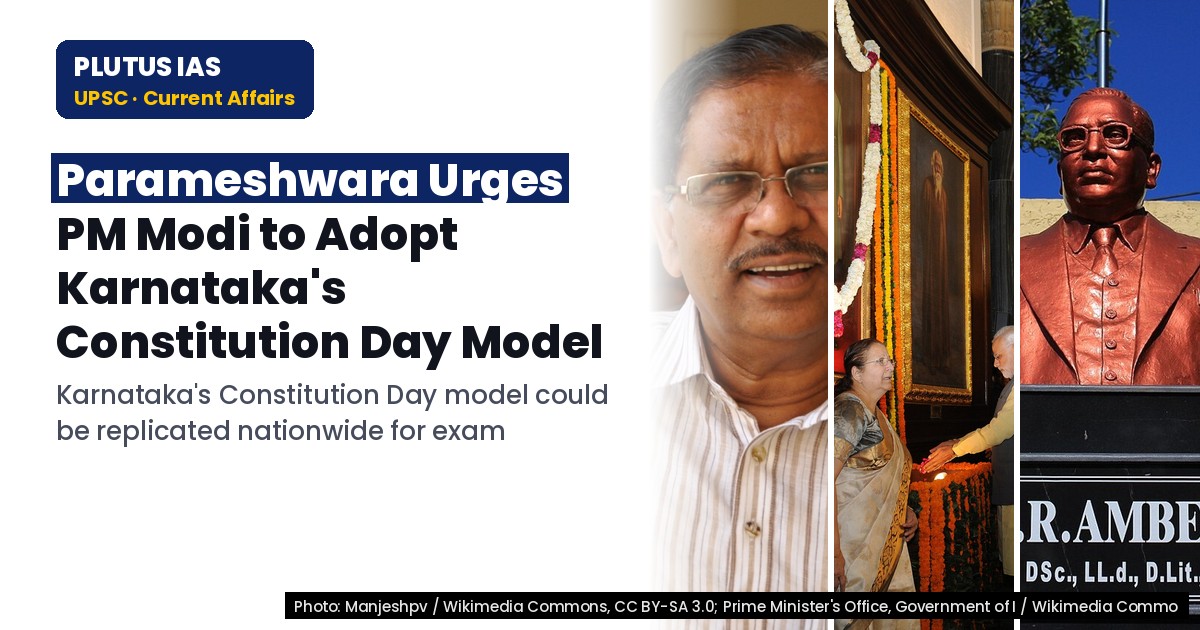
27 Nov Karnataka’s Constitution Day Model: A National Replication?
✎ Constitution Day, observed on November 26th, commemorates the adoption of the Indian Constitution and honours Dr. B.R. Ambedkar, the chief architect, reinforcing the nation's commitment to its foundational principles of liberty…
Subject Relevance — Where This Topic Fits
- GS Paper II — Indian Constitution — Historical Underpinnings, Evolution, Features, Amendments, Significant Provisions and Basic Structure | GS Paper II — Indian Constitution — Preamble, Fundamental Rights, Fundamental Duties, Directive Principles of State Policy | GS Paper II — Governance — Government Policies and Interventions for Development in various sectors and Issues arising out of their Design and Implementation
- Prelims: Constitution Day, Samvidhan Divas, Dr. B.R. Ambedkar, Constituent Assembly, Preamble, Fundamental Rights, Directive Principles of State Policy, Liberty, Equality, Fraternity
- Essay: The Indian Constitution: A Living Document for a Vibrant Democracy, Constitutional Values and their Relevance in Contemporary India
Quick Revision: Constitution Day, observed on November 26th, commemorates the adoption of the Indian Constitution and honours Dr. B.R. Ambedkar, the chief architect, reinforcing the nation’s commitment to its foundational principles of liberty, equality, and fraternity.
Why is this in the news?
A Deputy Chief Minister recently advocated for the replication of a state’s model for Constitution Day celebrations across all states. This model includes institutionalising Constitution reading in educational institutions and organising state-level celebrations annually, with the objective of honouring Dr. B.R. Ambedkar, the principal architect of the Indian Constitution, and reinforcing constitutional values among citizens.
Background
- Constitution Day, also known as ‘Samvidhan Divas’, is celebrated in India on November 26th each year.
- This day commemorates the adoption of the Constitution of India by the Constituent Assembly on November 26, 1949.
- The Constitution officially came into force on January 26, 1950, which is celebrated as Republic Day.
- The Government of India declared November 26th as Constitution Day in 2015 as part of the year-long celebrations of the 125th birth anniversary of Dr. B.R. Ambedkar.
- The observance aims to promote constitutional values among citizens and to acknowledge Dr. Ambedkar’s pivotal role in drafting the Constitution.
- Prior to 2015, November 26th was observed as National Law Day.
What is the Indian Constitution?
- The Constitution of India is the supreme law of India, establishing the framework that demarcates fundamental political code, structure, procedures, powers, and duties of government institutions and sets out fundamental rights, directive principles, and the duties of citizens.
- It is the longest written constitution of any country in the world, originally comprising 395 articles in 22 parts and 8 schedules, and has undergone numerous amendments.
- The Constituent Assembly, formed in 1946, was tasked with drafting the Constitution, with Dr. B.R. Ambedkar chairing its Drafting Committee.
- The Preamble to the Constitution declares India to be a Sovereign, Socialist, Secular, Democratic Republic and secures to all its citizens Justice, Liberty, Equality, and Fraternity.
- It draws inspiration from various constitutional systems globally, incorporating principles such as parliamentary democracy, fundamental rights, and a federal structure.
- The Constitution embodies the principles of liberty, equality, and fraternity, which were central to Dr. Ambedkar’s philosophy and are considered foundational to Indian democracy.
- It provides for a parliamentary form of government which is federal in structure with certain unitary features.
- The Constitution is a dynamic document, designed to evolve with the nation’s needs, as evidenced by its amendment provisions, while upholding its basic structure.
Key Features
| Feature | Significance |
|---|---|
| Institutionalisation of Constitution Day | Elevates the observance from a mere commemorative event to a structured educational and civic engagement initiative. |
| Constitution reading in schools and colleges | Fosters constitutional literacy and inculcates democratic values among the youth from an early age. |
| Annual State-level celebrations | Provides a platform for public discourse on constitutional principles and reinforces the importance of the Constitution in governance and society. |
| Honouring Dr. B.R. Ambedkar | Acknowledges the pivotal role of the architect of the Indian Constitution and his contributions to social justice and equality. |
| Emphasis on ‘We, the People of India’ | Highlights the foundational principle of popular sovereignty and the inclusive nature of the Constitution, transcending individual, caste, or religious affiliations. |
Why it Matters
Governance and Policy
- Promotes a culture of constitutionalism within governmental structures and public administration.
- Encourages policy formulation and implementation to be aligned with the fundamental tenets of the Constitution, such as equality and social justice.
Social and Cultural
- Strengthens social cohesion by reinforcing shared constitutional values among diverse populations.
- Educates citizens about their rights and responsibilities, fostering informed participation in democratic processes.
Educational
- Integrates constitutional studies into the academic curriculum, enhancing civic education.
- Inspires critical thinking about the Constitution’s relevance to contemporary societal challenges.
Political
- Reinforces the democratic ethos by reminding political stakeholders of their commitment to constitutional principles.
- Acts as a check against arbitrary governance by promoting adherence to the rule of law.
Challenges
1. Ensuring Uniform Implementation
- Varying levels of commitment and resources across states may hinder consistent replication of the model.
- Developing standardised guidelines while allowing for regional adaptations can be complex.
UPSC Link: Federalism, Centre-State Relations
2. Sustaining Public Engagement
- Maintaining public interest beyond initial enthusiasm requires innovative and continuous outreach efforts.
- Preventing the observance from becoming a mere ritual without substantive engagement.
UPSC Link: Citizen Participation, Democratic Values
3. Addressing Misinterpretations
- Ensuring that the constitutional principles are accurately conveyed and understood, avoiding selective interpretations.
- Countering narratives that undermine the spirit of the Constitution, particularly its emphasis on equality and fraternity.
UPSC Link: Constitutional Philosophy, Social Justice
4. Resource Allocation
- Allocating adequate financial and human resources for effective implementation of educational and celebratory activities.
- Ensuring that resource constraints do not disproportionately affect certain regions or institutions.
UPSC Link: Public Finance, State Budgets
Challenges — UPSC Perspective
| Issue | Concern |
|---|---|
| Variability in State Capacity | Not all states possess the same administrative or financial capacity to replicate a comprehensive model effectively. |
| Curriculum Integration | Challenges in seamlessly integrating Constitution reading into existing, often overloaded, school and college curricula without compromising other subjects. |
| Political Will and Consensus | Securing sustained political will across different administrations and fostering inter-party consensus for a nationwide initiative. |
| Measuring Impact | Difficulty in quantitatively assessing the long-term impact of such initiatives on constitutional literacy and civic behaviour. |
| Digital Divide | Ensuring equitable access to constitutional education resources, especially in areas with limited digital infrastructure. |
Way Forward
- Develop a national framework for Constitution Day observance, allowing states flexibility for localised implementation.
- Integrate constitutional education into teacher training programmes to ensure effective dissemination of knowledge.
- Utilise digital platforms and multimedia resources to make constitutional principles accessible and engaging for a wider audience.
- Encourage civil society organisations and educational institutions to actively participate in organising awareness programmes.
- Establish a dedicated fund or allocate specific budgetary provisions for states to support Constitution Day activities.
- Promote inter-state sharing of best practices and successful models for constitutional literacy initiatives.
- Conduct periodic assessments to gauge the effectiveness of these programmes and make necessary adjustments.
UPSC Value Addition
Keywords for Mains Answer-Writing
Constitution Day · Constitutionalism · Dr. B.R. Ambedkar · Preamble · Fundamental Principles · Liberty, Equality, Fraternity · Constitutional Morality · Civic Education · Democratic Values · Federalism
Constitutional & Policy Linkages
- {‘Article 14’: ‘Equality before law and equal protection.’}
- {‘Article 15’: ‘Prohibition of discrimination on various grounds.’}
- {‘Article 19’: ‘Protection of certain rights regarding freedom.’}
- {‘Article 21’: ‘Protection of life and personal liberty.’}
- {‘Preamble’: ‘Sovereign, Socialist, Secular, Democratic Republic ideals.’}
Concept Flow
Karnataka institutionalises Constitution Day observance. → Includes Constitution reading in educational institutions. → Organises annual State-level celebrations. → Deputy Chief Minister urges national replication. → Aims to foster constitutional literacy and values. → Reinforces principles of liberty, equality, fraternity.
Prelims Practice Questions
Q1. Consider the following statements regarding Constitution Day in India:
1. Constitution Day is observed on November 26th each year to commemorate the adoption of the Constitution of India.
2. The Constitution of India was formally signed by the members of the Constituent Assembly on January 26, 1950.
3. The idea of celebrating Constitution Day was first proposed by Dr. B.R. Ambedkar.
How many of the above statements are correct?
- Only one
- Only two
- Only three
- None
Answer: Only one — Statement 1 is correct: Constitution Day, also known as Samvidhan Divas, is celebrated on November 26th to mark the adoption of the Constitution by the Constituent Assembly in 1949.
Statement 2 is incorrect: The Constitution was adopted on November 26, 1949, and came into full effect on January 26, 1950. The signing by members of the Constituent Assembly took place on January 24, 1950.
Statement 3 is incorrect: The idea of celebrating Constitution Day on November 26th was officially declared by the Government of India in 2015, not proposed by Dr. B.R. Ambedkar.
Q2. Which of the following principles, as enshrined in the Preamble of the Indian Constitution, were emphasized by Dr. B.R. Ambedkar as foundational to the nation’s ethos?
- Sovereignty, Socialism, Secularism
- Justice, Liberty, Equality
- Fraternity, Unity, Integrity
- Democracy, Republic, Welfare
Answer: Justice, Liberty, Equality — Dr. B.R. Ambedkar consistently emphasized the principles of Liberty, Equality, and Fraternity as the bedrock of the Indian Constitution and society, drawing inspiration from various philosophical traditions.
Mains Practice Question
✍ Examine the significance of observing Constitution Day in promoting constitutional values and civic education in India. Discuss how institutionalising such observances can strengthen democratic principles. (15 Marks)
Approach: Introduction: Briefly define Constitution Day (November 26th) and its historical context (adoption of the Constitution).
Significance of Constitution Day:
1. Commemoration of Dr. B.R. Ambedkar’s role as the chief architect.
2. Reinforcement of constitutional values: Justice, Liberty, Equality, Fraternity, Secularism, Democracy.
3. Promotion of constitutional literacy and awareness among citizens.
4. Fostering a sense of national identity and shared constitutional morality.
5. Opportunity for reflection on the working of the Constitution and its amendments.
Institutionalising Observances for Strengthening Democratic Principles:
1. Role of educational institutions (schools, colleges) in Constitution reading and discussions.
2. State-level celebrations and public engagement initiatives.
3. Encouraging debates and seminars on constitutional issues.
4. Promoting understanding of fundamental rights and duties.
5. Strengthening accountability and transparency in governance by recalling constitutional mandates.
6. Connecting constitutional principles to contemporary governance challenges and welfare programmes.
Conclusion: Summarise the importance of sustained efforts in constitutional education for a vibrant democracy.
Source: The Hindu
Karnataka PCS (KPSC) — State PCS Practice
Prelims: Which of the following statements is/are correct regarding Karnataka’s Constitution Day model, as urged for replication by Parameshwara?
- A. It involves reading the Preamble of the Constitution in all schools and colleges.
- B. It mandates a holiday on November 26th every year.
- C. It focuses on celebrating the adoption of the Constitution with cultural events.
- D. It is primarily an initiative to promote national integration through sports.
Answer: A. It involves reading the Preamble of the Constitution in all schools and colleges. — The Karnataka model for Constitution Day, as highlighted, involves the reading of the Preamble in educational institutions.
Mains: Analyze the significance of Karnataka’s Constitution Day model in fostering constitutional values and its potential implications if replicated at the national level, considering the state’s unique initiatives.
Generated by AanyaAi for educational purpose.
Related guides on our sites
- Best PSIR optional coaching for upsc
- Best PSIR optional teacher for upsc
- Best teacher of PSIR optional for upsc
- Best PSIR optional coaching in delhi for UPSC

- Karnataka’s Constitution Day Model: A National Replication? - November 27, 2026
- पश्चिम बंगाल में ₹75,000 करोड़ की राष्ट्रीय राजमार्ग परियोजनाओं की घोषणा - November 27, 2026
- DFS Pension Reforms Tops GRAI for Grievance Redressal - November 27, 2026

No Comments