


20 Aug Karnataka’s Demand to Freeze Lok Sabha Seats: Why It Matters for UPSC 2026
✎ The proposal to freeze the Lok Sabha seat count at 543 and implement women’s reservation within the existing framework is constitutionally grounded in the principles of federalism, proportional representation, and fiscal…
Subject Relevance — Where This Topic Fits
- GS Paper II — Parliament and State Legislatures — Structure, Functioning, Conduct of Business, Powers & Privileges and Issues Arising out of these | GS Paper III — Government Budgeting and Resource Mobilisation — Centre-State Financial Relations
- Prelims: Delimitation Commission, Article 82 of the Constitution, Article 330 (Reservation of seats for Scheduled Castes and Scheduled Tribes), Women’s Reservation Bill, Zonal Councils, Article 263 (Inter-State Councils), Mines and Minerals (Development and Regulation) Act, 1957, Mekedatu Project, Supreme Court Judgment on Mineral Taxation
- Essay: Federalism in India: Balancing Unity and Diversity, Representation and Inclusion: The Imperative of Proportional Political Voice
Quick Revision: The proposal to freeze the Lok Sabha seat count at 543 and implement women’s reservation within the existing framework is constitutionally grounded in the principles of federalism, proportional representation, and fiscal autonomy, while addressing concerns of demographic parity and inter-state equity.
Why is this in the news?
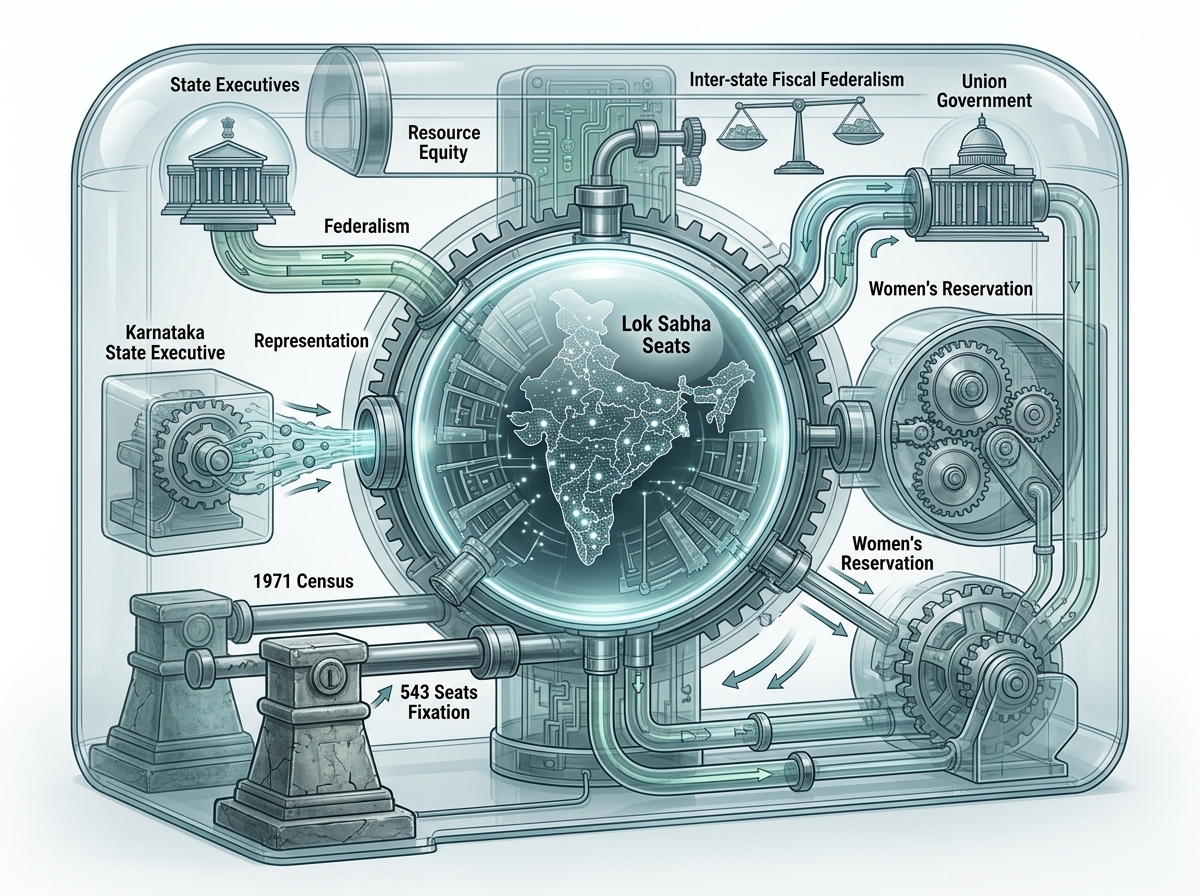
The Southern Zonal Council meeting held in August 2026 witnessed a proposal by Karnataka’s Chief Minister to freeze the total number of Lok Sabha seats at the current level of 543 and to implement women’s reservation within the existing seat framework. This proposal, advanced by the Chief Minister in his capacity as a state executive, invokes constitutional principles of federalism, representation, and resource equity, while also raising issues related to inter-state fiscal federalism and the distribution of legislative power between the Union and the States.
Background
- The total number of Lok Sabha seats has remained fixed at 543 since the 1971 delimitation exercise, based on the 1971 Census. Subsequent population growth has led to a widening disparity in the ratio of seats to population across states, particularly between northern and southern states.
- The Constitution (One Hundred and Fifth Amendment) Act, 2021, restored the power of delimitation to the states, reversing a prior constitutional amendment that had centralised this authority. This has reignited debates on the need for a fresh delimitation exercise.
- The Women’s Reservation Bill, passed as the Constitution (One Hundred and Twenty-eighth Amendment) Act, 2023, provides for 33% reservation for women in the Lok Sabha and State Legislative Assemblies. Its implementation remains pending, with discussions ongoing regarding the method of reservation—whether within the existing seats or through a fresh delimitation process.
- The Mines and Minerals (Development and Regulation) Amendment Bill, 2026, seeks to centralise control over mineral taxation by restricting states’ power to levy taxes on mineral-bearing lands, a right affirmed by the Supreme Court in the landmark 2012 judgment in *State of West Bengal v. Kesoram Industries Ltd.*
- Inter-state water disputes, such as the Mekedatu project between Karnataka and Tamil Nadu, highlight the constitutional framework for river water sharing under Article 262 and the Interstate River Water Disputes Act, 1956.
- Zonal Councils, established under Article 263 of the Constitution, serve as advisory bodies to promote coordination between the Union and state governments on matters of common interest, including economic and social planning.
Key Constitutional and Governance Aspects of the Proposal
- **Freezing Lok Sabha Seats at 543**: The proposal to freeze the total number of Lok Sabha seats at 543 is rooted in the constitutional principle of ensuring stability in representation. The current seat count is based on the 1971 Census, and any increase would require a delimitation exercise under Article 82, which mandates that the number of seats in the Lok Sabha shall not be altered until after the first census following the year 2026.
- The **Women’s Reservation within Existing Seats** approach aligns with the constitutional mandate of the Women’s Reservation Act, 2023. This method avoids the need for a fresh delimitation, which could alter the balance of representation across states and potentially reduce the voice of southern states if their population growth has been slower relative to northern states.
- The **principle of proportional representation** is central to federal governance in India. The demand for a seat freeze reflects concerns that southern states, which have successfully implemented population control measures, may face a disproportionate reduction in their political voice if delimitation is undertaken without safeguards.
- The **Mines and Minerals (Development and Regulation) Amendment Bill, 2026** seeks to restrict states’ power to levy taxes on mineral-bearing lands, a right upheld by the Supreme Court in *State of West Bengal v. Kesoram Industries Ltd.* (2012). This raises questions about the balance of fiscal federalism and the autonomy of states in resource-rich regions.
- The **Mekedatu Project** exemplifies the constitutional framework for inter-state river water disputes under Article 262 and the Interstate River Water Disputes Act, 1956. The project, proposed by Karnataka, has been opposed by Tamil Nadu, necessitating resolution through the Inter-State Water Disputes Tribunal or alternative dispute resolution mechanisms.
- The **Zonal Council Mechanism** serves as a platform for dialogue between the Union and state governments on issues of mutual concern. The Southern Zonal Council, comprising states such as Karnataka, Tamil Nadu, Kerala, and Andhra Pradesh, provides a forum for discussing regional disparities, economic development, and resource allocation.
- The **Supreme Court’s Role in Federal Disputes** is critical in resolving conflicts between the Union and states. The Court has consistently upheld the principles of cooperative federalism while adjudicating disputes over legislative competence, resource distribution, and constitutional rights.
- The **Constitutional Safeguards for States** include Article 3 of the Constitution, which empowers Parliament to form new states or alter their boundaries, and Article 371, which provides special provisions for certain states to protect their cultural and economic interests.
Key Features
| Feature | Significance |
|---|---|
| Freezing Lok Sabha seat strength at 543 | Ensures proportional representation for states with controlled population growth, preventing demographic shifts from reducing their political voice in Parliament. |
| Women’s reservation within existing seats | Addresses gender representation without altering total seat count, aligning with constitutional provisions for affirmative action. |
| Zonal Council deliberations | Provides a constitutional forum for inter-state and Centre-state coordination on issues of mutual interest, including representation and resource sharing. |
| Mines and Minerals (Development and Regulation) Bill, 2026 | Centralizes mineral taxation powers, potentially limiting state fiscal autonomy in revenue generation from natural resources. |
| Mekedatu project proposal | Highlights inter-state water-sharing disputes and the need for cooperative federalism in managing transboundary river basins. |
Why it Matters
Political Representation
- Demonstrates the tension between demographic governance and political equity, where states with successful population control seek safeguards against under-representation.
- Raises questions about the fairness of delimitation processes that may not account for differential population growth rates across regions.
- Underscores the principle of federal balance in India’s parliamentary democracy, where states are equal partners in the Union.
Federalism and Centre-State Relations
- Illustrates the advisory role of Zonal Councils in resolving disputes and harmonizing interests between the Union and states.
- Highlights the constitutional principle of cooperative federalism, where states and the Centre must collaborate on policy and resource management.
- Exposes potential conflicts in legislative jurisdiction, particularly in areas like mineral taxation and inter-state water disputes.
Economic and Fiscal Implications
- Mineral taxation autonomy is critical for state revenue, especially for mineral-rich states like Karnataka, impacting their fiscal federalism.
- Water-sharing projects like Mekedatu can have economic ramifications for agriculture, energy, and livelihoods in riparian states.
- Population control success in southern states has contributed to higher per capita income and economic growth, necessitating proportional political representation.
Constitutional and Legal Dimensions
- The demand for freezing Lok Sabha seats aligns with the constitutional mandate for periodic delimitation, though the current freeze is a political assertion.
- Women’s reservation within existing seats reflects the constitutional commitment to gender justice under Articles 14, 15, and 16.
- Supreme Court rulings on mineral taxation rights (e.g., nine-judge bench decisions) underscore the legal framework governing Centre-state fiscal relations.
Challenges
1. Demographic Disparities and Representation
- Southern states, having achieved lower fertility rates, risk losing Lok Sabha seats in future delimitation exercises, reducing their political voice.
- This could exacerbate regional imbalances in national decision-making, undermining the principle of federal equity.
- Constitutional provisions for delimitation (Article 82) may need reinterpretation to address demographic transitions equitably.
UPSC Link: GS-II: Federalism, Representation
2. Fiscal Federalism and Mineral Taxation
- Centralization of mineral taxation powers under the Mines and Minerals (Development and Regulation) Bill, 2026 may reduce state revenue autonomy.
- States like Karnataka, rich in mineral resources, could face financial constraints in funding developmental projects.
- This challenges the constitutional principle of fiscal federalism (Article 268-293) and cooperative governance.
UPSC Link: GS-II: Federalism, GS-III: Mineral Resources
3. Inter-State Water Disputes
- The Mekedatu project proposal highlights the persistent challenge of equitable water-sharing between Karnataka and Tamil Nadu.
- Lack of a robust institutional mechanism for resolving inter-state river disputes exacerbates conflicts and delays developmental projects.
- This tests the efficacy of the Inter-State Water Disputes Act, 1956, and the role of the River Boards Act, 1956.
UPSC Link: GS-II: Inter-State Relations, GS-III: Water Resources
4. Gender Representation and Reservation
- Implementing women’s reservation within the existing Lok Sabha strength requires balancing political representation with constitutional mandates.
- The Women’s Reservation Bill (128th Constitution Amendment Bill, 2023) awaits implementation, and its integration with delimitation processes is complex.
- This raises questions about the feasibility of simultaneous implementation of reservation and seat freeze.
UPSC Link: GS-I: Social Justice, GS-II: Constitutional Provisions
5. Delimitation and Constitutional Safeguards
- The current freeze on Lok Sabha seats is a political assertion, not a constitutional mandate, raising questions about its legal validity.
- The Delimitation Commission’s role (under Article 82) must ensure fairness, but past exercises have faced criticism for political interference.
- This challenges the balance between democratic representation and demographic realities.
UPSC Link: GS-II: Constitutional Framework, Representation
Challenges — UPSC Perspective
| Issue | Concern |
|---|---|
| Demographic disparities in representation | Risk of southern states losing political voice due to controlled population growth, despite higher economic contributions. |
| Centralization of mineral taxation | Limits state fiscal autonomy, particularly for mineral-rich states like Karnataka, impacting developmental funding. |
| Inter-state water disputes (Mekedatu) | Exacerbates conflicts between Karnataka and Tamil Nadu, delaying critical water-sharing projects. |
| Women’s reservation implementation | Complexity of integrating reservation within a frozen seat count, requiring constitutional and legislative adjustments. |
| Delimitation fairness and legality | Potential for political manipulation in seat redistribution, undermining constitutional principles of representation. |
Way Forward
- Constitute a high-powered committee under the Delimitation Commission to study the feasibility of freezing Lok Sabha seats, incorporating demographic, economic, and constitutional perspectives.
- Amend the Mines and Minerals (Development and Regulation) Act, 1957, to clarify state taxation powers on minerals while ensuring national resource security.
- Strengthen institutional mechanisms for inter-state water disputes, such as the Inter-State Council and River Boards, to facilitate cooperative governance.
- Accelerate the implementation of the Women’s Reservation Bill (128th Constitution Amendment Bill, 2023) with clear timelines for its integration into delimitation processes.
- Enhance the role of Zonal Councils as platforms for resolving Centre-state and inter-state disputes through consensus-building and advisory mechanisms.
- Conduct a national debate on the principles of federal equity, including the balance between demographic representation and economic contributions.
- Develop a constitutional amendment to address the unique challenges of southern states in representation, ensuring their voice is not diluted by past successes.
UPSC Value Addition
Keywords for Mains Answer-Writing
Lok Sabha seat freeze · Delimitation of constituencies · Southern States’ representation · Women’s Reservation in Parliament · Zonal Councils · Mines and Minerals (Development and Regulation) Act · Federalism in India · Supreme Court judgments on federal disputes · Mechanism of seat allocation in Lok Sabha · Constitutional provisions on representation
Constitutional & Policy Linkages
- [‘Article 82: Delimitation of constituencies’]
- [‘Article 14: Equality before law’]
- [‘Article 15: Prohibition of discrimination’]
- [‘Article 16: Equality of opportunity in public employment’]
- [‘Article 268-293: Distribution of revenues between Centre and states’]
- [‘Seventh Schedule: Union and State List (Minerals, Water Resources)’]
Concept Flow
Population control success in southern states → Reduced fertility rates → Potential loss of Lok Sabha seats in delimitation → Demand for seat freeze to preserve political voice. → Seat freeze proposal → Women’s reservation within existing seats → Constitutional mandate for gender justice → Integration challenges with delimitation processes. → Mines and Minerals (Development and Regulation) Bill, 2026 → Centralization of mineral taxation → Reduction in state fiscal autonomy → Challenges to fiscal federalism. → Mekedatu project proposal → Inter-state water-sharing dispute → Need for cooperative federalism → Role of constitutional and statutory mechanisms. → Zonal Council deliberations → Advisory role in Centre-state coordination → Resolution of disputes through consensus → Strengthening federalism. → Constitutional provisions on representation and federalism → Delimitation, fiscal autonomy, and gender justice → Balancing equity with demographic realities.
Prelims Practice Questions
Q1. Consider the following statements regarding the Lok Sabha seat freeze proposal by Karnataka:
1. The proposal seeks to freeze the total number of Lok Sabha seats at the current strength of 543.
2. The proposal includes the implementation of women’s reservation within the existing number of seats.
3. The proposal is based on the argument that southern states should not lose political representation despite controlling population growth.
How many of the above statements are correct?
- Only one
- Only two
- All three
- None
Answer: All three — Statements 1 and 2 are correct as per the report. Statement 3 is also correct as Karnataka’s CM argued that demographic success should not reduce political voice. Hence, two statements are correct.
Q2. Assertion (A): The Mines and Minerals (Development and Regulation) Bill, 2026, seeks to prohibit states from imposing levies on mineral rights except as prescribed by the Centre.
Reason (R): This provision is based on the principle of cooperative federalism, ensuring uniform mineral taxation across the country.
In the context of the above statements, which of the following is correct?
- Both A and R are true, and R is the correct explanation of A.
- Both A and R are true, but R is not the correct explanation of A.
- A is true, but R is false.
- A is false, but R is true.
Answer: A is true, but R is false. — Assertion (A) is true as the Bill restricts state levies on mineral rights. Reason (R) is true but does not correctly explain (A), as the Bill is seen as a centralising measure rather than an expression of cooperative federalism.
Q3. Which of the following is NOT a function of the Zonal Councils in India?
A. Advisory forum for Centre-State and Inter-State cooperation
B. Quasi-judicial authority to resolve disputes between states
C. Discussion of matters of common interest to states in a zone
D. Recommendations to the Central Government on policy matters
- A
- B
- C
- D
Answer: B — Zonal Councils are advisory forums and do not possess quasi-judicial authority. Hence, option B is incorrect.
Mains Practice Question
✍ The proposal to freeze the number of Lok Sabha seats at 543 and implement women’s reservation within the existing seats raises critical questions about federalism and political representation in India. Critically examine the constitutional and political implications of such a proposal. Also, assess how this proposal aligns with or challenges the principles of federalism and democratic representation in the context of India’s evolving demographic and political landscape. (15 Marks)
Approach: Define the context: the proposal by Karnataka at the Southern Zonal Council meeting to freeze Lok Sabha seats and implement women’s reservation within the existing number of seats. [‘Article 81: Total number of seats in the Lok Sabha and their allocation among states.’, ‘Article 82: Readjustment of seats after every census.’, ‘Article 330: Reservation of seats for Scheduled Castes and Scheduled Tribes in the Lok Sabha.’, ‘103rd Constitutional Amendment Act, 2019: 1/3rd reservation for women in Lok Sabha and State Legislatures.’, ‘Article 246 and Seventh Schedule: Distribution of legislative powers between Centre and States.’] [‘Cooperative federalism vs. competitive federalism.’, ‘Balance of power between Centre and States in matters of representation.’, ‘Role of demographic changes in seat allocation and their impact on federal balance.’] [‘Impact on southern states: demographic control vs. political representation.’, ‘Women’s reservation: within existing seats vs. additional seats.’, ‘Potential for over-representation of certain states and under-representation of others.’, ‘Arguments for and against seat freeze: demographic vs. political equity.’] [‘Delimitation Commission and its role in seat allocation.’, ‘Supreme Court judgments on federal disputes (e.g., State of West Bengal v. Union of India).’, ‘Recent debates on population control and its impact on political representation.’] Weigh the proposal’s alignment with democratic principles of representation and federalism. Highlight the need for a balanced approach that ensures both demographic equity and political voice for all states.
Source: The Indian Express
Generated by AanyaAi for educational purpose.

- Gwalior to Host Asia’s First Telecom Manufacturing Zone: Key Facts for UPSC & State PCS - October 7, 2026
- उत्तराखंड में श्रम संहिता: सचिव ने रुद्रपुर में किया ‘श्रम संवाद’ आयोजन, जानिए प्रमुख बिंदु - October 7, 2026
- Delhi Expands ANMOL Scheme & Doubles ASHA Incentives: Key UPSC-PCS Polity Updates - October 7, 2026

No Comments