


08 Aug Karnataka’s Mahajan Commission: BCC Delay Sparks Legal Action Demand
✎ The Mahajan Commission’s 1967 report on Belagavi’s integration with Karnataka is legally valid, and the State government’s acceptance of it, along with resolutions passed in the State legislature, mandates the Belagavi City…
Subject Relevance — Where This Topic Fits
- GS Paper II — Functions and Responsibilities of the Union and the States, Issues and Challenges pertaining to the Federal Structure, Devolution of Powers and Finances up to Local Levels and Challenges therein | GS Paper III — Role of State and Local Governance in Socio-Economic Development, Issues Arising out of their Design and Implementation
- Prelims: Mahajan Commission, Belagavi dispute, Article 243 of the Constitution (Urban Local Bodies), Karnataka State Border and River Protection Commission, Urban Local Body (ULB) resolutions, Constitutional provisions on federalism, State legislature resolutions
- Essay: Federalism in India: Balancing Unity and Regional Aspirations, The Role of Local Governance in National Integration
Quick Revision: The Mahajan Commission’s 1967 report on Belagavi’s integration with Karnataka is legally valid, and the State government’s acceptance of it, along with resolutions passed in the State legislature, mandates the Belagavi City Corporation to pass a resolution affirming the same without further delay.
Why is this in the news?
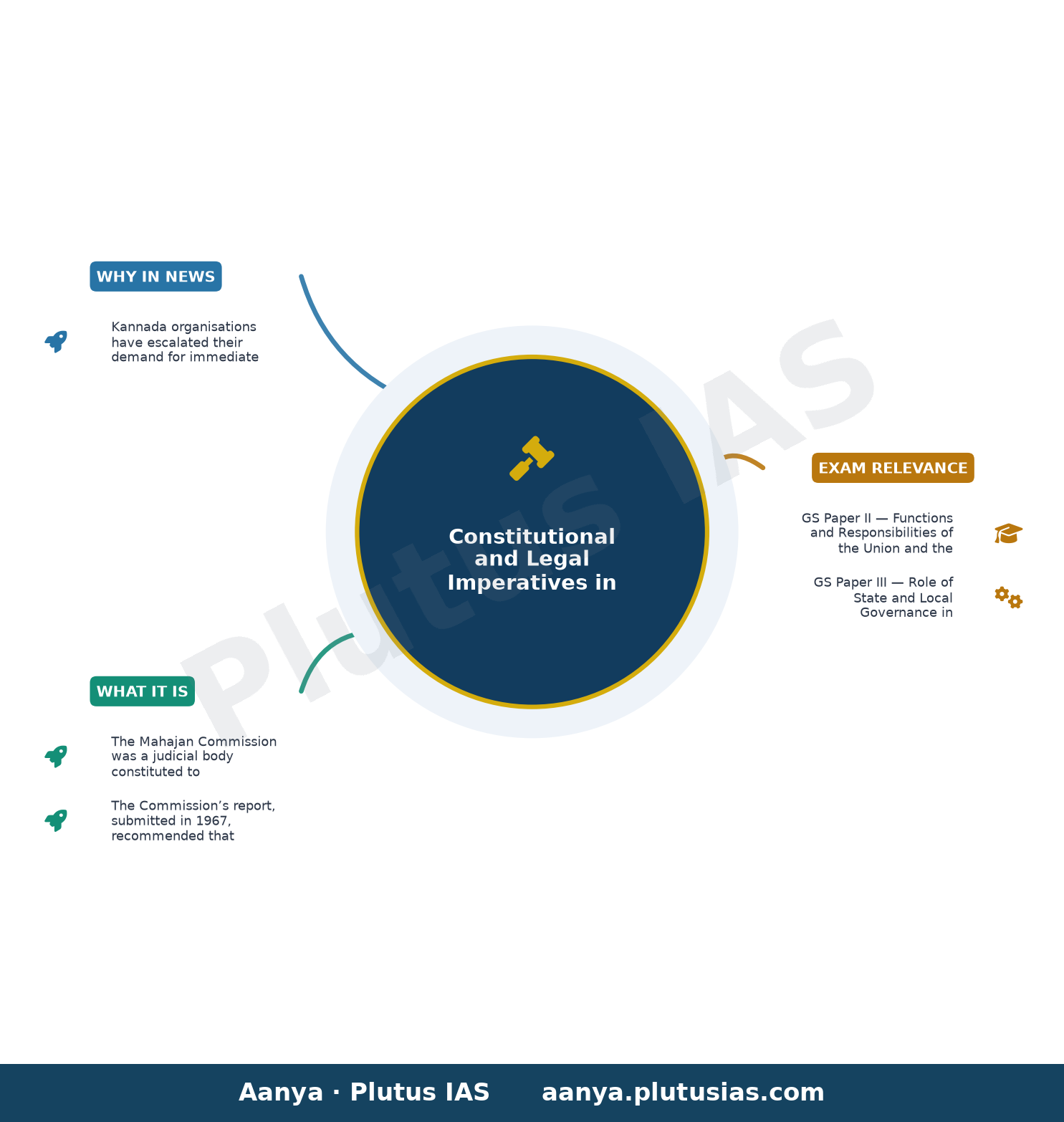
Kannada organisations have escalated their demand for immediate action against the Belagavi City Corporation (BCC) for its failure to pass a resolution affirming Belagavi as an integral part of Karnataka, as recommended by the Mahajan Commission. The delay, despite legal clarity from the State government and the Chief Secretary’s office, has led to protests and arrests, highlighting tensions between local governance and constitutional federalism. The issue underscores the importance of timely implementation of judicial and executive decisions in matters of territorial integrity.
Background
- The Mahajan Commission, headed by Justice Mehr Chand Mahajan, was constituted in 1966 to resolve the border dispute between Karnataka and Maharashtra, particularly concerning Belagavi (then Belgaum).
- The Commission submitted its report in 1967, recommending that Belagavi be retained within Karnataka, a decision accepted by the Government of Karnataka.
- The State legislature of Karnataka has, on multiple occasions, passed resolutions reaffirming Belagavi as an integral part of the state, including in 2006 and 2013.
- The Karnataka State Border and River Protection Commission, chaired by Justice Nagamohan Das, has reiterated the legal validity of the Mahajan Commission’s recommendations.
- The Belagavi City Corporation (BCC), an urban local body (ULB), has been reluctant to pass a resolution endorsing the Mahajan Commission’s report, citing the need for a legal opinion, despite the State government’s clarification that no legal hurdles exist.
- Protests by Kannada organisations, including arrests of activists, have intensified pressure on the BCC and the State government to resolve the matter.
What is the Mahajan Commission and its relevance to the Belagavi dispute?
- The Mahajan Commission was a judicial body constituted to adjudicate the border dispute between Karnataka and Maharashtra, primarily concerning the Belagavi region.
- The Commission’s report, submitted in 1967, recommended that Belagavi be retained within Karnataka, citing linguistic and administrative considerations.
- The report was accepted by the Government of Karnataka, which passed resolutions in the State legislature in 2006 and 2013 reaffirming Belagavi as part of Karnataka.
- The **Karnataka State Border and River Protection Commission**, chaired by Justice Nagamohan Das, has consistently upheld the legal validity of the Mahajan Commission’s recommendations, stating that no legal impediments exist to passing resolutions endorsing the report.
- The **Belagavi City Corporation (BCC)**, as an urban local body (ULB), is constitutionally mandated under **Article 243 of the Constitution** to function as a representative body for local governance, including passing resolutions on matters of regional significance.
- The **delay in passing the resolution** by the BCC, despite the State government’s stance, raises questions about the **autonomy of ULBs** versus the **primacy of State policy** in matters of territorial integrity.
- The **Constitution of India** empowers the State legislature to make laws on matters within its jurisdiction, including the resolution of border disputes, as seen in the acceptance of the Mahajan Commission’s report.
Key Features
| Feature | Significance |
|---|---|
| Mahajan Commission Recommendations | The Justice M.C. Mahajan Commission was constituted in 1966 to examine the border dispute between Karnataka and Maharashtra, particularly regarding Belagavi. Its recommendations affirm Belagavi as an integral part of Karnataka, forming the legal and historical basis for the State’s claim. |
| Belagavi City Corporation (BCC) Resolution | The BCC, as an urban local body, is expected to pass resolutions reflecting the State’s official stance on territorial integrity. Delay in passing such resolutions undermines constitutional and administrative coherence. |
| Legal Opinion from State Government | The Karnataka State government, through the Chief Secretary’s office and Chief Minister’s office, has repeatedly confirmed that there are no legal impediments to passing the resolution. This reinforces the State’s constitutional authority over the issue. |
| Kannada Organisations’ Role | Kannada organisations act as civil society watchdogs, ensuring that the State’s linguistic and territorial identity is preserved. Their protests highlight the democratic deficit when administrative bodies delay resolutions aligned with State policy. |
| Mayor’s Referral to State Government | The Mayor of BCC referred the matter to the State government for a legal opinion, despite the State’s clear stance. This reflects either administrative confusion or deliberate delay, both of which are constitutionally untenable. |
UPSC Value Addition
Keywords for Mains Answer-Writing
Mahajan Commission · Belagavi border dispute · Karnataka-Karnataka border issues · State legislature resolutions on territorial integrity · Constitutional provisions on local governance · Urban Local Bodies (ULBs) and state authority · Inter-State border disputes in India · Doctrine of territorial integrity · Legal opinions on administrative resolutions · Public protests and administrative accountability
Prelims Practice Questions
Q1. Consider the following statements regarding the Mahajan Commission and the Belagavi border dispute:
1. The Mahajan Commission was constituted to resolve the inter-state border dispute between Karnataka and Maharashtra.
2. The Commission recommended that Belagavi be considered an integral part of Karnataka.
3. The State government of Karnataka has not passed any resolution in the State legislature endorsing the Commission’s recommendations.
4. The Belagavi City Corporation (BCC) is legally obligated to pass a resolution endorsing the Commission’s recommendations.
How many of the above statements are correct?
- Only one
- Only two
- Only three
- All four
Answer: Only three — Statements 1 and 2 are correct. The Mahajan Commission was indeed constituted to resolve the inter-state border dispute between Karnataka and Maharashtra, and it recommended Belagavi as part of Karnataka. Statement 3 is incorrect as the State legislature has passed resolutions endorsing the Commission’s recommendations. Statement 4 is incorrect because the BCC is not legally obligated to pass such a resolution; it is a matter of administrative decision.
Q2. Assertion (A): The State government of Karnataka has accepted the recommendations of the Mahajan Commission that Belagavi is an integral part of Karnataka.
Reason (R): The State government has passed resolutions in the State legislature endorsing the Commission’s recommendations.
In the context of the above statements, which of the following is correct?
- Both A and R are true, and R is the correct explanation of A.
- Both A and R are true, but R is not the correct explanation of A.
- A is true, but R is false.
- A is false, but R is true.
Answer: Both A and R are true, but R is not the correct explanation of A. — Both Assertion (A) and Reason (R) are true, and Reason (R) correctly explains Assertion (A). The State government’s acceptance of the Mahajan Commission’s recommendations is evidenced by its passage of resolutions in the State legislature.
Q3. Match the following pairs related to inter-state border disputes in India:
Column I (Dispute/Commission) | Column II (States Involved)
1. Mahajan Commission | A. Karnataka and Maharashtra
2. Bachawat Tribunal | B. Haryana and Punjab
3. Godavarman Committee | C. Karnataka and Kerala
4. Krishna Water Disputes Tribunal | D. Andhra Pradesh and Karnataka
Select the correct match:
- 1-A, 2-B, 3-C, 4-D
- 1-B, 2-A, 3-D, 4-C
- 1-A, 2-B, 3-D, 4-C
- 1-D, 2-A, 3-B, 4-C
Answer: 1-A, 2-B, 3-C, 4-D — The correct matches are: 1-A (Mahajan Commission involved Karnataka and Maharashtra), 2-B (Bachawat Tribunal involved Haryana and Punjab), 3-C (Godavarman Committee involved Karnataka and Kerala), and 4-D (Krishna Water Disputes Tribunal involved Andhra Pradesh and Karnataka).
Mains Practice Question
✍ Critically examine the constitutional and administrative dimensions of the demand by Kannada organisations for the Belagavi City Corporation (BCC) to pass a resolution endorsing the Mahajan Commission’s recommendations on Belagavi’s territorial integrity. In your answer, discuss the legal and constitutional framework governing inter-state border disputes and the role of urban local bodies in this context. (15 Marks)
Approach: MODEL-ANSWER SKELETON:
1. **Constitutional Framework for Inter-State Border Disputes:**
– Article 3 of the Constitution empowers Parliament to alter the boundaries of states, but inter-state disputes are typically resolved through negotiations or tribunals (e.g., Mahajan Commission, Bachawat Tribunal).
– The Supreme Court in *State of Punjab v. State of Haryana* (2004) upheld the validity of tribunal awards, reinforcing the doctrine of territorial integrity.
2. **Role of State Legislature and Government:**
– The State government of Karnataka has passed resolutions in the legislature endorsing the Mahajan Commission’s recommendations, demonstrating its constitutional authority under Article 166 (Conduct of Government Business).
– The State’s acceptance of the Commission’s report reflects the principle of cooperative federalism (Article 263).
3. **Legal Opinion and Administrative Authority:**
– The Chief Secretary’s office and Chief Justice Nagamohan Das (Karnataka State Border and River Protection Commission) have opined that there is no legal hurdle to passing the resolution, reinforcing the State’s authority.
– The BCC’s delay in passing the resolution raises questions about the autonomy of urban local bodies (Article 243W) versus the State’s directive authority under Article 243ZD (District Planning Committee).
4. **Doctrine of Territorial Integrity:**
– The demand by Kannada organisations is rooted in the doctrine of territorial integrity, which holds that once a state’s boundaries are legally established, they cannot be altered unilaterally.
– The Supreme Court in *State of West Bengal v. Union of India* (1995) affirmed that the Union’s power under Article 3 is subject to judicial review and parliamentary approval.
5. **Administrative Accountability and Public Protests:**
– The BCC’s failure to act despite protests highlights the tension between local autonomy and State authority. The demand for superseding the BCC or withholding funds reflects public dissatisfaction with administrative inaction.
6. **Balancing Views:**
– **Pro-State View:** The State’s endorsement of the Commission’s recommendations is legally sound and aligns with the doctrine of territorial integrity.
– **Local Autonomy View:** The BCC’s delay may stem from local political considerations, but it does not negate the State’s constitutional authority to direct the resolution’s passage.
7. **Conclusion:**
– The legal and constitutional framework supports the State’s position. The BCC’s inaction is administrative, not legal, and the State must assert its authority to ensure compliance with the Mahajan Commission’s recommendations.
Source: The Hindu
Generated by AanyaAi for educational purpose.

- आरबीआई ने सरकारी प्रतिभूतियों की ओएमओ बिक्री की घोषणा, जानिए पूरा विवरण - September 23, 2026
- RBI to Sell ₹25,000 Crore Govt Securities via OMO on Sept 28, 2026 - September 23, 2026
- भारत-श्रीलंका नौसैनिक अभ्यास ‘स्लाईनेक्स-26’: विशाखापत्तनम में संपन्न, जानें प्रमुख बिंदु - September 23, 2026

No Comments