


07 Feb Kavach and AI-Driven Railway Safety Reforms: Transforming India’s Rail Network
This article covers “Daily Current Affairs” and the Kavach and AI-Driven Railway Safety Reforms: Transforming India’s Rail Network
SYLLABUS MAPPING:
GS- 3 – Infrastructure & Science & Technology- Kavach and AI-Driven Railway Safety Reforms: Transforming India’s Rail Network
FOR PRELIMS
What is Kavach? Discuss the key safety features of Kavach.
FOR MAINS
Evaluate the role of indigenous technology in transforming railway safety in India.
Why in the News?
In January 2026, Indian Railways achieved a landmark milestone by installing the Kavach Version 4.0 safety system on 472.3 route kilometres in a single month, the highest ever recorded. As of early 2026, the indigenously developed Automatic Train Protection (ATP) system has been implemented on more than 2,200 route kilometres, reflecting an accelerating pace of technological modernization across the national network.
Definition and Concept
Kavach is an indigenously developed Automatic Train Protection (ATP) system that provides comprehensive train protection and collision prevention capabilities. It functions as an automated situational awareness system, safeguarding against dangerous incidents caused by human error, operational limitations, and equipment failures. Certified to Safety Integrity Level 4 (SIL-4)—the highest global safety standard in railway signaling—it continuously monitors train location, speed, and movement authority to automatically intervene and prevent unsafe operations.
Background and Context
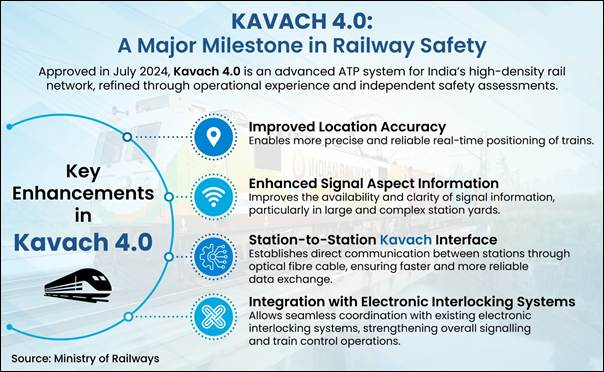
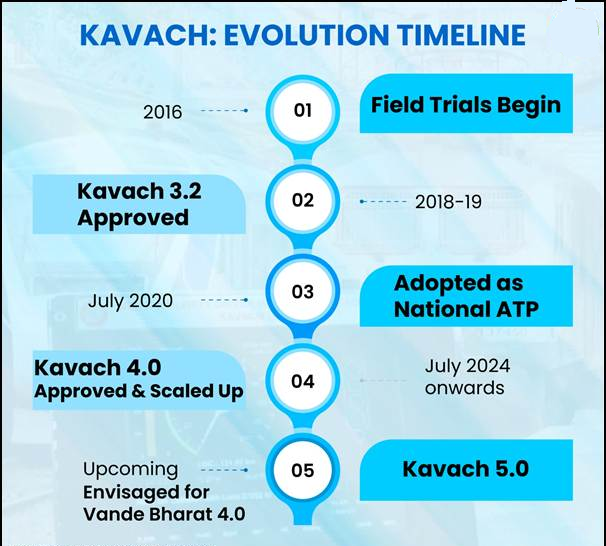
Traditionally, Indian Railways relied on trackside signaling and manual control. While modern interlocking improved safety, train driving remained heavily dependent on the Loco Pilot’s ability to observe line-side signals and regulate speed manually. This human-dependent system faced inherent limitations: missed or misinterpreted signals led to serious accidents, and factors like track curvature, adverse weather (fog), and high speeds reduced reaction times. The transition to Kavach represents a shift from manual observation to onboard intelligence. Developed by the Research Designs & Standards Organization (RDSO), the system has evolved from initial field trials in February 2016 to the adoption of Kavach as the National ATP system in July 2020. The recent approval of Kavach Version 4.0 in July 2024 marks a significant technological leap, tailored for India’s diverse and high-density rail environment.
Significance and Importance
1. Safety as a Deeply Human Promise: Every journey carries the expectation that families will reunite and workers will return home safely; Kavach is the technological backbone of this promise.
2. Mitigating Human Error: By preventing Signal Passing at Danger (SPAD) and excessive speeding, Kavach eliminates the most common causes of rail accidents.
3. High-Speed Operations: The system provides a real-time in-cab display of signaling information (movement authority, target speed, and distance), which is essential for safe operations beyond 120 kmph.
4. Operational Efficiency: Unlike conventional systems that require large safety margins and greater spacing between trains, Kavach enables higher network capacity and reliability.
5. Atmanirbhar Bharat: As an indigenous innovation, it ensures multi-vendor interoperability, preventing dependence on a single global supplier and allowing for solutions specifically suited to Indian conditions.
Key Issues and Challenges
• Scale of the Network: Implementing ATP across a vast, diverse network is a massive infrastructure challenge involving trackside, station-based, and locomotive-borne equipment.
• High-Density Traffic: Nearly 96% of railway traffic is carried on High-Density (HDN) and Highly Used (HUN) networks, where implementation is most critical but also most complex due to high traffic frequency.
• Technical Transition: Upgrading from Version 3.2 to 4.0, and preparing for the upcoming Kavach 5.0 (designed for suburban sections to reduce inter-train headway), requires seamless integration and extensive staff training.
• Environmental Obstacles: Low visibility in Northern India due to fog and the presence of wildlife on tracks present unique operational risks that standard signaling cannot always address.
Technological Working Principle
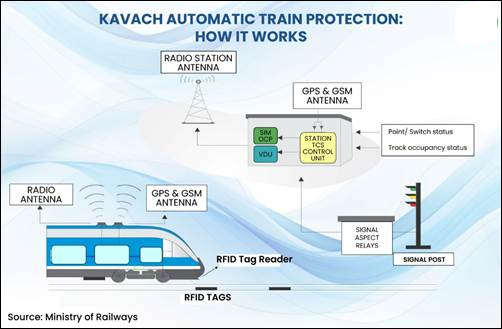
• Infrastructure: It utilizes secure Ultra High Frequency (UHF) radio antennae and track-mounted Radio Frequency Identification (RFID) tags for precise train location.
• Data Integration: Wayside units collect live data from station interlocking systems regarding signal aspects, track occupancy, and route status.
• Automated Intervention: The system calculates Movement Authority (the safe distance a train is permitted to travel) and transmits it to the onboard unit. If a pilot exceeds speed limits or approaches a danger signal, the system automatically applies brakes.
• Collision Prevention: If two trains are detected moving toward each other in a block section, an automatic Stop-on-Sight (SoS) command is issued to both.
Economic, Social, and Environmental Impact
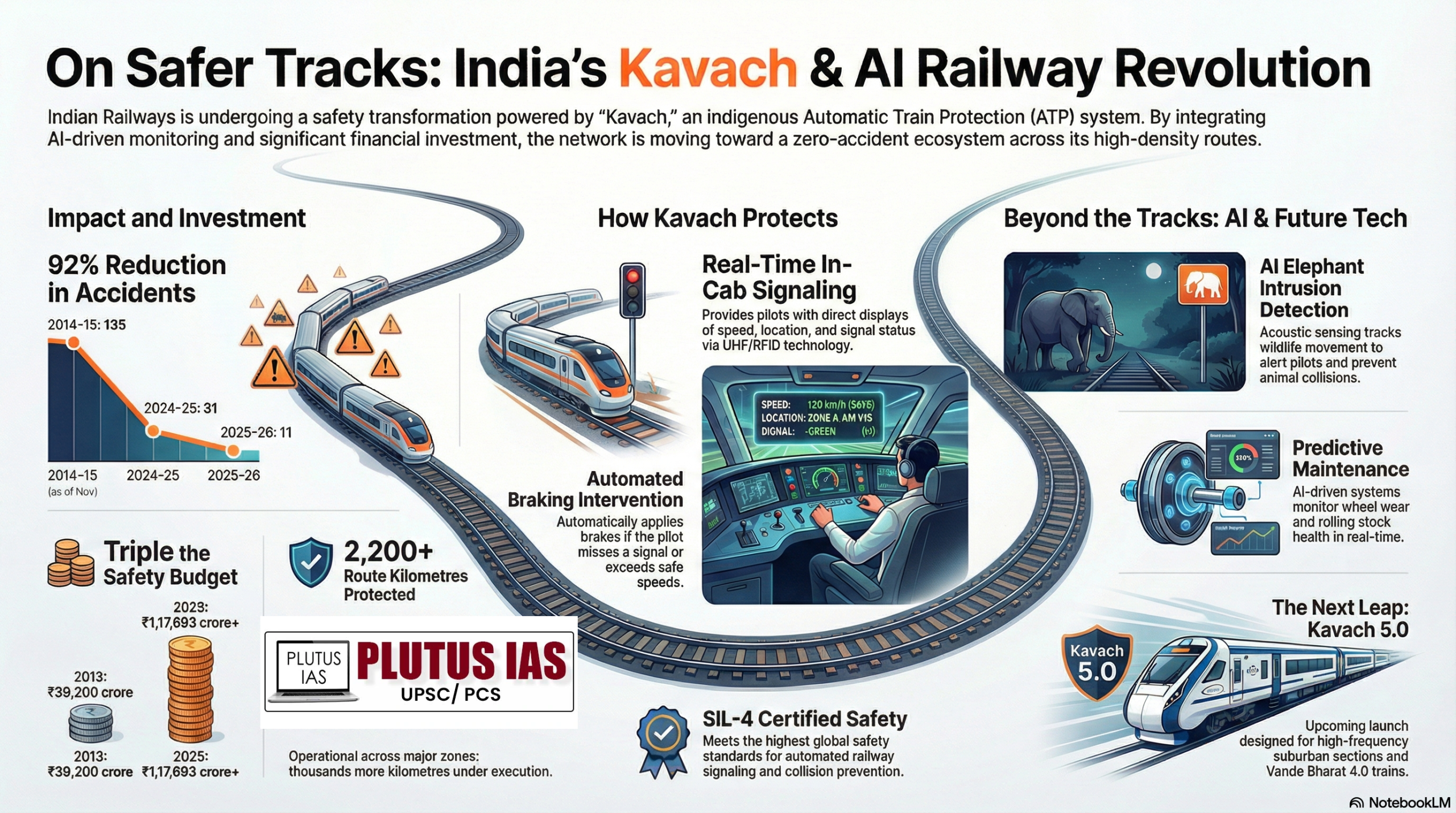
• Economic Resilience: The safety transformation is backed by sustained financial investment, with the safety budget increasing from ₹39,200 crore in 2013–14 to ₹1,17,693 crore in 2025–26. This prevents the immense economic loss associated with accidents and infrastructure damage.
• Social Stability: Improved safety has led to a sharp decline in consequential accidents, from 135 in 2014–15 to just 11 in 2025–26 (up to November), fostering public trust in national infrastructure.
• Environmental Protection: The AI-enabled Intrusion Detection System (IDS) using Distributed Acoustic Sensing (DAS) technology protects wildlife. It generates real-time alerts for elephants and other animals on tracks, covering 141 route kilometres on the Northeast Frontier Railway with 981 more kilometres tendered. Innovative Honey Bee buzzer devices also act as repellents to move elephants away from tracks.
Governance and Institutional Aspects
1. Priority 1: High-Density Routes (e.g., New Delhi–Mumbai, New Delhi–Howrah) cleared for 160 kmph.
2. Priority 2: Highly Used Network routes with Automatic Block Signaling (ABS).
3. Priority 3: Other passenger high-density routes.
4. Priority 4: All remaining routes. Institutional collaboration is furthered through MoUs with DFCCIL for machine vision inspection systems and DMRC for automatic wheel profile measurement, ensuring cross-sectoral technical excellence.
Complementary AI and Digital Measures
• AI-driven Predictive Maintenance: Systems like Online Monitoring of Rolling Stock (OMRS) and Wheel Impact Load Detectors (WILD) detect defects early to prevent derailments.
• Surveillance: Video Surveillance Systems (VSS) with AI-based analytics and Facial Recognition Software (FRS) are active at 1,731 stations for proactive safety management.
• Track Health: Ultrasonic Flaw Detection (USFD) and Track Recording Cars (TRC) are used for regular rail health monitoring.
• Telecom: The expansion of the Optical Fibre Cable (OFC) network to 67,233 route kilometres supports the high-speed data needs of modern signaling.
Way Forward
1. Scaling Coverage: The priority must remain on completing the 2,667 route kilometres of sanctioned works currently under execution.
2. Mission Raftar: Kavach 4.0 must be integrated with the goal of upgrading speeds to 160 kmph on trunk routes.
3. Suburban Focus: The launch of Kavach 5.0 (announced April 2025) will be critical for high-frequency suburban networks and the upcoming Vande Bharat 4.0 fleet.
4. Digital Asset Management: Continued adoption of web-based online monitoring for track assets will enable rationalized maintenance planning.
5. Climate Resilience: Expanding GPS-based Fog Safety Devices (FSD) and thermal vision cameras will ensure safety during extreme weather events and low-visibility conditions.
Conclusion
Q. With reference to ‘Kavach’, consider the following statements:
1. It is India’s indigenous Automatic Train Protection (ATP) system.
2. It is certified to Safety Integrity Level 4 (SIL-4).
3. It prevents Signal Passing at Danger (SPAD) and automatically applies brakes if required.
4. It replaces all existing interlocking systems on Indian Railways.
Which of the statements given above are correct?
(a) 1, 2 and 3 only
(b) 1 and 4 only
(c) 2 and 3 only
(d) 1, 2, 3 and 4
Answer: A
Mains Questions
Q. Technological interventions such as Kavach and AI-driven monitoring systems are transforming railway safety in India.” Discuss the significance of these reforms in enhancing operational efficiency, capacity, and passenger safety.
(250 words, 15 marks)

- RBI’s Shrinking Real-Rate Cushion Amid Rising Inflation and Strong Demand - September 21, 2026
- India’s NGOs at a New Funding Crossroads - September 21, 2026
- Deep-Sea Discovery, Environmental Responsibility - September 19, 2026

No Comments