


13 Aug Kerala Challenges Centre’s Mining Bill: Federalism at Stake in UPSC 2026
✎ The Mines and Minerals (Development and Regulation) Amendment Bill, 2026 raises critical questions about the constitutional division of legislative powers between the Union and States, particularly regarding land and mineral…
Subject Relevance — Where This Topic Fits
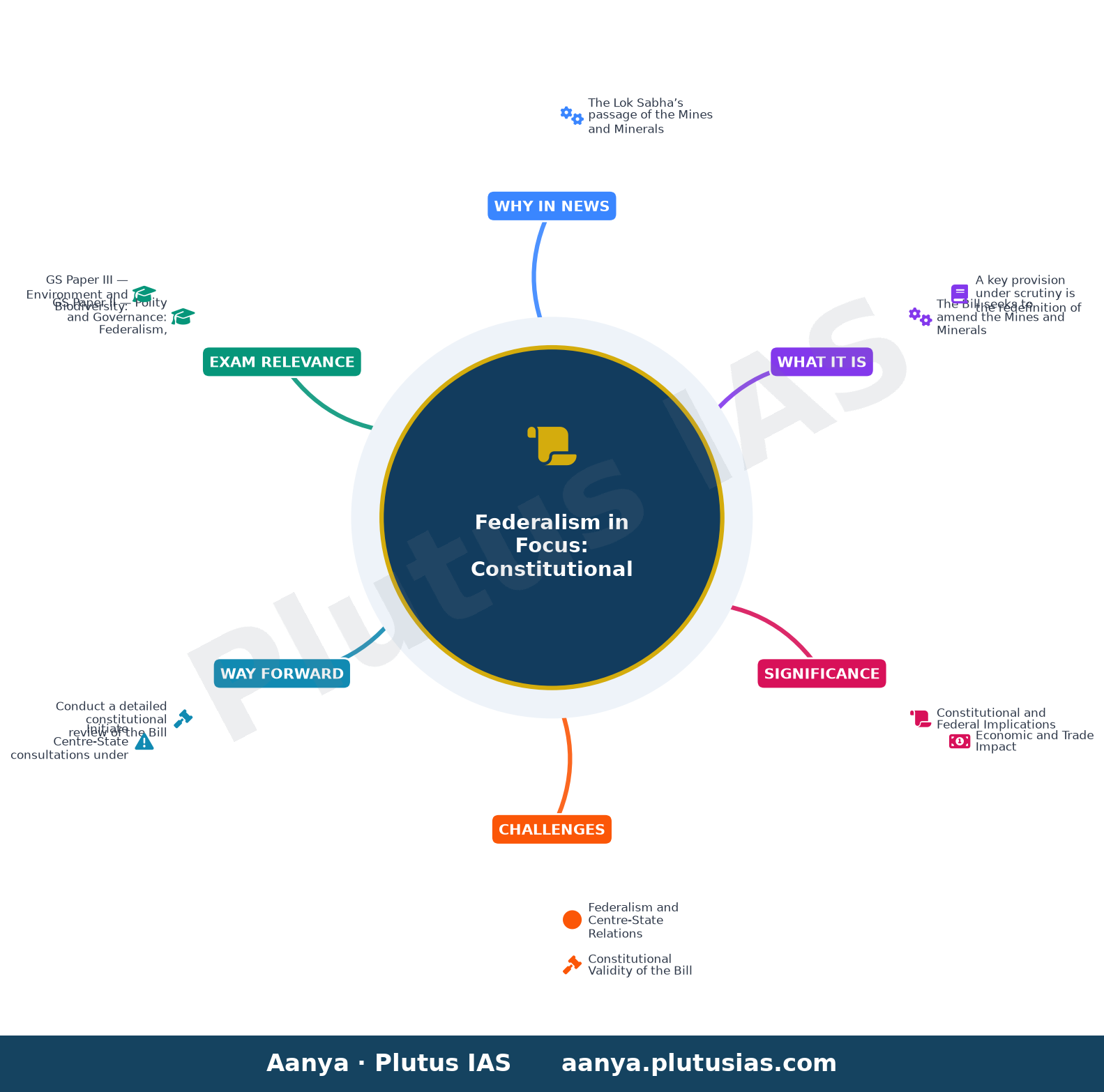
- GS Paper II — Polity and Governance: Federalism, Constitutional Provisions, Legislative Relations between Union and States | GS Paper III — Environment and Biodiversity: Mineral Resource Governance, Environmental Safeguards
- Prelims: State List (Entry 18), Concurrent List, Seventh Schedule, Mines and Minerals (Development and Regulation) Act, 1957, Federal structure, Legislative competence, Union List, Concurrent List, Constitutional provisions on land, EXIM cargo, Vizhinjam International Seaport, Container Freight Station, Customs-bonded area, National Highways Authority of India (NHAI), Foreign Contribution (Regulation) Act (FCRA), FCRA renewal, NGOs, Port infrastructure
- Essay: Federalism in India: Balancing Centre-State Relations in Resource Governance, Economic Development vs. Environmental Conservation: The Case of Mineral Extraction
Quick Revision: The Mines and Minerals (Development and Regulation) Amendment Bill, 2026 raises critical questions about the constitutional division of legislative powers between the Union and States, particularly regarding land and mineral resources, as delineated in the Seventh Schedule of the Indian Constitution.
Why is this in the news?
The Lok Sabha’s passage of the Mines and Minerals (Development and Regulation) Amendment Bill, 2026 has triggered a constitutional and political debate, with Kerala’s State government asserting that the Bill encroaches upon its exclusive legislative competence over land and threatens the federal structure. The Bill’s provisions, particularly those redefining ‘mineral-bearing land,’ have been criticised for potentially expanding the Centre’s jurisdiction without adequate safeguards for State rights or environmental concerns. This development underscores the recurring tensions in Centre-State relations, especially in domains where legislative powers are constitutionally delineated.
Background
- The Mines and Minerals (Development and Regulation) Act, 1957 (MMDR Act) is the primary legislation governing the regulation and development of mines and minerals in India, with its ambit extending to all minerals except minor minerals.
- The Seventh Schedule of the Indian Constitution divides legislative powers between the Union and the States via the Union List, State List, and Concurrent List. Entry 18 of the State List confers exclusive legislative competence to States over ‘land, that is to say, rights in or over land, land tenures including the relation of landlord and tenant, and the collection of rents; transfer and alienation of agricultural land; land improvement and agricultural loans; colonisation’.
- The MMDR Act has undergone multiple amendments, including in 2015 and 2021, to align with economic and environmental priorities, but disputes over jurisdiction between the Centre and States have persisted, particularly in mineral-rich States.
- Kerala, a coastal State with significant environmental and biodiversity concerns, has historically opposed large-scale mining activities to protect its fragile ecosystems and coastal zones.
- The Vizhinjam International Seaport, a key infrastructure project in Kerala, has been a focal point for debates on economic development, environmental impact, and federal governance, including issues related to funding and regulatory compliance.
- The Foreign Contribution (Regulation) Act (FCRA), 2010, governs the receipt and utilisation of foreign contributions by NGOs, with renewal processes often scrutinised for compliance with legal provisions.
What is the Mines and Minerals (Development and Regulation) Amendment Bill, 2026?
- The Bill seeks to amend the Mines and Minerals (Development and Regulation) Act, 1957, to introduce provisions for the regulation of mineral-bearing lands, including definitions, leasing mechanisms, and environmental safeguards.
- A key provision under scrutiny is the redefinition of ‘mineral-bearing land,’ which critics argue could expand the Centre’s jurisdiction over land-related matters, traditionally under the State List (Entry 18).
- The Bill proposes to empower the Union government to identify and notify mineral-bearing lands, potentially overriding State-level decisions on land use and mining activities.
- Environmental groups and State governments, including Kerala, have expressed concerns that the Bill may dilute environmental safeguards, particularly in ecologically sensitive areas such as coastal zones and forests.
- The Bill includes provisions for auction-based mineral leasing, aiming to enhance transparency and revenue generation, but raises questions about the balance between economic development and State autonomy.
- The Bill has been passed by the Lok Sabha but awaits consideration in the Rajya Sabha, where further debates on its constitutional validity and implications for federalism are expected.
- The Bill’s provisions on mineral-bearing lands intersect with other legislations, such as the Environment Protection Act, 1986, and the Coastal Regulation Zone (CRZ) Notification, 2019, raising questions about overlapping jurisdictions and regulatory coherence.
- The Bill’s passage has reignited debates on the principle of cooperative federalism, with States asserting their constitutional rights while the Centre seeks to streamline mineral resource governance for national economic priorities.
Key Features
| Feature | Significance |
|---|---|
| Mines and Minerals (Development and Regulation) Amendment Bill, 2026 | Proposes centralisation of legislative and administrative control over mining activities, including the definition of ‘mineral-bearing land’, potentially encroaching on State List subjects under Entry 18 (Land). |
| State List Entry 18 (Land) | Constitutional provision vesting exclusive legislative competence over land with State governments, forming the basis of Kerala’s opposition to the Bill. |
| Federal Structure of India | The Bill’s provisions, if enacted, may alter the balance of federalism by shifting authority from States to the Union, raising constitutional concerns. |
| Vizhinjam International Seaport EXIM Cargo Movement | Marks Kerala’s first direct export-import cargo operations, reducing dependence on transshipment and enhancing economic benefits from the port. |
| Customs-Bonded Area at Vizhinjam Port | Facilitates direct cargo handling by establishing a bonded zone within the port, reducing logistical delays and costs for traders. |
Why it Matters
Constitutional and Federal Implications
- The Bill challenges the constitutional distribution of legislative powers between the Union and States, particularly under Entry 18 of the State List (Land).
- It raises questions about the Centre’s authority to redefine ‘mineral-bearing land’ without explicit constitutional backing, potentially undermining federalism.
- Kerala’s opposition underscores the need for Centre-State consultations in matters affecting State subjects, as envisaged under Article 254 of the Constitution.
Economic and Trade Impact
- Direct EXIM cargo movement at Vizhinjam Port will enhance Kerala’s trade competitiveness by reducing transit costs and time for cargo originating from or destined for the State.
- The establishment of a Customs-bonded area within the port streamlines trade processes, attracting investment and boosting port revenues.
- Reduction in transshipment dependency may improve India’s maritime logistics efficiency and reduce costs for exporters and importers.
Environmental and Land Use Concerns
- Centralisation of mining regulation could impact State-level environmental safeguards and land-use policies, particularly in ecologically sensitive areas like coastal zones and forests.
- Kerala’s objection to the Bill highlights concerns over potential dilution of State-level environmental and social impact assessments in mining projects.
Legal and Administrative Challenges
- Kerala’s threat of legal recourse reflects the need for judicial clarity on the Centre’s authority to legislate on matters constitutionally assigned to States.
- The Bill’s passage without debate in the Lok Sabha raises procedural concerns, warranting scrutiny of parliamentary processes.
Challenges
1. Federalism and Centre-State Relations
- The Bill’s provisions risk altering the constitutional balance, potentially leading to disputes over legislative competence between the Union and States.
- States may face erosion of autonomy in land and resource governance, undermining cooperative federalism.
- Lack of prior consultation with States may exacerbate Centre-State tensions, as seen in Kerala’s strong opposition.
UPSC Link: GS-II: Federalism, Centre-State Relations
2. Constitutional Validity of the Bill
- The Bill’s attempt to redefine ‘mineral-bearing land’ without explicit constitutional authority may face judicial review for exceeding legislative competence.
- Kerala’s legal challenge could set a precedent for future disputes over the Centre’s power to legislate on State subjects.
- The Bill’s provisions may conflict with Article 246(3), which grants States exclusive legislative power over subjects in the State List.
UPSC Link: GS-II: Basic Structure Doctrine, Judicial Review
3. Environmental and Social Safeguards
- Centralisation of mining regulation could weaken State-level environmental protections, particularly in coastal and forest areas.
- Potential for increased mining activities without adequate State oversight may lead to ecological degradation and displacement of local communities.
- Kerala’s concerns highlight the need for robust environmental impact assessments and stakeholder consultations in mining projects.
UPSC Link: GS-III: Environmental Governance, Sustainable Development
4. Port Infrastructure and Trade Logistics
- Despite Vizhinjam Port’s operational readiness, Kerala must address gaps in hinterland connectivity and infrastructure to fully leverage its trade potential.
- The absence of a Container Freight Station in Thiruvananthapuram necessitates ad-hoc arrangements, which may increase operational costs.
- Dependence on national highways for cargo movement underscores the need for multi-modal connectivity improvements.
UPSC Link: GS-III: Infrastructure Development, Logistics
5. Legal and Procedural Concerns
- The Bill’s passage without debate raises questions about the transparency and inclusivity of legislative processes.
- Kerala’s opposition may trigger prolonged legal battles, delaying the implementation of the Bill’s provisions.
- The need for judicial clarity on Centre-State legislative competence may lead to prolonged uncertainty in governance.
UPSC Link: GS-II: Parliamentary Procedures, Constitutional Amendments
Challenges — UPSC Perspective
| Issue | Concern |
|---|---|
| Centralisation of Mining Regulation | Risk of undermining State autonomy in land and resource governance under Entry 18 of the State List. |
| Environmental Safeguards | Potential dilution of State-level environmental protections in mining and coastal areas. |
| Judicial Review and Validity | Likelihood of legal challenges questioning the Bill’s constitutional competence and parliamentary procedures. |
| Port Infrastructure Gaps | Need for improved hinterland connectivity and logistics to fully utilise Vizhinjam Port’s trade potential. |
| Centre-State Consultation | Lack of prior consultation with States may exacerbate tensions and undermine cooperative federalism. |
| Operational Challenges at Vizhinjam Port | Ad-hoc arrangements for cargo handling may increase costs and reduce efficiency. |
Way Forward
- Conduct a detailed constitutional review of the Bill to assess its compatibility with Entry 18 of the State List and Article 246(3).
- Initiate Centre-State consultations under Article 263 or inter-governmental forums to address Kerala’s concerns and explore amendments.
- Strengthen State-level environmental and social impact assessment frameworks to mitigate risks from centralised mining regulation.
- Accelerate infrastructure development at Vizhinjam Port, including hinterland connectivity and the establishment of a Container Freight Station.
- Enhance multi-modal logistics networks to reduce dependence on national highways for cargo movement.
- Establish a joint monitoring committee with representation from the Centre and Kerala to oversee the implementation of the Bill’s provisions.
- Promote stakeholder consultations with local communities, environmental groups, and industry to ensure inclusive governance.
- Leverage judicial recourse if necessary, while ensuring that legal challenges are framed within constitutional principles and precedents.
UPSC Value Addition
Keywords for Mains Answer-Writing
Mines and Minerals (Development and Regulation) Amendment Bill, 2026 · Federal structure of India · State List vs Union List · Entry 18 of State List · Constitutional distribution of legislative powers · Mineral-bearing land · Centre-State relations · Legal remedies against Centre’s legislation · Vizhinjam International Seaport · Direct EXIM cargo movement · Coastal area regulation · Forest conservation and mining
Constitutional & Policy Linkages
- Article 246(3) – Exclusive State Legislative Power over State List (Entry 18: Land)
- Article 254 – Inconsistency between Union and State laws
- Article 263 – Inter-State Council for Centre-State coordination
- Seventh Schedule – Division of Legislative Subjects (State List Entry 18: Land)
- Article 293 – Borrowing powers of States
Concept Flow
Parliament passes Mines and Minerals (Development and Regulation) Amendment Bill, 2026 → Bill redefines ‘mineral-bearing land’ and centralises mining regulation → Kerala opposes on grounds of encroachment on State List (Entry 18: Land) → Constitutional dispute arises over Centre-State legislative competence → Potential judicial review of Bill’s validity → Implementation delayed pending legal clarity → Vizhinjam Port begins EXIM cargo movement, enhancing Kerala’s trade competitiveness → State addresses infrastructure gaps to fully utilise port potential → Centre-State tensions highlight need for cooperative federalism and consultation mechanisms.
Prelims Practice Questions
Q1. Consider the following statements regarding the Mines and Minerals (Development and Regulation) Amendment Bill, 2026:
1. The Bill seeks to bring powers relating to land under the Union List.
2. Land falls under Entry 18 of the State List as per the Seventh Schedule of the Constitution.
3. The Bill excludes coastal areas and forests from its ambit.
4. The Bill was passed by the Lok Sabha without debate.
How many of the above statements are correct?
- Only one
- Only two
- Only three
- All
Answer: Only three — Statements 1, 2, and 4 are correct. Statement 3 is incorrect as the Bill does not explicitly exclude coastal areas and forests.
Q2. Assertion (A): The Mines and Minerals (Development and Regulation) Amendment Bill, 2026, is constitutionally valid as it pertains to minerals, a subject under the Union List.
Reason (R): The Constitution vests exclusive legislative power over minerals in the Parliament under the Union List.
In the context of the above two statements, which of the following is correct?
- Both A and R are true, and R is the correct explanation of A
- Both A and R are true, but R is not the correct explanation of A
- A is true, but R is false
- A is false, but R is true
Answer: A is false, but R is true — Assertion (A) is false because the Bill encroaches on land, which is under the State List (Entry 18). Reason (R) is true as minerals are under the Union List, but it does not justify the Bill’s encroachment on land.
Q3. Match the following entries in the Seventh Schedule of the Indian Constitution with their respective lists:
Column I (Entry) | Column II (List)
—————–|—————-
A. Entry 18 | 1. Union List
B. Entry 66 | 2. State List
C. Entry 17 | 3. Concurrent List
D. Entry 42 | 4. Residuary Powers
Select the correct match:
- A-2, B-1, C-3, D-4
- A-2, B-1, C-4, D-3
- A-1, B-2, C-3, D-4
- A-3, B-2, C-1, D-4
Answer: A-2, B-1, C-3, D-4 — Entry 18 (Land) is under the State List, Entry 66 (Oil fields and mineral development) is under the Union List, Entry 17 (Forests) is under the Concurrent List, and Entry 42 (Residuary powers) is not explicitly listed in the Seventh Schedule but is a residuary power.
Mains Practice Question
✍ The Mines and Minerals (Development and Regulation) Amendment Bill, 2026, has been criticised for encroaching upon the constitutional domain of the States by redefining ‘mineral-bearing land’. Critically examine the constitutional validity of such legislation in the context of federalism. Also, analyse the implications of this Bill for the federal structure of India. (15 Marks)
Approach: MODEL-ANSWER SKELETON:
1. **Constitutional Framework of Federalism** (2 Marks):
– Briefly explain the distribution of legislative powers under the Seventh Schedule (Union List, State List, Concurrent List).
– Highlight Entry 18 (Land) under the State List and Entry 66 (Oil fields and mineral development) under the Union List.
2. **Analysis of the Bill’s Provisions** (4 Marks):
– Examine the Bill’s attempt to redefine ‘mineral-bearing land’ and its potential to encroach upon State powers over land.
– Discuss whether the Bill conflates ‘minerals’ (Union List) with ‘land’ (State List), violating the federal principle.
3. **Judicial Precedents and Doctrine of Federalism** (4 Marks):
– Cite key Supreme Court judgments (e.g., *State of West Bengal v. Union of India*, 1963; *S.R. Bommai v. Union of India*, 1994) on Centre-State relations and federalism.
– Discuss the doctrine of ‘pith and substance’ and ‘colourable legislation’ to assess the Bill’s validity.
4. **Implications for Federal Structure** (3 Marks):
– Analyse the potential erosion of State autonomy and the concentration of power in the Centre.
– Discuss the risks of undermining cooperative federalism and the cooperative model of governance.
5. **Conclusion and Way Forward** (2 Marks):
– Summarise the constitutional concerns and propose measures to balance Centre-State interests (e.g., consultations with States, judicial review).
Source: The Hindu
Generated by AanyaAi for educational purpose.

- Gurugram’s groundwater extraction exceeds limit by 212%; HC seeks ban - October 4, 2026
- स्वतंत्रता सेनानी श्यामजी कृष्ण वर्मा की जन्म जयंती पर पीएम का श्रद्धांजलि - October 4, 2026
- KWML’s Feasibility Reports for Water Metro in 18 Cities: UPSC & PCS Insights - October 3, 2026

No Comments