


19 Aug Kerala CM’s Silence on PM SHRI Scheme: BJP’s Demand for Clarity
✎ The PM SHRI scheme is a Centrally Sponsored Scheme launched under NEP 2020 to transform 14,500 schools into model institutions, with shared funding between the Centre and States, and a focus on equity, quality, and innovation in…
Subject Relevance — Where This Topic Fits
- GS Paper II — Government Policies and Interventions for Development in various sectors | GS Paper III — Issues relating to Development and Management of Social Sector/Services relating to Education
- Prelims: PM SHRI Scheme, National Education Policy (NEP) 2020, Article 28 of the Constitution (Freedom as to attendance at religious instruction or religious worship in certain educational institutions), Sarva Shiksha Abhiyan (SSA), Rashtriya Madhyamik Shiksha Abhiyan (RMSA), Right to Education (RTE) Act, 2009
- Essay: The Role of Central-State Relations in Educational Policy Implementation, Balancing Autonomy and Accountability in Public Institutions
Quick Revision: The PM SHRI scheme is a Centrally Sponsored Scheme launched under NEP 2020 to transform 14,500 schools into model institutions, with shared funding between the Centre and States, and a focus on equity, quality, and innovation in education.
Why is this in the news?
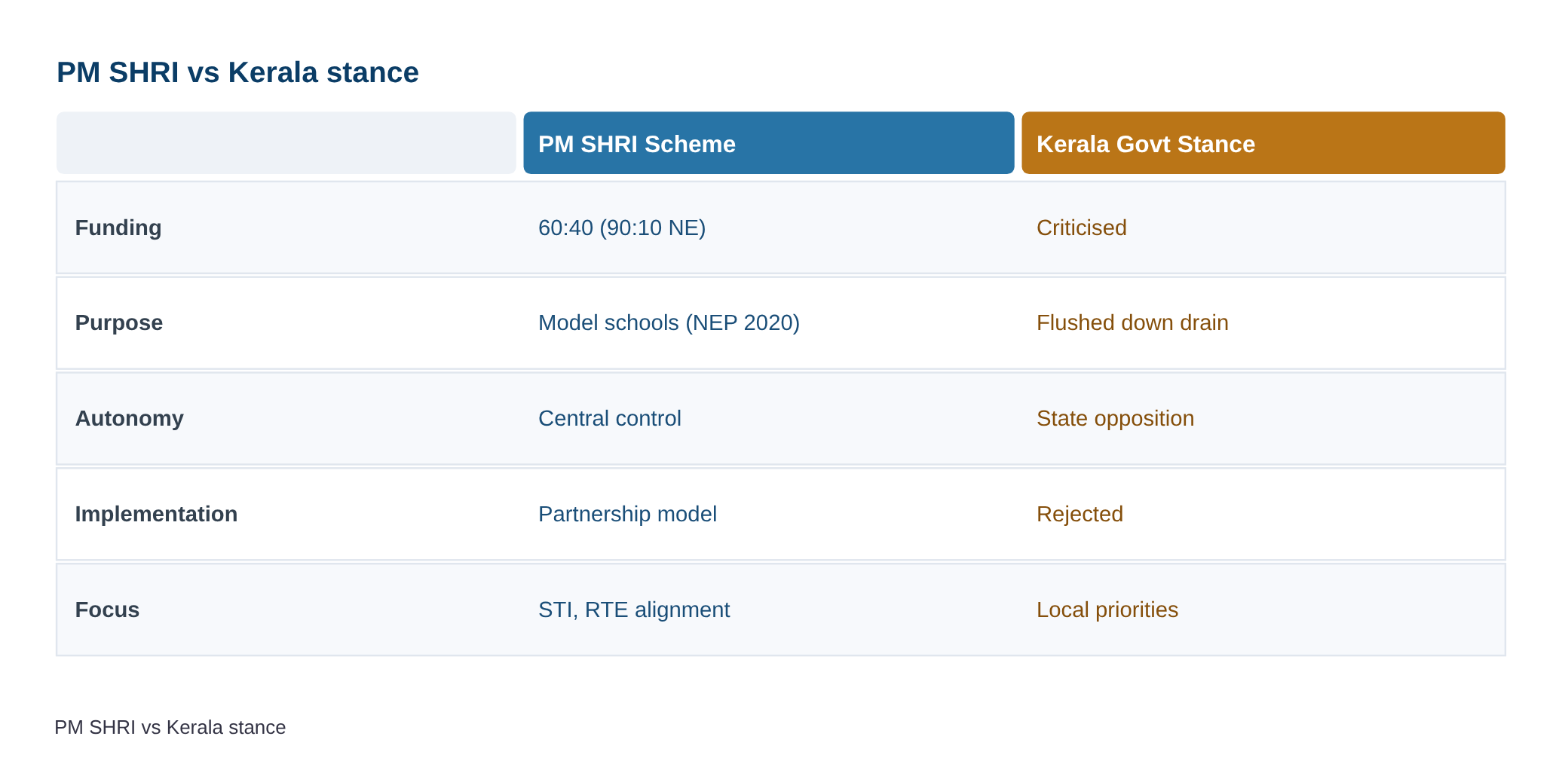
The demand by a national executive committee member of the BJP for the Kerala Chief Minister to clarify his stand on the PM SHRI (Prime Minister’s Schools for Rising India) scheme has brought into focus the constitutional and policy dimensions of this centrally sponsored initiative. The controversy stems from a statement by the Kerala State Panchayat Minister, who suggested that the scheme should be ‘flushed down the drain,’ raising questions about the state government’s stance on centrally sponsored educational programmes and the broader implications for federalism in India’s education sector.
Background
- The PM SHRI scheme was launched by the Government of India in September 2022 as a centrally sponsored initiative under the Ministry of Education, aiming to develop 14,500 schools across the country into model schools exemplifying the implementation of the National Education Policy (NEP) 2020.
- The scheme is designed to provide high-quality education, equitable access, and a conducive learning environment, with a focus on science, technology, and innovation to foster academic excellence among students.
- The scheme is implemented through a partnership between the Central Government and State Governments, with funding shared in a 60:40 ratio (90:10 for North-Eastern and Himalayan States).
- The scheme is aligned with the objectives of the Right to Education (RTE) Act, 2009, and aims to bridge gaps in educational infrastructure and quality across states.
- The controversy in Kerala highlights the tension between state autonomy in educational policy and the Centre’s role in ensuring uniform standards through centrally sponsored schemes.
- The demand for clarification reflects broader debates on federalism, cooperative federalism, and the implementation of centrally sponsored schemes in states governed by opposition parties.
What is the PM SHRI Scheme?
- Objective: To develop 14,500 existing government and government-aided schools into ‘PM SHRI Schools’ that exemplify the key features of the National Education Policy (NEP) 2020, including holistic, experiential, and inquiry-based learning.
- Coverage: Schools are selected based on predefined criteria, including existing infrastructure, student-teacher ratio, and commitment to NEP 2020 principles. The scheme covers all states and Union Territories.
- Funding: The scheme is a Centrally Sponsored Scheme (CSS) with a total outlay of ₹27,360 crore over five years (2022-2027). The funding pattern is 60% from the Central Government and 40% from State Governments (90:10 for North-Eastern and Himalayan States).
- Implementation Framework: Schools under PM SHRI are required to adopt innovative pedagogical practices, integrate technology in classrooms, and ensure equitable access to quality education for all students, including marginalised communities.
- Monitoring and Evaluation: The scheme includes a robust monitoring mechanism through the PM SHRI portal, with regular reviews by the Ministry of Education and State Education Departments to ensure compliance with NEP 2020 guidelines.
- Alignment with NEP 2020: The scheme is a direct implementation tool for NEP 2020’s vision of transforming India’s education system by 2030, focusing on foundational literacy, numeracy, and critical thinking.
- Inclusivity: The scheme mandates the inclusion of students from disadvantaged backgrounds, with provisions for special training, resource materials, and infrastructure support to ensure no child is left behind.
- Outcome Indicators: The scheme aims to improve learning outcomes, reduce dropout rates, and enhance the employability of students by providing a modern, technology-enabled learning environment.
Key Features
| Feature | Significance |
|---|---|
| PM SHRI Scheme | A centrally sponsored initiative aimed at transforming schools into model institutions by integrating science and technology to enhance academic excellence and equity. |
| State-Centre Coordination | The constitutional framework mandates cooperative federalism, requiring states to engage constructively with centrally sponsored schemes for national development goals. |
| Academic Autonomy vs. Accountability | States retain pedagogical autonomy but must align with national educational standards to ensure uniform quality and inclusivity in school education. |
| Public Funding in Education | Central schemes like PM SHRI utilise public funds to address regional disparities, necessitating transparent utilisation and equitable distribution across states. |
Why it Matters
Educational Governance
- Demonstrates the interplay between state and central policies in implementing national educational reforms, particularly in technologically-driven learning environments.
- Highlights the role of states in either leveraging or rejecting centrally funded schemes based on local priorities, administrative coherence, and political considerations.
- Exposes potential conflicts between state autonomy in education policy and the Centre’s objectives of standardised, technology-integrated schooling.
Federalism and Public Policy
- Illustrates the tensions inherent in cooperative federalism, where states may critique or resist schemes perceived as politically motivated or misaligned with local developmental agendas.
- Underscores the need for clear communication and consensus-building between state governments and central agencies to avoid policy dissonance.
- Raises questions about the accountability of state governments in utilising central funds for schemes designed to benefit marginalised student populations.
Public Perception and Trust
- Public statements by state ministers can influence trust in government schemes, particularly when framed as dismissive or derogatory, potentially undermining national objectives.
- Media amplification of political rhetoric may polarise public opinion, affecting the perceived legitimacy of educational reforms and their beneficiaries.
Challenges
1. Policy Dissonance Between State and Centre
- States may reject centrally sponsored schemes on ideological or political grounds, leading to non-implementation and loss of developmental opportunities for students.
- Lack of constructive dialogue between state and central authorities can exacerbate administrative bottlenecks and delay project execution.
UPSC Link: Federalism – Centre-State Relations
2. Politicisation of Educational Schemes
- Educational policies risk being framed as tools of political rivalry rather than instruments of public good, distorting their intended objectives.
- Public criticism of schemes by elected representatives may discourage beneficiary participation and reduce the scheme’s impact.
UPSC Link: Role of Media and Pressure Groups
3. Administrative Coordination and Implementation Gaps
- Delays in clarifying state positions on schemes can stall fund utilisation and hinder the achievement of targeted outcomes.
- Lack of inter-departmental coordination within states may lead to inefficient execution or outright rejection of centrally funded initiatives.
UPSC Link: Public Administration – Challenges
4. Equity and Inclusivity Concerns
- Rejection or non-participation in national schemes may disproportionately affect underprivileged student populations who stand to benefit the most.
- Political rhetoric that undermines schemes risks normalising exclusionary practices in education governance.
UPSC Link: Inclusive Growth and Social Justice
Challenges — UPSC Perspective
| Issue | Concern |
|---|---|
| State Rejection of Central Schemes | Loss of developmental opportunities for students due to ideological or political opposition. |
| Lack of Clarity in State Position | Delays in policy implementation and fund utilisation, affecting beneficiaries. |
| Politicisation of Educational Policies | Distortion of scheme objectives due to partisan framing, reducing public trust. |
| Administrative Bottlenecks | Coordination failures between state and central agencies leading to inefficiencies. |
| Marginalisation of Beneficiaries | Potential exclusion of underprivileged students from national educational reforms. |
Government Initiatives — Must-Memorise for Prelims
- Pradhan Mantri Schools for Rising India (PM SHRI) Scheme
Way Forward
- States must issue formal, time-bound clarifications on their stance regarding centrally sponsored schemes to avoid ambiguity and administrative delays.
- Establish structured dialogue mechanisms between state governments and central ministries to resolve policy dissonance and ensure constructive engagement.
- Conduct joint reviews of scheme implementation at the state level to assess progress, address bottlenecks, and realign objectives with local needs.
- Promote public awareness campaigns to highlight the benefits of national schemes, countering misinformation and political rhetoric.
- Strengthen inter-departmental coordination within states to streamline fund utilisation and project execution.
- Encourage bipartisan consensus on educational reforms to depoliticise their implementation and ensure continuity across administrations.
- Monitor beneficiary feedback to assess the scheme’s impact and identify areas for improvement in equity and inclusivity.
UPSC Value Addition
Keywords for Mains Answer-Writing
PM SHRI Scheme · Pradhan Mantri Schools for Rising India · Union-State relations in education policy · National Education Policy 2020 · Kerala’s education governance · Parliamentary Acts in education · Central sector schemes in States · Academic federalism · Concurrent List (7th Schedule) · Union Government’s role in school education
Concept Flow
State minister’s public criticism of PM SHRI → Political rhetoric amplifies → Ambiguity in state position delays implementation → Potential loss of developmental opportunities for students → Public trust in national schemes erodes → Broader debate on federalism and educational governance intensifies.
Prelims Practice Questions
Q1. Consider the following statements regarding the Pradhan Mantri Schools for Rising India (PM SHRI) Scheme:
1. It is a centrally sponsored scheme aimed at transforming existing government schools into model schools.
2. The scheme is implemented by the Ministry of Education, Government of India.
3. PM SHRI schools are required to follow the National Education Policy 2020.
4. The scheme is applicable only to schools in Union Territories.
How many of the above statements are correct?
- Only one
- Only two
- Only three
- All four
Answer: All four — Statements 1, 2, and 3 are correct. Statement 4 is incorrect as the scheme is applicable to government schools across all States and Union Territories in India.
Q2. Assertion (A): The PM SHRI Scheme is designed to enhance the quality of education through the integration of science, technology, and innovation.
Reason (R): The scheme mandates the adoption of the National Education Policy 2020 in all PM SHRI schools.
In the context of the above two statements, which one of the following is correct?
- Both A and R are true, and R is the correct explanation of A.
- Both A and R are true, but R is not the correct explanation of A.
- A is true, but R is false.
- A is false, but R is true.
Answer: A is true, but R is false. — Both the Assertion (A) and Reason (R) are true. However, the Reason (R) does not directly explain the Assertion (A), as the scheme’s focus on science, technology, and innovation is a broader objective, while the adoption of NEP 2020 is a separate requirement.
Q3. Match the following pairs related to Union-State relations in education policy:
Column I (Scheme/Initiative) Column II (Implementing Authority)
A. PM SHRI Scheme 1. State Education Department
B. Sarva Shiksha Abhiyan 2. Ministry of Education, Government of India
C. Rashtriya Madhyamik Shiksha Abhiyan 3. NITI Aayog
D. National Education Policy 2020 4. Ministry of Education, Government of India
Select the correct match:
- A-2, B-4, C-1, D-2
- A-2, B-4, C-4, D-3
- A-1, B-2, C-4, D-3
- A-4, B-1, C-2, D-3
Answer: A-2, B-4, C-4, D-3 — A-2: PM SHRI Scheme is implemented by the Ministry of Education, Government of India. B-4: Sarva Shiksha Abhiyan is also implemented by the Ministry of Education. C-1: Rashtriya Madhyamik Shiksha Abhiyan is implemented by State Education Departments. D-2: National Education Policy 2020 is formulated by the Ministry of Education.
Mains Practice Question
✍ Critically examine the constitutional and policy framework governing the implementation of centrally sponsored schemes in education, such as the PM SHRI Scheme, in the context of cooperative federalism. Also, analyse the implications of a State government’s refusal to participate in such schemes for the academic federalism in India. (15 Marks)
Approach: MODEL-ANSWER SKELETON:
1. **Constitutional Framework**:
– Entry 25 of the Concurrent List (7th Schedule) empowers both the Union and State governments to legislate on education.
– Article 292 and 293 of the Constitution provide for financial relations between the Union and States.
– The National Policy on Education (NPE) 1986 and its subsequent revisions (e.g., NEP 2020) serve as guiding frameworks.
2. **Centrally Sponsored Schemes (CSS)**:
– Definition and purpose: CSS are schemes where the financial contribution is shared between the Union and States (e.g., PM SHRI Scheme: 60% Union, 40% State).
– Legal basis: Article 282 of the Constitution allows the Union to make grants for purposes not within its legislative competence.
– Examples: PM SHRI, Samagra Shiksha Abhiyan, Rashtriya Madhyamik Shiksha Abhiyan.
3. **Cooperative Federalism**:
– Principle: The Union and States work together to achieve common goals while respecting each other’s autonomy.
– Mechanisms: NITI Aayog’s role in coordinating CSS, GST Council for fiscal federalism.
– Judicial interpretation: Supreme Court in *State of West Bengal v. Union of India* (1963) and *S.R. Bommai v. Union of India* (1994) underscores the balance between Union and State powers.
4. **State Refusal and Academic Federalism**:
– Legal implications: States cannot unilaterally reject CSS as they are voluntary but incentivized through funding. Refusal may lead to loss of financial benefits for schools and students.
– Policy implications: Erosion of uniformity in education standards, potential for regional disparities in educational outcomes.
– Political implications: Tensions between Union and State governments may arise, as seen in debates over NEP 2020 implementation.
5. **Case Study**:
– Kerala’s stance on PM SHRI Scheme: Potential loss of benefits for students, debate over autonomy vs. uniformity in education policy.
6. **Conclusion**:
– Balancing cooperative federalism with State autonomy is critical. The Union’s role in ensuring equity in education must be balanced with respect for State-level governance.
– Recommendations: Strengthening consultative mechanisms (e.g., Inter-State Council), ensuring transparency in CSS funding, and promoting dialogue to align State and Union priorities.
Source: The Hindu
Generated by AanyaAi for educational purpose.

- Gurugram’s groundwater extraction exceeds limit by 212%; HC seeks ban - October 4, 2026
- स्वतंत्रता सेनानी श्यामजी कृष्ण वर्मा की जन्म जयंती पर पीएम का श्रद्धांजलि - October 4, 2026
- KWML’s Feasibility Reports for Water Metro in 18 Cities: UPSC & PCS Insights - October 3, 2026

No Comments