


08 Aug Kerala HC Orders Panchayat to Compensate Stray Dog Attack Victim: Key Legal Implications for UPSC
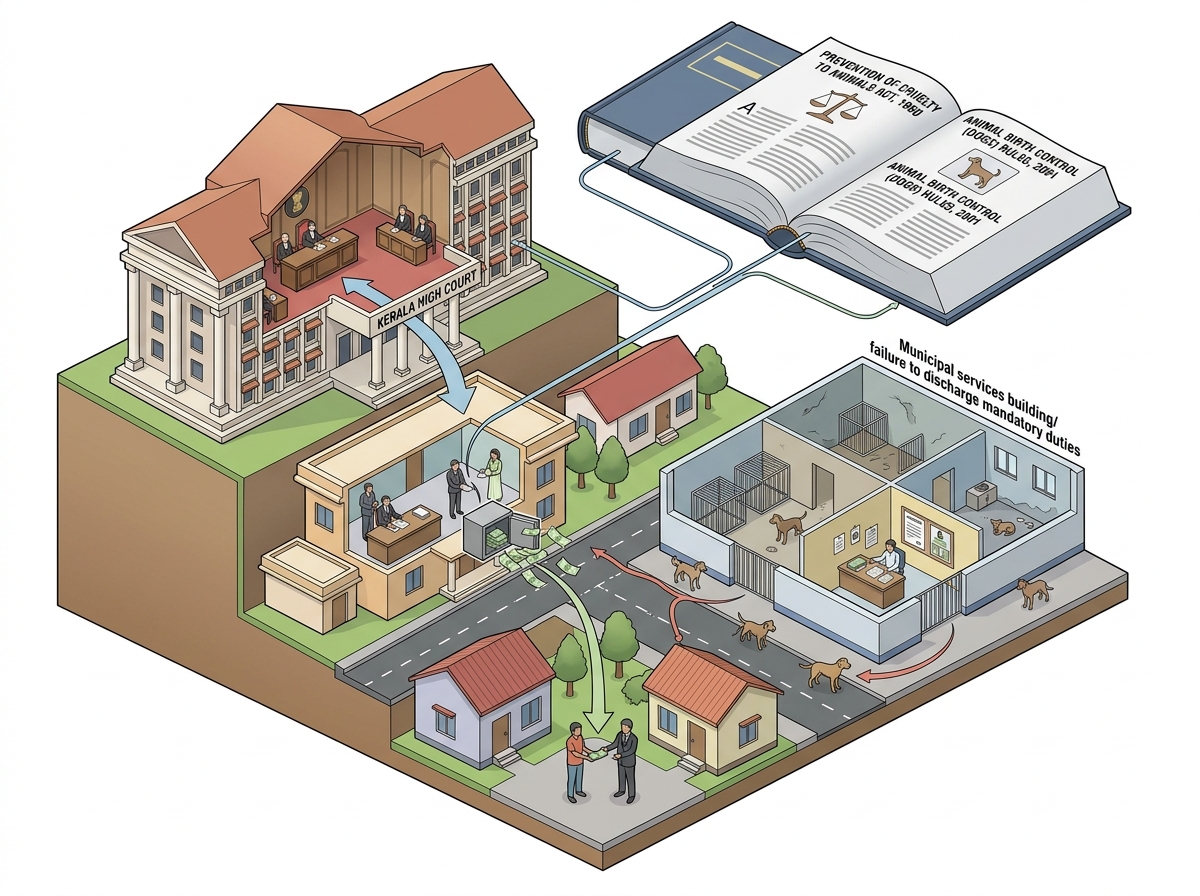
PanchayatStray dogVictimCompensationPublic healthAnimal welfare✎ The court held the panchayat liable for compensation of ₹10,000 to a victim of a stray dog attack in 2007, citing its failure to discharge mandatory duties such as licensing domestic dogs and controlling stray dog populations.
Subject Relevance — Where This Topic Fits
- GS Paper II — Governance, Constitution, Polity, Social Justice and International Relations | GS Paper III — Environment, Disaster Management, and Legal Aspects
- Prelims: Panchayati Raj Institutions (PRIs), Animal Welfare Board of India (AWBI), Prevention of Cruelty to Animals Act, 1960, Birth Control Rules for Dogs, Local Self-Government, Judicial Activism, Tort Law, Vicarious Liability
- Essay: The Role of Local Governments in Balancing Public Health and Animal Welfare: A Case Study of Stray Dog Management, Judicial Intervention in Governance: Ensuring Accountability of Local Bodies through Compensation Orders
Why is this in the news?
The court held the panchayat liable for compensation of ₹10,000 to a victim of a stray dog attack in 2007, citing its failure to discharge mandatory duties such as licensing domestic dogs and controlling stray dog populations. This ruling underscores the legal accountability of panchayats in public health and safety matters, particularly in the context of zoonotic disease prevention and animal welfare governance.
Background
- The Prevention of Cruelty to Animals Act, 1960, is the primary legislation governing animal welfare in India, with provisions mandating the prevention of cruelty and regulation of animal populations, including stray dogs.
- Panchayati Raj Institutions (PRIs) in India are constitutionally mandated to function as local self-governments (Article 243G of the Constitution), with responsibilities including public health, sanitation, and animal control within their jurisdictions.
- Stray dog attacks pose a significant public health challenge in India, with the World Health Organization (WHO) estimating that dog bites account for over 20,000 rabies deaths annually in the country.
- The Kerala High Court’s judgment aligns with prior judicial precedents recognising the liability of local bodies for negligence in public health duties, including cases involving mosquito-borne diseases and sanitation failures.
- The case highlights the tension between limited financial resources of local bodies and their statutory obligations, a recurring issue in India’s decentralised governance framework.
Legal and Institutional Framework Governing Stray Dog Management in India
- The Prevention of Cruelty to Animals Act, 1960, is the foundational legislation governing animal welfare, with Section 11 criminalising cruelty to animals and Section 38 empowering the central government to frame rules for animal control.
- Panchayati Raj Institutions (PRIs) are constitutionally empowered under Article 243G to manage local affairs, including public health and sanitation, which encompasses stray dog control and animal welfare.
- The Animal Welfare Board of India (AWBI), established under the Act, serves as the apex advisory body for animal welfare policies and monitors compliance with the Act’s provisions by local authorities.
- Local bodies are required to issue licences for domestic dogs, maintain records of licensed animals, and implement stray dog control measures, including sterilisation and vaccination, in accordance with the Birth Control Rules.
- Failure to discharge these statutory duties may result in legal liability, including compensation orders, as demonstrated by the Kerala High Court’s judgment in the *Tankappan* case.
- The judiciary has increasingly intervened to enforce accountability of local bodies in public health matters, including through compensation orders for negligence, as seen in cases involving sanitation, water supply, and disease outbreaks.
- The judgment reinforces the principle of *vicarious liability*, where local bodies may be held accountable for harm caused by their failure to implement statutory duties, even if the harm is not directly caused by the body itself.
Key Features
| Feature | Significance |
|---|---|
| Statutory duty of panchayats under PCA Act, 1960 | Panchayats are legally obligated to control stray dog populations through licensing, sterilisation, and seizure, failing which they incur liability for resultant harm. |
| Judicial interpretation of local body liability | The Kerala High Court held that panchayats cannot evade responsibility for failing to discharge mandatory duties, even if financial constraints exist. |
| Compensation mechanism for victims | Courts can award compensation for injuries caused by stray dogs when local bodies neglect statutory obligations, setting a precedent for similar cases. |
| Interpretation of ‘foreseeable consequence’ | The court ruled that a dog attack is a reasonably foreseeable outcome of a panchayat’s failure to control stray dogs, establishing a causal link. |
| Appeal process in civil liability cases | The case demonstrates the layered judicial process—Munsiff Court, Sub-court, and High Court—reappreciating evidence and legal standards. |
Why it Matters
Legal and Jurisprudential
- This judgment reinforces the principle of strict liability for local bodies failing to discharge statutory duties under animal welfare laws.
- It clarifies that financial constraints or lack of state assistance cannot absolve panchayats of their legal obligations.
- The ruling establishes a precedent for compensating victims of animal attacks when negligence by public authorities is proven.
Administrative and Governance
- Panchayats must prioritise implementation of the Prevention of Cruelty to Animals Act and Birth Control Rules to prevent stray dog proliferation.
- The case underscores the need for proactive measures such as licensing, sterilisation drives, and public awareness campaigns.
- Local bodies must maintain records of actions taken to demonstrate compliance with statutory duties in potential litigation.
Public Health and Safety
- Uncontrolled stray dog populations pose risks of zoonotic diseases and injuries, necessitating robust municipal governance.
- The judgment highlights the intersection of public health policy and local governance, emphasising preventive measures over reactive compensation.
- It serves as a deterrent for local authorities to neglect their responsibilities in managing stray animal populations.
Challenges
1. Implementation Gaps in Local Governance
- Many panchayats lack the financial and human resources to effectively implement stray dog control measures.
- Inadequate coordination between local bodies, veterinary departments, and animal welfare organisations hinders progress.
- Public apathy and resistance to sterilisation or relocation efforts pose operational challenges.
UPSC Link: GS-II: Local Governance and 73rd/74th Constitutional Amendments
2. Legal Ambiguity in Liability
- The extent of liability for local bodies in cases of animal attacks remains contested, leading to prolonged litigation.
- Courts must balance compensation awards with the financial capacity of panchayats to avoid unsustainable burdens.
- Lack of uniform guidelines for determining compensation amounts creates inconsistency in judicial rulings.
UPSC Link: GS-II: Judicial Activism and Public Interest Litigation
3. Resource Constraints and Policy Gaps
- Insufficient state funding for stray dog management programmes limits the effectiveness of local initiatives.
- The Birth Control Rules for Dogs (2001) are often poorly enforced due to logistical and financial constraints.
- Delays in legislative reforms to address emerging challenges in animal welfare exacerbate existing issues.
UPSC Link: GS-II: Centre-State Financial Relations and Resource Allocation
Challenges — UPSC Perspective
| Issue | Concern |
|---|---|
| Financial Constraints | Panchayats lack adequate funds to implement stray dog control measures, including sterilisation and vaccination. |
| Regulatory Gaps | Inconsistent enforcement of the Prevention of Cruelty to Animals Act and Birth Control Rules across jurisdictions. |
| Public Resistance | Community opposition to sterilisation drives or relocation of stray dogs due to cultural or ethical concerns. |
| Operational Inefficiencies | Delays in capturing and sterilising stray dogs, leading to unchecked population growth. |
| Legal Ambiguity | Unclear delineation of responsibility between panchayats, state agencies, and animal welfare organisations. |
Way Forward
- Panchayats must conduct regular audits of stray dog populations and document all control measures undertaken to demonstrate compliance with statutory duties.
- State governments should allocate dedicated funds for stray dog management, including sterilisation, vaccination, and public awareness campaigns.
- Strengthen inter-departmental coordination between panchayats, veterinary departments, and municipal corporations to streamline implementation.
- Promote public-private partnerships to augment resources for stray dog control and rehabilitation efforts.
- Enhance capacity-building programmes for panchayat officials on animal welfare laws and their statutory obligations.
- Establish a grievance redressal mechanism for victims of animal attacks to expedite compensation claims.
- Conduct periodic reviews of the Birth Control Rules for Dogs (2001) to address emerging challenges and improve enforcement.
- Raise public awareness about responsible pet ownership and the risks of unchecked stray dog populations.
UPSC Value Addition
Keywords for Mains Answer-Writing
Local self-government in India · Panchayati Raj Institutions · Prevention of Cruelty to Animals Act, 1960 · Birth Control Rules for stray dogs · Judicial activism in local governance · Compensation for animal attack victims · Statutory duties of local bodies · Kerala High Court judgments · Animal welfare laws in India · Constitutional provisions for local governance · Public health and municipal responsibilities · Judicial review of administrative inaction
Constitutional & Policy Linkages
- [‘Article 243G’, ‘Empowers panchayats to manage animal welfare as part of local governance.’]
- [‘Article 40’, ‘Directs the state to organise village panchayats and endow them with powers to function as units of self-government.’]
Concept Flow
Statutory duty under PCA Act, 1960 and Birth Control Rules mandates panchayats to control stray dogs. → Failure to implement licensing, sterilisation, or seizure leads to unchecked stray dog proliferation. → Increased stray dog population elevates the risk of dog attacks on humans. → Victim sustains injuries in a dog attack within panchayat limits. → Panchayat’s negligence in discharging statutory duties is established in court. → Court holds panchayat liable for compensation due to foreseeable consequences of its inaction. → Judgment reinforces strict liability and sets a precedent for similar cases.
Prelims Practice Questions
Q1. Consider the following statements regarding the statutory duties of a Panchayat under the Prevention of Cruelty to Animals Act, 1960 and the Birth Control Rules for stray dogs:
1. Every Panchayat is duty-bound to issue licences for domestic dogs within its jurisdiction.
2. The Panchayat must ensure the capture and sterilisation of stray dogs as per the Birth Control Rules.
3. The Panchayat is exempt from liability if a stray dog attack occurs outside its jurisdiction.
4. The Panchayat can claim immunity from financial liability if it has not received State assistance for stray dog control.
How many of the above statements are correct?
- Only one
- Only two
- Only three
- All four
Answer: Only three — Statements 1 and 2 are correct as per the Kerala High Court ruling and the provisions of the Prevention of Cruelty to Animals Act, 1960, and Birth Control Rules. Statements 3 and 4 are incorrect as the Panchayat’s liability is not contingent on the location of the attack or the receipt of State assistance.
Q2. Assertion (A): The Kerala High Court held the Eruvessy grama panchayat liable for compensating a victim of a stray dog attack due to its failure to discharge statutory duties.
Reason (R): The panchayat had not issued licences for domestic dogs or implemented stray dog control measures in accordance with the Prevention of Cruelty to Animals Act, 1960 and Birth Control Rules.
Options:
A. Both A and R are true, and R is the correct explanation of A.
B. Both A and R are true, but R is not the correct explanation of A.
C. A is true, but R is false.
D. A is false, but R is true.
Answer: ? — Both Assertion (A) and Reason (R) are true, and the Reason (R) correctly explains the Assertion (A) as the court’s ruling was based on the panchayat’s failure to implement statutory duties under the cited laws.
Q3. Match the following legal provisions with their respective objectives:
Column I
1. Section 3 of the Prevention of Cruelty to Animals Act, 1960
2. Article 243G of the Constitution of India
3. Birth Control Rules for stray dogs
4. Section 11 of the Protection of Children from Sexual Offences Act, 2012
Column II
A. Empowers Panchayats to perform functions as specified by State legislatures
B. Prohibits cruelty to animals and mandates humane treatment
C. Provides for sterilisation and immunisation of stray dogs
D. Protects children from sexual offences
- 1-B, 2-A, 3-C, 4-D; 1-A, 2-B, 3-C, 4-D; 1-D, 2-A, 3-B, 4-C; 1-C, 2-D, 3-A, 4-B
- answer_index_for_json_output_only_0_to_3_where_0_is_first_option_etc.
Answer: 1-B, 2-A, 3-C, 4-D; 1-A, 2-B, 3-C, 4-D; 1-D, 2-A, 3-B, 4-C; 1-C, 2-D, 3-A, 4-B — 1-B: Section 3 of the Prevention of Cruelty to Animals Act, 1960 prohibits cruelty to animals. 2-A: Article 243G empowers Panchayats to perform functions as specified by State legislatures. 3-C: Birth Control Rules for stray dogs mandate sterilisation and immunisation. 4-D: Section 11 of POCSO Act protects children from sexual offences.
Mains Practice Question
✍ The Kerala High Court’s directive to the Eruvessy grama panchayat to compensate a victim of a stray dog attack underscores the principle of ‘statutory duty and liability’ in local self-governance. Critically examine the legal and constitutional foundations of this principle with reference to the Prevention of Cruelty to Animals Act, 1960, the Birth Control Rules for stray dogs, and the 73rd Constitutional Amendment Act. Also, analyse the implications of this judgment for the accountability of Panchayati Raj Institutions (PRIs) in public health and animal welfare governance. (15 Marks)
Approach: MODEL-ANSWER SKELETON:
1. **Statutory Foundations**:
– Article 243G of the Constitution of India empowers Panchayats to perform functions as specified by State legislatures, including public health and animal welfare.
– Section 3 of the Prevention of Cruelty to Animals Act, 1960 prohibits cruelty to animals and mandates humane treatment, while the Birth Control Rules (2001) provide for the capture, sterilisation, and immunisation of stray dogs.
– The Kerala Panchayat Raj Act, 1994, read with these central laws, imposes a duty on Panchayats to control stray dogs and protect citizens.
2. **Judicial Precedent and Principle**:
– The Kerala High Court’s ruling aligns with the doctrine of ‘statutory duty and liability’, where failure to perform a mandatory function under law renders the local body liable for compensation.
– Cite the judgment in *State of Punjab v. Ram Lubhaya Bagga* (1998) 4 SCC 117, which established that statutory bodies can be held liable for inaction.
– Contrast with *State of Bihar v. Murad Ali Khan* (1991) 1 SCC 112, where the Supreme Court held that liability arises only if the statutory duty is non-discretionary and enforceable.
3. **Accountability of PRIs**:
– Discuss the 73rd Constitutional Amendment Act’s emphasis on decentralisation and the need for PRIs to discharge their functions effectively.
– Highlight the challenge of resource constraints and lack of State assistance, as argued by the panchayat in the case, and its limited validity as a defence.
– Examine the role of judicial activism in ensuring accountability, citing *Animal Welfare Board of India v. A. Nagaraja* (2014) 7 SCC 547, where the Supreme Court upheld the constitutional status of animal welfare.
4. **Public Health and Animal Welfare Governance**:
– Analyse the intersection of public health and animal welfare, citing the One Health approach endorsed by the WHO and OIE.
– Discuss the need for a multi-stakeholder approach involving PRIs, State agencies, and civil society for effective stray dog management.
– Conclude with the broader implications: PRIs must prioritise statutory duties, and citizens can seek judicial recourse for inaction, ensuring a balance between local autonomy and accountability.
Source: The Hindu
Generated by AanyaAi for educational purpose.

- आरबीआई ने सरकारी प्रतिभूतियों की ओएमओ बिक्री की घोषणा, जानिए पूरा विवरण - September 23, 2026
- RBI to Sell ₹25,000 Crore Govt Securities via OMO on Sept 28, 2026 - September 23, 2026
- भारत-श्रीलंका नौसैनिक अभ्यास ‘स्लाईनेक्स-26’: विशाखापत्तनम में संपन्न, जानें प्रमुख बिंदु - September 23, 2026

No Comments