


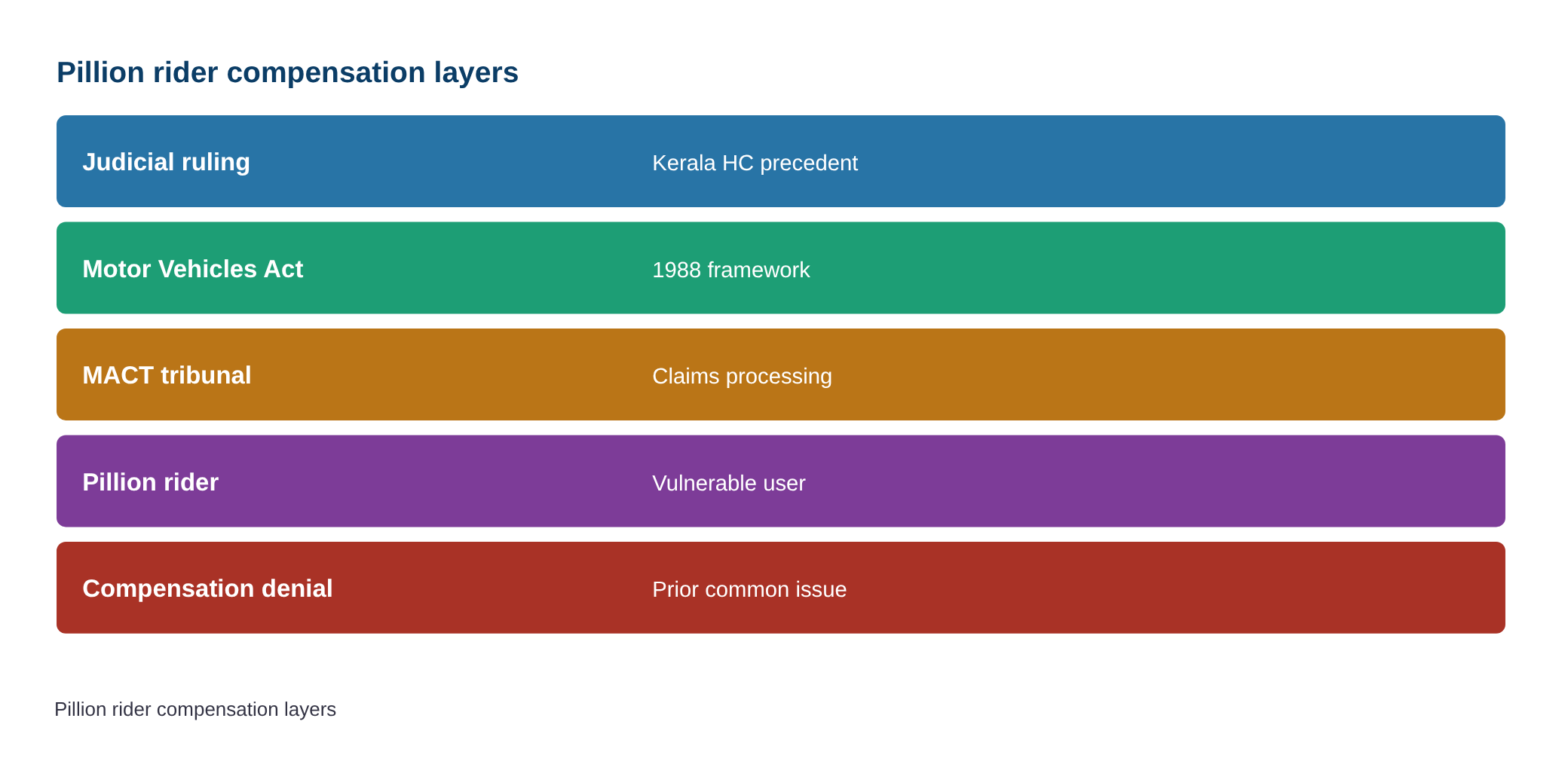
08 Aug Kerala HC: Pillion Rider Cannot Be Denied Compensation for Vehicle Rider’s Negligence
✎ In motor accident compensation claims, the Motor Accident Claims Tribunal (MACT) must prioritise substantive evidence over corroborative reports like scene mahazar, and contributory negligence cannot be presumed solely due to…
Subject Relevance — Where This Topic Fits
- GS Paper II — Judiciary and Constitutional Framework | GS Paper III — Infrastructure: Transport and Road Safety
- Prelims: Motor Vehicles Act, 1988, Motor Accident Claims Tribunal (MACT), Contributory Negligence, Pillion Rider Compensation, Scene Mahazar, Standard of Proof in Compensation Claims
- Essay: The Role of Judiciary in Ensuring Social Justice: A Case Study of Motor Accident Compensation Claims, Balancing Individual Rights and Collective Safety in Road Transport Policies
Quick Revision: In motor accident compensation claims, the Motor Accident Claims Tribunal (MACT) must prioritise substantive evidence over corroborative reports like scene mahazar, and contributory negligence cannot be presumed solely due to triple riding or lack of helmet use unless directly linked to the accident.
Why is this in the news?
The Kerala High Court’s recent judgment in *<Anonymous Petitioner> v. Insurance Company* (2026) has established a significant precedent by ruling that compensation to a pillion rider in a motor accident cannot be denied solely on the grounds of alleged negligence by the vehicle’s rider. The decision underscores the judiciary’s role in ensuring equitable compensation under the Motor Vehicles Act, 1988, while clarifying the evidentiary standards applicable to such claims. This ruling is particularly relevant in the context of rising road accidents in India and the persistent issue of undercompensation for victims, especially pillion riders, who are often the most vulnerable road users.
Background
- The Motor Vehicles Act, 1988, governs compensation for victims of road accidents through the Motor Accident Claims Tribunal (MACT).
- Pillion riders, despite being non-driving occupants, frequently face denial of compensation due to allegations of contributory negligence, such as triple riding or lack of helmet use, even when such factors are not directly linked to the accident’s cause.
- The Kerala High Court’s judgment addresses a long-standing ambiguity in the application of *contributory negligence* in motor accident claims, particularly where the tribunal’s reliance on *scene mahazar* (accident site report) and inspection reports overshadows substantive evidence.
- The case highlights the disparity in compensation awards, where tribunals often undervalue claims by pillion riders compared to drivers or pedestrians, despite the former’s heightened vulnerability in accidents.
- The judgment aligns with the Supreme Court’s observations in *National Insurance Company Ltd. v. Pranay Sethi* (2017), which emphasized the need for a uniform approach in compensating accident victims, irrespective of their role in the vehicle.
- The ruling also reflects the judiciary’s evolving interpretation of *standard of proof* in compensation claims, which is less stringent than in criminal or civil cases, given the remedial nature of such proceedings.
What is the Legal Framework Governing Compensation for Pillion Riders in Motor Accidents?
- Pillion riders are entitled to compensation as *third-party beneficiaries* under the Act, provided they are not the primary cause of the accident. The Act does not distinguish between drivers and pillion riders in terms of compensation eligibility.
- The **standard of proof** in MACT proceedings is *balance of probabilities*, which is lower than the *beyond reasonable doubt* standard in criminal cases. This is because MACT proceedings are *quasi-judicial* and aimed at providing *speedy relief* rather than punishing the wrongdoer.
- The concept of **contributory negligence** allows tribunals to reduce compensation if the victim’s negligence contributed to the accident. However, the Kerala High Court clarified that *triple riding* or lack of helmet use *per se* does not establish contributory negligence unless directly linked to the accident’s cause.
- The **scene mahazar** (accident site report) and inspection reports are *corroborative evidence* and cannot substitute for direct evidence of negligence. Tribunals must rely on *witness testimonies, medical reports, and forensic evidence* to determine fault.
- The **Compensation Calculation** under MACT follows structured guidelines, including compensation for loss of income, medical expenses, pain and suffering, and funeral expenses (if applicable).
- The **Kerala High Court’s judgment** reinforces the principle that *compensation is a right, not a privilege*, and tribunals must adopt a victim-centric approach while determining claims.
Key Features
| Feature | Significance |
|---|---|
| Judicial Pronouncement on Pillion Rider Compensation | Establishes that negligence of the vehicle rider cannot be imputed to the pillion rider for denying compensation under the Motor Vehicles Act, 1988. |
| Standard of Proof in Motor Accident Claims | Clarifies that the standard of proof in such cases is lower, akin to civil proceedings, and not criminal or quasi-criminal, thus easing the burden on claimants. |
| Contributory Negligence Principle | Mandates a specific inquiry into the conduct of the claimant to determine if their negligence contributed to the accident, ensuring fairness in compensation awards. |
| Role of Motor Accident Claims Tribunal (MACT) | Highlights the tribunal’s obligation to rely on substantive evidence rather than scene mahazar or inspection reports to determine negligence and compensation. |
| Enhancement of Compensation | Demonstrates the judiciary’s role in rectifying errors in compensation awards by ensuring adequate consideration of medical expenses, loss of income, and other damages. |
Why it Matters
Legal and Judicial
- Reinforces the principle that compensation under the Motor Vehicles Act is not contingent on the negligence of the vehicle rider alone, protecting the rights of pillion riders.
- Sets a precedent for future cases involving motor accident claims, particularly those involving pillion riders, by emphasizing the need for evidence-based adjudication.
- Clarifies the distinction between civil and criminal standards of proof in motor accident claims, reducing the burden of proof on claimants.
- Underscores the role of the judiciary in correcting errors committed by tribunals in assessing compensation, ensuring justice for victims.
Social and Welfare
- Enhances the safety net for pillion riders, who are often vulnerable road users, by ensuring they are not unfairly denied compensation due to the actions of the vehicle rider.
- Promotes accountability among vehicle riders and insurers, as negligence cannot be used as a blanket defense to deny compensation.
- Encourages a more equitable distribution of compensation in motor accident cases, aligning with the principles of social justice.
Institutional
- Strengthens the functioning of Motor Accident Claims Tribunals by highlighting the need for thorough evidence-based adjudication.
- Demonstrates the judiciary’s role in upholding the rights of victims and ensuring that tribunals adhere to legal principles.
- Provides clarity on the interpretation of the Motor Vehicles Act, 1988, and related rules, reducing ambiguity in future cases.
Challenges
1. Inadequate Evidence and Tribunal Errors
- Tribunals often rely on scene mahazars and inspection reports rather than substantive evidence, leading to erroneous conclusions about negligence.
- The lack of a standardized approach to assessing compensation results in inconsistent awards, disadvantaging claimants.
- Delays in adjudication and appeals prolong the suffering of victims, exacerbating financial and emotional hardships.
UPSC Link: GS-II: Judiciary and Tribunals
2. Insurer Resistance and Legal Loopholes
- Insurance companies frequently contest compensation claims, citing contributory negligence or procedural lapses, to minimize payouts.
- The ambiguity in defining ‘negligence’ and ‘contributory negligence’ creates scope for exploitation by insurers and vehicle riders.
- The absence of clear guidelines for calculating compensation for non-fatal injuries and long-term disabilities leads to undercompensation.
UPSC Link: GS-II: Insurance Regulation
3. Public Awareness and Enforcement Gaps
- Many pillion riders are unaware of their rights to compensation, leading to underutilization of legal remedies.
- Poor enforcement of traffic rules and lack of awareness among vehicle riders contribute to the prevalence of accidents.
- The lack of a centralized database for motor accident claims hampers efficient adjudication and data-driven policy formulation.
UPSC Link: GS-II: Road Safety and Traffic Management
4. Judicial Backlog and Delayed Justice
- The high volume of motor accident claims clogs the judicial system, leading to prolonged litigation and delayed compensation.
- The absence of fast-track mechanisms for motor accident claims exacerbates the problem of judicial backlog.
- The lack of specialized training for tribunal members in assessing compensation claims further delays justice.
UPSC Link: GS-II: Judicial Reforms
Challenges — UPSC Perspective
| Issue | Concern |
|---|---|
| Reliance on Scene Mahazars | Tribunals often prioritize scene mahazars over substantive evidence, leading to erroneous conclusions about negligence. |
| Inconsistent Compensation Awards | The lack of standardized guidelines for compensation calculation results in arbitrary and inconsistent awards. |
| Insurer Resistance | Insurance companies frequently contest claims to minimize payouts, exploiting legal ambiguities. |
| Public Awareness Gaps | Pillion riders are often unaware of their rights, leading to underutilization of legal remedies. |
| Judicial Backlog | The high volume of motor accident claims clogs the judicial system, delaying justice for victims. |
| Enforcement Gaps | Poor enforcement of traffic rules and lack of awareness among vehicle riders contribute to accident prevalence. |
Way Forward
- Strengthen the evidentiary standards for Motor Accident Claims Tribunals to prioritize substantive evidence over scene mahazars and inspection reports.
- Develop standardized guidelines for calculating compensation, including provisions for non-fatal injuries, long-term disabilities, and loss of income.
- Enhance public awareness campaigns to educate pillion riders about their rights to compensation and the legal recourse available.
- Implement fast-track mechanisms for motor accident claims to reduce judicial backlog and ensure timely justice.
- Provide specialized training for tribunal members to improve their ability to assess compensation claims accurately.
- Strengthen the enforcement of traffic rules, particularly those related to helmet use, triple riding, and vehicle maintenance.
- Encourage the use of technology, such as GPS and dashcams, to provide objective evidence in motor accident claims.
- Establish a centralized database for motor accident claims to improve data-driven policy formulation and efficient adjudication.
UPSC Value Addition
Keywords for Mains Answer-Writing
Motor Vehicles Act, 1988 · Motor Accidents Claims Tribunal (MACT) · Pillion rider compensation · Negligence in road accidents · Contributory negligence · Kerala High Court judgment · Standard of proof in motor claims · Triple riding and rash driving · Motor Vehicle (Amendment) Act, 2019 · Insurance claims and liability · Road safety and legal provisions · Judicial interpretation of negligence · Compensation enhancement criteria · Two-wheeler accident liability
Concept Flow
Motor accident involving a pillion rider and a stage carrier → Pillion rider files a compensation claim before the Motor Accident Claims Tribunal (MACT) → Tribunal denies compensation citing negligence of the vehicle rider, relying on scene mahazar and inspection report → Pillion rider approaches the Kerala High Court, arguing that negligence of the vehicle rider cannot be imputed to them → High Court holds that the tribunal committed a grave error by not relying on substantive evidence → High Court enhances the compensation awarded to the pillion rider, setting a precedent for future cases → Judicial pronouncement reinforces the principle of fair compensation and the need for evidence-based adjudication
Prelims Practice Questions
Q1. Consider the following statements regarding the Motor Vehicles Act, 1988 and its amendments:
1. The Act mandates that the Motor Accidents Claims Tribunal (MACT) must award compensation to a pillion rider even if the rider of the vehicle is found negligent.
2. The standard of proof required in motor accident claims before MACT is the same as in criminal cases.
3. The Motor Vehicle (Amendment) Act, 2019 introduced stricter penalties for triple riding.
4. Contributory negligence is not a relevant factor in determining compensation under the Act.
How many of the above statements are correct?
- Only one
- Only two
- Only three
- All four
Answer: Only two — Statement 1 is correct as the Kerala High Court ruled that a pillion rider cannot be denied compensation solely due to the rider’s negligence. Statement 2 is incorrect; the standard of proof in MACT is lower than in criminal cases. Statement 3 is correct as the 2019 amendment introduced penalties for triple riding. Statement 4 is incorrect; contributory negligence is a relevant factor under the Act.
Q2. Assertion (A): The Kerala High Court held that triple riding by itself does not amount to rash driving.
Reason (R): The Motor Vehicles Act, 1988 explicitly defines ‘rash driving’ as driving at a speed or in a manner likely to cause danger to the public, irrespective of the number of riders.
Options:
A. Both A and R are true, and R is the correct explanation of A.
B. Both A and R are true, but R is not the correct explanation of A.
C. A is true, but R is false.
D. A is false, but R is true.
- A
- B
- C
- D
Answer: C — Assertion (A) is true as the Kerala High Court observed that triple riding alone does not constitute rash driving. Reason (R) is also true as the definition of ‘rash driving’ under the Act focuses on the manner of driving and danger to the public, not the number of riders. However, R does not directly explain A, as the court’s observation pertains to the lack of evidence of negligence, not the definition itself.
Q3. Match the following terms related to motor accident claims with their correct descriptions:
Column I
1. Motor Accidents Claims Tribunal (MACT)
2. Contributory negligence
3. Standard of proof in MACT
4. Motor Vehicle (Amendment) Act, 2019
Column II
A. A tribunal established under the Motor Vehicles Act to adjudicate compensation claims.
B. A legal principle where compensation is reduced based on the claimant’s share of fault in the accident.
C. A lower standard of proof compared to criminal cases, based on preponderance of probabilities.
D. An Act that introduced stricter penalties for traffic violations, including triple riding.
Options:
1-A, 2-B, 3-C, 4-D
1-B, 2-A, 3-D, 4-C
1-C, 2-D, 3-A, 4-B
1-D, 2-C, 3-B, 4-A
- 1-A, 2-B, 3-C, 4-D
- 1-B, 2-A, 3-D, 4-C
- 1-C, 2-D, 3-A, 4-B
- 1-D, 2-C, 3-B, 4-A
Answer: 1-A, 2-B, 3-C, 4-D — 1-A: MACT is established under the Motor Vehicles Act to adjudicate compensation claims. 2-B: Contributory negligence reduces compensation based on the claimant’s fault. 3-C: The standard of proof in MACT is lower, based on preponderance of probabilities. 4-D: The 2019 Amendment introduced stricter penalties, including for triple riding.
Mains Practice Question
✍ The Kerala High Court has recently held that a pillion rider cannot be denied compensation solely on the ground of negligence attributed to the rider of the vehicle. Critically examine the legal and policy implications of this judgment in the context of the Motor Vehicles Act, 1988 and the Motor Vehicle (Amendment) Act, 2019. Also, discuss the role of contributory negligence in determining compensation under the Act. (15 Marks)
Approach: MODEL-ANSWER SKELETON:
1. **Legal Framework**:
– Briefly outline Sections 165-168 of the Motor Vehicles Act, 1988, which establish the Motor Accidents Claims Tribunal (MACT) and its jurisdiction.
– Highlight the role of the Motor Vehicle (Amendment) Act, 2019, in strengthening road safety and compensation mechanisms, including stricter penalties for traffic violations.
2. **Judicial Reasoning in the Kerala High Court Case**:
– Explain the court’s observation that triple riding alone does not constitute rash driving and that the standard of proof in MACT is lower than in criminal cases.
– Discuss the court’s rejection of the tribunal’s reliance on the scene mahazar and inspection report without adequate evidence of the petitioner’s negligence.
3. **Contributory Negligence and Compensation**:
– Define contributory negligence under Section 140 of the Act and its application in reducing compensation.
– Argue that the judgment reinforces the principle that compensation cannot be denied without specific evidence of the claimant’s negligence.
4. **Policy Implications**:
– Discuss how the judgment aligns with the objectives of the Motor Vehicle (Amendment) Act, 2019, particularly in protecting vulnerable road users like pillion riders.
– Highlight the need for standardized evidence collection and adjudication processes in MACT to avoid arbitrary denials of compensation.
5. **Balancing Views**:
– Present the counter-argument that insurance companies may face higher liability, potentially leading to increased premiums.
– Conclude with the view that the judgment strengthens consumer protection and road safety by ensuring fair compensation without undue reliance on procedural technicalities.
Source: The Hindu
Generated by AanyaAi for educational purpose.

- यूपीएससी के लिए महत्वपूर्ण: 91, 182 और 364 दिन के टी-बिल नीलामी परिणाम - September 23, 2026
- RBI Auction Results: Key Cuts in 91/182/364-Day T-Bill Yields Explained for UPSC - September 23, 2026
- विकलांग सैन्य कैडेटों को पेंशन देने से रोक रही सरकार की नीति: केंद्र ने सुप्रीम कोर्ट में बताया - September 23, 2026

No Comments