


08 Sep Kerala HC Reserves Verdict in Muttil Tree Felling Case: Key Polity Insights for UPSC
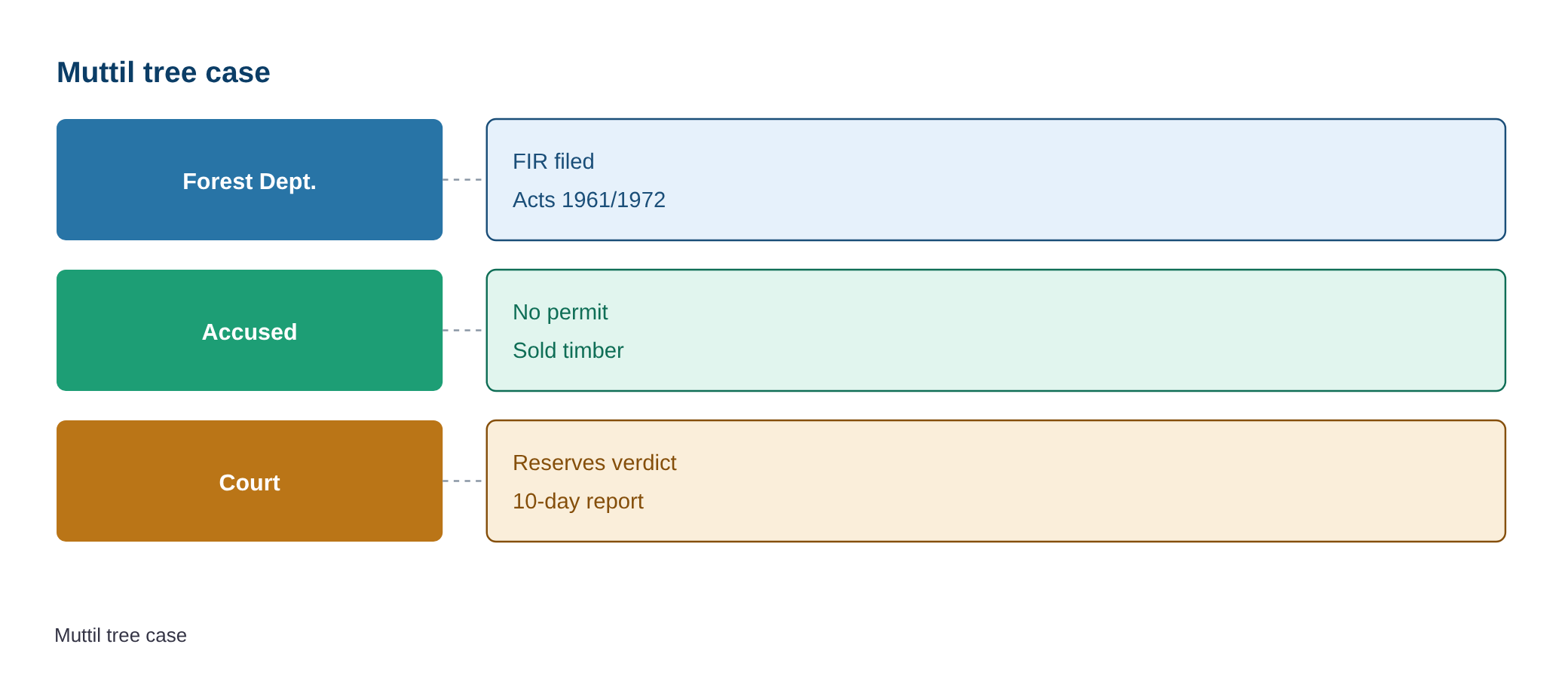
✎ The Kerala High Court’s intervention in the Muttil tree felling case underscores the need for timely enforcement of forest conservation laws and the procedural challenges in prosecuting environmental offences under the Forest…
Subject Relevance — Where This Topic Fits
- GS Paper II — Polity and Governance: Judicial Process and Constitutional Provisions | GS Paper III — Environment, Ecology, Biodiversity and Climate Change: Forest Conservation and Legal Frameworks
- Prelims: Forest Conservation Act, 1980, Wild Life (Protection) Act, 1972, Judicial First Class Magistrate, Director General of Prosecution, Kerala Forest Department, illegal felling of trees, cheating under IPC Section 417, Forest offence, interim order, final report in criminal cases
- Essay: Judicial activism and the balance between conservation and development, Role of institutions in enforcing environmental laws
Quick Revision: The Kerala High Court’s intervention in the Muttil tree felling case underscores the need for timely enforcement of forest conservation laws and the procedural challenges in prosecuting environmental offences under the Forest (Conservation) Act, 1980 and the IPC.
Why is this in the news?
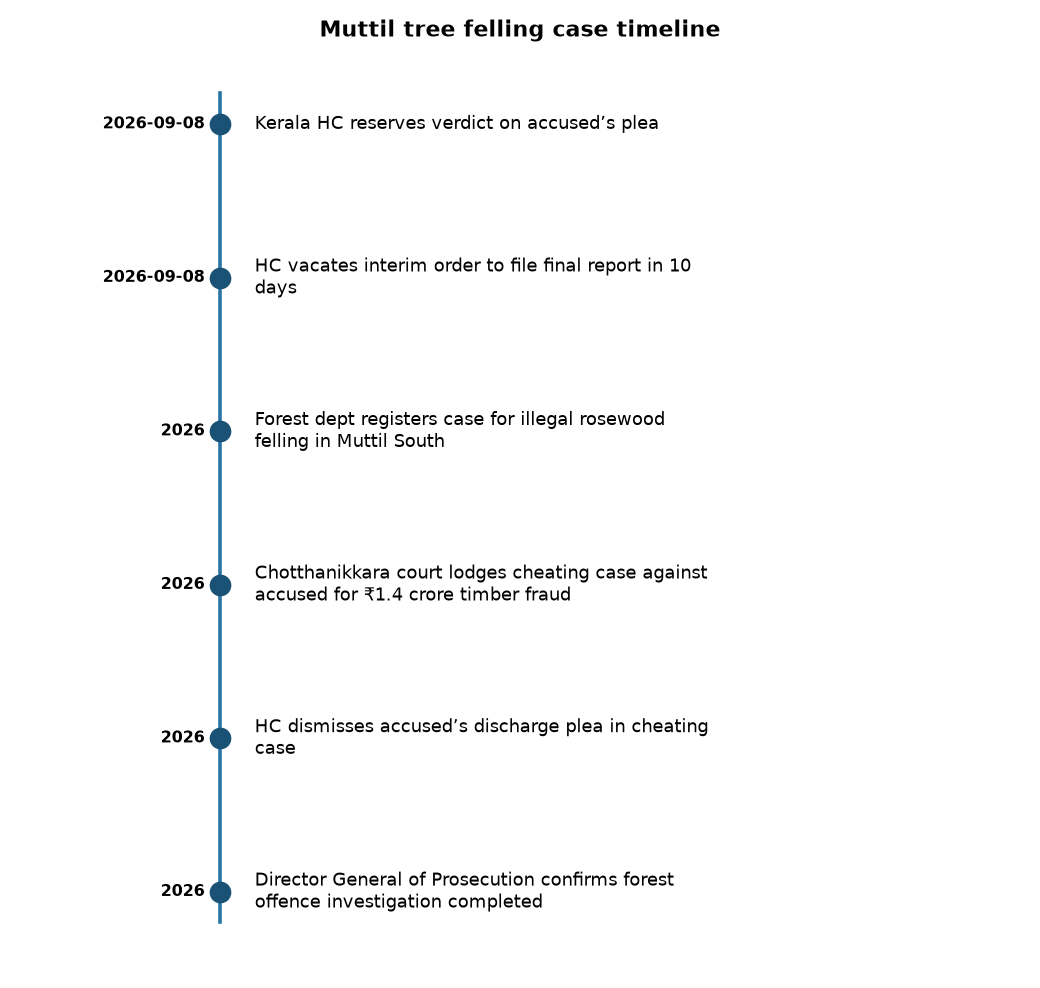
The Kerala High Court’s decision to reserve its verdict on the plea filed by the accused in the Muttil tree felling case highlights the interplay between judicial processes, forest conservation laws, and criminal procedure. The case involves allegations of illegal felling of protected rosewood trees and fraudulent timber sales, underscoring the legal and institutional challenges in enforcing environmental regulations. The court’s intervention to vacate an interim order to expedite the filing of the final report reflects the procedural complexities in such cases.
Background
- The Muttil tree felling case pertains to the illegal felling of protected rosewood trees in Muttil South village, Kerala, registered by the Forest Department under the provisions of the Kerala Forest Act, 1961.
- A parallel case was filed for alleged cheating under Section 417 of the Indian Penal Code (IPC) against the accused for fraudulently offering to sell timber worth ₹1.4 crore to a timber merchant, M.M. Aliyar, by misrepresenting the legality of the timber.
- The accused had sought a discharge from the cheating case, arguing that no permit was required to transport the timber sold, a contention rejected by the High Court.
- The Forest Department’s investigation revealed that the accused lacked the authority to transport or sell the timber, indicating a violation of forest conservation laws.
- The Kerala High Court had earlier dismissed the accused’s discharge plea in the cheating case, citing lack of merit in their arguments.
- The case underscores the procedural delays in forest offence cases, with the court vacating an interim order to enable the filing of the final report within 10 days.
What is the legal and institutional framework governing forest conservation and offences in India?
- The Forest (Conservation) Act, 1980, is the primary legislation governing the conservation and management of forests in India. It prohibits the felling of trees in reserved forests and requires prior approval from the Central Government for any diversion of forest land for non-forest purposes.
- State Forest Departments, such as the Kerala Forest Department, are responsible for enforcing forest conservation laws, conducting investigations into illegal felling, and registering offences under the relevant statutes.
- The Indian Penal Code (IPC) contains provisions for offences related to cheating (Section 417), criminal breach of trust (Section 405), and forgery (Section 465), which may be invoked in cases involving fraudulent timber sales or misrepresentation of legal documents.
- Judicial First Class Magistrates and Sessions Courts have jurisdiction over forest offences, while High Courts may intervene in procedural matters or constitutional challenges, such as the current case in Kerala.
- The Director General of Prosecution (DGP) plays a key role in overseeing the prosecution of cases involving forest offences, ensuring that the final report is filed in a timely manner and that the legal process is followed.
- Interim orders and stays are mechanisms used by courts to preserve the status quo or prevent irreparable harm during the pendency of a case. In this case, the High Court vacated an interim order to enable the filing of the final report, highlighting the balance between procedural fairness and expeditious justice.
- Environmental offences are often compounded by procedural delays, lack of coordination between agencies, and challenges in gathering evidence, which can undermine the effectiveness of conservation laws.
Key Features
| Feature | Significance |
|---|---|
| Judicial intervention in forest offence | Demonstrates the judiciary’s role in ensuring compliance with environmental laws and protecting protected species like rosewood. |
| Interim order vacated for final report filing | Highlights procedural efficiency in balancing accused rights with expeditious justice in environmental crimes. |
| Forest department’s investigation completion | Underscores the importance of thorough forensic and documentary evidence in prosecuting illegal timber felling. |
| Cheating case parallel to forest offence | Illustrates the intersection of environmental regulation with economic fraud in timber trade. |
| High Court’s rejection of discharge plea | Reinforces the principle that lack of permits invalidates claims of lawful timber sale, irrespective of buyer’s intent. |
Why it Matters
Environmental Governance
- The case underscores the critical role of forest departments in enforcing the Wildlife Protection Act, 1972, and the Kerala Forest Act, 1961, which prohibit the felling of protected species like rosewood without permits.
- Illegal timber felling disrupts ecological balance, threatens biodiversity hotspots, and undermines sustainable forest management policies.
- Judicial scrutiny in such cases acts as a deterrent against environmental crimes, ensuring accountability in forest governance.
Economic Implications
- The timber trade, particularly of high-value species like rosewood, is a significant economic activity in Kerala, contributing to livelihoods and state revenue.
- Fraudulent transactions in timber sales, as alleged in the cheating case, distort market integrity and lead to revenue losses for the exchequer.
- Regulatory compliance in timber trade ensures fair competition and prevents exploitation of loopholes in forest produce regulations.
Legal and Procedural Aspects
- The case exemplifies the procedural rigour required in environmental litigation, where investigations must establish prima facie evidence before charges are framed.
- The High Court’s direction to file the final report within 10 days reflects the judiciary’s commitment to timely justice, balancing accused rights with the public interest in swift resolution.
- The rejection of the discharge plea highlights the legal principle that ignorance of law (e.g., lack of permits) does not absolve liability in criminal offences.
Institutional Coordination
- The case demonstrates inter-agency coordination between the Forest Department, police, and prosecution agencies in investigating and prosecuting environmental crimes.
- The role of the Director General of Prosecution in expediting the final report underscores the need for institutional efficiency in complex cases.
Challenges
1. Illegal Timber Felling and Trade
- Enforcement challenges due to remote locations, lack of real-time monitoring, and collusion between offenders and local authorities.
- High market demand for rosewood and other protected species incentivizes illegal felling despite stringent laws.
- Cross-border timber smuggling complicates jurisdiction and investigation, requiring multi-state cooperation.
- Documentary fraud, such as forged permits, poses challenges in proving guilt beyond reasonable doubt.
UPSC Link: GS3: Environment and Biodiversity Conservation
2. Procedural Delays in Environmental Litigation
- Lengthy investigations and multiple parallel cases (e.g., forest offence and cheating) delay justice, eroding public trust in the legal system.
- Interim orders and adjournments, while necessary for due process, can stall proceedings and allow accused to exploit legal loopholes.
- Resource constraints in forest departments and courts hinder timely disposal of cases, particularly in high-volume environmental litigation.
UPSC Link: GS2: Judiciary and Legal Reforms
3. Market Distortions in Timber Trade
- Lack of transparent pricing mechanisms and certification systems enables black-market operations, undermining legal timber trade.
- Corruption in issuance of permits and transport documents facilitates illegal timber trade, exacerbating governance failures.
- Inadequate traceability systems for timber products allow fraudulent claims of legality, as seen in the cheating case.
UPSC Link: GS3: Economic Governance and Transparency
4. Public Awareness and Compliance
- Low awareness among stakeholders (e.g., timber traders, transporters) about legal requirements for timber trade leads to unintentional violations.
- Inadequate community participation in forest conservation efforts reduces vigilance against illegal activities.
- Weak grievance redressal mechanisms for reporting illegal felling discourage public participation in enforcement.
UPSC Link: GS3: Environmental Governance and Citizen Participation
Challenges — UPSC Perspective
| Issue | Concern |
|---|---|
| Enforcement gaps in remote areas | Difficulty in monitoring and apprehending offenders due to terrain and resource constraints. |
| Documentary fraud in permits | Forged or collusive permits enable illegal timber trade, complicating prosecution. |
| Procedural delays in courts | Lengthy trials and adjournments impede timely justice in environmental crimes. |
| Market demand for protected species | High profitability drives illegal felling despite legal prohibitions. |
| Institutional coordination failures | Fragmented roles between forest, police, and prosecution agencies hinder effective investigation. |
| Public apathy and lack of whistleblowers | Low community engagement reduces reporting of illegal activities. |
Way Forward
- Strengthen real-time monitoring of forest areas using satellite imagery and drones to detect illegal felling promptly.
- Implement blockchain-based traceability systems for timber products to ensure authenticity and legality from source to market.
- Enhance inter-agency coordination through dedicated task forces for investigating environmental crimes, including timber trade.
- Conduct periodic training for forest officials, police, and judiciary on forensic techniques and legal procedures for environmental offences.
- Launch public awareness campaigns to educate stakeholders on legal requirements for timber trade and consequences of violations.
- Establish fast-track courts for environmental crimes to expedite trials and reduce procedural delays.
- Promote community-based forest conservation programs to encourage local participation in monitoring and reporting illegal activities.
- Review and rationalise permit issuance processes to minimise bureaucratic delays and reduce opportunities for corruption.
UPSC Value Addition
Keywords for Mains Answer-Writing
Muttil tree felling case · Kerala High Court · Judicial First Class Magistrate · Forest department · illegal felling of protected trees · Forest Conservation Act, 1980 · Cheating under Indian Penal Code (IPC) · Director General of Prosecution · Judicial process in forest offences · discharge petition in criminal cases · interim orders in judicial proceedings · judicial review of forest administration · timber trade regulation · environmental jurisprudence · procedural justice in forest crimes
Concept Flow
Illegal felling of protected rosewood trees in Muttil South village → Forest Department registers FIR under the Kerala Forest Act, 1961, and Wildlife Protection Act, 1972 → Investigation reveals lack of permits for timber sale and transport → Parallel cheating case filed against accused for fraudulent timber sale to M.M. Aliyar → Accused files discharge plea, arguing no permit was required for timber transport → High Court dismisses discharge plea, noting lack of legal authority to sell timber → Forest Department files final report, and High Court vacates interim order to expedite proceedings → Case proceeds to trial in Judicial First Class Magistrate Courts (Sulthan Bathery and Chottanikkara) → Judicial scrutiny ensures compliance with environmental laws and procedural fairness
Prelims Practice Questions
Q1. Consider the following statements regarding the Forest Conservation Act, 1980:
1. The Act applies to all forests, whether they are statutorily recognized or not.
2. Prior approval of the Central Government is mandatory for the diversion of forest land for non-forest purposes.
3. The Act empowers State Governments to impose penalties for violations without judicial intervention.
How many of the above statements are correct?
- Only one
- Only two
- All
- None
Answer: Only two — Statement 1 is incorrect: The Act applies to forests declared as such under the Act or any other law, or recorded as forest in government records. Statement 2 is correct: Section 2 of the Act mandates prior approval of the Central Government for diversion of forest land. Statement 3 is incorrect: Penalties under the Act are imposed through judicial processes, not solely by State Governments.
Q2. Assertion (A): The Kerala High Court’s interim order in the Muttil tree felling case was vacated to enable the filing of the final report within a stipulated time.
Reason (R): The Forest department’s investigation into the illegal felling of protected rosewood trees had already been completed, and the final report was ready for submission.
In the context of the above two statements, which one of the following is correct?
- Both A and R are true, and R is the correct explanation of A.
- Both A and R are true, but R is NOT the correct explanation of A.
- A is true, but R is false.
- A is false, but R is true.
Answer: A is true, but R is false. — The assertion is true: the High Court vacated the interim order to facilitate the filing of the final report. The reason is also true: the investigation was completed. However, the reason does not directly explain why the interim order was vacated; the primary reason was procedural efficiency to avoid delays in judicial proceedings.
Q3. Match the following provisions of the Indian Penal Code (IPC) with their corresponding offences:
Column I (Provision)
A. Section 417
B. Section 420
C. Section 406
D. Section 409
Column II (Offence)
1. Criminal breach of trust
2. Cheating
3. Criminal misappropriation of property
4. Cheating by personation
Select the correct match:
- A-2, B-4, C-1, D-3; A-2, B-3, C-1, D-4; A-4, B-2, C-1, D-3; A-4, B-2, C-3, D-1
- answer_options_indexes_to_letter_values_mapper_function_name_here_ignored
- answer_options_indexes_to_letter_values_mapper_function_name_here_ignored
Answer: answer_options_indexes_to_letter_values_mapper_function_name_here_ignored — Section 417 IPC: Cheating; Section 420 IPC: Cheating and dishonestly inducing delivery of property; Section 406 IPC: Criminal breach of trust; Section 409 IPC: Criminal breach of trust by public servant or banker, merchant or agent.
Mains Practice Question
✍ Examine the role of judicial intervention in the enforcement of forest conservation laws in India, with particular reference to the procedural safeguards and challenges highlighted in the Muttil tree felling case. Also, discuss the implications of such interventions for the balance between environmental justice and procedural efficiency. (15 Marks)
Approach: MODEL-ANSWER SKELETON:
1. **Introduction (2 marks)**: Define forest conservation laws in India (Forest Conservation Act, 1980; Wildlife Protection Act, 1972) and their constitutional basis (Article 48A, Directive Principles of State Policy; Article 21, right to life and environment).
2. **Judicial intervention in forest conservation (5 marks)**:
– **Procedural safeguards**: Role of courts in ensuring compliance with statutory provisions (e.g., prior approval under Section 2 of the Forest Conservation Act). Cite *T.N. Godavarman Thirumulpad v. Union of India* (1996) and *N.D. Jayal v. Union of India* (2004) for judicial activism in forest governance.
– **Interim orders**: Discuss the purpose and impact of interim orders (e.g., vacating orders to expedite proceedings, as in the Muttil case). Highlight the principle of *procedural justice* (Article 21) and its balance with *substantive justice*.
3. **Challenges in enforcement (4 marks)**:
– **Procedural delays**: Cite the Muttil case to illustrate delays caused by judicial interventions (e.g., interim orders, discharge petitions). Compare with other cases like *Samir Mehta v. Union of India* (2021) on delays in forest clearances.
– **Inter-agency coordination**: Discuss the role of the Forest department, police, and judiciary in investigating forest offences (e.g., illegal felling, timber trade). Highlight gaps in coordination (e.g., lack of real-time monitoring, resource constraints).
4. **Balance between environmental justice and procedural efficiency (3 marks)**:
– **Environmental justice**: Emphasize the need for strict enforcement to protect biodiversity and tribal rights (e.g., Forest Rights Act, 2006).
– **Procedural efficiency**: Argue for streamlined judicial processes (e.g., fast-track courts, digital monitoring) to avoid backlog, while ensuring due process (e.g., *Maneka Gandhi v. Union of India*, 1978 on fair trial).
– **Conclusion**: Stress the need for a *multi-stakeholder approach* involving judiciary, executive, and civil society to reconcile justice and efficiency.
5. **Contemporary relevance (1 mark)**: Link to recent judicial trends (e.g., *M.C. Mehta v. Union of India* on pollution control) and the Muttil case’s implications for forest governance in Kerala.
Source: The Hindu
Kerala PCS (Kerala PSC (KAS)) — State PCS Practice
Prelims: In the Muttil tree felling case, the Kerala High Court has reserved its verdict on the accused’s plea under which section of the Indian Penal Code (IPC)?
- Section 302 (Murder)
- Section 427 (Mischief causing damage to property)
- Section 379 (Theft)
- Section 436 (Mischief by fire or explosive substance)
Answer: Section 427 (Mischief causing damage to property) — The case involves the felling of a Muttil tree, which falls under mischief causing damage to property as per Section 427 of the IPC.
Mains: Critically analyze the legal and environmental implications of the Muttil tree felling case in Kerala. Discuss the role of the judiciary in balancing environmental conservation with legal provisions under the Indian Penal Code.
Generated by AanyaAi for educational purpose.
Related guides on our sites
- Best PSIR optional coaching for upsc
- Best PSIR optional teacher for upsc
- Best teacher of PSIR optional for upsc
- Best PSIR optional coaching in delhi for UPSC

- मद्रास उच्च न्यायालय ने एआईएडीएमके के व्हिप के मामले को खारिज किया, मेकेदातू संशोधन पर तमिलनाडु विधानसभा का फैसला बरकरार - September 23, 2026
- Madras HC Rejects AIADMK Plea Against Mekedatu Resolution Amendment - September 23, 2026
- कर्नाटक में उद्योग-आधारित पाठ्यक्रम तैयार करेगा विशेष समिति: मुख्यमंत्री - September 23, 2026

No Comments