


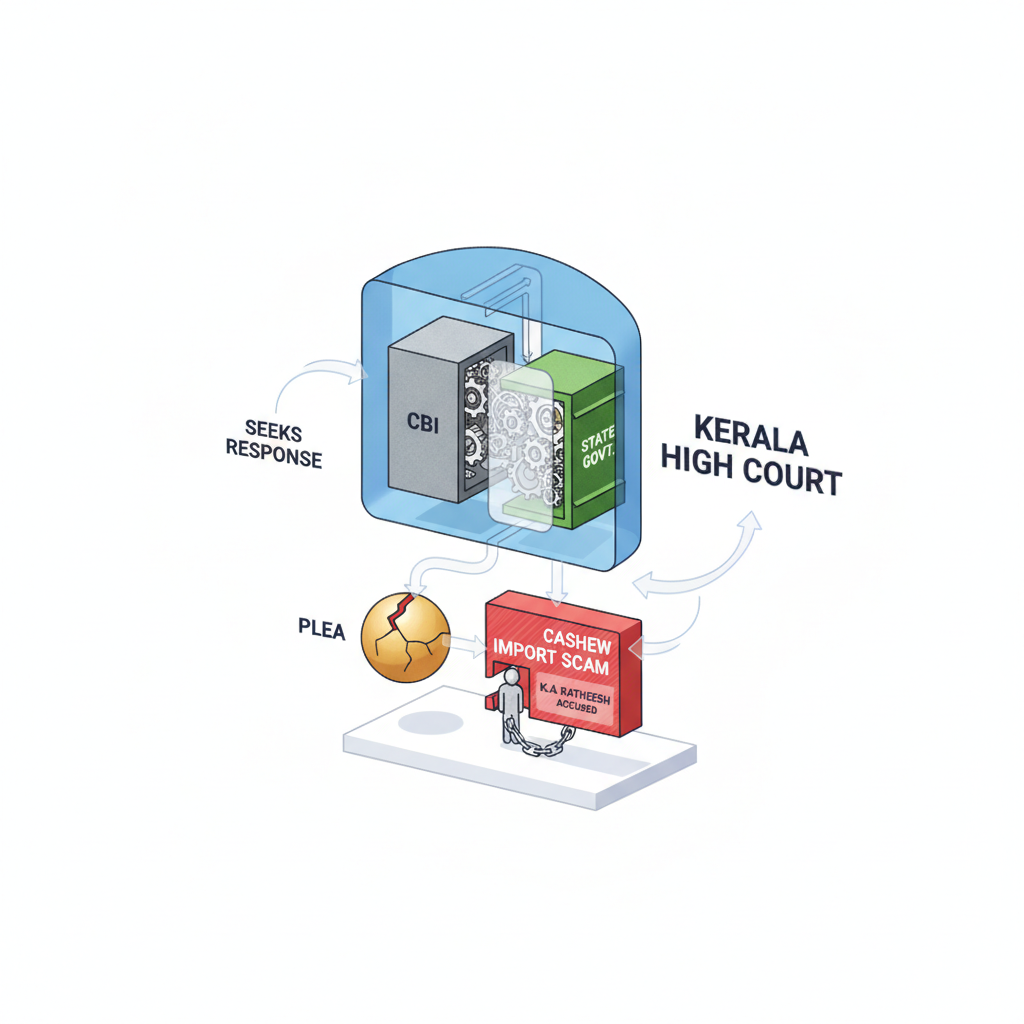
08 Aug Kerala HC seeks CBI, State reply on cashew scam accused’s govt posts
Kerala High CourtCentral Bureau of InvestigationState governmentK.A. Ratheesh✎ The Kerala High Court's intervention in the cashew import scam underscores the critical role of judicial oversight and investigative agencies like the CBI in ensuring accountability and upholding public integrity in governance.
Subject Relevance — Where This Topic Fits
- GS Paper II — Governance, Constitution, Polity, Social Justice and International Relations | GS Paper IV — Ethics, Integrity, and Aptitude
- Prelims: Kerala High Court, Central Bureau of Investigation (CBI), Kerala State Cashew Development Corporation (KSCDC), Corruption in public office, Vigilance Director, Khadi and Village Industries Board
- Essay: The imperative of ethical governance in fostering public trust and economic development., Combating corruption: institutional mechanisms and challenges in ensuring accountability.
Quick Revision: The Kerala High Court’s intervention in the cashew import scam underscores the critical role of judicial oversight and investigative agencies like the CBI in ensuring accountability and upholding public integrity in governance.
Why is this in the news?
The Kerala High Court has sought responses from the Central Bureau of Investigation (CBI) and the State government regarding a petition challenging the appointment of K.A. Ratheesh, an accused in the ₹600-crore cashew import scam, to key government positions. The petition, filed by K.M. Shajahan, alleges that such appointments violate established norms of public integrity and transparency, particularly given that prosecution sanction has been granted in the corruption case against Mr. Ratheesh, who currently holds multiple significant posts including Secretary of the Kerala Khadi and Village Industries Board.
Background
- K.A. Ratheesh, former Managing Director of the Kerala State Cashew Development Corporation (KSCDC), is the first accused in a CBI case concerning alleged misappropriation in the import of raw cashew between 2006 and 2015.
- The allegations involve dishonestly awarding tenders to a private supplier for purchasing cashews at inflated rates, thereby circumventing established store purchase rules.
- The estimated financial misappropriation in the scam is approximately ₹600 crore.
- The petitioner, K.M. Shajahan, has highlighted that Mr. Ratheesh continues to hold crucial government positions despite being chargesheeted by the CBI and having prosecution sanction granted against him.
- Current posts held by Mr. Ratheesh include Secretary, Kerala Khadi and Village Industries Board; Managing Director, RUTRONIX; and Chief Executive Officer, Kerala Khadi Workers’ Welfare Fund Board.
- The petition underscores concerns about potential further financial losses, citing allegations of the Khadi Board purchasing substandard materials from unauthorised traders.
Understanding the Central Bureau of Investigation (CBI) and its Role
- The Central Bureau of Investigation (CBI) is the premier investigating agency of India, functioning under the jurisdiction of the Ministry of Personnel, Public Grievances and Pensions.
- It was established in 1963 by a resolution of the Ministry of Home Affairs, drawing its powers from the Delhi Special Police Establishment Act, 1946.
- The CBI is primarily responsible for investigating a wide range of criminal cases, including corruption, economic offences, and serious organised crime.
- Its mandate includes investigating cases of corruption against public servants, economic frauds, and cases of national and international ramifications.
- The agency plays a crucial role in upholding public integrity by prosecuting individuals involved in corrupt practices within government and public sector undertakings.
- State governments can refer cases to the CBI, and the Supreme Court and High Courts can also direct the CBI to investigate cases without the consent of the state.
Key Features
| Feature | Significance |
|---|---|
| Alleged misappropriation in raw cashew imports (2006-2015) | Highlights systemic failures in procurement norms, tender processes, and financial oversight in a key agro-processing sector. |
| CBI chargesheet against K.A. Ratheesh and R. Chandrasekharan | Demonstrates the investigative role of the Central Bureau of Investigation in high-value corruption cases involving public sector undertakings. |
| Kerala State Cashew Development Corporation (KSCDC) involvement | Reveals vulnerabilities in state-owned enterprises where political and administrative oversight may be compromised. |
| Petition seeking bar on accused holding government posts | Raises constitutional and ethical questions about the eligibility of individuals facing corruption charges to hold public office. |
| Ongoing vigilance and judicial scrutiny | Showcases the role of the judiciary and vigilance mechanisms in ensuring accountability and transparency in public administration. |
Why it Matters
Economic Governance
- Exposes systemic inefficiencies in public procurement, particularly in the agro-processing sector, leading to financial losses and resource misallocation.
- Undermines public trust in state-owned enterprises and their capacity to manage strategic commodities like cashew nuts.
- Highlights the economic cost of corruption in terms of direct financial loss (₹600 crore) and indirect reputational damage to Kerala’s agro-industry.
Institutional Integrity
- Questions the efficacy of vigilance mechanisms and anti-corruption agencies in preventing and prosecuting financial irregularities in public sector undertakings.
- Raises concerns about the appointment of individuals facing corruption charges to key administrative positions, potentially compromising institutional integrity.
- Demonstrates the judiciary’s proactive role in ensuring accountability by directing responses from investigative agencies and the executive.
Legal and Ethical Dimensions
- Reinforces the principle that individuals facing serious corruption charges should not hold positions of public trust pending resolution of their cases.
- Highlights the ethical obligations of public servants to uphold transparency and integrity, even in the face of political pressures.
- Showcases the use of public interest litigation (PIL) as a tool to challenge administrative decisions that violate norms of probity.
Public Policy Implications
- Underscores the need for stricter procurement norms, transparent tender processes, and independent audits in state-owned enterprises.
- Calls for reforms in the appointment and tenure policies of public officials, particularly those facing corruption allegations.
- Emphasises the importance of inter-agency coordination between the CBI, state vigilance, and judiciary to expedite corruption cases.
Challenges
1. Institutional Delays in Corruption Prosecution
- Prolonged legal proceedings (e.g., cases dating back to 2006-2015) delay justice and allow accused individuals to hold public office.
- Overburdened judiciary and investigative agencies struggle to expedite high-profile corruption cases.
UPSC Link: GS2: Role of CBI, Judiciary and Public Accounts Committee in tackling corruption
2. Conflict of Interest in Public Appointments
- Appointment of individuals facing corruption charges to key government posts undermines public confidence in governance.
- Lack of clear guidelines on the eligibility of accused individuals to hold public office post-chargesheet.
UPSC Link: GS4: Ethics in Governance – Conflict of Interest and Probity
3. Weakening of Vigilance Mechanisms
- Inadequate vigilance and internal audits in state-owned enterprises may enable financial irregularities to go unchecked.
- Dependence on external agencies (e.g., CBI) for investigations highlights systemic gaps in internal oversight.
UPSC Link: GS2: Institutional mechanisms for transparency and accountability
4. Political Interference in Administrative Decisions
- Potential political influence in the appointment and retention of officials facing corruption charges.
- Lack of autonomy in the functioning of public sector undertakings, particularly in procurement and financial management.
UPSC Link: GS2: Separation of powers and checks and balances
5. Economic Losses and Resource Misallocation
- Direct financial losses (₹600 crore) and potential additional losses (₹300 crore) due to substandard procurement practices.
- Misallocation of resources in a key agro-processing sector, impacting livelihoods and economic stability.
UPSC Link: GS3: Government Budgeting and Resource Mobilisation
6. Public Trust Erosion
- Corruption scandals in public sector undertakings erode public trust in government institutions and their economic policies.
- Undermines investor confidence and the credibility of Kerala’s agro-industry.
UPSC Link: GS4: Citizen’s Charter and Transparency in Governance
Challenges — UPSC Perspective
| Issue | Concern |
|---|---|
| Prolonged legal proceedings | Delays justice and allows accused to hold public office. |
| Conflict of interest in appointments | Undermines public confidence in governance and ethical standards. |
| Weak vigilance mechanisms | Enables financial irregularities to persist unchecked in public sector undertakings. |
| Political interference | Compromises autonomy and integrity of administrative decisions. |
| Economic resource misallocation | Leads to direct financial losses and undermines sectoral growth. |
| Public trust erosion | Damages credibility of institutions and investor confidence. |
Way Forward
- Strengthen internal vigilance mechanisms in state-owned enterprises through mandatory audits and real-time monitoring of procurement processes.
- Enact clear guidelines to bar individuals facing serious corruption charges from holding public office pending trial, aligning with constitutional principles of probity.
- Expedite judicial processes in corruption cases by setting up special courts or fast-track mechanisms to ensure timely justice.
- Enhance transparency in tender processes by mandating e-procurement, third-party audits, and public disclosure of award criteria.
- Implement conflict-of-interest policies to prevent the appointment of accused individuals to key administrative positions.
- Conduct periodic reviews of the functioning of public sector undertakings to identify systemic vulnerabilities and rectify governance gaps.
- Promote whistleblower protection mechanisms to encourage reporting of financial irregularities without fear of retaliation.
- Undertake capacity-building initiatives for officials in procurement, financial management, and vigilance to reduce procedural lapses.
UPSC Value Addition
Keywords for Mains Answer-Writing
Public integrity and transparency in governance · Corruption in public procurement · CBI and State government responses to corruption allegations · Vigilance mechanisms in India · Prosecution sanction in corruption cases · Role of High Courts in addressing corruption · KSCDC cashew import scam · Public office eligibility for chargesheeted officials · Constitutional norms of probity in public life · Transparency in government appointments
Constitutional & Policy Linkages
- [‘Article 14: Equality before law and equal protection of laws’, ‘Ensures fair treatment of accused individuals in appointments.’]
- [‘Article 16: Equality of opportunity in public employment’, ‘Prohibits discrimination but must balance with integrity concerns.’]
- [‘Article 311: Safeguards against arbitrary dismissal of public servants’, ‘Raises questions on eligibility of accused individuals to hold office.’]
- [‘Directive Principles of State Policy (DPSP), Article 39A’, ‘Emphasises equal justice and reduction of inequality in governance.’]
Concept Flow
Alleged financial irregularities in KSCDC (2006-2015) → CBI investigation and chargesheet → Accused (Ratheesh) appointed to key government posts → Petition filed in Kerala High Court → Judicial scrutiny and direction for responses → Broader implications for institutional integrity and governance.
Prelims Practice Questions
Q1. Consider the following statements regarding the Kerala State Cashew Development Corporation (KSCDC) scam:
1. The alleged misappropriation involved the import of raw cashew between 2006 and 2015.
2. K.A. Ratheesh, the former Managing Director of KSCDC, is the first accused in the CBI case.
3. The scam involved the awarding of tenders to private suppliers at inflated rates.
4. The total financial loss estimated in the scam is ₹300 crore.
How many of the above statements are correct?
- Only one
- Only two
- Only three
- All four
Answer: Only three — Statements 1, 2, and 3 are correct. Statement 4 is incorrect as the estimated financial loss is ₹600 crore, not ₹300 crore.
Q2. Assertion (A): The Kerala High Court has directed the CBI and the State government to respond to allegations of appointing a chargesheeted official to key government posts.
Reason (R): The petitioner alleged that such appointments violate norms of public integrity and transparency.
Options:
A. Both A and R are true, and R is the correct explanation of A.
B. Both A and R are true, but R is not the correct explanation of A.
C. A is true, but R is false.
D. A is false, but R is true.
Answer: ? — Both the assertion and reason are true. The High Court’s direction to respond is a procedural step following the petitioner’s allegation that the appointment violates public integrity norms, making R the correct explanation of A.
Q3. Match the following officials with their alleged roles in the Kerala cashew import scam:
Column I (Official) | Column II (Alleged Role)
——————- | ———————-
1. K.A. Ratheesh | A. Former Chairman of KSCDC
2. R. Chandrasekharan | B. Former Managing Director of KSCDC
3. V.S. Achuthananthan | C. Former Chief Minister of Kerala
4. K.M. Shajahan | D. Former Additional Private Secretary to the Chief Minister
Options:
A. 1-B, 2-A, 3-C, 4-D
B. 1-A, 2-B, 3-C, 4-D
C. 1-B, 2-A, 3-D, 4-C
D. 1-D, 2-C, 3-A, 4-B
Answer: ? — K.A. Ratheesh is the former Managing Director of KSCDC (1-B), R. Chandrasekharan is the former Chairman of KSCDC (2-A), V.S. Achuthananthan is the former Chief Minister of Kerala (3-C), and K.M. Shajahan is the former Additional Private Secretary to the Chief Minister (4-D).
Mains Practice Question
✍ The appointment of officials facing corruption charges to key government posts undermines the constitutional principles of probity and transparency in public life. Critically examine this proposition with reference to the Kerala cashew import scam and the role of vigilance mechanisms in India. (15 Marks)
Approach: MODEL-ANSWER SKELETON:
1. **Constitutional Framework**: Art. 311 (2) (probity in public employment), Art. 14 (equality), and Art. 300A (property rights) — discuss the balance between disciplinary action and continued service.
2. **Vigilance Mechanisms**: Role of CBI (under DSPE Act, 1946), Central Vigilance Commission (CVC) guidelines, and State Vigilance Departments — highlight the need for expeditious disposal of corruption cases.
3. **Kerala Case Analysis**: KSCDC scam (₹600 crore), CBI chargesheet, prosecution sanction granted, and the petitioner’s concerns about continued appointment of Ratheesh — link to violation of norms.
4. **Judicial Precedents**: Cite relevant Supreme Court judgments (e.g., *Union of India v. Tulsiram Patel*, 2006; *State of Punjab v. Ram Lubhaya Bagga*, 1998) on disciplinary proceedings and constitutional safeguards.
5. **Proposed Reforms**: Suggest measures such as automatic suspension pending trial, time-bound vigilance inquiries, and transparency in appointments to sensitive posts.
6. **Balanced View**: Acknowledge the presumption of innocence until proven guilty but argue that high public office demands higher standards of integrity.
Source: The Hindu
Generated by AanyaAi for educational purpose.

- हिमाचल में बाल पोषण योजना: अब सप्ताह में दो बार मिलेगा अंडा या फल - September 23, 2026
- Himachal Pradesh’s Nutritious Food Scheme: Eggs/Fruits Twice Weekly for 5.5L Students - September 23, 2026
- रिफाइनरी क्षेत्र के लिए ऊर्जा सुरक्षा और नेट-ज़ीरो लक्ष्य में संतुलन जरूरी: विशेषज्ञ - September 23, 2026

No Comments