


11 Aug Kerala HC Stays SIC Order on PSC Mark Disclosure: Key RTI & Privacy Issues
Kerala High CourtState Information CommissionPublic Service CommissionPlanning BoardRTI ActPersonal data✎ Under the RTI Act, personal information of candidates in public recruitment examinations can only be disclosed if a compelling public interest is established, as per Section 8(1)(j), and the State Information Commission must…
Subject Relevance — Where This Topic Fits
- GS Paper II — Judiciary and Constitutional Framework | GS Paper III — Transparency and Accountability in Governance | GS Paper IV — Ethics in Governance: Privacy and Transparency
- Prelims: Right to Information Act, 2005; Public Service Commission; State Information Commission; Right to Privacy; Article 21 of the Constitution; Section 8(1)(j) of RTI Act
- Essay: Transparency vs. Privacy: Balancing Public Interest and Individual Rights in Governance, The Role of Judiciary in Upholding Constitutional Values in Administrative Decisions
Quick Revision: Under the RTI Act, personal information of candidates in public recruitment examinations can only be disclosed if a compelling public interest is established, as per Section 8(1)(j), and the State Information Commission must weigh this against the right to privacy guaranteed under Article 21 of the Constitution.
Why is this in the news?
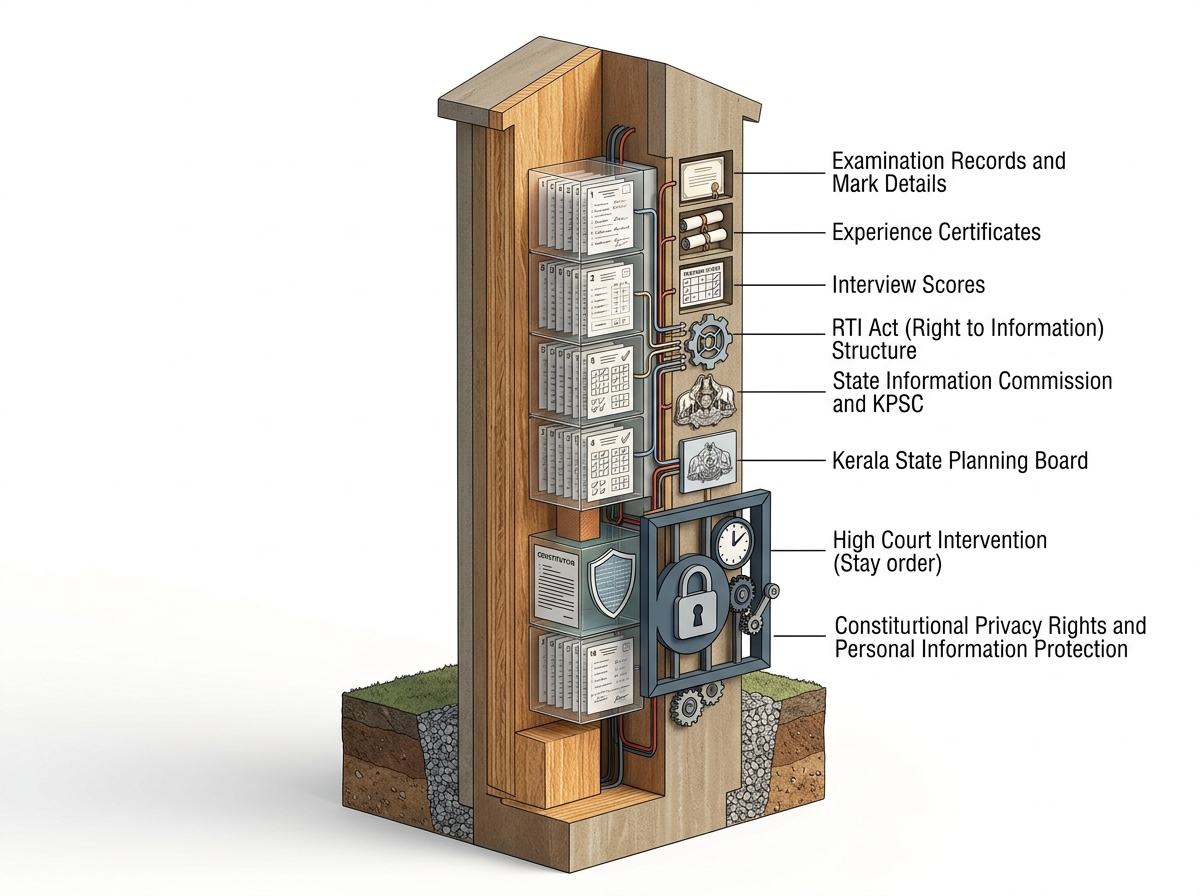
The Kerala High Court has stayed, for a month, an order of the State Information Commission directing the Kerala Public Service Commission (PSC) to disclose examination records—including marks, experience certificates, and interview scores—to the Kerala State Planning Board under the Right to Information (RTI) Act, 2005. The case raises critical questions about the balance between transparency in public recruitment processes and the protection of personal information of candidates under the RTI Act and constitutional privacy rights.
Background
- The KPSC contested the KSIC’s order, arguing that the requested information constituted personal data of third parties and that no overriding public interest justified its disclosure under the RTI Act.
- The KPSC highlighted the impracticality of disclosing personal credentials for over 1.25 crore candidates, asserting that it already publishes aggregated rank lists and marks after completing the selection process.
- The third-ranked candidate in the recruitment examination had sought the information under the RTI Act, contending that non-disclosure violated transparency norms.
- The Kerala High Court, while staying the KSIC’s order for a month, posted the matter for hearing on September 10, 2026, to examine the legal and constitutional validity of the disclosure.
- The case underscores the recurring tension between the RTI Act’s mandate for transparency and the constitutional protection of privacy under Article 21 of the Constitution.
What is the Legal and Constitutional Framework Governing Disclosure of Examination Records under the RTI Act?
- The Right to Information Act, 2005, empowers citizens to seek information from public authorities, subject to specific exemptions under Section 8, including personal information that has no public interest.
- Section 8(1)(j) of the RTI Act exempts disclosure of personal information if it has no relationship to any public activity or interest, or if disclosure would cause unwarranted invasion of privacy, unless the competent authority or the Central or State Information Commission determines that larger public interest justifies the disclosure.
- Article 21 of the Constitution guarantees the right to privacy as part of the right to life and personal liberty, which has been interpreted by the Supreme Court to include informational privacy in landmark judgments such as *Puttaswamy v. Union of India* (2017).
- Public Service Commissions (PSCs) in India conduct recruitment examinations for government services and are public authorities under the RTI Act, making them subject to transparency obligations while also bound by privacy protections.
- The Kerala Public Service Commission (KPSC) contends that examination records, including marks and experience certificates, are personal information of candidates and their disclosure without compelling public interest would violate privacy rights.
- The State Information Commission (SIC) is empowered under the RTI Act to direct disclosure of information if it determines that public interest outweighs privacy concerns, as per Section 19(8)(a) of the Act.
- The Kerala High Court’s intervention highlights the judiciary’s role in adjudicating conflicts between transparency obligations and privacy rights, ensuring that administrative decisions align with constitutional and statutory mandates.
- The case reflects broader debates on the scope of RTI in recruitment processes, where transparency in selection is balanced against the protection of candidates’ personal data, particularly in high-stakes examinations.
Key Features
| Feature | Significance |
|---|---|
| Right to Information Act, 2005 (RTI Act) | Establishes the legal framework for citizens to access information held by public authorities, balancing transparency with privacy and confidentiality. |
| State Information Commission (SIC) | Quasi-judicial body constituted under the RTI Act to adjudicate disputes between citizens and public authorities regarding information access requests. |
| Kerala Public Service Commission (PSC) | Constitutional body responsible for conducting recruitment examinations for state government services, ensuring merit-based selection. |
| Privacy Rights under Article 21 of the Constitution | Recognises the right to privacy as a fundamental right, which may be restricted only under legally sanctioned conditions. |
| Judicial Review of Administrative Orders | High Court’s power to stay or quash orders of subordinate bodies like SIC, ensuring adherence to legal and constitutional principles. |
Why it Matters
Governance and Transparency
- The case underscores the tension between transparency in public recruitment and the protection of personal data of candidates, a critical issue in contemporary governance.
- The PSC’s argument highlights the operational challenges of disclosing voluminous personal data of 1.25 crore candidates, raising questions about feasibility and resource allocation.
- The SIC’s order reflects the expectation of proactive disclosure of recruitment-related information, aligning with the RTI Act’s objective of promoting openness in public institutions.
Legal and Constitutional Implications
- The case exemplifies the need to interpret the RTI Act in harmony with constitutional rights, particularly the right to privacy and the right to information.
- The High Court’s intervention demonstrates the judiciary’s role in resolving conflicts between statutory bodies and ensuring adherence to legal provisions.
- The dispute centres on the interpretation of ‘public interest’ under the RTI Act, a concept that must be balanced against individual privacy rights.
Administrative Efficiency
- The PSC’s contention about the impracticality of disclosing personal data for a large volume of candidates raises concerns about administrative burden and resource utilisation.
- The case highlights the need for clear guidelines on what constitutes ‘public interest’ in the context of recruitment examinations, to avoid ad-hoc decisions.
Challenges
1. Balancing Transparency and Privacy
- The primary challenge is reconciling the public’s right to information with the privacy rights of individuals, particularly in large-scale recruitment processes.
- Determining what constitutes ‘larger public interest’ under the RTI Act remains a subjective and contentious issue, requiring judicial or legislative clarity.
- The administrative burden of processing and disclosing voluminous personal data poses a significant operational challenge for public authorities.
UPSC Link: GS-II: Fundamental Rights, RTI Act
2. Operational Feasibility of RTI Disclosures
- Public authorities like the PSC may face logistical and financial constraints in complying with RTI requests for large-scale data, necessitating resource allocation and process redesign.
- The lack of standardised procedures for handling such requests can lead to inefficiencies and potential misuse of the RTI mechanism.
UPSC Link: GS-II: Governance, RTI Act
3. Judicial Interpretation of RTI Provisions
- The judiciary’s role in interpreting the RTI Act’s provisions, particularly in cases involving personal data, requires a nuanced understanding of constitutional rights.
- The High Court’s stay order reflects the need for judicial caution in balancing transparency with privacy, avoiding precedents that could undermine either principle.
UPSC Link: GS-II: Judiciary, RTI Act
Challenges — UPSC Perspective
| Issue | Concern |
|---|---|
| Definition of Public Interest | Lack of clarity in the RTI Act on what constitutes ‘larger public interest’, leading to subjective interpretations and disputes. |
| Volume of Data | Handling and disclosing personal data of 1.25 crore candidates poses significant operational and resource challenges for public authorities. |
| Privacy Rights | Risk of infringing upon the fundamental right to privacy under Article 21 of the Constitution when disclosing personal information. |
| Administrative Burden | Public authorities may struggle to comply with RTI requests efficiently, leading to delays and potential misuse of the system. |
| Judicial Precedents | The absence of clear judicial precedents on similar cases complicates the interpretation of RTI provisions in recruitment contexts. |
Way Forward
- The State Information Commission should issue detailed guidelines on what constitutes ‘larger public interest’ in the context of recruitment examinations to avoid ad-hoc decisions.
- Public authorities like the PSC should develop standardised protocols for handling RTI requests, including resource allocation and data anonymisation where necessary.
- The judiciary should expedite the hearing of the case to provide clarity on the interpretation of RTI provisions and privacy rights in recruitment processes.
- The RTI Act may require amendments to explicitly define ‘public interest’ and specify the types of information that can be disclosed in recruitment contexts.
- Capacity-building initiatives should be undertaken for public authorities to enhance their understanding of RTI provisions and privacy rights.
- A collaborative framework between the SIC, PSC, and judiciary should be established to resolve disputes efficiently and ensure consistency in decisions.
- Candidates should be sensitised about the balance between transparency and privacy, and their rights and obligations under the RTI Act.
UPSC Value Addition
Keywords for Mains Answer-Writing
Right to Information Act, 2005 · Right to Privacy · Public Service Commission · State Information Commission · Kerala High Court · RTI disclosure norms · Examination transparency · Third-party information · Public interest override · Recruitment examination records
Constitutional & Policy Linkages
- Article 19(1)(a): Right to Freedom of Speech and Expression, including the right to information.
- Article 21: Right to Privacy as a fundamental right.
- Article 32: Right to Constitutional Remedies, enabling judicial review of administrative orders.
Concept Flow
RTI request by third-rank holder for mark details and personal data → PSC denies disclosure citing privacy and impracticality → SIC orders disclosure citing public interest → PSC challenges SIC’s order in High Court → High Court stays SIC’s order for a month → Case adjourned for hearing on September 10, 2026 → Judicial interpretation pending on balance between transparency and privacy.
Prelims Practice Questions
Q1. Consider the following statements regarding the Right to Information (RTI) Act, 2005:
1. The RTI Act mandates the disclosure of personal information of third parties if a larger public interest is established.
2. The Act empowers the State Information Commissions to direct public authorities to disclose information, including examination records.
3. The Kerala Public Service Commission (PSC) is exempt from the provisions of the RTI Act under Section 24.
4. The RTI Act does not permit the disclosure of marks secured by candidates in recruitment examinations.
How many of the above statements are correct?
- Only one
- Only two
- Only three
- All
Answer: Only three — Statements 1 and 2 are correct as per Sections 8(1)(j) and 19 of the RTI Act. Statement 3 is incorrect as the PSC is not exempt. Statement 4 is incorrect as the Act permits disclosure unless prohibited by other laws.
Q2. Assertion (A): The Kerala High Court stayed the State Information Commission’s order directing the Kerala Public Service Commission to disclose examination records.
Reason (R): The PSC had contended that the information sought consisted of personal data of third parties and no larger public interest was established.
In the context of the above statements, which of the following is correct?
- Both A and R are true, and R is the correct explanation of A
- Both A and R are true, but R is not the correct explanation of A
- A is true, but R is false
- A is false, but R is true
Answer: A is true, but R is false — Both the assertion and reason are factually accurate. However, the High Court’s stay was not solely because of the PSC’s contention but also due to procedural and legal grounds under the RTI Act and privacy rights.
Mains Practice Question
✍ The Kerala High Court’s interim stay on the State Information Commission’s order directing the Kerala Public Service Commission to disclose examination records raises critical questions about the balance between transparency and privacy under the Right to Information Act, 2005. Critically examine the legal and constitutional dimensions of this issue. Also, analyse the implications for recruitment examinations conducted by Public Service Commissions across India. (15 Marks)
Approach: MODEL-ANSWER SKELETON:
1. **Legal Framework**:
– Provisions of the RTI Act, 2005: Sections 8(1)(j) (exemption of personal information), 19 (appeals and orders of Information Commissions), and 22 (override of other laws).
– Constitutional Right to Privacy (Puttaswamy judgment, 2017) and its interplay with transparency obligations.
– Role of State Information Commissions as quasi-judicial bodies under the RTI Act.
2. **Case Analysis**:
– Kerala High Court’s reasoning for the stay: potential conflict with privacy rights of third parties (candidates ranked lower) and practical challenges in disclosing personal credentials.
– PSC’s argument: disclosure of marks and personal documents of third parties is not justified under the RTI Act unless larger public interest is established.
– Third rank holder’s contention: PSC’s reluctance to disclose examination records violates the RTI Act’s transparency mandate.
3. **Balancing Transparency and Privacy**:
– Doctrine of ‘public interest override’ under Section 8(1)(j): when can personal information be disclosed?
– Landmark judgments: *RBI v. Jayantilal N. Mistry* (2016) on disclosure of personal information; *Canara Bank v. CBI* (2005) on balancing transparency and privacy.
– Role of Information Commissions in determining ‘larger public interest’ and the need for a case-specific approach.
4. **Implications for Public Service Commissions**:
– Challenges in disclosing examination records: scale (1.25 crore candidates in Kerala PSC), practical feasibility, and potential misuse of personal data.
– Need for standardized protocols for disclosure of examination records post-recruitment to avoid RTI litigation.
– Recommendations: (a) Proactive disclosure of marks and rank lists post-selection; (b) Limited disclosure of personal documents (e.g., experience certificates) only in exceptional cases; (c) Strengthening data protection measures for candidates.
5. **Conclusion**:
– The Kerala High Court’s intervention underscores the necessity of a nuanced approach to RTI disclosures in recruitment examinations.
– Public Service Commissions must adopt a balanced framework that upholds transparency while safeguarding privacy, guided by judicial precedents and statutory provisions.
Source: The Hindu
Generated by AanyaAi for educational purpose.

- Gurugram’s groundwater extraction exceeds limit by 212%; HC seeks ban - October 4, 2026
- स्वतंत्रता सेनानी श्यामजी कृष्ण वर्मा की जन्म जयंती पर पीएम का श्रद्धांजलि - October 4, 2026
- KWML’s Feasibility Reports for Water Metro in 18 Cities: UPSC & PCS Insights - October 3, 2026

No Comments